Last updated: November 28, 2026
Quick Answer: In a debt snowball with collections accounts, the usual starting order is smallest balance first, and a collections account can sit anywhere in that order unless a specific issue changes the priority. This is information, not financial advice; a qualified adviser should review your own situation before you decide the order.
Key takeaways
- A collections account is still a debt, so it can be listed with your other balances in a snowball plan.
- The usual snowball rule is simple: smallest balance first, unless a collections account creates a real problem you need to address sooner.
- A charged-off debt and a collections account are not the same thing, even though they often show up together.
- Old debts can be tricky because payment order can affect stress, credit reports, and contact from a collection agency.
- The right order is the one you can follow for 3 to 12 months without getting stuck.
Who this applies to
This applies to someone using the debt snowball method who has at least one collections account on the list and wants to know where it goes. It assumes the reader already has a basic budget, knows the balances on their credit card debt and other bills, and is trying to choose an order rather than decide whether the debt exists.
A debt snowball with collections accounts usually starts with the same rule that applies to other unsecured debts: rank by balance, not by fear. A collections account is not always the first item to pay. In most snowball plans, it sits beside other unsecured debts and is ranked by balance, just like any other line item. The reason that gets messy is that collections are not only about size; they can also involve a charged-off debt, a collection agency, an old due date, or a dispute about who owns the balance. For background on debt collection rights, see the Consumer Financial Protection Bureau.
The approach does not fit every case. If the account is tied to a lawsuit, a wage garnishment, a tax debt, child support, or a secured loan, the snowball order is not the main question anymore. Those situations can need qualified help because the order of payment may not control the outcome the way it does with ordinary credit card debt. For help understanding collection rules, the FTC debt collection page is a useful starting point.
For the rest of the page, “collections account” means a debt that has been turned over to a collection agency or sold to a collector, while “charged-off debt” means the original creditor has written the account off as a loss on its books. Those are accounting and collection steps, not a magic eraser. The balance can still matter, and the date can still matter.
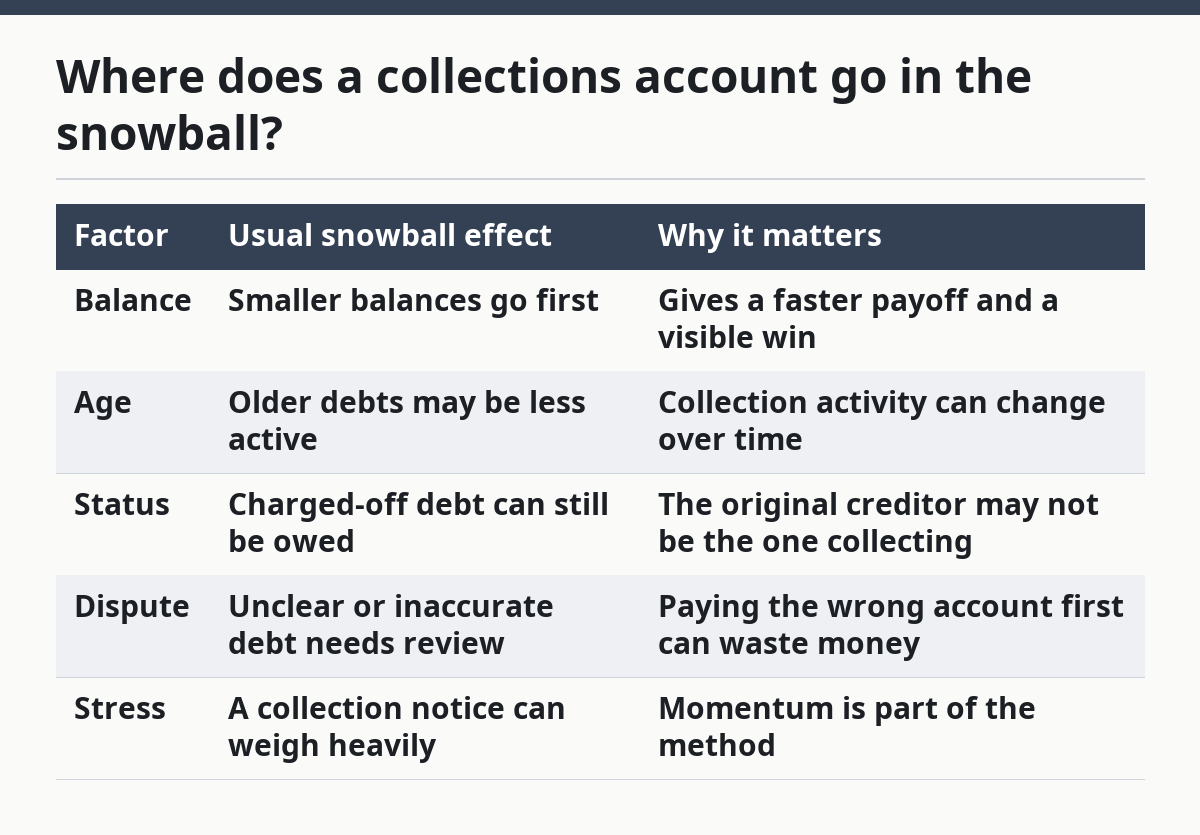
Where does a collections account go in the snowball?
A collections account goes where its balance and urgency place it, but the default snowball answer is still “smallest balance first.” If the collection balance is lower than your other unsecured debts, it usually belongs near the top of the list, because the debt snowball method uses quick wins to build momentum.
That said, collections can break the usual small-balance logic. A $300 medical collections account may feel like a fast win, while a much older $900 collection may be less urgent if the collector has stopped active contact. The numbers matter, but so do the practical effects on your daily life and your ability to keep paying month after month.
| Factor | Usual snowball effect | Why it matters |
|---|---|---|
| Balance | Smaller balances go first | Gives a faster payoff and a visible win |
| Age | Older debts may be less active | Collection activity can change over time |
| Status | Charged-off debt can still be owed | The original creditor may not be the one collecting |
| Dispute | Unclear or inaccurate debt needs review | Paying the wrong account first can waste money |
| Stress | A collection notice can weigh heavily | Momentum is part of the method |
The collection account does not automatically move ahead of every other debt just because it is in collections. A debt snowball is a sequencing tool, not a punishment system. If the collection is large and the smaller balance on a credit card can be cleared in 2 or 3 payments, the credit card may still come first.
Can a collections account be part of the debt snowball?
Yes, a collections account can be part of the debt snowball if you can identify the balance, confirm it is yours, and keep the order consistent. The method works best when every debt has a clear place in the list and a clear next payment. For a broader explanation, see the debt snowball method guide.
The simplest way to include it is to list all unsecured debts together: credit card debt, personal loans, medical collections, utility collections, and any charged-off debt that still has a balance. Then sort by balance from smallest to largest. If two accounts are close, pick one order and keep it; changing the plan every month is what kills momentum. If the paperwork is complicated, it is wise to consult a professional before you lock in the order.
A collections account is different from a current bill because payment may go to a collection agency, not the original lender. That means the “minimum payment” may not exist in the usual sense, and contact may be irregular. Still, the snowball idea stays the same: make the required payment if one exists, then throw extra money at the first debt in the queue until it is gone.
The hard part is not the math. It is deciding whether the account is stable enough to sit in the snowball without surprise changes. If the debt is disputed, recently transferred, or missing from your records, it needs review before it takes a spot in the order.
How do I sort the order step by step?
You sort the order by listing every debt, checking the status of each collections account, and ranking the balances from smallest to largest. The process is mechanical, but the details matter because one missing account can throw off the whole plan for months.
- Write down every debt on one page. Include credit card debt, personal loans, and each collections account, then note the balance, creditor or collector name, and the payment due date if there is one. Verify that the list matches your statements and letters; a problem is any debt you cannot identify clearly.
- Mark which accounts are in collections or charged off. Label them as “current,” “charged off,” or “collections” so you can see status at a glance. Verify whether the original creditor still owns the account or whether a collection agency now handles it; a problem is conflicting names or duplicate listings.
- Sort the balances from lowest to highest. Use the actual balance you can confirm today, not a guess from memory. Verify that the smallest debt really is the one you can finish first; a problem is using an outdated balance and then losing momentum when the payoff takes longer than planned.
- Move any disputed or unclear collection to a review box. Put debts with missing details, mismatched balances, or questionable ownership aside until you can confirm them. Verify you still have a full list after that; a problem is skipping a debt entirely because the paperwork is messy.
- Keep required payments current on every account not yet at the top. Pay the minimum or required amount listed on statements, then send any extra money to the first debt in order. Verify the due date each month; a problem is a late fee or missed payment that undoes the snowball.
- Track one payoff at a time. Cross off the first debt only when the balance is fully cleared and the account shows zero owed. Verify the closing letter or final statement if you get one; a problem is assuming an account is done when the collector still shows a small balance or fee.
- Roll the old payment into the next debt immediately. Take the amount you were sending to the finished account and add it to the next one in line the same month if possible. Verify the new payment amount is correct; a problem is letting freed-up cash disappear into everyday spending.
- Recheck the list every 30 days. Accounts can change hands, and balances can shift after interest, fees, or adjusted collection records. Verify the order still makes sense; a problem is letting an old plan run for 6 months without a checkup.
This step-by-step order is the same backbone used in the main debt snowball method guide, but collections accounts add a paperwork step before the first payoff. That extra minute of checking can save a lot of confusion later.
Should a charged-off debt come before a smaller current balance?
A charged-off debt does not automatically come before a smaller current balance unless you decide the collections issue is more urgent than the size of the debt. The term “charged off” sounds final, but it usually means the original lender has moved the account out of its own books; it does not mean the balance vanished.
That matters because some people put every collection at the front simply because it feels serious. In practice, that can slow the snowball. If a $150 current balance can be finished this month and a $1,200 charged-off debt will take many months, the smaller win may be the better first move if your goal is momentum.
The trade-off is pressure. A collection account can cause more mental drag than a normal bill, and that stress can be real. If the account keeps you from sticking with the plan, you may choose to move it up one place so the snowball feels doable. The method is meant to support progress over 3 to 12 months, not create a spreadsheet you stop using.
A useful test is this: if you move the charged-off debt ahead, does the rest of the list still feel manageable? If yes, the order is probably fine. If no, the better order is the one you can keep following without freezing up.
When should a collections account change the order?
A collections account should change the order when the normal smallest-balance rule would create a real risk, delay, or confusion. That means the snowball order is still the base plan, but it is not fixed when the facts around the debt are not ordinary.
A lawsuit has started: the debt is no longer just a balance on paper — get qualified help before deciding payment order, because court deadlines can matter more than the snowball.
The debt is disputed or looks wrong: the balance, owner, or even the debt itself may be unclear — pause that account until you confirm the records, because paying the wrong party can waste money.
The account was recently transferred: the collector can change, and so can the balance details — wait for written confirmation before you rank it, because the old record may be stale.
The debt is tied to a secured loan or a priority obligation: the snowball method was built for unsecured debt, not every kind of debt — handle that separately with professional guidance if needed.
You are already behind on an essential bill: rent, utilities, or food money is short — the snowball should not come before keeping the lights on, because a payoff plan that breaks the household budget fails fast.
The collection is causing constant collection activity: repeated letters or calls can drain attention — moving that account higher may help your plan survive the next 30 days, even if it is not the smallest balance.
These are not signs that the debt snowball is bad. They are signs that the normal order needs a second look. In money work, the wrong debt first can be as costly as no plan at all.
What mistakes do people make with collections accounts?
The biggest mistake is treating every collections account as if it must be paid first. That can slow down the snowball and leave smaller, easier wins untouched. The better choice is to rank by balance unless another real issue makes the collection more urgent.
Another mistake is ignoring a collections account because it feels old. Old does not mean gone. A charged-off debt can still sit on a list and still affect how the plan feels, even if the original lender is no longer handling it.
A third mistake is mixing up the collector and the creditor. If the original creditor sold the account, the name on the letter may not match the name on the first bill. The consequence is confusion, duplicate entries, or a payment sent to the wrong place.
A fourth mistake is skipping the review step for disputed balances. A person who starts paying before checking the paperwork can spend months on an account that turns out to be incorrect, incomplete, or already resolved. The fix is to verify first, then rank.
A fifth mistake is chasing the collection account so hard that the rest of the list breaks. If the plan causes missed payments elsewhere, the order is not helping. The correct alternative is a snowball that keeps the minimums current and uses extra cash in one place only.
What if the collection account is small but inactive?
A small inactive collection usually stays in the snowball order by balance, but it may be a lower emotional priority than a current bill that keeps the household stable. “Inactive” here means the collector is not actively pressing the account in the moment, though the debt can still exist and the record can still matter.
If the balance is small, that can make it a clean early win. Finishing a $200 or $400 account can clear mental space and make the next debt easier to attack. If the account is inactive and the paperwork is clear, the snowball logic is simple: put it near the front and keep moving.
Because the account is inactive but unclear, the order changes if the details are not solid. An inactive collection with a bad address, mismatched balance, or missing ownership record should not automatically outrank a smaller, simple debt you can verify today. The better rule is: easy to confirm first, then smallest balance first, unless a specific risk says otherwise.
One more practical point: inactive does not mean irrelevant. A dormant collection can reappear in records or contact later, and old debts can still feel unfinished even when they are quiet. That is why the snowball method works best when the list is reviewed every month, not once and forgotten.
FAQ
Should a collections account always come first?
No, a collections account should not always come first. In a debt snowball, balance usually drives the order, so a smaller current debt can come before a larger collection. The exception is when the collection has a special problem, like a dispute, a lawsuit, or paperwork that needs review.
Can I include collections in a debt snowball?
Yes, you can include collections in a debt snowball if the balance is clear and the account is yours. Treat it as one line on the list, alongside other unsecured debts, then sort by balance. If the collection details are unclear, pause and verify the records before putting it into the order.
What if the collection account is small but inactive?
A small inactive collection often makes a good early snowball target because it can be cleared faster than a larger balance. If the account is inactive but the paperwork is messy, verify the details first. The snowball works best when the first win is both small and certain.
Drafted with AI; not yet reviewed by a person.