Last updated: November 18, 2026
Key Takeaways
- Trim the easiest recurring bills first, then move to the ones that need more comparison shopping.
- Start with the bill that has the least value and the easiest exit.
- Pull 90 days of statements and follow a step-by-step review.
- Hold off on some bills until you check the consequences; cutting them too fast can cost more.
If you want to increase debt payments, the first place to look is your recurring bills. In this guide to what bills to cut before you increase debt payments, we focus on subscriptions, utilities, cell phone plans, insurance, and other fixed charges that come out every month. It is for someone who already has minimum payments covered and wants to free up cash flow before making extra debt payments. For a broader plan, see the debt payoff planning and budgeting hub, and check the budgeting basics guide before you change any bill. It is information, not financial advice; a qualified adviser should be consulted for your own situation.
Which bills to cut first, and why that order matters

Because recurring bills do not all behave the same way, the easiest cuts should come first. That usually means subscriptions first, then usage-based utilities, then your cell phone plan, then insurance, then other recurring bills that are quietly draining your budget.
This order matters because not every expense cuts cleanly. A streaming service can disappear in 2 minutes. A utility bill takes behavior changes and a full billing cycle to show up. An insurance policy may need a renewal date, a new quote, or a higher deductible to lower the premium, and that can change your risk. The point is not to become miserly; it is to remove waste before you redirect cash to debt.
Start by separating expenses into three groups:
- Easy cuts: subscriptions, app fees, duplicate memberships, auto-renewals.
- Adjustment cuts: utilities, cell phone plan, groceries delivered on a schedule, bank fees.
- Review-only cuts: insurance, annual memberships, service contracts, tax-related payments, or anything with a penalty for ending early.
A bill is often a strong first cut if canceling it leaves no practical gap in daily life. If you can stop paying for something and not miss it after 30 days, that is a strong candidate. If ending a bill would create a late fee, a lapse, or a replacement cost that wipes out the savings, it needs a slower review.
A useful way to think about this is cash flow cleanup: removing fixed outflows that keep repeating every 30 days even when the value has dropped. That cleanup supports the broader debt payoff plan on the debt payoff planning and budgeting hub, without forcing you to guess where the money should come from.
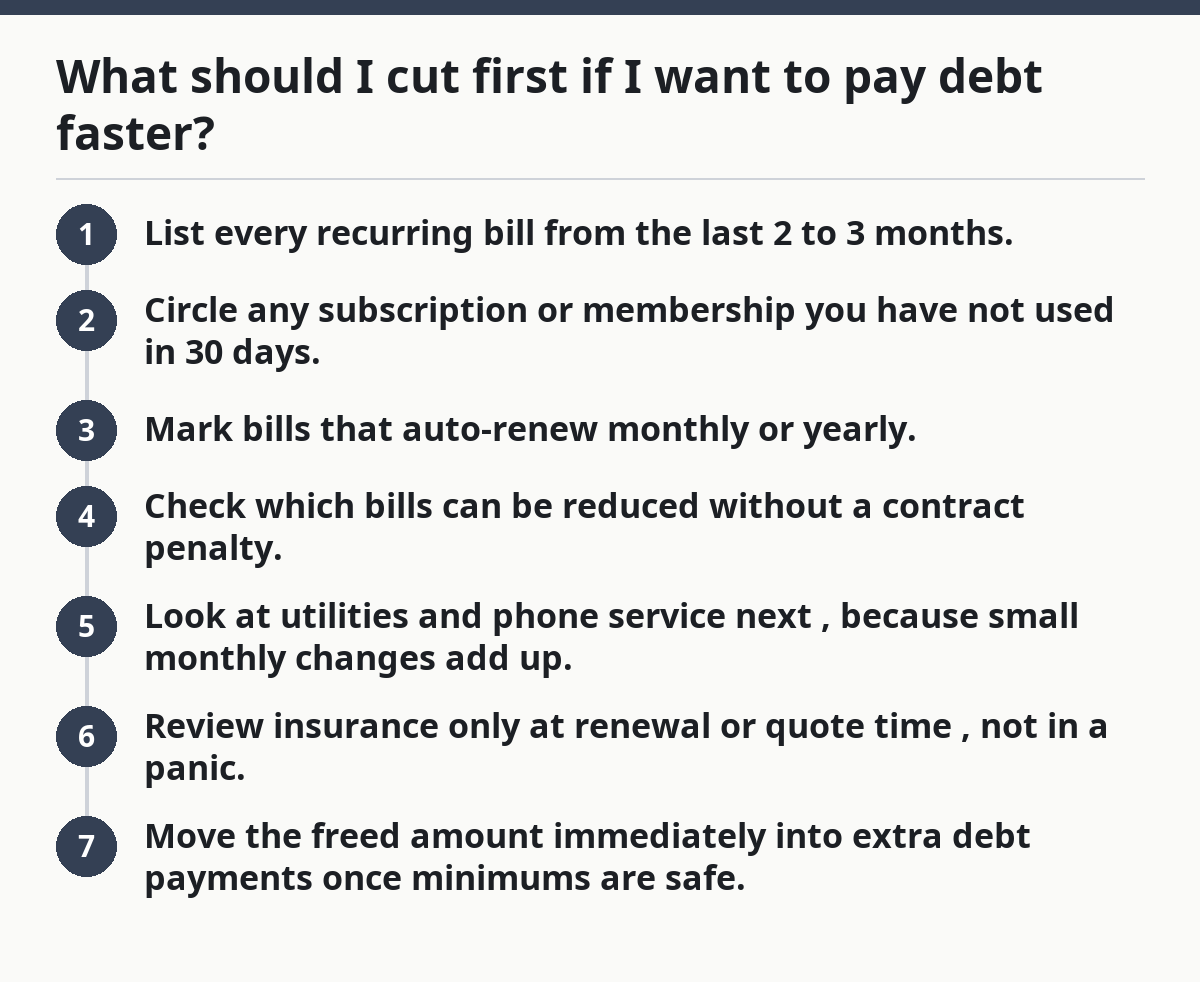
What should I cut first if I want to pay debt faster?
To pay debt faster, start with the highest-waste bill first: the one with the lowest real value and the easiest exit.
A practical order looks like this:
- List every recurring bill from the last 2 to 3 months.
- Circle any subscription or membership you have not used in 30 days.
- Mark bills that auto-renew monthly or yearly.
- Check which bills can be reduced without a contract penalty.
- Look at utilities and phone service next, because small monthly changes add up.
- Review insurance only at renewal or quote time, not in a panic.
- Move the freed amount immediately into extra debt payments once minimums are safe.
For each item, verify three things: the due date, the cancellation rule, and whether there is a replacement cost. If the bill is for a service you rarely use, that is a cut candidate. If it is protecting you from a real loss, it may need adjustment instead of cancellation.
A problem shows up when people focus only on the biggest number. A large insurance premium may not be the right first cut if ending it creates a coverage gap. A small app subscription may look minor, but several of them together can free money every month with almost no pain. Cutting in the right order can prevent churn, but if a contract, fee, or coverage issue is unclear, consult a qualified professional before you cancel and rebuy. The Consumer Financial Protection Bureau offers guidance on reviewing bills and recurring charges: CFPB on tracking spending.
If you are unsure where to begin, start with any bill under a monthly cycle that you can cancel online in under 10 minutes. Those are usually the quickest wins.
How do I audit subscriptions, utilities, and other recurring bills?

You audit recurring bills by checking each charge against three questions: do I still use it, can I reduce it, and what happens if I stop it?
Use this step-by-step process:
- Pull 90 days of statements. Include checking, credit card, and online account histories. Verify that every recurring charge appears at least twice. If a bill shows up only once, it may be quarterly or annual, which changes the decision. A problem is missing annual fees that hide between statements.
- Sort charges into subscriptions, utilities, phone, insurance, and other recurring bills. Put each in a separate list. Verify the category and billing frequency, such as monthly, quarterly, or yearly. A problem is lumping all fixed charges together and missing the ones you can cut fastest.
- Identify duplicate services. Look for two music services, two cloud storage plans, two delivery memberships, or a streaming bundle and a stand-alone plan. Verify whether one already covers the same need. A problem is paying for overlap you do not notice because the logos look different.
- Cancel or pause the weakest subscription first. Use the provider’s cancellation path, not a backdoor workaround. Verify the end date and whether access continues through the paid period. A problem is forgetting that a “free trial” can roll into a paid month unless you cancel before renewal.
- Reduce utility waste before changing service providers. Check thermostat settings, water heater temperature, laundry habits, lighting, and phantom loads from devices that stay plugged in. Verify the next bill after the change, because one billing cycle may still reflect earlier usage. A problem is expecting instant savings before the meter cycle resets.
- Call the cell phone carrier and ask for plan review options. Compare data allowance, unlimited vs tiered use, device financing, and line count. Verify any early termination fee or installment balance before changing plans. A problem is saving a few dollars on the plan but paying more to finish the phone.
- Review insurance at renewal, not randomly. Ask whether the deductible, coverage limits, bundling, or payment schedule can be changed. Verify that reduced premium does not weaken coverage in a way you cannot absorb. A problem is saving on premium while exposing yourself to a loss you cannot cover.
- Find other recurring charges that behave like bills. Think bank account fees, storage rentals, gym memberships, software renewals, school or association dues, and subscription boxes. Verify whether they are truly monthly obligations or optional services. A problem is ignoring small charges because they do not feel like “bills.”
The point is to build a clean list, not a fantasy budget. If you cannot name the cancellation rule, the renewal date, and the amount saved, the item is not ready to cut.
Which recurring expenses should stay in place for now?
Some bills should stay until you have checked the consequences, because cutting them too quickly can create a bigger problem than the savings.
Keep a bill in place, or modify it instead of canceling, when any of these are true:
- It protects against a large loss. Insurance is the obvious example. If a policy covers a car, home, or health exposure, ending it without replacement can leave you exposed to a much larger bill.
- It has an early termination fee. Some contracts make the first exit expensive. If the fee wipes out 1 to 3 months of savings, waiting for the contract end may be smarter.
- It would trigger a higher replacement cost. Canceling a storage unit may sound efficient until you need to rent one again or replace what was stored.
- It affects your ability to work or communicate. A cell phone plan that keeps your job contacts, two-factor codes, and emergency access running may need downgrading, not cancellation.
- It is tied to a fixed deadline or legal obligation. Annual dues, licensing-related payments, or required fees may not be discretionary in the month you want to cut them.
- It is already a low-cost version of the service. Some utility or phone plans are near the bottom of the available range, and chasing a smaller bill can create more hassle than cash saved.
The consequence of cutting the wrong bill is not just inconvenience. It can mean lapse notices, reinstatement fees, loss of coverage, or a service interruption that costs more than the original charge. That is why the right move is not “cut everything”; it is “cut what is optional, then review what is protected by a contract or by risk.”
If a bill is important but expensive, the usual alternative is reduction rather than removal. Lower the coverage level only if the remaining exposure is manageable. Lower the plan only if the usage data supports it. Change the renewal timing or billing cycle when that helps. The question is not whether the bill exists; it is whether the current version still fits.
The mistakes people make when trimming bills
The most common mistake is cutting the visible bill and ignoring the hidden one.
Here are the errors that cause trouble:
-
Canceling based on guilt instead of usage. A person keeps paying for a service because they “should” use it someday. The consequence is months of waste. The better move is to check actual use over 30 days, then cancel if the service is not part of regular life.
-
Chasing savings that create a new fee. Someone downgrades a plan, then pays overage charges, late fees, or reinstatement fees. The consequence is that the cut does not stick. The better move is to compare total cost over one billing cycle, not just the sticker amount.
-
Cutting insurance without checking replacement coverage. The consequence can be a coverage gap that leaves a large exposure. The better move is to review the policy at renewal, understand the deductible and limits, and only reduce coverage if the remaining risk is manageable.
-
Ignoring annual and quarterly charges. These bills do not show up every month, so they vanish from memory. The consequence is a false sense of progress. The better move is to list every recurring charge over 12 months, not just the last statement.
-
Waiting for perfect numbers before acting. People over-analyze a 10-minute subscription cancelation and never start. The consequence is delayed debt payoff. The better move is to remove the obvious waste first and keep refining.
-
Using the freed money for spending instead of debt. A canceled bill creates slack, and slack gets absorbed if it is not assigned. The consequence is that nothing changes. The better move is to redirect the exact amount into the debt-payment budget the same day the cancellation takes effect.
A clean bill-cutting plan is not about austerity. It is about making each monthly dollar show up on purpose instead of disappearing through auto-renewal and habit.
When should you stop cutting bills and get help with the numbers?
You should stop the DIY trim and get qualified help when the bill problem is tied to contracts, coverage, or a budget that no longer balances.
You are behind on minimum payments: The debt is already in delinquency or collections — pause extra-payment planning and address the arrears first, because cutting bills alone will not fix a damaged account.
Your insurance coverage is hard to compare: You are dealing with life, disability, health, business, or home policies with riders or exclusions — review the policy language with a qualified adviser before changing it.
A phone or utility bill includes financing or termination fees: The savings are not obvious until the contract balance is known — ask the provider for the payoff, fee schedule, and effective date before changing anything.
Your income varies by week or month: A fixed extra payment may not fit the cash cycle — build a variable plan with a professional who can map payments to real inflows.
Cutting a bill would create a hardship elsewhere: Losing internet, transportation, or a covered service would threaten work, housing, or basic communication — do not force the cut; redesign the budget instead.
The consequence of pushing past these points is usually the same: fees, gaps, or payment stress that make debt reduction harder. The point where the standard approach stops working is the point where the budget needs a more exact solution, not more pressure.
What does a good result look like after the first 30 days?
A good result is a smaller bill stack and a clear cash amount you can move to debt without guessing.
After 30 days, you should be able to point to at least one canceled subscription, one reduced recurring charge, or one renegotiated bill. You should also know the exact date the savings starts. If a streaming service ends today but the next bill still posts because of a paid-through period, that is not a failure; it is just a delayed payoff.
A good result has three features:
- It is measurable. You can name the line item and the monthly amount it removed.
- It is repeatable. The savings show up every month, not as a one-time discount.
- It does not create a new cost. No late fee, no overage, no emergency replacement.
If you only save on paper, the plan is not finished. The money needs a destination. Put the freed amount into your debt-payment plan after minimums are current, and keep the bill list updated once a month. That one habit stops recurring charges from creeping back in.
For readers who want a broader structure, the next step is to connect these cuts to the larger debt payoff planning and budgeting system so the freed cash does not drift away.
How do I free up money for debt payments without slashing everything?
You free up money for debt payments by trimming recurring bills in layers, not by stripping your budget bare.
Start with subscriptions, then utilities, then the cell phone plan, then insurance review, then any other recurring bill that no longer fits. Keep the changes small enough that you can sustain them for 3 months. The goal is not to live on the edge; the goal is to create enough margin that extra debt payments happen on schedule.
This approach works best when you track each cut in writing, watch one billing cycle, and stop once the savings are real. If the first round of cuts does not help enough, return to the list and review the next layer. The answer is rarely “cut everything.” It is usually “cut the bills that no longer earn their place.”
Drafted with AI; not yet reviewed by a person.