Last updated: November 18, 2026
Quick answer: In most cases, should you pay off highest interest debt first or highest balance debt first comes down to one number and one constraint: the higher APR usually costs less overall to attack first, while the bigger balance can relieve monthly pressure faster. I’m writing about should you pay off highest interest debt first or highest balance debt first because that is the debt payoff prioritization method people actually use when one card has a sharp APR and another has the bigger balance.
This is information, not financial advice; for your own situation, especially if you have variable rates, tax issues, or missed payments, a qualified financial adviser should review the full picture. Personal finance rules change by country and lender, so the right order depends on the terms in front of you.
Key takeaways
- Should you pay off highest interest debt first or highest balance debt first depends on whether you are trying to cut total interest or ease monthly pressure.
- The highest interest debt method is built to reduce interest charges faster, especially when a balance has a much higher APR than the rest.
- The highest balance method is built to free up cash flow when the large debt’s minimum payment is crowding the budget.
- Interest rate strategy and balance size strategy solve different problems; they are not interchangeable.
- The best choice is the one that fits your real constraint: total cost, monthly pressure, or the risk of falling behind.
- If a debt has a penalty APR, a promotional rate ending soon, or a delinquency risk, that debt can move to the front even if its balance is not the largest.
- For broader context on debt payoff prioritization, the hub on debt payoff prioritization is the right next stop.
The real difference between interest rate strategy and balance size strategy

Should you pay off highest interest debt first or highest balance debt first? The highest interest debt method wins when the cost of carrying debt is the problem. The highest balance debt method wins when the size of the payment is the problem. That split sounds simple, but the consequences are different enough that a reader can choose the wrong one for months.
With interest rate strategy, the goal is to attack the balance with the highest APR first after minimum payments. APR matters because interest compounds on what remains unpaid. For example, on a credit card at 28% APR, monthly carrying costs are generally higher than on a card at 18% APR, all else equal. The exact savings depend on balances, payment amounts, and how fast you can clear the debt, which is why no honest article can promise a universal amount saved. For the mechanics of APR and credit card interest, see the Consumer Financial Protection Bureau and the Federal Trade Commission. Consumer Financial Protection Bureau and Federal Trade Commission.
With balance size strategy, the goal is to remove the biggest balance first, even if the rate is lower. The appeal is psychological and practical: a big debt with a large minimum payment can choke cash flow. Once that account disappears, the freed minimum payment can be redirected to the next debt. That can make budgeting feel less brittle, especially when loan terms are long or minimums are high.
The trade-off is real. Interest-first usually saves more money. Balance-first can make the monthly budget easier to survive. If the budget is so tight that you keep missing payments, the “cheaper” method on paper is not the better one in practice.
The honest side-by-side
Should you pay off highest interest debt first or highest balance debt first? The highest interest debt method usually wins for pure cost control, while the highest balance debt method wins when monthly cash flow matters more than interest math. The table below shows when each one takes the lead.
| Criteria | Highest Interest Debt | Highest Balance Debt | Winner for [condition] |
|---|---|---|---|
| Interest saved over time | Targets the most expensive rate first | May leave the most expensive rate untouched longer | Highest interest, when cost is the goal |
| Monthly cash flow relief | Can be slower to change minimum payments | Can remove a large minimum payment sooner | Highest balance, when budget pressure is high |
| Simplicity of the rule | Easy if APRs are clearly listed | Easy if balances are obvious | Tie, when the debts are straightforward |
| Risk from variable rates | Better when one APR can jump | Less responsive to rate changes | Highest interest, when rates may rise |
| Motivation from visible wins | Can feel slow if the high-APR debt is not large | Often shows a dramatic balance drop | Highest balance, for someone who needs momentum |
| Effect on long loan terms | Better when terms stretch interest over years | May not address the priciest debt first | Highest interest, when terms are long |
| Cash trapped in minimums | Does not always free the biggest payment quickly | Can free a large minimum payment earlier | Highest balance, when minimums are the pain point |
| Delinquency risk | Good if the costly debt is also the riskiest | Good if the large debt is the one most likely to go unpaid | Tie, when missed payments are the bigger threat |
| Psychological payoff | Often delayed until the balance shrinks | Often immediate once the largest account disappears | Highest balance, for morale |
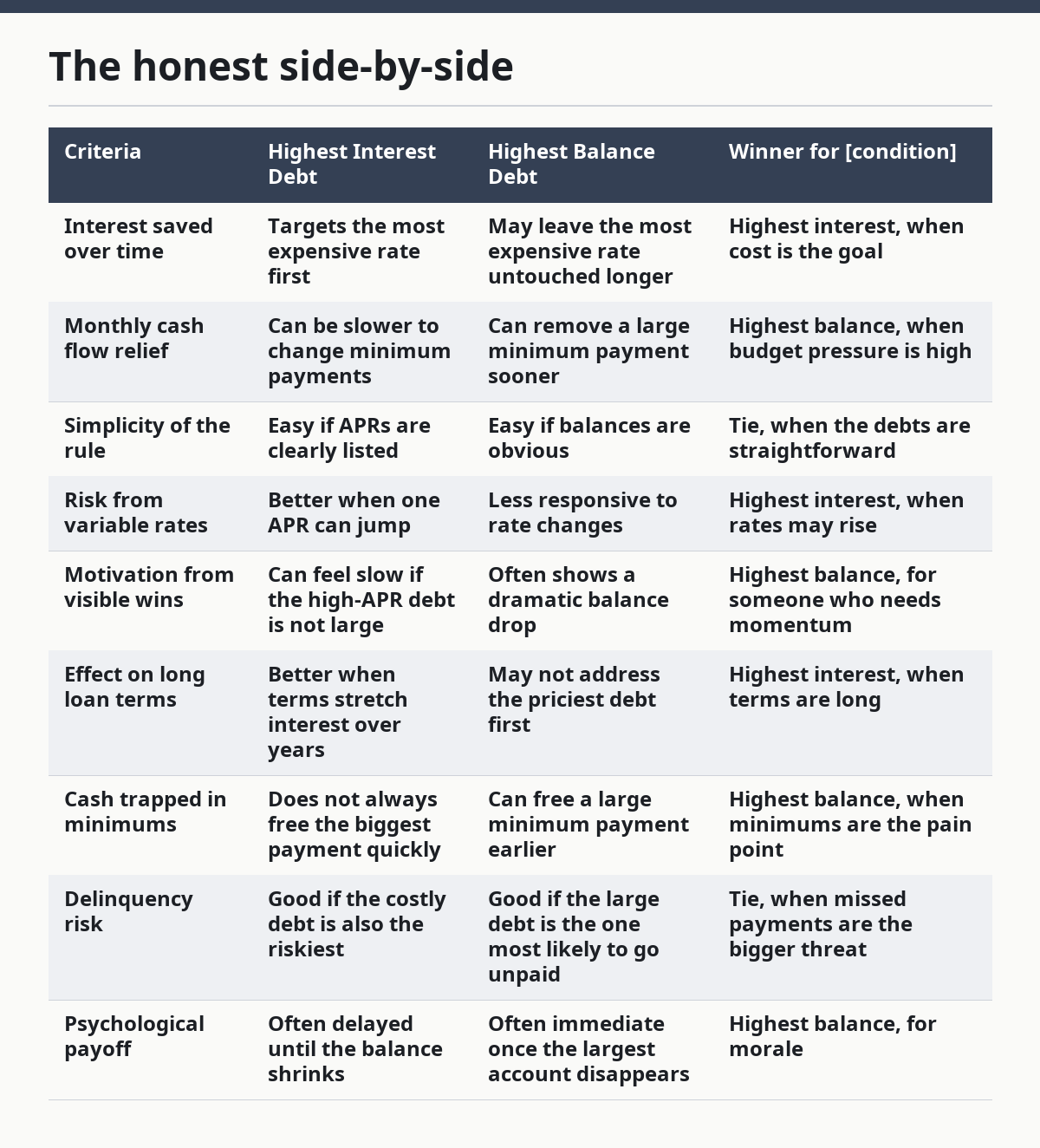
The table is useful because it shows what generic advice leaves out: these methods optimize different outcomes. The wrong choice is not “bad” in the abstract. It is bad only if it ignores the thing hurting you most right now, whether that is interest cost, a long loan term, or a minimum payment that keeps breaking the budget.
Highest interest debt first: who should actually use it

Should you pay off highest interest debt first or highest balance debt first? The highest interest debt method wins for anyone whose main problem is the cost of carrying balances. That is the cleanest recommendation when one account has a much higher APR than the others and you can keep making all minimum payments on time.
This approach is especially strong with credit card debt, because credit cards often carry variable rates and minimum payments that do very little to reduce principal. A debt with a 24% or 30% APR is not just expensive; it becomes more expensive the longer it stays open. When the difference in interest rates is wide, putting extra money toward the top APR usually gives the most efficient use of each dollar. The CFPB’s credit card guidance and the FTC’s interest-rate explanation both support that basic math. Consumer Financial Protection Bureau and Federal Trade Commission.
It also fits readers who can stay disciplined without needing visible wins every month. If the balance is large but the rate is even larger, the math points clearly toward interest first. That is the point of a debt payoff method: the order should reflect the cost of waiting.
The weakness is psychological and practical. If the highest-rate account also has a manageable minimum payment, you may not feel much relief for a while. The balance can look stubborn. That can tempt some people to abandon the plan entirely. The method is also less helpful if the rate gap is tiny, because the difference in savings may be small enough that motivation matters more than arithmetic.
A reader should skip this method if the biggest danger is not interest cost but cash crunch. If a large minimum payment is what keeps causing late fees, overdrafts, or missed bills, a balance-first order can be the more survivable plan even if it costs more over time.
Highest balance debt first: when the bigger balance wins
Should you pay off highest interest debt first or highest balance debt first? The highest balance debt strategy wins when the size of the debt is the thing dragging the budget down. That is common when a single loan or card has a high minimum payment, a long term, or a balance so large that it dominates every monthly spreadsheet.
This method makes sense when your problem is not abstract interest cost but day-to-day room in the budget. A large balance often means a larger required payment, and getting rid of that payment can change the whole structure of your cash flow. One removed minimum payment can be redirected to the next debt, to savings, or to a bill that has become harder to manage.
The appeal is also emotional. Seeing the biggest balance disappear can create momentum. Some people stay on a plan longer when they see a large, visible account shrink first. That matters because a payoff method only works if the person using it can keep going for months or years.
The downside is that a larger balance is not always the most expensive balance. If the biggest debt has a lower interest rate, you may spend more total money by leaving a higher-APR debt in place. That is the price of prioritizing cash flow over interest cost.
This method is not the right answer for someone who is mathematically focused and able to stay organized around rate differences. It is also a poor fit if your largest balance is a low-rate installment loan and your real emergency is a high-APR revolving balance. In that case, the debt hierarchy should probably change.
What changes the decision in real life
Should you pay off highest interest debt first or highest balance debt first? The decision changes when one of four things is true: the rate gap is large, the minimum payment is crushing the budget, a promotion is about to expire, or a debt is close to delinquency. Those situations can flip the order even if the rest of the portfolio points the other way.
A promotional rate that ends soon deserves attention because the loan term after the promo can become much more expensive. The exact rules vary by lender and country, so the offer terms matter more than the headline rate. A debt with a penalty APR or a balance-transfer window nearing its end can jump ahead of a larger but cheaper balance.
The same is true for missed payments. If one account is near delinquency, the short-term damage from fees, collection calls, or a credit score hit can outweigh a nicer-looking long-term payoff order. An adviser or nonprofit credit counselor can help in those cases.
The order also changes if there are only one or two debts left. At that point, the gap between the methods may shrink enough that the simpler plan is the one you can actually follow. A method that is abandoned after two months is worse than a less optimal method that lasts 24 months.
The verdict: which one to choose and why
Should you pay off highest interest debt first or highest balance debt first? Choose highest interest debt first if your main goal is to lower the cost of debt and you can keep every minimum payment current. Choose highest balance debt first if your main goal is to free monthly cash flow and the large balance is the bill most likely to break your budget. Neither if you are already missing payments, because then the first job is to stabilize the account before you optimize the order.
That is the plain call. If the APRs are meaningfully different, interest-first is usually the cleaner financial choice. If the minimum payment on the largest balance is what is squeezing you, balance-first can be the more practical choice. The wrong method is the one that ignores your actual constraint.
When to reconsider the whole order
Should you pay off highest interest debt first or highest balance debt first? The order deserves a fresh look when your budget, rates, or loan terms change. A refinance, a balance transfer, a rate reset, a new minimum payment, or a job change can turn yesterday’s best choice into today’s wrong one.
This matters because debt hierarchy is not fixed. A debt that started as a low-priority balance can become urgent if its rate changes or its promotional period ends. A debt that once looked expensive can become manageable after a payment adjustment. Even a small change in minimum payment can shift the cash flow impact enough to justify reordering.
Reconsider the plan if you can no longer cover the minimums on all debts. At that point, the question is not “Which debt should be first?” It is “How do I stop damage from spreading?” That may mean contacting the lender, asking about hardship options, or getting help from a qualified adviser or nonprofit counselor.
The same is true if the emotional cost is derailing you. A mathematically elegant debt payoff method is useless if it makes you quit. The best order is the one that matches both the numbers and the budget you can live with for the next 6 to 24 months.
Which debt should I pay first if I want to save the most interest?
The highest interest debt should go first if your only goal is to reduce interest charges. That approach targets the most expensive APR while you keep minimum payments current on everything else. The exact savings depend on balances, rates, and loan terms, so a payoff calculator or adviser can help with a personal estimate.
Is it better to pay the biggest debt or the highest interest debt first?
The highest interest debt is usually better if you care most about total cost, while the biggest debt can be better if you need faster cash flow relief. The right answer depends on whether your bigger problem is paying less interest or freeing up a large monthly minimum payment. A financial adviser can help if the choice is close.
Drafted with AI; not yet reviewed by a person.