
Last updated: November 18, 2026
Quick Answer: In debt payoff order for mixed loans and cards, start with the debt that has the highest cost and the harshest penalty risk; for many people, that is one top target, not a universal smallest-balance rule. This article covers debt payoff order for mixed loans and cards: how to prioritize when your debts are very different, especially when rates, collateral, and delinquency rules do not match. If your debts are very different, the right payoff order is the one that lowers total interest without letting a car loan, student loan, or credit card turn into a collection problem.
Key takeaways
- Rank debts by more than balance size. Interest rate, payment rules, and penalty risk all matter.
- Credit cards usually sit near the top because revolving balances can cost more than installment loans.
- Student loans and car loans can move up the list if the lender has harsh delinquency rules or a lien on the car.
- A small loan is not always the best first target if a larger loan is charging much more.
- The best order can change when a debt is in forbearance, deferment, past due, or tied to a tax or title issue.
What should come first?

The first debt to target is the one that is most expensive to carry and most likely to create damage if you miss a payment. For mixed debts, that usually means comparing a credit card, student loan, car loan, and personal loan by interest rate, payment type, and consequences for falling behind.
A generic “smallest balance first” rule can fail when a 4-figure credit card rate sits beside a car loan with a lien or a student loan with special repayment terms. A mixed-debt order is a triage list, not a contest. The goal is to stop the most costly leak first, then move down the list in a way that still protects your transport, income, and credit file.
How do I rank debts with different rates and balances?
You rank them by rate first, then by risk, then by flexibility, and only then by balance. For many borrowers, that means a $2,000 credit card balance at a high variable rate can outrank a larger student loan if the student loan is in a stable repayment status, while a car loan with the vehicle as collateral may need attention before a slightly cheaper unsecured loan if a missed payment would leave you without transportation. For a mixed-debt payoff order, that ranking is usually the right starting point, but CFPB and Federal Student Aid both note that payment status and loan terms can change the consequences, so consider a qualified adviser or servicer guidance if the accounts are close.
A practical rule for debt payoff order for mixed loans and cards is to sort the list this way:
| Priority factor | What to check | Why it matters |
|---|---|---|
| Interest rate | APR or other stated rate on the statement | Higher rate debt grows faster |
| Payment status | Current, late, deferment, forbearance, or default | Delinquency can trigger fees and collection steps |
| Collateral | Car title, wage access, co-signer, or none | Secured debt can create bigger losses if ignored |
| Flexibility | Can the payment change? Can the rate reset? | Adjustable terms can make a debt harder to predict |
| Balance size | Remaining principal | Helps after the higher-risk debts are sorted |
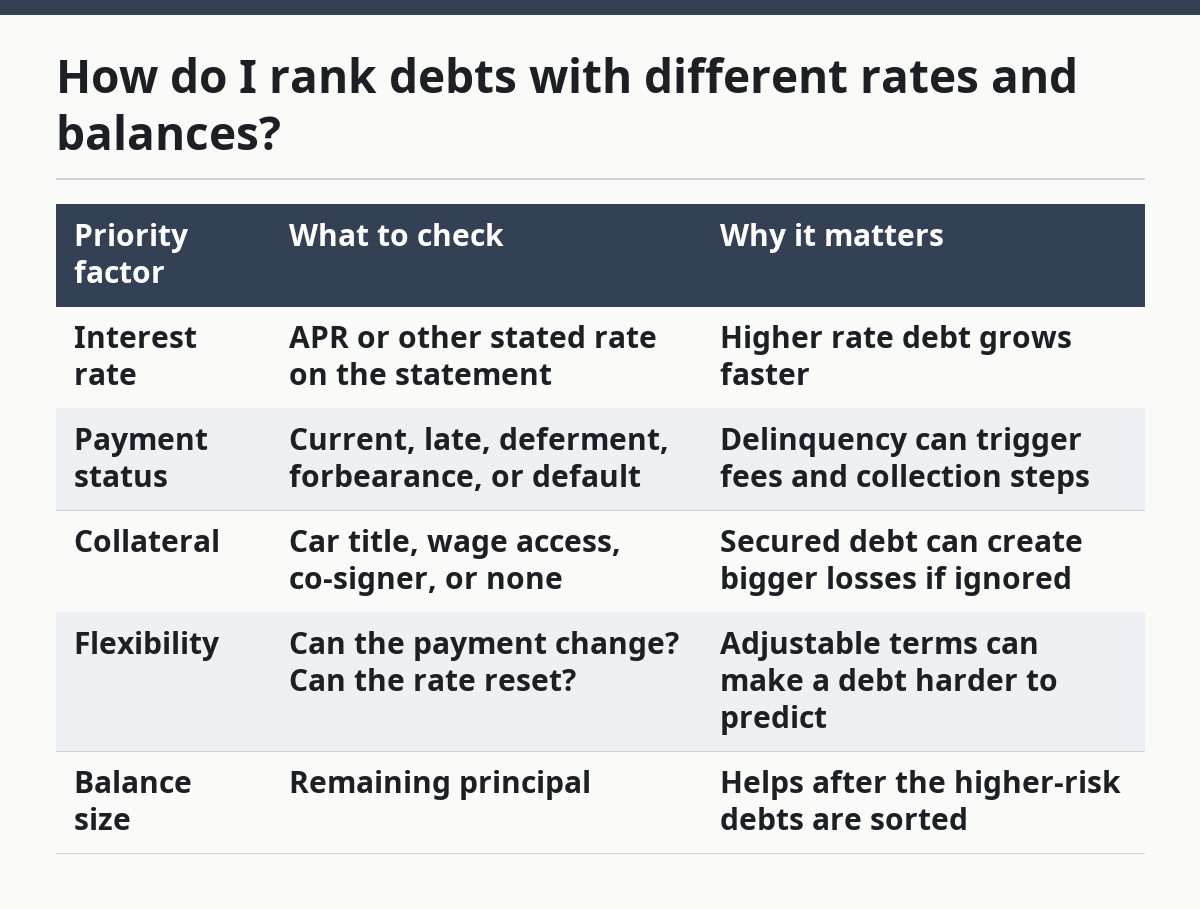
If two debts look close on paper, the one with the harsher penalty for missing a payment should move up. That rule matters when one account is unsecured and another can affect your car, your wages, or a co-signer, so a qualified adviser or servicer can help if the choice is not obvious. For mixed debts, the right order is usually not fixed forever; it changes when a lender changes terms or a loan status changes.
What is the usual order for credit cards, student loans, car loans, and personal loans?

The usual order is often credit cards first, then unsecured personal loans, then student loans or car loans depending on the terms, with the exact place of each secured debt set by rate and penalty risk. That is a common pattern, not a universal rule, and if the debts are close in cost or risk, a qualified adviser should review the order with you.
Credit cards often go near the top because revolving balances can stay expensive month after month if you carry them. Personal loans are installment loans, so they are easier to model, but they can still cost more than a student loan or car loan. Student loans can move lower if they have lower rates or payment protections, though special repayment plans can make them worth reviewing carefully. Car loans deserve close attention because the vehicle is collateral, which changes the cost of falling behind.
A simple priority sketch looks like this:
- Any debt already past due or at immediate risk of default.
- Highest-rate credit card.
- Highest-rate unsecured personal loan.
- Car loan, if the rate is high or the car is essential.
- Student loan, unless its terms make delay costly.
- Lower-rate installment loans.
That order is a starting point, not a rule carved in stone. The point is to keep the most expensive, least forgiving debt from sitting at the bottom by accident. For a broader framework, see how to choose a debt payoff method and how to compare debt repayment strategies.
How do I build the payment order step by step?
You build the order by listing every debt, checking the terms on each statement, and assigning any extra payment to one target at a time. The cleanest system is simple enough to run every month and specific enough to keep you from guessing.
- List every debt on one page. Include the lender, current balance, minimum payment, interest rate, and due date for each credit card, student loan, car loan, and personal loan. Verify that the rate type is fixed or variable. If a rate can change, that is a warning sign that the order may need a later review.
- Mark payment status. Write down whether each account is current, 30 days late, in deferment, in forbearance, or in collections. Verify the current status from the latest statement or servicer portal. If you cannot confirm status in 15 minutes, treat that account as unresolved and do not rank it loosely by memory.
- Separate secured from unsecured debt. Label any debt tied to a car title or other collateral. Verify whether a missed payment can lead to repossession or another lien action. If a debt is secured, its penalty for delay is different from a credit card with no collateral.
- Sort by cost, then by risk. Put the highest-rate debt first unless a lower-rate debt has a stronger penalty for missing payments. Verify that the ranking still makes sense after fees and status are included. If the top item changes just because the rate difference is tiny, the debt with the stricter penalty usually deserves the earlier slot.
- Keep every minimum payment current. Set aside the minimum due on every account before sending extra money anywhere. Verify that the due dates fit your pay cycle. If a minimum payment is skipped, the order is broken even if the top target gets extra cash.
- Send all extra money to one debt. Put the full extra amount beyond minimums on the first target in your list. Verify that the payment is marked as principal reduction when the lender allows it. If the lender applies the extra to future payments instead, the debt may not shrink as fast as expected.
- Retest the order each time a debt disappears. When one account is paid off, move that payment to the next debt on the list within the same 30-day cycle if possible. Verify that the next target still belongs above the others after the change. If not, rerank the list instead of keeping a stale order.
This method works because it gives one clear next move. It also avoids the trap of chasing the smallest balance while a more expensive card keeps growing. If the debt list is complicated enough that the order changes every month, that is a sign to get qualified help from a debt or credit specialist. For related planning, you can also review how debt avalanche works and how debt snowball works.
When should the standard order change?
The standard order should change when a debt has a special rule, a special penalty, or a special role in your life. A debt payoff order is not only about math; it is also about what happens if the payment slips by one month.
Past-due credit card or loan: This can trigger fees, collection calls, and credit damage — bring the account current before extra prepayments elsewhere.
Car loan with a car you need for work: Repossession risk can affect your commute and income — keep the car loan high in the order if losing the vehicle would disrupt your job.
Student loan in deferment or forbearance: The current payment may be paused or changed, which alters the payoff math — confirm whether interest still grows and whether the pause ends soon.
Variable-rate debt: The rate can rise, which changes the ranking — review the order when the rate resets or when a statement shows a sharp jump.
Personal loan with a co-signer: A missed payment can affect another person’s credit — treat the social cost as part of the priority decision.
Debt with tax, legal, or collection consequences: The penalty can be much larger than simple interest — get qualified help before making the payoff order the only decision tool. See the CFPB debt collection page for general consumer guidance.
The standard order also changes if you have cash reserves that are too small to absorb a shock. If one missed paycheck would force you to miss a payment, the order should protect the debts with the harshest consequences first. That is often the difference between a useful payoff plan and one that breaks after 1 month.
What are the mistakes people actually make?
The biggest mistake is ranking debts by balance alone, which can put a cheap loan ahead of a costly one and leave more interest on the table. A $1,000 balance is not automatically more urgent than a larger debt if the larger debt carries a much higher rate.
Another mistake is treating all installment loans as if they work the same way. A student loan, car loan, and personal loan can each have different repayment rules, different late-fee structures, and different fallout from missing one payment. That mistake can push a person to overpay the wrong account while a more dangerous one stays exposed.
A third mistake is ignoring the minimums while sending extra money to the top target. That can create late fees and credit damage even when the plan looks disciplined on paper. The correct alternative is to keep every minimum current, then aim all extra dollars at one debt.
A fourth mistake is not checking whether extra payments reduce principal. Some lenders apply extra money to future payments unless the borrower gives clear instructions. If the payment does not reduce principal, the payoff order may be right but the result will still be slower than expected.
A fifth mistake is leaving student loans or car loans out of the comparison because they feel “different.” They are different, and that is exactly why they belong in the list. The right order depends on how each debt behaves, not on the label alone. For more context, Federal Student Aid explains federal loan repayment options, and that can change how a student loan fits into the order.
What if the debts are too different to compare cleanly?
The right move is to use a two-step rule: protect the debt with the worst penalty first, then rank the rest by cost. That is the cleanest answer when one debt is secured, one is past due, and one has a lower rate but a big balance.
If a student loan is in a special repayment status, or a car loan is tied to a vehicle you need daily, those facts can matter more than a small rate gap. If a credit card rate is clearly higher than the others and the account is current, that card often stays first even if the balance is not the smallest. If two debts are still hard to separate after that, the more expensive one usually gets the extra payment until the numbers become clearer.
For readers who want a broader method choice, the hub on choosing the right debt payoff method gives the larger framework this page fits into. This page is only about the order of mixed debts, not the whole method selection process.
The best payoff order is the one that can survive a normal month, not just a perfect spreadsheet. If the plan needs constant rescues, the ranking is probably too fragile.
Drafted with AI; not yet reviewed by a person.