Last updated: November 28, 2026
Quick answer: yes, you can use the debt snowball method with 3 kinds of debt — credit cards, student loans, and a car loan — but a mixed debt portfolio needs one extra layer of sorting. The method still starts with balances, not interest rates, yet secured debt like a car loan and student loan rules can change the order if a payment must stay current or a loan has special terms. If you are unsure, check the lender or servicer and, if needed, consult a qualified financial professional. For the basic method, see the debt snowball method hub.
Key takeaways
- Mixed debt does not break the debt snowball method; it just adds debt-type checks before the list is final.
- Credit cards, student loans, and car loans do not behave the same way, so the “smallest balance first” rule can need one exception.
- Secured debt, such as a car loan, can affect the order because missed payments can have faster consequences than an unsecured credit card; if the account is late, consult the lender or a qualified adviser.
- Student loans may have grace periods, deferment, income-based plans, or servicer rules that matter before extra payments go anywhere; check the servicer or consult a qualified adviser.
- This is information, not financial advice; a qualified adviser should be consulted for your own situation.
Who this applies to
This applies to someone with a mixed debt portfolio who wants to use the debt snowball method and already knows the basic idea: list balances, pay minimums on everything, and throw extra money at one debt at a time. It assumes the reader has at least 3 debts, such as a credit card, a student loan, and a car loan, and wants to know how to handle them together instead of treating them all the same; if your situation is more complex, consult a qualified adviser.
The mixed part matters because not every debt has the same structure. A credit card is usually unsecured debt, while a car loan is secured by the vehicle, and many student loans come with servicer rules, repayment plans, or relief options that can change the practical order. That is why this page focuses on how mixed debts fit into a snowball, not on whether the snowball itself is the right system for every borrower. For repayment basics, the Consumer Financial Protection Bureau credit card page and Federal Student Aid repayment plans are useful starting points.
This guide is not for someone already behind on secured debt, in active collections, or facing a repossession or default notice. Those situations can turn a simple payoff plan into a timing problem, and a qualified financial or legal professional should be involved; if that sounds like your case, get help before changing the payoff order. For background on the method itself, the debt snowball method hub covers the basic framework.
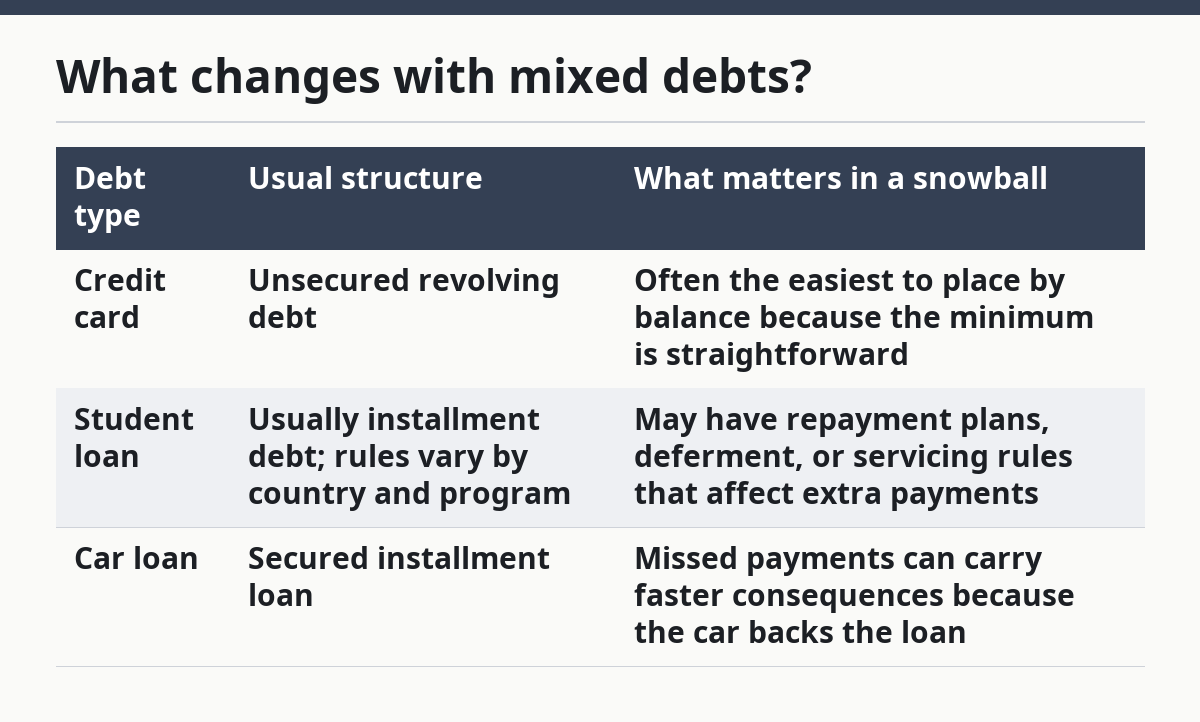
What changes with mixed debts?
Because mixed debts change the snowball, debt type can matter as much as balance size. The snowball rule still uses the smallest balance first, but a mixed portfolio adds 2 checks: whether the debt is secured or unsecured, and whether the loan has special repayment rules that affect minimums, deferment, or payoff timing. If those details are unclear, consult the lender, servicer, or a qualified adviser.
Here is the practical difference in plain terms:
| Debt type | Usual structure | What matters in a snowball |
|---|---|---|
| Credit card | Unsecured revolving debt | Often the easiest to place by balance because the minimum is straightforward |
| Student loan | Usually installment debt; rules vary by country and program | May have repayment plans, deferment, or servicing rules that affect extra payments |
| Car loan | Secured installment loan | Missed payments can carry faster consequences because the car backs the loan |
The key mistake is treating all 3 as if they behave the same way once they are all on the list. They do not. A snowball order can still be based on balance, but a loan with a required payment condition or a serious delinquency risk may need to stay current even if it is not the next target for extra money. That is a rule check, not a math problem; if you are not sure which rule applies, ask a servicer or adviser.
A second issue is that balance alone can hide risk. A $1,500 credit card balance and a $1,500 student loan balance may look equal on paper, but the payment terms, grace status, and collateral are not equal. A mixed portfolio needs a list that shows both the numbers and the debt type in the same place, ideally in one spreadsheet or notebook page with columns for balance, minimum payment, rate, and debt type. For a second reference on repayment structures, see Federal Student Aid and the CFPB credit card guidance.
How do you build the list?
You build the list by ranking balances first, then checking the payment rules for each debt before you start the snowball. The cleanest way is to make one full inventory of every debt, then sort by balance, then mark any item that has a special rule or a missed-payment risk.

- Write down every debt balance. List each credit card, student loan, and car loan with its current balance, lender name, and minimum payment. Use one line per account, not one line per type. If a balance is missing or outdated by more than one billing cycle, the order can be wrong.
- Label each debt as secured or unsecured. A car loan is usually secured, while a credit card is usually unsecured. Student loans are often installment loans with their own rules. If you cannot tell the type from the statement, check the loan agreement; a wrong label can hide repossession or default risk.
- Sort the list by balance from smallest to largest. This is the core debt snowball step. Keep the amounts visible, and do not move a larger balance ahead of a smaller one unless a special rule requires it. If the list is not sorted strictly by balance, the snowball is no longer a snowball.
- Check whether each debt has a minimum that must stay current. Write the exact minimum beside the balance. For student loans, look at the repayment status and servicer instructions. If the minimum payment is unclear or missing, that is a warning sign that the account needs review before extra money is sent elsewhere.
- Mark any debt with collateral, such as a car loan. Secured debt deserves a red flag because the lender can have a claim on the vehicle. If the loan is already late, the normal snowball order may be too slow for that account.
- Check for student loan features that affect payment strategy. Look for deferment, forbearance, income-driven repayment, or another plan name in the servicer portal or statement. These features can change the required payment or the amount that counts toward the loan. If the loan is in a special status, do not assume the minimum works the same way as a standard installment loan.
- Choose the smallest debt that is safe to attack extra. The target should be the smallest balance that is not disqualified by a special rule or immediate risk. If the smallest debt is also the one most likely to trigger a missed-payment problem, the order needs review before extra dollars go there.
- Send every extra dollar to that one target until it is gone. Keep minimums on the other debts current. If you split extra money across two debts, the snowball loses momentum. The warning sign is simple: if the extra payment amount changes every month without a reason, the plan is drifting.
A useful source for the mechanics of minimum payments and repayment planning is the Consumer Financial Protection Bureau’s credit card guidance and the U.S. Federal Student Aid page on repayment options. Those pages do not tell the reader which debt to choose, but they explain how the accounts work.
What about a car loan?
A car loan can stay in the snowball, but it needs a closer look because it is secured debt. The balance may be large, yet the real question is whether the payment is current and whether the vehicle is needed for work, school, or family logistics.
If the car loan is current and the lender terms are normal, it can be placed in balance order with the other debts. If the car loan is late, the payment risk can outweigh the simple snowball order because the consequence of falling behind can involve the car itself. In that case, the plan may need to prioritize keeping the loan current before extra snowball money is assigned elsewhere; if you are unsure, consult the lender or a qualified adviser.
A common mistake is assuming that a bigger car loan should always be ignored until the end because it is “too big to matter.” That can backfire if the loan is the one debt that cannot absorb even one missed payment. Another mistake is overpaying a car loan while a lower-balance credit card or student loan sits untouched, which breaks the momentum the snowball is meant to create.
The clean rule is this: keep the car loan on the list, keep the minimum current, and only let it stay in its balance position if it is not carrying a special risk. If the car is collateral and the account is already shaky, that is a sign to get individualized help rather than forcing the snowball to fit.
Do student loans change the order?
Student loans can change the order when their repayment status or servicer rules make the standard snowball sequence misleading. The balance may be small, but the loan may be in deferment, forbearance, or a repayment plan that changes what “minimum payment” means in practice.
A student loan in normal repayment can sit in the snowball like any other installment loan, ranked by balance. A student loan with special status needs a closer review before extra payments are aimed at it. If the loan has a required payment that is not obvious, or if the servicer says a certain amount must be paid to preserve a plan, the order should reflect that rule before the balance rule.
The mistake to avoid is assuming that every student loan must be paid exactly like a credit card or exactly like a car loan. Those are different products. Student loan terms can include grace periods, income-based plans, or consolidation-related changes, and those terms can alter the practical payoff order without changing the snowball concept itself. For the exact plan rules, see Federal Student Aid.
A second issue is account grouping. One student loan servicer may show several loans separately, each with its own balance. In a snowball, each loan should be treated as its own line item unless the servicer’s structure or repayment terms say otherwise. If the statements do not make that clear, the safest next step is to verify the account setup before extra money is sent.
What are the common mistakes?
The most common mistakes are sorting by interest rate by habit, ignoring secured debt risk, and forgetting that student loan status can change the rules. Each mistake can weaken the snowball or create a payment problem that was avoidable with a 10-minute account check.
- Mixing up balance order and interest-rate order: This turns the snowball into a different method and can make the plan confusing. The fix is to keep the list ranked by balance unless a special debt rule forces an exception.
- Treating every debt as if it were unsecured: This can hide the risk in a car loan. The fix is to label secured debt clearly and check whether the loan is current.
- Ignoring student loan status: This can lead to missed plan requirements or a payment that does not behave as expected. The fix is to check the servicer portal and note whether the loan is in standard repayment, deferment, or another status.
- Paying extra to several debts at once: This slows the payoff cycle because no single debt disappears quickly. The fix is to pick one target and keep all extra dollars there until it is gone.
- Using old balances: A payoff list from 3 months ago can be wrong enough to upset the order. The fix is to refresh the balances before starting a new target, especially after a statement cycle changes.
When should this approach stop?
This approach should stop when a debt’s consequences are more urgent than the snowball sequence. The method works best when all accounts are current enough to stay in order and the borrower can keep every minimum payment on time.
A car loan is already behind: that can mean collateral risk, not just a large balance — get individualized help before extra money is aimed elsewhere.
A student loan has a special repayment status you do not understand: the minimum may not behave like a normal installment loan — confirm the rule with the servicer or an adviser first.
A credit card is in collections or legal action: the account may need separate handling from a standard snowball — do not assume balance order is enough.
Minimums cannot be kept current on all debts: the plan is too tight for the cash flow — pause the snowball and address affordability before the order matters.
The debt list changes every month because of new charges or missed bills: the snowball cannot gain traction if the balances keep moving — stabilize spending and statements before restarting.
In a mixed debt portfolio, the right answer is not always “smallest balance first at all costs.” Sometimes the right answer is “keep the account from worsening first, then resume the snowball.” That is especially true when secured debt or student loan terms make the consequences of delay more serious than the balance number suggests.
What does a good mixed-debt snowball look like?
A good mixed-debt snowball looks simple on paper and disciplined in cash flow. It has one current list, one chosen target, and minimum payments on the rest, with the target changing only after the prior debt is gone.

The list should show each debt’s balance, type, and payment status in the same view. The current target should be the smallest debt that does not create a rule problem. If the balances shift after a statement closes, the order should be checked again rather than assumed to be the same as last month.
A mixed portfolio usually works best when the borrower can say one clear sentence about the plan: “I am paying minimums on everything, then putting every extra dollar on the smallest safe debt.” If that sentence no longer matches the account reality, the snowball needs a fresh review.
FAQ
Can I snowball different kinds of debt together?
Yes, different kinds of debt can sit in one snowball as long as the order is checked for special rules first. The method still uses balance ranking, but credit cards, student loans, and car loans should be labeled by type so secured debt and loan status do not get missed.
Should a car loan stay in the snowball if it’s large?
Yes, a car loan can stay in the snowball if it is current and there is no special payment problem. A large balance does not remove it from the method, but a late payment or collateral risk can change the order because the vehicle backs the loan.
Do student loans change the debt snowball order?
Yes, student loans can change the order if their repayment status or servicer rules matter. A student loan in standard repayment can usually be listed by balance, but deferment, forbearance, or another plan can change what payment action makes sense before extra money is sent there.
Drafted with AI; not yet reviewed by a person.