Last updated: November 20, 2026
Quick answer: for most people, debt payoff methods and ordering starts with 4 steps — keep every account current, pay the minimum on all debts, list the balances, rates, and due dates, and put any extra money toward one debt at a time. This guide, Debt payoff methods and ordering — The Complete Guide, explains the two most common payoff orders, snowball and avalanche, and how to choose between them without missing payments. This is information, not financial advice; a qualified adviser should be consulted for your own situation.
Key takeaways
- Pay the minimum on every debt first, or the whole plan can break fast.
- Snowball uses balance size to create quick wins; avalanche uses interest rate to reduce cost.
- The best order is the one you can follow for months, not the one that looks smartest for 1 week.
- If cash flow is unstable, a simple order beats a complicated spreadsheet.
- If you are already behind on essentials, debt payoff is not the first job.
What order should I pay debts in?

Quickly put, debt payoff methods and ordering work best when you keep every account current, then send all extra money to one target debt at a time. Start by listing every debt, the minimum payment, the balance, and the interest rate, because that 4-part list shows both the monthly strain and the total cost. See the Consumer Financial Protection Bureau for basic debt-management guidance and the Federal Trade Commission for help choosing a counselor if you need one.
The most common order is this: make every minimum payment, then choose one debt for extra payments, then repeat after that debt is gone. If all debts are credit cards, personal loans, student loans, or medical bills, the same logic still applies, but the details can differ by country, lender, and local law. Rates, limits, and collection rules change often, so the numbers that matter for one reader may not fit another.
For example, a beginner usually gets stuck on one false choice: “Should I pay the smallest balance or the highest interest rate first?” The real answer is that both can work, but they solve different problems. The smallest-balance order gives visible progress. The highest-rate order reduces interest cost faster, which can matter if a debt carries a large rate spread or will sit around for a long time.
However, the order also changes when a debt is already in collections, tied to tax rules, or part of an employer plan. Those are not normal “line them up and pay them off” debts. If a debt has legal consequences, a hardship program, or a tax issue attached to it, the payoff order may need professional review before any extra payment is sent.
Therefore, for readers looking for a simple starting point, the safest general order is: essential bills first, minimums second, then one chosen debt with every spare dollar. The danger is not the method itself; the danger is trying to split extra money across 6 balances and losing momentum. One target at a time is easier to track and easier to finish.
Snowball or avalanche?
Snowball helps more people stick with a payoff plan, while avalanche saves more on interest cost when the plan lasts long enough. Snowball means paying the smallest balance first after minimums; avalanche means paying the highest interest rate first after minimums.
Because the snowball method works because each closed account is a visible win, a reader with 5 debts can see progress after the first balance disappears, then roll that freed payment into the next one. That matters if motivation is the main problem, because debt payoff often fails for emotional reasons long before it fails on math.
Meanwhile, avalanche works because interest is a drag that keeps charging while a balance stays open. If one debt has a much higher rate than the others, pushing extra money there first can lower the total cost of carrying debt. The trade-off is psychological: the highest-rate debt is not always the smallest, so the first win may take longer.
Here is the clean way to think about the two methods:
| Criteria | Snowball | Avalanche | Winner for this condition |
|---|---|---|---|
| First extra payment target | Smallest balance | Highest interest rate | Snowball if you need a quick win |
| Motivation | Stronger for many beginners | Weaker if the first target is large | Snowball if follow-through is the main risk |
| Interest cost | Usually higher than avalanche | Usually lower than snowball | Avalanche if you can stay consistent |
| Complexity | Very simple | Slightly more tracking | Snowball if you want the easiest system |
| Best for debt lists with many small balances | Yes | Sometimes, but not usually | Snowball |
| Best for long payoff timelines | Can be slower on cost | Better on cost over time | Avalanche |
| Risk of quitting early | Lower for some people | Higher if the first target is far away | Snowball |
| Works with uneven cash flow | Yes, if rules stay simple | Yes, but requires more discipline | Snowball for irregular budgets |
| Best when interest rates differ a lot | Not ideal | Strong fit | Avalanche |
| Best when rates are similar | Fine | Fine | Either one |
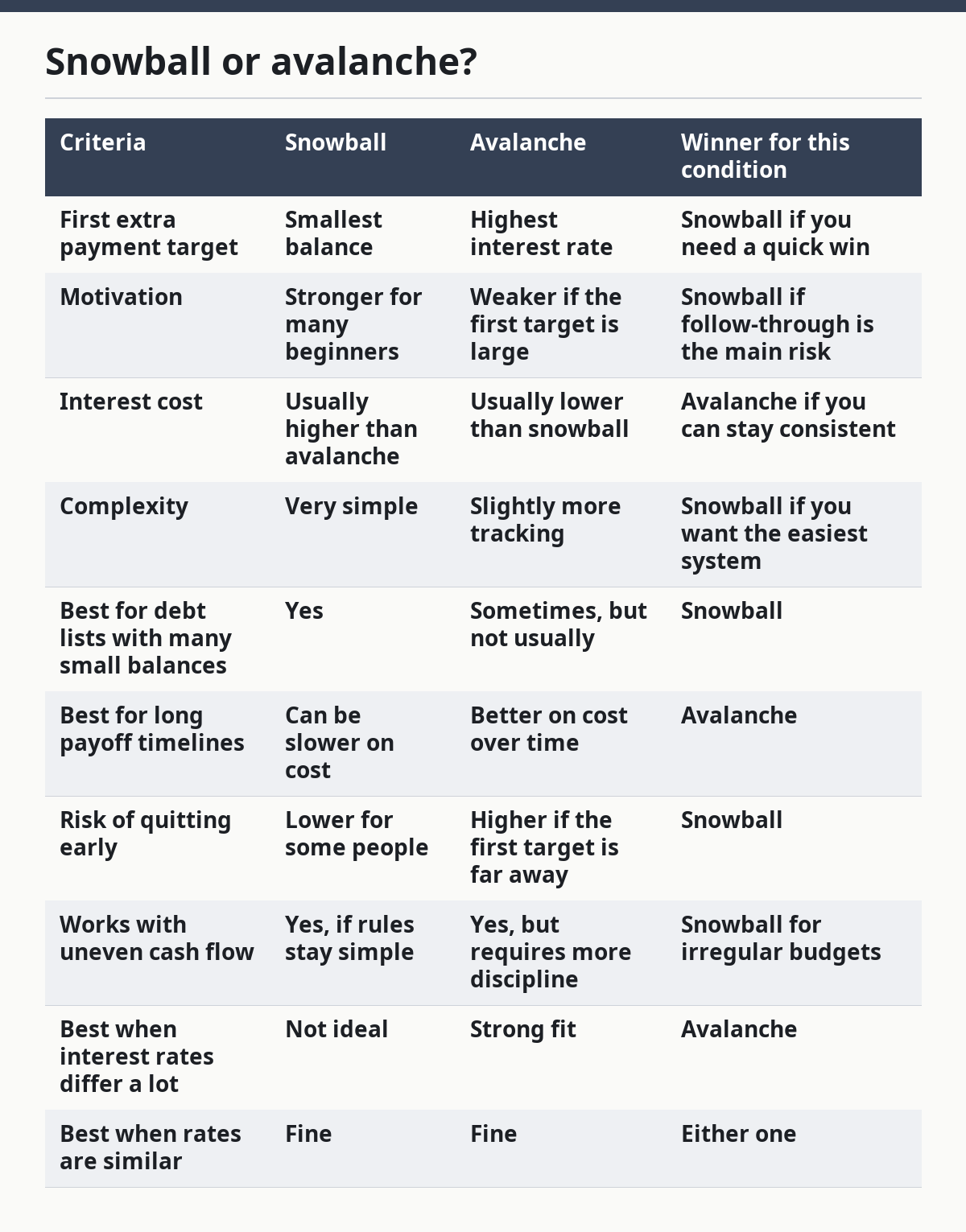
However, the table hides one important detail: the “best” method is not the same as the “best for you.” If the avalanche method saves more on paper but gets abandoned in month 2, it loses in real life. If the snowball method keeps the plan alive for 18 months, it can beat a smarter plan that never gets finished.
A generic article often says “just pick the one you like.” That is too vague. Pick snowball if you need visible progress, if you are new to debt payoff, or if your budget is already stretched and simple rules matter most. Pick avalanche if you are comfortable tracking rates, can stay patient, and want the payoff order tied to cost instead of emotion.
For a reader on a phone, the easiest test is blunt: if the first debt you would target makes you quit, snowball is the better choice. If you can see the first target through without frustration, avalanche can be the more efficient choice.
How do I list debts before I start?

So, list debts in one place with 4 columns: name, balance, minimum payment, and interest rate. That is enough to choose an order without drowning in paperwork.
This list matters because “smallest balance” is not always “smallest monthly pain.” A debt with a modest balance can still have a large minimum payment, and that can squeeze cash flow. Another debt may have a tiny minimum but a steep rate, which makes it expensive to keep around.
The first pass should be boring and complete. Include credit cards, personal loans, student loans, medical bills, and any other unsecured debt you are trying to erase. If a debt is secured, overdue, or tied to a vehicle or home, it may need a separate plan because the consequences of falling behind are different.
Next, mark which debts are current and which are already behind. Current debts usually stay in the main payoff list. Behind debts can trigger fees, collection calls, or worse terms, and they may need a different plan before extra payments make sense.
Then, add due dates to the list. A debt payoff plan fails faster when a due date is missed than when the “optimal” order is imperfect. Payment timing matters as much as payment order if cash arrives at uneven times during the month.
Do not split extra money across several balances because it feels fair. Fair is not the goal. Finished is the goal. One debt gets the extra payment, and the rest get minimums. That is the whole engine of both snowball and avalanche.
If the list looks too messy, shrink it to 3 decisions: what must be paid to avoid harm, what debt gets extra money, and what can wait until next month. That is often enough to start.
What if I have credit card debt?
Therefore, credit card debt usually needs the strictest order because rates are often high and minimum payments can keep the balance alive for a long time. That does not mean every card should be targeted first; it means the cards should be handled with the same 2-method logic as any other debt, but with less room for drift.
If there are several cards, the usual question is whether to target the smallest card balance or the card with the highest rate. Snowball is better if the borrower needs a quick win and has several small cards with similar rates. Avalanche is better if one card carries a clearly higher rate and the plan is likely to last for many months.
However, credit cards also demand attention because they are easy to reuse. A common failure point is paying down a card, then using it again for ordinary spending. That creates a treadmill, not a payoff plan. If the card stays open, the spending rule has to be strict enough that new charges do not wipe out the progress from the last 2 months.
A balance transfer, hardship program, or lender arrangement can change the math, but those are not automatic fixes. Each one has conditions, fees, or terms that vary by issuer and country. A reader should not assume that moving debt is the same as removing debt.
There is also a timing issue. A card with a small balance can disappear fast, which is useful if motivation is weak. But if another card has a much higher rate, the snowball choice can cost more over time. That is the core trade-off: speed of progress versus cost of carrying the debt.
The practical rule is simple. If the goal is to stay engaged, start with the card that will close soonest. If the goal is to reduce cost and the plan is stable, start with the highest-rate card. If the debt is already close to causing missed essentials, the first move is not a payoff order at all; it is a cash-flow fix.
When does the order flip?
Because the order flips when the plan would fail if it stayed “optimal,” a debt method that looks right on paper can be wrong if it ignores income swings, late fees, or the need to protect basic expenses.
Here are the main exception scenarios:
-
Cash flow is irregular. If paydays move around, the cleanest order may be the one that minimizes stress, not interest cost. A simple snowball can beat a precise avalanche if the precise plan is too hard to follow.
-
One debt has legal or collection pressure. If a debt is already in active collection or has a legal deadline attached, it may need priority over a smaller or higher-rate debt. That is not a math question; it is a consequences question.
-
An emergency would force new debt next month. If paying extra toward one account would leave nothing for essentials, the order is wrong. A payoff method should not create a fresh borrowing problem.
-
The interest-rate gap is tiny. If rates are close, the difference between snowball and avalanche can be small enough that motivation should decide. A reader who needs early wins may do better with snowball even if avalanche is slightly cheaper.
These flips matter because “best” is not one universal answer. A debt payoff method should fit the budget that exists, not the budget that would be nice to have. If the system collapses after 3 weeks, the perfect order was never useful.
A good check is to ask one blunt question: does this order still work if next month is messy? If the answer is no, simplify it. A plan that survives a bad month is worth more than a plan that looks elegant in a spreadsheet.
What are the biggest mistakes?
So the biggest mistakes are paying the wrong debt first, ignoring minimums, and trying to change the plan every few weeks. Debt payoff works better with one clear order than with constant optimization.
A common mistake is treating every extra dollar as something to split evenly. That feels balanced, but it slows progress and makes it harder to see results. Another mistake is chasing the smallest debt while leaving a very expensive balance untouched for too long. The third is stopping the plan after one account is paid off instead of rolling that payment into the next debt.
People also forget that the minimum payment is not the target; it is the floor. If the minimum is all that gets paid, the debt may linger far longer than expected. The payoff method matters only when extra money is assigned on purpose, every month.
A fourth mistake is choosing a method based on guilt. A borrower may think the smallest debt “deserves” to be first or that the highest-rate debt “should” be first. Debt payoff is not a moral contest. It is a cash-flow plan with a finish line.
The final mistake is making the plan so complex that it needs constant recalculation. If the order changes every time a bill arrives, the system becomes fragile. Simpler rules usually win because they are easier to repeat when life is noisy.
A practical standard helps here: if the method takes more than a few minutes to explain, it may be too complicated for a stressed household. The right method should fit on a single note, not a 20-page spreadsheet.
Which method should most beginners choose?
Ultimately, most beginners should choose snowball if they need momentum, and avalanche if they already know they can stay disciplined for months. The right choice depends on which risk is more dangerous: quitting early or paying extra interest.
Snowball is the better first pick for a reader who feels overwhelmed by 4, 5, or 6 debts, especially if several balances are small enough to disappear in sequence. The emotional reward of closing accounts can keep the plan alive. That matters because a plan that is easier to follow may beat a more efficient plan that never gets finished.
Avalanche is the better first pick for a reader who is calm with spreadsheets, comfortable tracking rates, and unlikely to get discouraged by a slower first win. It is the more cost-focused order, and that can matter a lot when high-rate debt would otherwise stay around for a long time. The downside is that patience becomes part of the method.
The wrong move is to pick snowball because it is “simple” and then ignore the interest cost forever, or to pick avalanche because it is “mathematically correct” and then stop after 2 months. The method is only useful if it survives real life.
A reader who cannot decide can use a tie-breaker: choose the method that is easiest to explain in one sentence. If that sentence feels impossible to follow, the order is probably too complicated for the moment. Debt payoff methods and ordering work best when the rules are easy to remember.
The verdict is plain: the best debt payoff system is the one that keeps payments on time, keeps the budget stable, and keeps extra money pointed at one target until it disappears. If that sounds obvious, that is the point. Debt payoff succeeds less from cleverness than from repetition.
Choose snowball if you need visible wins, your debt list is emotionally heavy, or you are likely to quit when the first target feels too slow. Choose avalanche if you can stay patient, want the payoff order to follow interest cost, and are confident the plan will keep running for months. Neither works if you are behind on essentials, because then the problem is cash flow, not order.
What about consolidation or settlement?
On the other hand, consolidation or settlement can change the payoff order, but they are not the default answer and they are not the same thing as paying debt off by method. Consolidation usually means combining debts into one new payment structure; settlement usually means trying to resolve a debt for less than the full balance under specific terms.
These options can help in some cases, but they also add new terms, new risks, and new rules. A consolidation plan may lower complexity but stretch the timeline. A settlement path may reduce what is paid on one debt, but it can also come with serious side effects depending on the country, lender, and account type. That is why they should not be treated as a simple version of snowball or avalanche.
A lot of generic advice blurs these ideas together. That is a mistake. Snowball and avalanche are ordering systems for debts you intend to pay. Consolidation and settlement are different tools with different trade-offs. Mixing them up can lead to a plan that sounds cleaner than it is.
Before using either one, a reader should check whether the new plan is actually easier to sustain than the current one. If the answer is only “maybe,” the safer move may be to keep the debts separate and improve the order. If the answer is “yes, clearly,” then the new structure may deserve consideration with professional guidance.
For a reader who just wants a first step, the standard method is still the most useful starting point: minimums on all debts, then one chosen target, then repeat. That is the core of debt payoff ordering whether or not another option is later added.
What should I do if my plan stops working?
Therefore, if the plan stops working, shrink it instead of abandoning it. The first fix is usually to protect the minimums, then lower the extra payment target, then reset the order.
A plan can stop working for simple reasons: a job change, a medical bill, a car repair, or a month where several expenses land at once. When that happens, the answer is not to keep forcing the original target. The answer is to preserve the system by making it smaller for a while.
If the debt order was based on snowball, the new target may need to change only if cash flow changes sharply. If the order was based on avalanche, the interest-rate priority usually still makes sense, but the extra amount may need to be cut back. In both cases, the minimums remain the line that protects the whole plan.
A useful reset takes 3 steps: update the debt list, check which payments are still current, and choose one new extra-payment target for the next month. That keeps the system from turning into a pile of guilt and unfinished decisions.
If the plan fails because essentials cannot be covered, debt payoff should pause and the budget should be rebuilt. No payoff order can fix a budget that cannot absorb basic living costs. In that situation, a qualified adviser or local debt-counseling resource may be more useful than a new method.
The most honest rule is this: keep the method only as long as it is helping. Once it starts causing missed payments or panic, simplify. The best debt payoff system is the one that stays alive long enough to finish.
FAQ
Should I pay off the smallest debt first or the highest interest rate first?
If motivation is your biggest problem, the smallest-debt order is often easier to stick with. If interest cost is your biggest concern and you can stay disciplined, the highest-rate order usually makes more sense. The better choice depends on whether you are more likely to quit early or carry debt for a long time.
Do I still make minimum payments on every debt?
Yes, minimum payments come first on every debt that stays in the plan. The extra money is what gets directed to one target debt at a time. Skipping minimums can trigger fees, damage your payment history, or break the whole method.
Can I switch from snowball to avalanche later?
Yes, you can switch later if your situation changes. A reader might start with snowball to build momentum, then move to avalanche once the routine is stable. The switch should be intentional, not random, and it should be based on a fresh look at balances, rates, and cash flow.
What if I only have a little extra money each month?
Even a small extra amount can still work if it is used consistently. The point is not the size of the extra payment; the point is that it is repeated on one debt until that debt is gone. Small, steady extra payments are usually better than waiting for a perfect month that never comes.
Is debt payoff ordering the same for every country?
No, it is not the same everywhere. Local rules can affect interest charges, collections, consumer protection, and tax treatment, so the details can vary by country and can change over time. For a personal situation, a qualified adviser or local debt professional should review the exact rules that apply.
Useful references
The Consumer Financial Protection Bureau explains debt management plans and related credit tools here: https://www.consumerfinance.gov/consumer-tools/debt-collection/
The U.S. Federal Trade Commission explains how to choose a credit counselor here: https://consumer.ftc.gov/articles/choosing-credit-counselor
The Federal Deposit Insurance Corporation offers consumer guidance on managing debt and credit here: https://www.fdic.gov/resources/consumers/money-and-credit/credit-cards/index.html
Drafted with AI; not yet reviewed by a person.