Last updated: November 20, 2026
Quick answer: a hybrid debt payoff order uses 2 rules — one for the starting target and one for the switch — so you can keep one payoff order even when priorities change. That is the core of how to build a hybrid debt payoff order without starting over. You set a rule for which debts get extra money first, then add a second rule for when you are allowed to switch. For budgeting basics, see the Consumer Financial Protection Bureau and the FTC’s guidance on managing debt.
Key takeaways
- A hybrid plan mixes the debt snowball and debt avalanche so the order is not rigid.
- The plan works best when the first rule is simple and the switch rule is written down.
- Minimum payments still go to every debt on time; the extra payment is what moves.
- A debt payoff tracker keeps the order from changing every month.
- If cash flow is unstable or your debts are tied to legal terms you do not fully control, the hybrid method may need outside review.
Who should use a hybrid payoff plan?
A hybrid debt payoff plan is for someone who wants structure but does not want to be trapped by one method. It suits a reader who already makes minimum payments on time, has more than one debt, and wants to blend debt snowball momentum with debt avalanche interest control. It is not for someone who is behind on basic bills, because a payoff order cannot fix a broken budget.
This hybrid debt payoff order assumes you already know each balance, each minimum payment, and roughly how much extra money you can send each month. A debt payoff tracker, even a simple spreadsheet, helps because the plan depends on order, not memory. If your income changes a lot from month to month, the rule may need to be looser, not more aggressive.
A practical use case is a person who starts with snowball-style wins on smaller momentum debts, then shifts toward avalanche-style interest-driven debts once the plan is working. That is useful when motivation matters but interest still hurts. It is less useful if you keep changing the goal every 30 days, because the whole point is consistency.
What is a hybrid debt payoff order?
A hybrid debt payoff order is a written rule for deciding which debt gets your extra payment next. It combines the debt snowball, which usually targets smaller balances first for quick wins, and the debt avalanche, which usually targets higher-interest debts first to cut cost over time. The order stays stable until a trigger you chose tells it to change.
The word “hybrid” matters because this is not random switching. A real hybrid plan names the debt types, the priority rules, and the switch point in advance. Without that, “hybrid” becomes a feeling, and feelings change too easily when one bill looks annoying. For a broader overview of payoff methods, see our debt payoff methods guide and debt snowball vs. avalanche.
A simple version can have two lanes. Lane one might put one small balance first for 2 or 3 months to build momentum. Lane two might move the extra payment to the highest-interest debt after that, or after the balance drops under a set amount. The exact trigger is yours, but the rule has to be written before the next payment is due.
How do you build the order without starting over?
You build it by keeping the debts in one list, then changing only the extra-payment target when the rule says to switch. The core list does not restart each time you change your mind. The minimum payments stay fixed, and the extra payment moves from one debt to the next based on your rule.
- List every debt in your debt payoff tracker, including balance, minimum payment, and interest rate, then verify nothing is missing; if a debt is absent, the order will break as soon as that bill comes due.
- Group debts into momentum debts and interest-driven debts, then verify the labels fit your own plan; if everything is in one pile, you cannot tell which rule is leading.
- Choose your starting method, snowball or avalanche, then verify the first extra-payment target is obvious; if you need to debate the first pick every month, the rule is too vague.
- Write your switch trigger in one sentence, such as “switch after the smallest balance is below a set point” or “switch after 3 on-time payment cycles,” then verify the trigger is specific; if the trigger uses words like “soon” or “later,” it is not usable.
- Assign minimum payments to every debt and send any extra money only to the current target, then verify the total scheduled payments still fit your budget; if the extra payment requires skipping another bill, the plan is failing.
- Track each payment date and updated balance on the same day every month, then verify the next target is still the same under your rule; if the next target changes because of a mood shift, the tracker is not doing its job.
- Switch the extra payment to the next target only when the trigger is met, then verify the old debt stays on minimum only; if you keep splitting the extra payment across several balances, the order loses its power.
- Review the order after every major income change or new debt, then verify the rule still matches your budget; if a new debt makes the old order impossible, adjust the rule rather than pretending nothing changed.
A good hybrid debt payoff order has one clear extra-payment target at any time. A bad one has three “almost first” debts and no rule for choosing between them. The difference shows up fast in a tracker: one path is easy to follow, the other turns into monthly guesswork.
What should the switch rule be?
The switch rule should be specific enough to follow on a bad month. A good rule names a number, a condition, or a time frame, not a mood. For example, the switch can happen after a balance falls below a set amount, after 3 full payment cycles, or after one priority debt is closed.
The cleanest rules are the ones you can verify in 30 seconds. If the trigger depends on “feeling ready,” it is not really a rule. If it depends on a clear balance level or payment count, it is easier to keep the order stable.
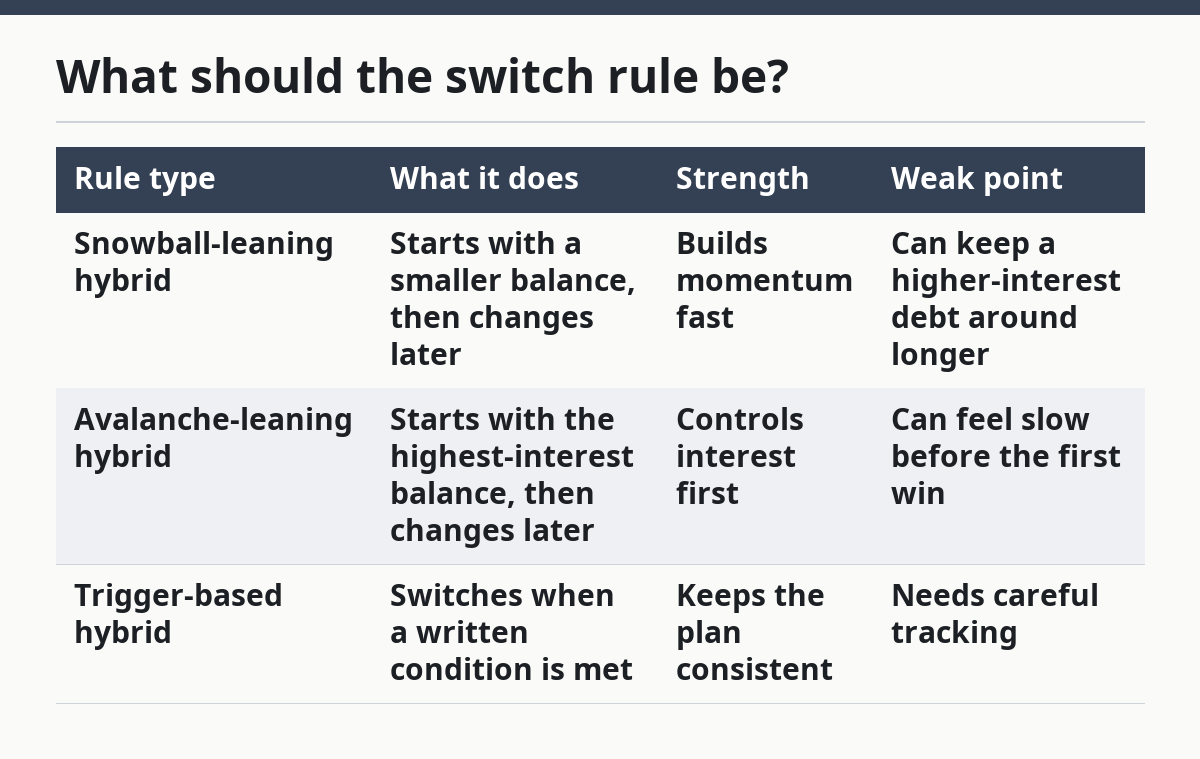
Here is the difference in practice:
| Rule type | What it does | Strength | Weak point |
|---|---|---|---|
| Snowball-leaning hybrid | Starts with a smaller balance, then changes later | Builds momentum fast | Can keep a higher-interest debt around longer |
| Avalanche-leaning hybrid | Starts with the highest-interest balance, then changes later | Controls interest first | Can feel slow before the first win |
| Trigger-based hybrid | Switches when a written condition is met | Keeps the plan consistent | Needs careful tracking |
A written rule also helps if your priorities change. If you get a small bonus, you do not have to redesign the whole plan. You just send the extra money to the current target, then keep the switch rule intact. For help organizing payments, see our debt payoff tracker template.
When should you stop and rethink the plan?
You should stop using the current order when the rule no longer matches your cash flow or debt list. That does not mean the hybrid method failed; it means the setup needs a reset.
You miss minimum payments for any debt: the order is not the main problem anymore — the budget is — and the next step is to review your full payment plan before choosing a target.
Your income changes enough to affect one monthly payment: the rule may be too strict — adjust the extra-payment amount, not just the order.
A debt has a penalty, fee, or legal term that changes its cost: the old priority may no longer fit — read the current terms and get qualified help if the account language is unclear. For rights and complaints about debt, the CFPB is a useful reference, and a licensed professional can help with account-specific questions.
You keep switching targets before the trigger is met: the hybrid plan has turned into a habit of starting over — write the rule down and use a debt payoff tracker to enforce it.
You cannot tell which debt is the current target in under 1 minute: the system is too complicated — simplify the rule to one target plus one switch condition.
A new debt appears and changes the order by more than one place: the plan needs an update, not a patch — rebuild the list once, then resume from the new target.
The point of stopping is not to quit. It is to avoid running a broken order for 6 more months and calling it discipline.
What mistakes do people make?
The most common mistake is blending two methods without rules. That creates the illusion of flexibility, but it usually means the extra payment gets scattered. The fix is to name one current target and one switch condition.
Another mistake is treating minimum payments like optional filler. Minimums are the floor, not the leftover, and if you are unsure how minimum-payment priorities interact with other bills, a licensed financial professional can help you review the plan. If those payments are not protected, the plan can fall apart before the first debt is closed. The Consumer Financial Protection Bureau also explains why paying at least the minimum matters.
A third mistake is switching because a balance “feels close.” A balance can feel close for 4 months and still need more than the extra payment schedule you planned. The better move is to use the tracker, not the feeling.
A fourth mistake is ignoring interest-driven debts because a smaller balance looks cleaner. That can make the plan look active while interest keeps building. If the higher-interest debt is not your first target, it should still be on a written path to the top.
A fifth mistake is rebuilding the list every time life changes a little. A hybrid debt payoff order is supposed to absorb small changes. If a new card, a rate change, or one uneven month wipes out the plan, the rule was too fragile.
When does the standard approach not apply?
The standard hybrid approach does not fit every debt set. It needs modification when the debts are hard to compare, the payment timing is unusual, or the budget shifts often enough that one fixed order no longer works.
If a debt has a very small balance but a large minimum payment, the snowball-style win may be less helpful than it looks. If a debt has a much higher interest rate than the rest, the avalanche-style cost control may deserve more weight. Those are not reasons to abandon the hybrid idea; they are reasons to state the rule more carefully.
A good adjustment is to keep the same structure but change the trigger. Instead of switching after a balance is gone, switch after a specific payment count or a balance threshold that matches your tracker. The plan still stays hybrid; it just fits the debts you actually have.
For broader debt order questions, the hub on debt payoff methods and ordering can sit above this page as the main overview, while this page handles the hybrid setup itself. See also our debt management hub for related planning pages.
How do I know the plan is working?
The plan is working if you can point to one debt that gets every extra dollar, and you can say why that debt is next. That should be true after 1 payment cycle and still true after 6. If the answer changes every week, the plan is not stable yet.
A working hybrid debt payoff order also leaves a clean trail in the tracker. You should be able to see the target debt, the minimum payments on the others, and the switch condition in the same place. If you cannot explain the next step in one sentence, the plan is too loose.
The best sign is not excitement; it is repeatability. If the same rule holds when you are tired, busy, or frustrated, the order is doing its job.
Can I switch from snowball to avalanche later?
Yes. A hybrid debt payoff order can start with snowball and later move toward avalanche if your written rule says that is the switch point. The key is not the switch itself; it is avoiding a full restart. Keep the same tracker, keep the minimum payments going, and move the extra payment only when the trigger is met.
How do I set rules for a hybrid payoff plan?
Set one rule for the starting target and one rule for the switch. The rule should name a balance, a time frame, or a payment count, not a vague feeling. Put the rule in the same debt payoff tracker that shows balances and minimum payments, so the next target is easy to verify in under a minute.
When does a hybrid payoff plan make sense?
A hybrid payoff plan makes sense when you want a mix of fast motivation and interest control. It fits a person who can keep minimum payments current but wants a path that can change without starting from zero. It is less useful if your budget is unstable enough that even the minimums are hard to keep up with.
Drafted with AI; not yet reviewed by a person.