Last updated: November 20, 2026
Quick answer: choose the payoff order you can keep using when your extra payment is $0, $50, or $500. For people comparing how to choose a debt payoff method when your monthly surplus changes, the safest practical rule is usually the one that keeps minimum payments steady and assigns only the extra money by a clear order. This is information, not financial advice, and a qualified adviser should review your own situation before you change a repayment plan.
Key takeaways
- A changing surplus does not mean you need a new method every month; it means you need a rule for where extra money goes.
- Keep minimum payments fixed, then assign only the extra payment by a clear order such as smallest balance, highest rate, or a hybrid rule.
- A debt payoff tracker helps you see whether a month has enough surplus for an extra payment or only enough to protect your cash.
- A buffer month is useful only if it has a job: cover a lean month, not become a reason to stop paying debt.
- If your surplus swings wildly, the most workable method is usually the one you can follow in both a strong month and a weak one.
What is a variable monthly debt plan?
A variable monthly debt plan is a repayment setup that keeps your minimum payment steady and changes only the extra payment when your budget changes. It fits people whose budget variance is normal, not rare: some months have room for more, some months do not, and a few months may have nothing left after essentials.
This plan is not a promise that debt gets paid faster every month. It is a rule for deciding what to do when the surplus changes by month. In other words, how to choose a debt payoff method when your monthly surplus changes comes down to surplus allocation, which means deciding how to divide the money left after minimum payments, rent, food, and other fixed bills.
A generic “just pick the snowball” answer misses the real issue. If your surplus jumps around, the wrong method is not always the one with the wrong math; it is the one that breaks the first time a lean month arrives. The right method is the one you can repeat in a $0 extra month and a stronger month without rethinking the whole plan.
A good source for repayment basics is the Consumer Financial Protection Bureau’s debt payoff guidance, and the Federal Trade Commission also explains how minimum payments and extra payments work in its debt help resources. Those pages are a useful check on the mechanics, but they do not choose the method for you.
How do I choose the right payoff order?
You choose the payoff order by matching the order to how steady your extra payment is, then keeping the same rule for at least a few months. The point is not to find one perfect method; the point is to pick the one that still works when the surplus is small, zero, or larger than expected.
Use this comparison to sort the usual options before you commit:
| Method | Best when surplus changes by month | Main strength | Main weakness |
|---|---|---|---|
| Snowball | You need simple progress and quick wins | Small balances disappear sooner | Can cost more in interest than rate-based methods |
| Avalanche | You can stick with a rate-first order | Targets higher-cost debt first | Feels slow if the first balance is large |
| Hybrid rule | Your surplus changes and your balances are uneven | Lets you keep one rule with small adjustments | Needs a clear rule so you do not improvise every month |
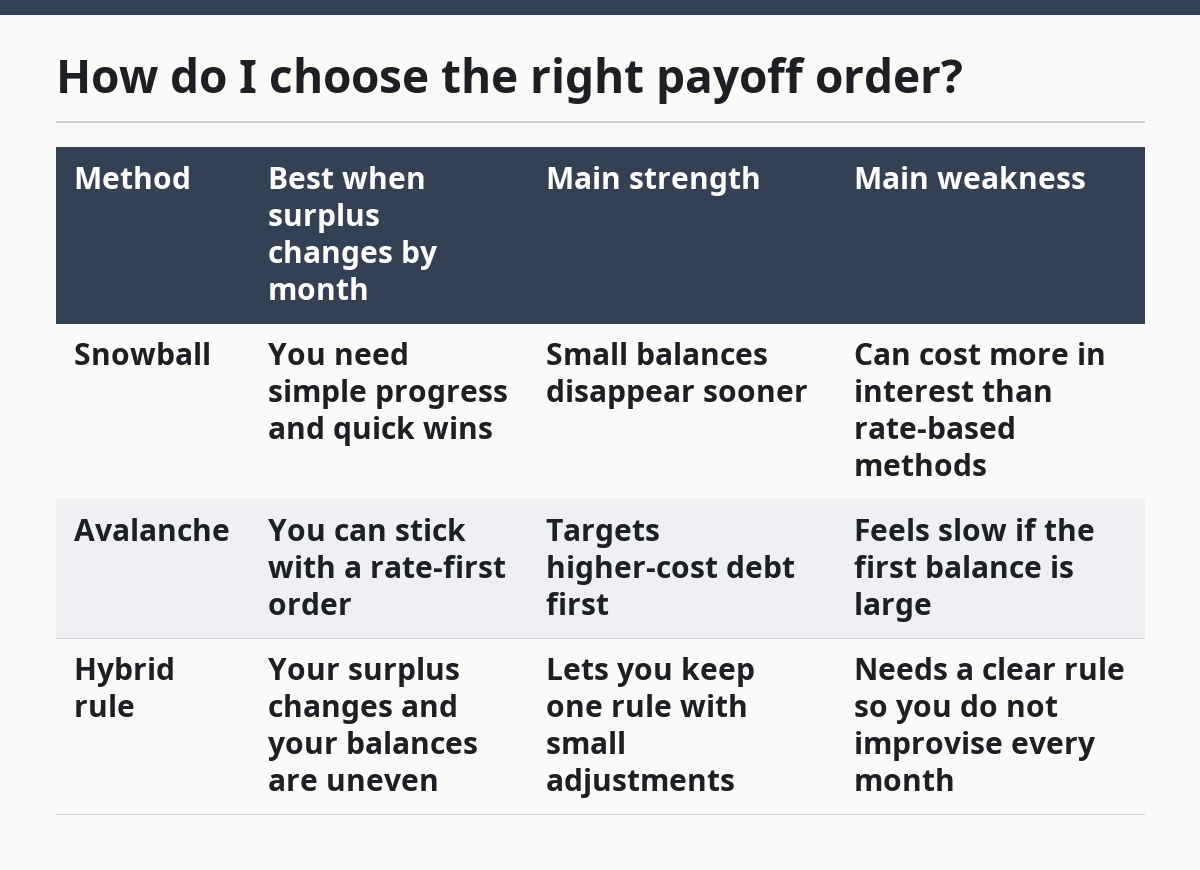
The right choice is often the one you can describe in one sentence. If that sentence changes every month, the method is too loose. If the sentence survives a month with no extra money, it is probably a better fit.
A snowball approach tends to suit people who need visible wins. An avalanche approach tends to suit people who can tolerate slower early progress in exchange for a cleaner order. A hybrid rule can work when your surplus is uneven because it gives you one fixed base rule and one fallback for lean months. For a deeper comparison, see debt payoff methods and budgeting for variable income.
How do I set up the plan month by month?
You set up the plan by deciding 7 steps before the month starts and then following them in the same order each time. That keeps the decision out of the moment, which matters when your surplus changes and you are tempted to improvise.
- List your minimum payment for every debt, then verify the total against the due dates on each statement. If a payment amount is unclear, the problem is not the method; it is the missing number.
- List your expected surplus as a range, not a single number, and label it low, medium, and high. If the low month is below zero after minimum payments, the plan needs a buffer or a different order.
- Choose one base rule for the extra payment, such as smallest balance first or highest rate first. Verify that the rule can be explained in one line; if it needs a long speech, it is too hard to follow.
- Create a buffer month if your surplus is unstable, and keep it separate from the extra payment rule. If the buffer is constantly used for everyday spending, it is not a buffer any more.
- Assign the extra payment only after minimum payments and essentials are covered. Verify that the extra payment does not force you to skip the next month’s minimum payment; if it does, the amount is too high for your current budget variance.
- Record the result in a debt payoff tracker the same day you make the payment. If the tracker is not updated, you may think you are following the plan when you are not.
- Review the rule after one full cycle of high, medium, and low months, then decide whether to keep it. If you are switching methods every month, the rule is not stable enough yet.
Because a strong month can disguise a weak pattern, the main thing to watch for is overcommitting early. A surplus that looks large on the 1st can vanish by the 20th if the month has a repair, a medical bill, or another nonmonthly expense. The better habit is to send the extra payment only after the month’s fixed bills and near-term essentials are covered.
What should I do with a strong month?
You should give the strong month to the same rule you already chose, then cap the extra payment at the amount you can repeat without strain. A strong month is useful only if it does not create a weak next month.
If you are using snowball, the strong month can make a small balance disappear faster. If you are using avalanche, the strong month can push more money toward the highest-rate debt without changing the order. If you are using a hybrid rule, you can send the base extra payment to the chosen debt and keep any remaining surplus for the buffer or the next scheduled payment, depending on your written rule.
The mistake here is treating one unusually good month as the new normal. A surplus spike is not proof that your budget changed permanently. If the extra payment depends on a month that may not repeat, it is better to split the amount between the planned extra payment and the buffer than to redirect the whole sum on impulse; if you are unsure, a qualified adviser should review the plan. The Consumer Financial Protection Bureau’s debt payoff guidance is a useful reference for how to structure the payment flow.
The money decision is simple: follow the rule first, then the balance. If the month is unusually strong, the best outcome is usually a payment you can still make when the surplus falls back to normal.
When should I stop using a standard payoff order?
You should stop using a standard payoff order when the plan no longer fits the size or rhythm of your surplus. That usually means the order is causing skipped minimum payments, repeated resets, or constant second-guessing.
If the extra payment would erase your next month’s cushion: the plan is too tight — reduce the extra payment and keep the minimum payment safe.
If your budget variance is so wide that one month is strong and the next is bare: the order needs a buffer rule — pause the extra payment in the lean month and protect the minimum payment.
If you keep changing the order based on mood: the method is no longer a method — pick one rule for 3 months and track it.
If one debt has a due date problem or penalty risk: the order should not ignore timing — keep that payment current before chasing extra principal.
If the tracker shows the plan only works on paper: the budget is missing real expenses — rebuild the surplus estimate before sending more money out.
The standard approach is not for people who need a different amount every week. It works best when the surplus changes monthly, not daily, and when the minimum payment can stay intact without guesswork. If those conditions are missing, a qualified adviser should help you sort the cash flow before you lock in a payoff order. The FTC’s debt help resources are another useful check on the mechanics.
What mistakes trip people up most?
The most common mistake is using the biggest surplus month as the template for the rest of the year. That can make the extra payment look easy for 1 month and impossible the next, which leads to skipped progress and stress. The safer alternative is to base the plan on a range and treat the highest month as a bonus, not a promise; if the pattern is unclear, consult a qualified adviser and check the CFPB and FTC guidance.
A second mistake is mixing several payoff rules at once. One month becomes snowball, the next becomes avalanche, and a third month gets whatever feels urgent. That makes the tracker useless because the order changes before you can see whether the method worked. Pick one rule and keep it for at least one full cycle.
A third mistake is sending the extra payment before checking the minimum payment calendar. If a due date is near and the bank account is thin, the extra payment can create a cash crunch. The fix is to confirm due dates first, then assign the extra payment.
A fourth mistake is leaving the buffer month vague. A buffer that has no named purpose gets spent on random costs. A named buffer, by contrast, can be used for a lean month, a repair, or a gap before the next surplus arrives.
A fifth mistake is ignoring debts that react badly to delay. If a payment has a fee, a penalty, or a higher cost when late, that bill gets priority over any extra payment rule. The method only works when the basics stay current.
How do I know the plan is working?
The plan is working if you can make every minimum payment, direct extra money on purpose, and avoid redoing the method each month. You should be able to look at the debt payoff tracker and see a clear pattern after 2 or 3 cycles, even if the surplus changes.
A good sign is that the plan still functions in a low month. Another good sign is that a high month has a clear job instead of becoming a scramble. If you can say, “This month’s extra payment goes here unless the buffer is underfunded,” the plan is probably specific enough.
A bad sign is that the plan only feels good when money is plentiful. That usually means the method is too aggressive or too vague for real budget variance. If that happens, lower the extra payment target, simplify the order, or ask a qualified adviser to review the structure before the next cycle.
FAQ
Should I use the same payoff method every month?
Yes, if the method still fits your monthly surplus and you can follow it without guessing. A single rule is easier to track than a new choice every month, especially when you are using a debt payoff tracker. If the rule keeps breaking in lean months, the method needs a clearer fallback.
How do I handle months with no extra money?
Treat that month as a minimum-payment month and keep the plan alive, with a qualified adviser if your cash flow keeps changing. The extra payment can pause without killing the method, as long as the minimum payment stays current and the next month’s surplus is handled by the same rule. If zero-extra months happen often, the plan may need a buffer or a simpler payoff order.
Can I switch between payoff orders month to month?
Yes, but only if the switch is part of a written rule, not a reaction to stress. Switching without a rule makes the tracker hard to trust and can hide the real pace of repayment. A cleaner approach is to pick one base order and allow one narrow exception for a specific month type.
Where this fits in the bigger payoff plan
This choice sits inside the larger debt payoff methods and ordering framework, so it is only one piece of the full plan. The method you choose should match your cash flow first and your preference second. If your surplus changes month to month, the best plan is the one that survives a full year of uneven payments without forcing you to rewrite the rules every 30 days.
Drafted with AI; not yet reviewed by a person.