Last updated: November 20, 2026
Write down the call as soon as it ends, and keep a creditor call log with the date, time, name, account number, reference number, what was promised, and the next deadline. If the call changed your payment plan, send a follow-up email the same day and save both records together. This is information, not financial advice; if your situation is unusual, a qualified adviser should review it.
Key takeaways
- A clean call log is more useful than a vague summary.
- The most important details are the exact payment terms, who said them, and how to reach that person again.
- A follow-up email matters most when the call changed a due date, amount, or fee.
- Keep the log with your statement, confirmation number, and any written reply in one place.
- If the creditor will not put terms in writing, treat that as a warning sign and pause before relying on the call alone.
Who should keep a creditor call log?

A creditor call log is for anyone who talks by phone with a lender, card issuer, servicer, or other company about debt payments and needs a record of what was said. It works best when you already have the account number, the customer service number, and a notebook or notes app ready before you call. A simple log can save a lot of confusion later if the payment date, amount, or fee is discussed.
This is not the right tool if you want legal help with a dispute, if the call is part of a court process, or if you are unsure whether the person on the line is the real creditor or a collector. In those cases, the issue is bigger than note-taking, and the better move is to get qualified help before you rely on the phone call. That matters because a record only helps if it matches the facts.
Use this approach when your goal is record keeping, not negotiation advice. The point is to preserve evidence of what was agreed, what was refused, and what the next step is. The Consumer Financial Protection Bureau has a debt collection resource page and the FTC has guidance on dealing with debt collectors; both are useful background reading on why written records matter.
How do you document the call step by step?
You document the call by writing down the details during the call, then confirming them in writing after the call ends. Keep the log in one place and use the same format every time so you can compare entries across 2 or 3 calls without guessing. A paper notebook, a spreadsheet, or a note app all work if they are easy to find later.
- Open your call log before dialing and enter the date, time, account number, and the creditor’s customer service number, then verify the account matches the debt you meant to discuss; if the account number is missing or wrong, stop and fix that before you talk.
- Write the name and department of the person who answers, plus any employee ID, extension, or reference number they give you; if the person will not identify themselves, note that gap because it can matter later.
- Record the reason for the call in one sentence, such as payment date, payment amount, or a request to confirm the next due date, and then verify that your note matches the exact topic discussed; if the conversation drifts, bring it back to the payment issue.
- Capture every promise or instruction in short phrases, including the amount due, the due date, any fee discussed, and whether the payment is automatic or manual; if the terms are unclear, ask for them again and write the second answer too.
- Note the creditor’s reference number, case number, or confirmation number before the call ends, and check that you copied it correctly; a single wrong digit can make the record hard to use later.
- Summarize the outcome in plain language, such as “payment moved to a later date” or “account stays on the current schedule,” and verify that the summary matches what was said; if it does not, do not treat the call as settled.
- Send a follow-up email the same day, or as soon as possible, with the key terms from the call, and ask for written confirmation; if you have no email address for the creditor, note that and keep the call log ready for the next contact.
- File the log, email, statement, and any confirmation together, either in one folder or one digital file, and check that each item shows the same date and account number; if any piece conflicts, flag it for review instead of smoothing it over.
A good log is specific enough that a stranger could read it 6 months later and know what happened. A weak log only says “called about payment” and leaves out the part that matters: who agreed to what, and when it was supposed to happen.
What should go in a creditor call log?

A creditor call log should hold the facts that prove the call happened and what was discussed. At minimum, write the date, start time, end time, phone number used, account number, name of the creditor, name of the representative, and the reference number if there is one. That is the core record, even if the call lasted only 3 minutes.
Add the subject of the call, the exact payment arrangement discussed, and any deadline mentioned. If the representative said a payment would post on a certain day, write the day exactly as spoken, not a loose phrase like “soon.” If the call covered more than one account, make a separate line for each account so the details do not blur together.
A useful log also records the tone of the call only when it affects the facts. For example, “rep said account was in good standing” is useful; “rep sounded annoyed” usually is not. The goal is a record that can stand next to a bill, statement, or email without confusion.
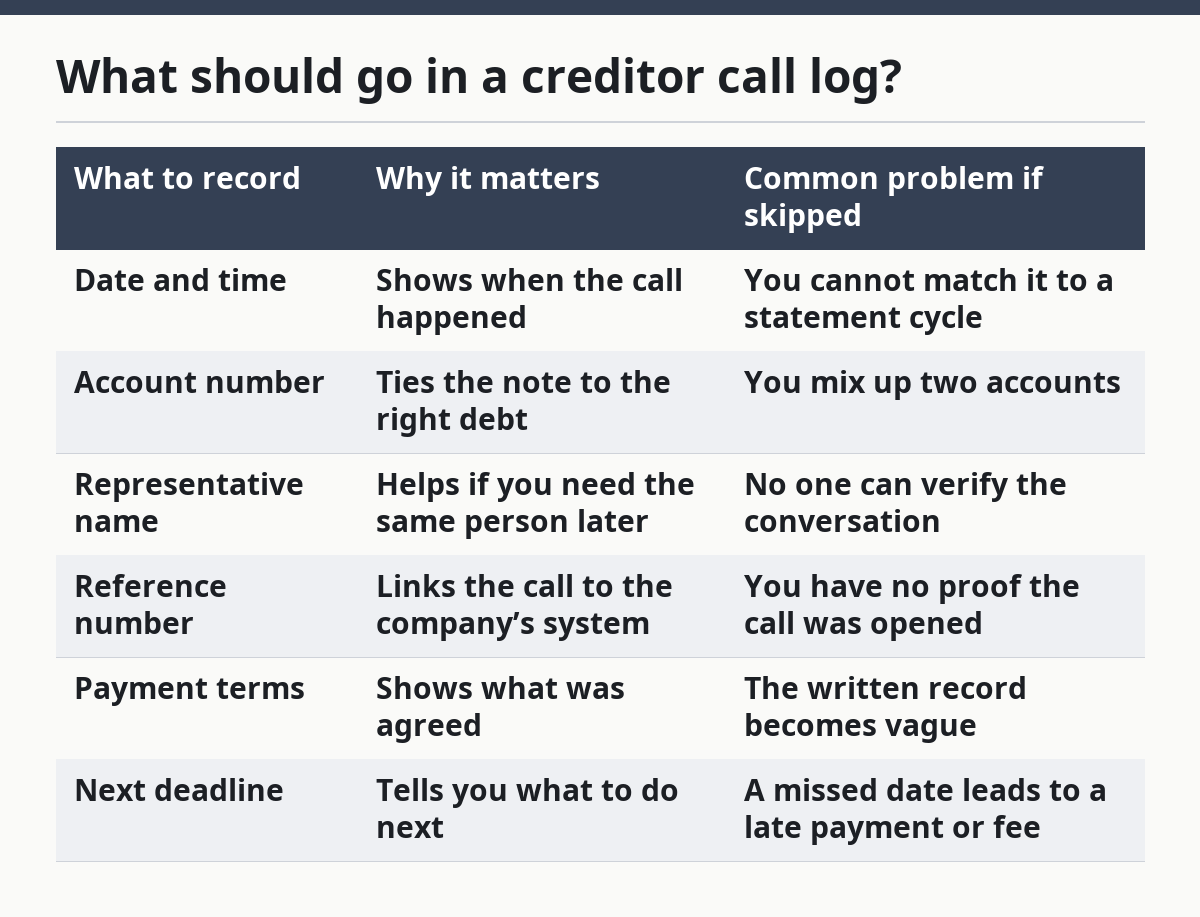
Here is the comparison that matters:
| What to record | Why it matters | Common problem if skipped |
|---|---|---|
| Date and time | Shows when the call happened | You cannot match it to a statement cycle |
| Account number | Ties the note to the right debt | You mix up two accounts |
| Representative name | Helps if you need the same person later | No one can verify the conversation |
| Reference number | Links the call to the company’s system | You have no proof the call was opened |
| Payment terms | Shows what was agreed | The written record becomes vague |
| Next deadline | Tells you what to do next | A missed date leads to a late payment or fee |
If the creditor sends a letter or email after the call, attach it to the same file. That written follow-up is often the best match for your notes, and it can catch mistakes before they grow into a payment problem.
What mistakes ruin the record?
The biggest mistake is waiting until later to write the details down. Even a 10-minute delay can blur the exact dollar amount, due date, or reference number, and those are the pieces most likely to matter if the account changes later. Write the note before you check another app or take another call.
A second mistake is using vague words like “they said it was fine.” That phrase does not show what “it” was, what “fine” meant, or whether the call changed anything. Write the actual term: “payment date moved to the 15th,” “no fee discussed,” or “rep asked for a payment by card today.”
A third mistake is mixing the log with your own guesses. If you think the creditor meant one thing but the rep said another, separate the two with clear labels. For example, write “rep said” and “my understanding” on different lines so the file stays honest.
A fourth mistake is failing to save the follow-up email or letter. The call log by itself may be useful, but the written reply often carries more weight because it shows the creditor had a chance to correct the record. If you received an email with the wrong account number, note that mismatch instead of ignoring it.
A fifth mistake is storing the record in 3 places and forgetting which version is current. Keep one master folder and one backup if you want, but do not create five versions with slightly different notes. A clean record is better than a crowded one.
When does this method stop being enough?
This method stops being enough when the call turns into a dispute, a threat, or a legally sensitive issue. In those cases, a simple log is still useful, but it is no longer the whole answer. The record may need to be reviewed by a qualified professional before you rely on it.
The representative refuses to give a name or reference number: that makes the record weaker — end the call politely, note the refusal, and try again through a channel that gives you written proof.
The creditor changes the payment terms during the call: the new terms matter more than your memory — write them down immediately and ask for written confirmation before you assume they took effect.
You hear a fee, penalty, or deadline you did not expect: the account may be at risk of extra cost — record the detail exactly and check the written statement before making the next payment.
The call involves more than one account or another person’s debt: details can get mixed fast — separate each account into its own log entry and do not combine balances in one note.
You are told the account is being transferred, sold, or reviewed by another department: your next contact may be a different company or team — write the transfer detail and the new contact number, then keep both records.
You are unsure whether the caller is really the creditor: a mistaken call can waste time and expose private information — hang up, use the number on your statement, and start over from a trusted source.
If the issue is bigger than record keeping, this page supports the broader debt payoff communication and hardship hub, but it does not replace direct help for a legal or court-linked problem.
What does a good follow-up look like?
A good follow-up confirms the call in writing within the same day, or as soon as possible, and repeats the exact terms without extra commentary. Keep it short: the account number, the date of the call, the name of the representative if you have it, the payment terms, and the request for confirmation. Long emails create room for errors.
A strong follow-up also uses the same language as the call log. If the rep said “payment due on the 20th,” do not rewrite that as “payment sometime this month.” If the creditor’s reply changes the details, save that reply and update your log with a new line rather than overwriting the old one. That gives you a 2-step history instead of one blurred note.
If you do not get a reply, keep the email anyway. Silence is part of the record, and it can matter later if you need to show that you tried to confirm the conversation. That is not a guarantee of anything; it is simply better documentation than memory.
For many readers, the safest rule is simple: phone call first, written confirmation second, payment third. When the order changes, the chance of confusion rises.
What should I write down after a creditor call?
Write down the date, time, the representative’s name, the account number, and the reference number if you get one. Then add the exact payment terms, any deadline, and what the creditor said would happen next. If you can, note whether you were told to expect a letter or email.
Do I need proof of a payment arrangement?
Yes, if the call changed anything that affects timing, amount, or fees, written proof is the stronger record. A call log helps, but a follow-up email or letter gives you something to match against later statements. If the creditor will not confirm in writing, keep extra notes and be careful about relying on the call alone.
How do I follow up after a phone call with a creditor?
Send a short email the same day that repeats the date of the call, the account number, the representative’s name if known, and the agreed payment details. Ask for written confirmation and keep a copy of the email, the reply, and your call log in one folder. If the company only uses phone support, note that too.
Drafted with AI; not yet reviewed by a person.