Last updated: November 20, 2026
Ask for a one-time payment extension before the due date, keep the request short, and be ready to say exactly when you can pay. This applies if you have one bill due soon and need a single due-date change, not a long-term payment rewrite. If your debt is already in collections, tied to a court order, or part of a bigger hardship case, get qualified help for your own situation; this is information, not financial advice.
Key takeaways
- A one-time extension is a short delay in the due date, not a reset of the debt.
- The best request is simple: say which payment is due, ask for the new date, and give one reason.
- Make the ask before the due date whenever possible so late fees or late marks are less likely.
- Get the creditor’s answer in writing, even if the first contact is by phone.
- A payment extension is not the same as a hardship plan, because it should apply to one payment only.
Who should use a one-time extension?

A one-time extension fits someone who can pay, just not on the current due date, and who expects to catch up on the new date. It is most useful for a single missed paycheck, an unexpected bill, or a short timing gap of a few days or a week. The key point is that the debt itself is still manageable; only the timing is the problem.
This approach is not a fit for every debt. If you already missed several payments, if the amount due is larger than you can cover on the new date, or if the creditor has already sent the account to collections, a simple extension may not solve the issue. In those cases, the better next step may be a different kind of payment change, and a qualified adviser should review the account terms, because country rules and lender policies differ.
A one-time extension also works differently depending on the creditor. A credit card issuer, personal loan lender, utility company, and medical office can all use different internal rules. Some will note the extension on your account, some will refuse, and some will offer late protection only if you ask before the due date. That is why the first job is to ask clearly, then confirm the result in writing.
How do you ask for a one-time payment extension?
You ask by giving the creditor the account, the due date, the reason, and the new payment date in one short request. The goal is to make the customer service agent or collections representative understand the request in under 2 minutes and see that you have a plan to pay.
-
Find the account statement, due date, and customer service number before you call. Check the exact payment date on the bill or online account, because “soon” is not enough for a payment extension request. Verify the balance, minimum payment, and any late-fee language; if you cannot find the due date, the request may be delayed or logged wrong.
-
Choose the new payment date you can actually meet. Pick one date, not a range, and make sure it is realistic based on your next paycheck or deposit. If the date still leaves you short, the request is likely to fail because the creditor will hear uncertainty instead of a firm plan.
-
Contact customer service before the due date by phone, secure message, or online chat if the account offers it. Ask for a one-time extension on the debt payment and say you are not asking for a permanent change. If the creditor only accepts phone calls, write down the time, the name of the person, and the reference number if you get one.
-
State the reason in one sentence without oversharing. “I need a one-time extension because my payment timing changed this month” is enough in many cases. If you give a long story, the request can drift into a broader hardship discussion that is not the point of this page.
-
Ask the creditor to confirm late protection and fee treatment before you agree to anything. Late protection means the creditor agrees not to treat the payment as late for that one due date, if their policy allows it. If the person cannot answer, ask for the account to be escalated or for a written policy note.
-
Verify the new due date, amount due, and any fee or interest impact in writing. Some extensions change only the timing, while others still let interest continue to accrue. If the representative cannot give you written confirmation, the problem is not solved yet, because phone-only promises are easy to misunderstand later.
-
Set a reminder for the new date and keep the money separate. A calendar alert for 3 to 5 days before the extension date gives you time to check the account again and avoid another miss. If you expect the money to be tight on the new date too, the request has become too risky and needs a different plan.
What should I say to request a payment extension?

You should say it plainly and ask for one thing: a one-time extension on the due date. A short script keeps the call focused and makes the request easier for customer service to process.
Here is a simple version you can adapt:
“I’m calling about account [number]. My payment due date is [date], and I need a one-time extension until [new date]. Can you tell me whether that can be approved and whether it will affect late fees or late reporting?”
That script works because it names the account, the current due date, the new date, and the exact policy questions. If the creditor asks for more detail, keep the answer short and factual. If the representative starts steering you toward a broader payment plan, say you are only asking about one payment right now.
A strong request also includes a backup question: “If you cannot approve that date, what is the nearest date you can offer?” That gives you a chance to compare options without guessing. If the only answer is “pay what you can,” that is not a one-time extension, and you should not treat it like one.
What should I check before I agree to anything?
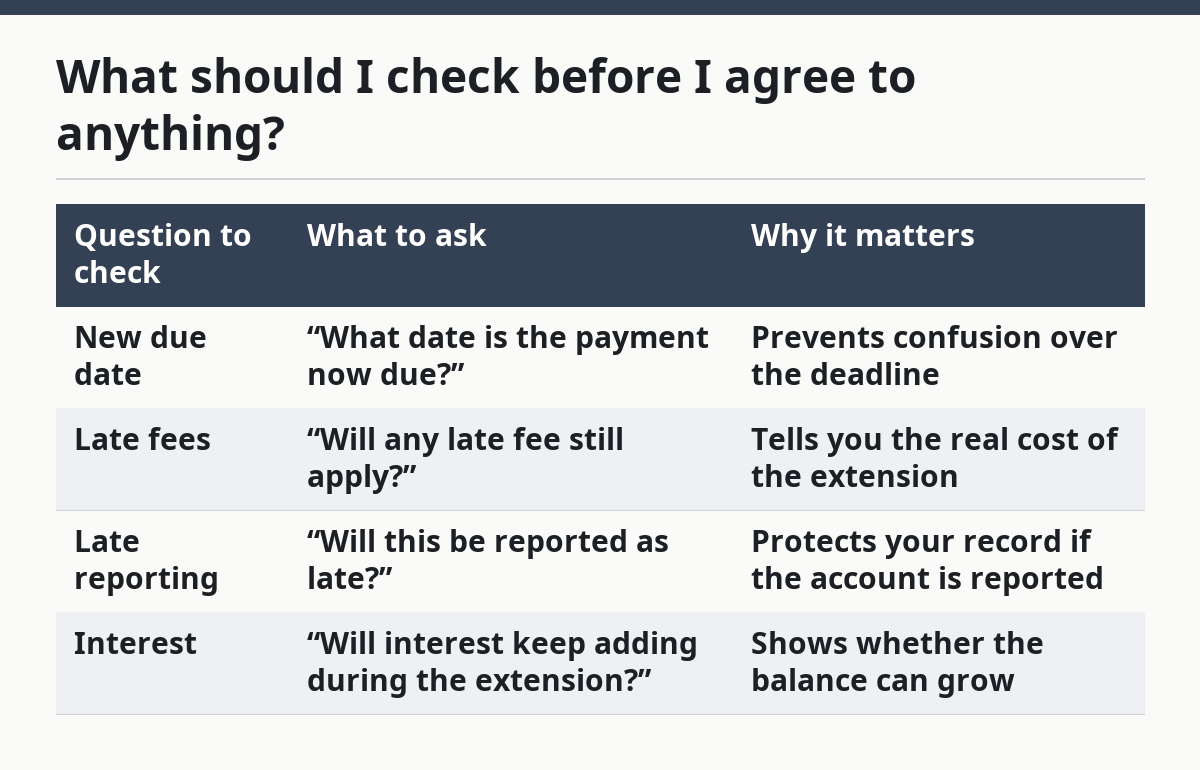
You should check the due date, the fee rules, the late reporting rules, and the exact new payment date before you accept the extension. Those four items decide whether the request actually helps or only shifts the problem.
Some creditors will agree to move the due date by a few days and pause a late fee. Others may still charge interest, and some may treat the account as current only if the payment arrives by a specific cutoff time, such as end of business or a midnight online deadline. The details matter more than the label “extension.”
| Question to check | What to ask | Why it matters |
|---|---|---|
| New due date | “What date is the payment now due?” | Prevents confusion over the deadline |
| Late fees | “Will any late fee still apply?” | Tells you the real cost of the extension |
| Late reporting | “Will this be reported as late?” | Protects your record if the account is reported |
| Interest | “Will interest keep adding during the extension?” | Shows whether the balance can grow |
If the answer to any of these is unclear, stop and ask again before you agree. A vague yes can hide a fee or a reporting issue. For a debt payoff snowball plan, this kind of clarity matters because one surprise fee can throw off the whole month.
When should you stop and get help instead?
You should stop and get qualified help when the request is no longer just a one-time timing fix. A one-time extension is a narrow tool, and it stops fitting in several common situations.
The payment is already past due by more than one cycle: That usually means the account may already have late fees, collections pressure, or a reporting issue — ask for account-specific help, not just a one-time extension.
The creditor has sent the debt to collections: The original customer service process may no longer control the account — contact the collector using the rules that apply to collections accounts and get qualified guidance if needed.
You cannot pay by the new date either: The extension would only delay the same miss — ask about a different payment arrangement or get qualified advice for your budget.
The debt is tied to a court order or judgment: Legal deadlines may control the account — get legal help rather than relying on a phone promise.
The account is a mortgage, tax debt, or another regulated debt with special rules: The normal extension request may not apply — use the process for that debt type and seek qualified advice.
The creditor offers a new plan with extra fees or a longer term: That is no longer a simple extension — ask for the full terms in writing before deciding.
The simple rule is this: if the request changes the structure of the debt, or if the account is already in a formal recovery stage, a one-time extension may not be the right tool. The Federal Trade Commission’s debt guidance and the Consumer Financial Protection Bureau’s debt-collection resources are useful starting points: FTC debt guidance and CFPB debt collection.
What mistakes cost people the most?
The most expensive mistakes are asking too late, being vague, and failing to get written confirmation. Those errors can lead to late fees, a missed payment mark, or a second call that takes 20 minutes because the first promise was never recorded correctly.
A common mistake is waiting until after the due date. That weakens the request because the creditor may already have processed the late payment. The better move is to call as soon as you know the date will not work.
Another mistake is asking for “help” without naming the exact extension date. That pushes the conversation toward a generic hardship review instead of a one-time fix. Say the date you need, even if it is only a few days away.
A third mistake is assuming the phone call is enough. If the creditor agrees verbally but no note appears on the account, the next agent may not honor it. Ask for a written message, a secure portal note, or an email confirmation if the creditor uses those channels.
A fourth mistake is treating the extension like free time. If the bill still needs to be paid on the new date, the money has to sit untouched until then. Without that discipline, the extension just creates a second missed payment.
A fifth mistake is mixing this request with a partial payment offer when the question is only about a single delay. That can change the way the account is handled. If the issue is only timing, keep the request narrow and specific.
How does a one-time extension differ from a hardship plan?
A one-time extension changes one due date, while a hardship plan changes the payment arrangement for more than one bill cycle. The difference sounds small, but it matters because the creditor may review them under different rules and record them differently on the account.
A one-time extension is best when the problem is brief and specific. A hardship plan is more likely when the same payment problem will continue for several months, or when several accounts need changes at once. If you only need a few extra days, asking for a larger plan can make the process slower than it needs to be.
A one-time extension can also be easier to explain and quicker to approve, sometimes in a single customer service call. A hardship plan may require documents, a longer review, or a formal agreement. If the creditor asks you to move from one to the other, read the terms carefully before saying yes.
Can I get a one-time extension on a debt payment?
Yes, sometimes you can, if the creditor allows it and your account is still in a stage where customer service can change the due date. The answer depends on the creditor’s policy, the type of debt, and whether you ask before the payment is already late.
The strongest request is simple: identify the account, name the due date, say you need a one-time extension, and give the new date you can pay. If the creditor agrees, get the late-fee and late-reporting terms in writing so you know what the extension actually does. If the creditor refuses or the debt is already in a formal stage, a different approach may be needed.
What should I say to request a payment extension?
Say the account number, the current due date, the new date you need, and ask whether late fees or late reporting will apply. A short script keeps the call focused and gives customer service the details needed to check the account. If the representative cannot approve it, ask for the nearest date they can offer.
Is a payment extension the same as a hardship plan?
No, a payment extension is usually a one-time due-date change, while a hardship plan changes the payment arrangement for a longer period. The two can lead to different fees, reporting, and paperwork. If you only need a short delay, ask for the extension first; if the problem will continue, a hardship review may be the better fit.
Drafted with AI; not yet reviewed by a person.