Last updated: November 20, 2026
Quick answer: if your average monthly extra payment is $150, you can estimate a debt payoff timeline by adding that amount to your required payment in a debt payoff calculator, then checking a lower and higher version of $150 to see the range. If you are making a legal, rental, or other high-stakes decision, consult a qualified financial professional and use a calculator such as the CFPB debt payoff calculator as a planning tool, not a guarantee.
Who this method fits
This method fits a person who has a debt payoff calculator, a monthly budget, and one number that sounds like “about $150 extra each month,” even if the exact amount changes. It works best when the debt has a normal monthly required payment and you want a practical estimate, not a perfect forecast.
It is not the right tool if your extra payment comes only from irregular income, windfalls, or a bonus that arrives once or twice a year. Those cases need a different model, because an average can hide long gaps with no extra payment at all.
This page sits under the debt payoff calculators and modeling hub and its job is narrower: estimate a timeline from a monthly average.
The key term here is average monthly extra payment. That means the amount you expect to send above the required payment over a typical month, smoothed across your budget. If you paid $0 one month and $300 the next, the average is $150 for those 2 months.
Key takeaways

- Use the average as a planning number, not as a promise.
- Check the timeline with 3 versions of the average: lower, middle, and higher.
- The more often the extra payment really happens, the more useful the estimate.
- A budget that cannot support the average in most months needs a different assumption.
- If the extra payment comes from irregular income, this page is the wrong match.
How do I estimate the timeline?
Therefore, you estimate the timeline by putting your average extra payment into a debt payoff calculator, then comparing the result with a lower and higher estimate so you can see the range. Start with the steady monthly amount you think you can keep inside your budget, because that is the number the calculator can actually use.
- List the debt balance, required monthly payment, and interest rate, then verify all 3 numbers match the latest statement; if the balance is stale by even 1 billing cycle, the payoff date will drift.
- Measure your average monthly extra payment over at least 3 months of spending, then verify it reflects real cash flow; if it depends on a one-time refund or bonus, the average is too shaky for this method.
- Enter the required payment plus the average extra payment into a debt payoff calculator, then verify the calculator treats the extra as a monthly amount; if it only accepts a one-time extra, the result will not fit this question. For a consumer-friendly tool, see the CFPB debt payoff calculator, and if the result affects a major decision, consult a qualified financial professional.
- Run the calculator with the average amount, then verify the payoff month lands inside a range you can explain to yourself; if the date feels unrealistically fast, your average may be too high.
- Repeat the calculator with a lower extra payment, such as a conservative version of the average, then verify how many months the payoff stretches; if the date jumps far out, your budget has little room for error.
- Repeat the calculator with a higher extra payment, then verify how much the payoff shortens; if the shorter timeline depends on months you cannot support, do not use it as the main estimate.
- Compare the 3 results against your monthly budget, then verify the middle case still leaves room for essentials; if the extra payment forces skipped bills, the average is not budget-safe. For budgeting help, review the Consumer.gov budget basics.
- Record the middle timeline and the range, then verify the plan still works if one month has no extra payment; if one missed month breaks the plan, your estimate is too fragile.
The most useful estimate is the one you can repeat in a 1-minute check, not the one that looks neat in a calculator. A single middle number is fine for planning, but the range tells the truth about uncertainty.
Why does an average work at all?

An average works because a debt payoff timeline depends on the total amount you send over time, not on the emotional feel of each individual month. If the debt balance, required payment, and interest rate stay the same, a steady monthly extra payment gives the calculator a usable pattern.
The catch is that an average hides swings. A person who pays $0 for 2 months and then $300 in month 3 may technically average $100 per month, but the debt does not behave like a true $100 every month plan. That is why the estimate should be treated as a smoothing tool, not as a guarantee; if the numbers will guide a major decision, consult a financial professional and check the result against the CFPB calculator.
Here is a simple comparison of what changes:
| Input style | What the calculator sees | What the estimate is good for | Main drawback |
|---|---|---|---|
| Steady extra payment | Same extra amount every month | A clean timeline estimate | Can feel too exact |
| Average monthly extra payment | Smoothed monthly amount | Quick planning when the extra changes a little | Can miss skipped months |
| Irregular extra payment | Uneven payments with gaps | Not a good fit for this page | Produces a misleading date |
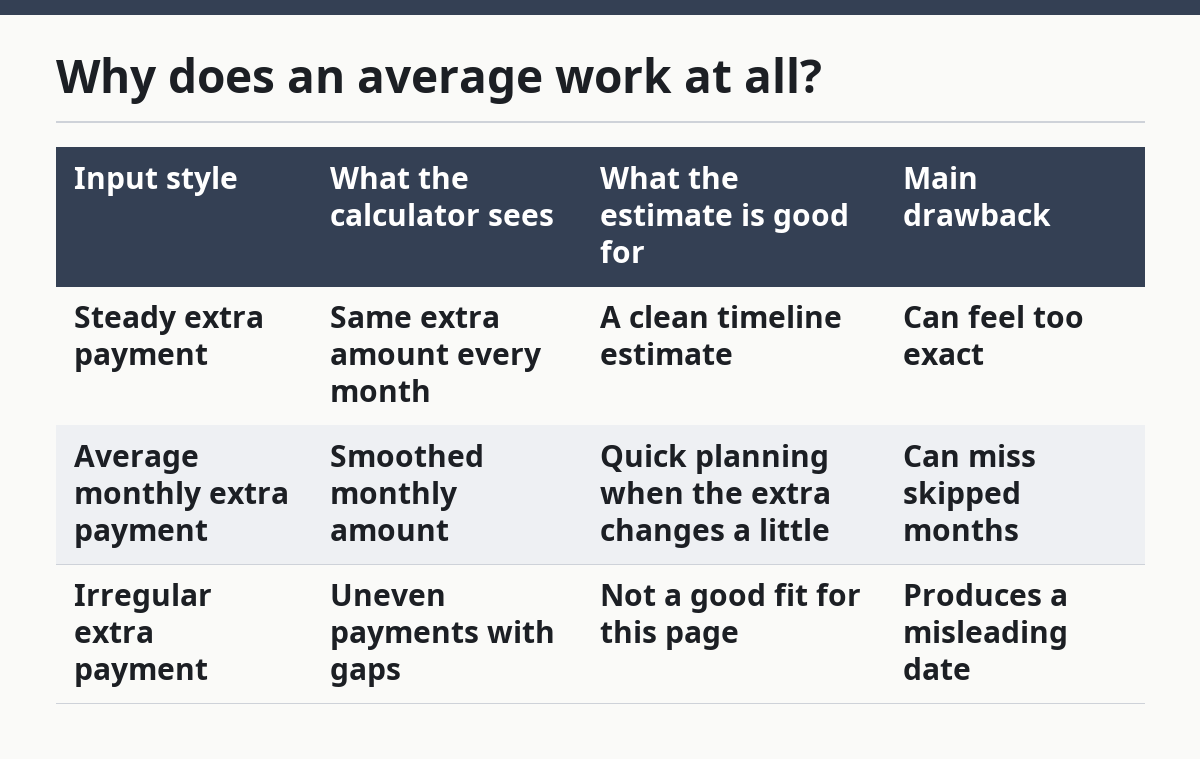
The middle row is the one this article is about. It is useful when the variation is small enough that a monthly average still resembles real life.
What should I check in my monthly budget?
Therefore, you should check whether the average extra payment fits after essentials, not before them. A number that looks comfortable on paper can still fail if it depends on groceries, gas, or rent money that already has another job.
Start with the amount you can move every month without breaking your budget for 2 or 3 months in a row. Then ask a blunt question: if one month is tight, can the extra payment drop without knocking out the entire plan? If the answer is no, the average is too aggressive.
The practical test is simple. If the extra payment would need you to guess, borrow, or reshuffle bills every month, your estimate is built on wishful thinking. If it comes from a line item you already track in the budget, such as a fixed savings reduction or a recurring spending cut, the number is much more dependable.
What mistakes change the result most?
The biggest mistakes are usually not math errors; they are assumption errors. A debt payoff calculator can only estimate what you put into it, so a bad average or a bad budget assumption can move the payoff date by months.
-
Using a one-time windfall as a monthly average. The consequence is a payoff date that looks much sooner than reality. The correct alternative is to treat that money separately instead of blending it into the average, and if you are unsure how to classify it, consult a financial professional or use the CFPB debt payoff calculator as a check.
-
Averaging over too short a period. The consequence is that one odd month can distort the plan. The correct alternative is to use enough months that the number reflects normal spending, not a single lucky stretch.
-
Ignoring months with no extra payment. The consequence is that the estimate assumes a steady rhythm you do not actually have. The correct alternative is to check a lower-case version of the average and see whether the plan still holds.
-
Putting the extra payment above what the budget can support. The consequence is missed payments or stress that breaks the plan. The correct alternative is to use the amount that still leaves room for essentials, and review your budget with Consumer.gov if the number keeps changing.
-
Treating the estimate as exact. The consequence is frustration when the date shifts. The correct alternative is to keep a range and update the calculator when the average changes; if the estimate will support a major decision, consult a qualified financial professional.
-
Mixing up required payment and extra payment. The consequence is double-counting or undercounting the real monthly total. The correct alternative is to enter the required payment first, then add the extra payment as a separate line.
When should I stop using this approach?
You should stop using this approach when the average no longer reflects how the money actually arrives. These situations usually need a different model, because the estimate becomes too loose to trust.
Your extra payment comes from a bonus, refund, or gift: that is not a monthly pattern — model it separately on a different page, because a monthly average will hide the gap between windfalls.
Your income changes sharply from month to month: the average may look neat but still miss real cash flow — use an irregular-income estimate instead, because the gap months matter more than the average. See also the irregular income budgeting guide.
You cannot cover the average inside a normal monthly budget: the plan is not budget-safe — lower the assumption until the number fits a real spending plan.
The debt has several balances with different rates and minimums: one average extra payment may not show the right order of payoff — use a model that tracks each balance on its own, such as a debt snowball calculator or debt avalanche calculator.
You need a date you can commit to for a legal, rental, or loan decision: a smoothing estimate is too loose — get qualified help and use an estimate built from the exact payment structure.
How accurate is a range estimate?
Because the middle estimate is only useful when you know how much wiggle room it has, a range estimate is more useful than a single date. It shows what happens if your average is a little high or a little low.
A good range has a middle case, a cautious case, and a hopeful case. If the gap between them is small, your average monthly extra payment is stable enough to plan around. If the gap is wide, your budget assumption is too soft and the debt payoff calculator is warning you that the answer depends on behavior you have not locked in yet.
The right standard here is not “exact to the month.” The right standard is “close enough to guide a budget decision without pretending the future is fixed.” For most people using a monthly average, that is the honest target.
What if my average changes later?
Therefore, if your average changes later, you should rerun the debt payoff calculator with the new number and treat the old estimate as outdated. A 10% shift in the extra payment can change the timeline enough to matter, especially on a smaller debt balance.
The cleanest habit is to review the average whenever your monthly budget changes, not only when you feel behind. That keeps the payoff timeline tied to real cash flow instead of stale assumptions. If the new average is lower, the debt will take longer; if it is higher, the payoff may move up.
Can I use a monthly average if my extra payment varies?
Yes, you can use a monthly average if the variation is small and the budget can support the number most months. The average monthly extra payment is a planning shortcut, not a perfect model, so the estimate should be treated as a range.
If the variation is large, the shortcut stops helping because the monthly average no longer matches how the money actually arrives. In that case, the calculator should be fed a different pattern, because a single average hides the months that actually decide whether the debt gets paid down on schedule.
Can I use an average extra payment amount?
Yes, if the amount comes from real monthly cash flow and not from a one-time event. The average extra payment amount is a useful input when it reflects what the budget can sustain over several months, not a single unusually good month. If the number only works on paper, it will not hold up in practice.
How accurate is a payoff estimate based on averages?
It is only as accurate as the average itself. A payoff estimate based on averages is usually decent for planning, but it can drift when the extra payment changes or disappears for a few months. A range around the average is more honest than a single exact date.
What if my extra payment varies each month?
Use the average only if the changes are modest and recurring. If the extra payment varies a lot, the timeline will be less reliable, and a month-by-month model is a better fit. The more uneven the payments, the less the average should be trusted as the main estimate.
Drafted with AI; not yet reviewed by a person.