Last updated: November 18, 2026
Key Takeaways
- Small cash buffers stop the next surprise from triggering new borrowing.
- Costly debt gets priority once you already have enough emergency cash.
- No savings and one surprise expense away from borrowing? Build a starter fund first.
- After a usable buffer exists, extra cash can go to debt reduction.
If you are deciding between paying off debt and building an emergency fund first, the usual answer is to build a small emergency fund first, then attack the debt faster. This guide to How to Decide Between Paying Off Debt and Building an Emergency Fund First is about avoiding the next expensive borrowing event, not about choosing savings over responsibility.
I’m writing this as personal finance information, not financial advice; a qualified adviser can help with your own situation, especially if you have uneven income, tax issues, or multiple debts with different rates and rules.
A reader stuck on how to decide between paying off debt and building an emergency fund first usually needs one clear rule: keep enough cash in a savings account to cover a real unexpected expense, then use everything above that for debt payments. That is the core of the cash reserve decision, and it matters because liquidity can stop a small shock from becoming a new loan, overdraft, or missed minimum payment.
Because the choice is so situation-specific, I use one basic question each time: which option leaves you more stable over the next 3 to 12 months? That answer depends on risk tolerance, job stability, debt cost, and whether your current budget can absorb a surprise without borrowing.
The real trade-off: lower debt balance or more cash on hand?

The cash reserve wins when the next surprise would force new borrowing. Debt payoff wins when your emergency fund is already large enough to handle a basic shock and the debt carries a cost that keeps compounding.
This is not a philosophical question. It is a liquidity question. Debt reduction improves your balance sheet, but cash in a savings account buys time. If the car needs a repair, the fridge dies, or a medical bill lands before payday, the cash reserve is what prevents a fresh balance from showing up on a credit card or personal loan.
The trap in generic advice is pretending there is one universal order. There isn’t. Rates, minimum payment terms, and deposit rules differ by country and lender, and those details matter. A household with unstable hours and one with a salaried paycheck do not need the same sequence.
For example, a minimum emergency fund is a starter buffer, not a full year of expenses. The point is to create enough liquidity to handle a true surprise without restarting the debt cycle.
For a reader deciding today, the key is simple: if your savings are zero and a small expense would push you back to borrowing, the emergency fund comes first in a limited form. If you already have a usable buffer and your debt balance is expensive, the debt gets the surplus cash.
How to choose based on your debt and your risk tolerance
Debt payoff wins here if the balance is costly and your income is predictable. A stable paycheck, a fixed housing payment, and a history of covering routine bills without strain all point toward more aggressive debt reduction after a starter buffer is in place.
That is because every dollar sent to debt lowers future interest charges, and high-cost debt gets expensive fast. You do not need a calculator to understand the pressure of a revolving balance that never seems to shrink. The weakness of putting every spare dollar at debt is obvious, though: one flat tire, one medical copay, or one delayed paycheck can send you right back to borrowing if the cash reserve is too thin.
The emergency fund wins here if your income swings from month to month, your job feels fragile, or your expenses have lots of moving parts. A freelancer, commission worker, seasonal employee, or parent juggling irregular childcare costs has more reason to protect liquidity than to chase the last bit of debt reduction speed.
Risk tolerance matters, but not as a personality quiz. It matters because some people can absorb a surprise without taking on new debt, while others cannot. If a 500-unit expense would force a credit card swipe, then you do not have enough margin yet, no matter how motivated you are to pay down balances.
A practical rule is this: keep a starter emergency fund first, even if the amount is modest by local standards, and only then push harder on debt. That rule is especially strong if your debt is unsecured and expensive, because the alternative is often a cycle of minimum payments plus new borrowing after every setback; a qualified adviser can help if your debts are mixed or unusually complex.
The downside of choosing cash first is slow progress on balances. The downside of choosing debt first is fragility. The right choice is the one that stops the next crisis from widening the hole.
The honest side-by-side

Here is the comparison that actually changes the decision.
| Criteria | Emergency fund first | Debt first | Winner for this condition |
|---|---|---|---|
| Ability to avoid new borrowing after a surprise | Stronger liquidity from day one | Weak if savings are near zero | Emergency fund first if cash is the thin spot |
| Speed of reducing total debt balance | Slower while cash builds | Faster once extra payments start | Debt first if cash is already adequate |
| Protection against missed minimum payment | Better, because cash can cover a gap | Worse if income stalls | Emergency fund first with unstable income |
| Interest cost over time | Usually higher if balances linger | Usually lower if balances fall faster | Debt first for costly balances |
| Stress level when bills arrive | Lower if the buffer is real | Higher if every setback feels dangerous | Emergency fund first for anxious budgets |
| Flexibility for irregular expenses | Better liquidity | Less room to react | Emergency fund first for variable expenses |
| Risk of restarting debt cycle | Lower | Higher if a shock hits | Emergency fund first when debt repayment is fragile |
| Confidence that the plan survives a bad month | Higher | Depends on perfect execution | Emergency fund first for fragile finances |
| Sense of momentum | Slower, because cash is not “visible progress” | Faster, because balances shrink | Debt first for disciplined, stable households |
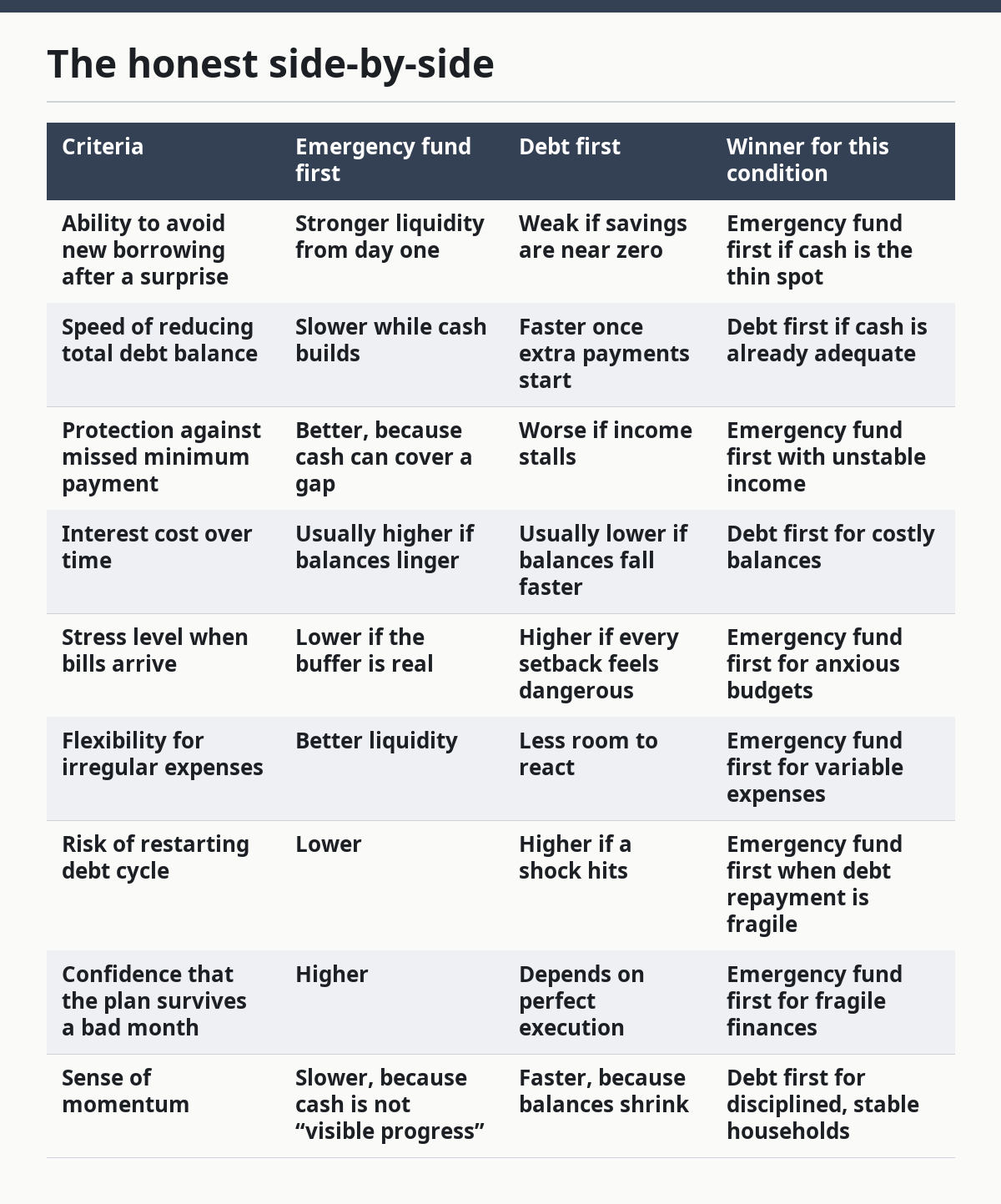
The table makes one thing plain: emergency funds are a stability tool, while debt payments are a cost-reduction tool. The winner depends on which problem is more dangerous right now.
When an emergency fund should come first
An emergency fund wins when you are one unexpected expense away from new borrowing. That is the clearest case, and it is the one most generic advice misses.
Start with a starter buffer if any of these are true: your savings account is empty, your paycheck timing is uneven, your car or housing situation is likely to throw surprises, or your minimum payment would become hard to cover after a single bad month. In those cases, liquidity is not a luxury. It is the thing keeping the rest of the plan alive.
This is also the better move if you have only one income in the household and no backup. A household with no spare cash and only one pay source has less room to absorb timing problems. The emergency fund is not there to maximize returns or to feel tidy. It exists so an ordinary disruption does not become a new debt.
The weakness is obvious: debt balances stay around longer, and if the debt is expensive, that can cost more over time. That trade-off is real. But a plan that breaks at the first tire blowout is not a strong plan.
A qualified adviser can help if your debt is mixed with tax debt, secured debt, or arrears, because those categories can change the order of priority. I’m not giving legal or tax advice here; the label on the debt matters. The CFPB explains that debt prioritization depends on the type of debt and the payment consequences.
When paying off debt faster makes more sense
Debt payoff wins after you already have a usable cash reserve and your monthly budget can handle a shock without borrowing. In that case, extra debt payments usually improve financial stability more than more idle cash sitting in the account.
The strongest version of this case is simple: you have a starter emergency fund, steady income, and debt that is clearly costing you money month after month. If the balance is on a credit card, personal loan, or other high-cost account, every extra payment reduces the amount left to charge interest on. That is the point where debt reduction begins to do more work than extra saving.
This approach is weaker if your emergency fund is only theoretical. A tiny balance that gets spent on routine costs is not much protection. It is also weaker if your job is unstable, because a faster payoff plan cannot help if the next slow month forces you back into borrowing.
The other limit is behavioral. Some people do better when they can see balances fall. Others do better when they know a cash cushion exists. The right answer is not “what feels nicer”; it is “what keeps the household functional.”
If you want a clean rule, use this one: once the minimum emergency fund is in place, redirect the next available dollars to debt until the balance is meaningfully lower. The cash reserve should not be so large that it becomes an excuse to postpone repayment indefinitely.
According to the Federal Reserve, even a modest expense can strain a budget, and the CFPB notes that an emergency buffer helps households avoid new debt when surprises hit.
The verdict: which one to choose and why
Choose the emergency fund first if you have little or no savings, irregular income, or a real chance that one unexpected expense would force new borrowing. Choose debt first if you already have a starter cash reserve and your income and bills are stable enough to absorb a short-term shock. Neither if the debt is tangled with legal, tax, or secured-account issues that change the order of priority; get qualified advice before you move money around.
That is the plain answer. The decision is not “save versus be responsible.” It is “which move makes the next setback less dangerous?”
For readers who want the bigger framework, this decision sits inside the debt payoff prioritization approach, where cash flow, liquidity, and debt cost all have to be considered together rather than as separate goals. See also emergency fund basics and debt snowball vs. avalanche for related ways to think about the sequence.
What would make me change the recommendation?
I would flip the answer if three things changed: your income became unstable, your savings disappeared after a necessary expense, or your debt became more urgent than a normal monthly payment plan can handle. Those are not theoretical exceptions; they are the situations that break tidy rules.
First, if income is irregular, the emergency fund deserves priority because timing risk becomes part of the problem. A late invoice or reduced shift count can turn a manageable balance into a missed minimum payment.
Second, if your savings account is being used for ordinary monthly spending, you do not yet have an emergency fund in the useful sense. A real cash reserve needs to stay separate from routine bills.
Third, if the debt has special consequences for missing payments, the category matters. Secured debts, tax-related debts, and overdue accounts can carry consequences that change the order of urgency. That is where a local professional can help sort the sequence, and the IRS and other official agencies note that tax debt and secured obligations can have different collection consequences.
The change point is not abstract. It is the moment when debt reduction stops being the safest use of extra cash and starts being the riskier one.
A simple way to decide this month
The emergency fund comes first if you cannot answer “yes” to both of these questions: can I cover a basic unexpected expense without borrowing, and can I still make every minimum payment if the month goes sideways?
If both answers are yes, debt payoff gets the extra money. If either answer is no, the cash reserve should be built or repaired first.
That decision rule works because it focuses on financial stability rather than perfection. It does not pretend that debt and savings are equal priorities. They are not. One protects you from chaos; the other lowers the cost of carrying the balance. The right choice is the one that leaves you less exposed next month, not the one that looks best on paper.
How much emergency fund should I have while paying debt?
A starter emergency fund is the usual answer while debt is still active. The exact amount depends on country, rent, family size, and income stability, so there is no universal number. The goal is enough liquidity to handle a true unexpected expense without taking on new borrowing or missing a minimum payment. A qualified adviser can help tailor the amount.
Is it okay to save while in debt?
Yes, saving while in debt is often the safer choice if you have little cash and no backup. The problem is not saving itself; it is saving so much that you stay exposed to the next shock. A modest cash reserve can prevent more debt from piling up, while extra money beyond that can usually go toward faster repayment.
Drafted with AI; not yet reviewed by a person.