
Last updated: November 18, 2026
Key Takeaways
- Turn the debt goal into 12 steps by tracking a starting balance, monthly action, and progress marker.
- Each checkpoint should record the balance, the payment made, and whether the target was met.
- Build the 12-month timeline from your debt goal and monthly cash flow together.
- Milestones fail when numbers are vague, timing slips, or the extra payment is treated as a guess.
A big debt goal becomes manageable when it turns into 12 monthly milestones, because each month gets a clear target, a visible checkpoint, and a specific extra payment to aim for. This article explains how to break a big debt goal into 12 monthly milestones, and it is information, not financial advice; a qualified adviser or debt professional should be consulted for your own situation, especially if your income changes, your interest rates are variable, or your debt mix includes tax, legal, or secured obligations. For general consumer debt guidance, see the Consumer Financial Protection Bureau’s debt collection resources and budgeting tools: https://www.consumerfinance.gov/consumer-tools/debt-collection/ and https://www.consumerfinance.gov/consumer-tools/budgeting/.
Who this method is for — and what it assumes

This method is for someone who has one large debt goal and wants a year-long timeline that feels concrete instead of vague. It assumes you already know your total debt balance, the minimum payments on each debt, and roughly how much extra payment you can spare each month without missing essentials such as rent, utilities, food, transport, and insurance. If you do not have those numbers yet, the 12-month plan will wobble from the start.
It also assumes you are not trying to solve every debt problem at once. A monthly milestone works best when the target is measurable and fixed for the year, even if the exact payoff date is still uncertain. That is why this approach is useful for a large credit card balance, a personal loan, or a mixed debt payoff goal where you need progress markers more than motivation speeches.
Some situations need qualified help before you build a plan on your own. If you are already behind on secured debt, facing collections or court action, juggling multiple overdue accounts, or unsure how your debt interacts with bankruptcy, taxes, or divorce, the timeline should be checked by a qualified debt adviser, attorney, accountant, or counselor in your country. Rules, limits, and protections differ by jurisdiction and change over time. The Federal Trade Commission and the CFPB both advise consumers to get help early when debt problems involve collection activity or legal risk: https://consumer.ftc.gov/articles/dealing-debt and https://www.consumerfinance.gov/consumer-tools/debt-collection/.
The basic tool here is simple: a monthly milestone is one checkpoint in a year-long timeline. The point is not to pretend the debt is smaller than it is. The point is to make the debt goal visible in 12 steps, so a large payoff target stops feeling like one blank wall.
How do you turn one debt goal into 12 monthly milestones?
You turn it into 12 monthly milestones by dividing the job into a starting balance, a monthly action, and a progress marker for each month. The cleanest version is a one-page plan with 12 rows, one for each month, and three columns: what you will pay, what balance you expect to see, and what you will verify before moving on.
- Write the debt goal in one sentence. State the total debt balance you want to reduce and the time frame you are using, such as “I want to cut this debt in 12 months.” Verify that the number is the current balance, not last month’s statement figure. If you are guessing at the balance, the whole timeline will be off.
- List every minimum payment and due date. Put each debt on one line with its minimum monthly payment, interest rate if known, and due date. Verify that the minimums fit inside your normal monthly budget before extra payments are added. If the base budget does not cover minimums, the 12-month plan is not the right first move.
- Decide the extra payment you can repeat for 12 months. Choose a fixed amount that you can realistically pay every month after essentials, irregular bills, and a small buffer. Verify that the amount is repeatable for 3 consecutive months, not just one good month. If the number only works by skipping groceries, repairs, or savings, it is too high.
- Pick one payoff method and keep it stable. Most people use either the avalanche method, which targets the highest interest rate first, or the snowball method, which targets the smallest balance first. Verify that the method matches your priority: lower cost over time or faster visible wins. If you switch methods every month, your milestones lose their meaning.
- Break the annual target into 12 checkpoints. Divide the debt goal into monthly milestones that show what must happen by the end of each month. You can use equal reductions, such as the same balance drop each month, or uneven milestones if your income is seasonal. Verify that month 12 still lands at a realistic ending balance, not a fantasy number.
- Assign each month one action number. For every month, write the required minimum payments plus the extra payment for that month. If your total debt balance is changing, calculate the expected remaining balance after that month’s payment. Verify the math against your statement dates, because finance charges can change the number between one cycle and the next. If the balance grows instead of shrinks, the milestone needs adjustment.
- Create a checkpoint date for each month. Use the same day each month, such as the 1st or the day after payday, so you can review progress without drifting. Verify that the checkpoint comes after the payment posts and before the next due date. If the checkpoint falls too early, you may think you missed the target when the payment is still pending.
- Set a correction rule for misses. Decide in advance what happens if you cannot make the full extra payment in a given month. The rule can be as simple as “reduce next month’s extra payment by the shortfall and recheck the timeline.” Verify that the rule does not depend on guilt or guesswork. If a missed month makes you abandon the plan, the milestones were too brittle.
A useful way to think about the plan is this: every month has a target, a payment, and a check. That is the whole system. If any one of those three is missing, the milestone is decorative instead of useful.
For readers who want a fuller planning framework, the hub on debt payoff planning milestones can sit above this process as the broader map, while this page handles the month-by-month breakdown.
What should each monthly checkpoint include?
Each monthly checkpoint should include the balance, the payment actually made, and a yes-or-no check on whether the month’s target was met. That sounds plain, but plain is the point. A checkpoint is not a mood report; it is a measurement.
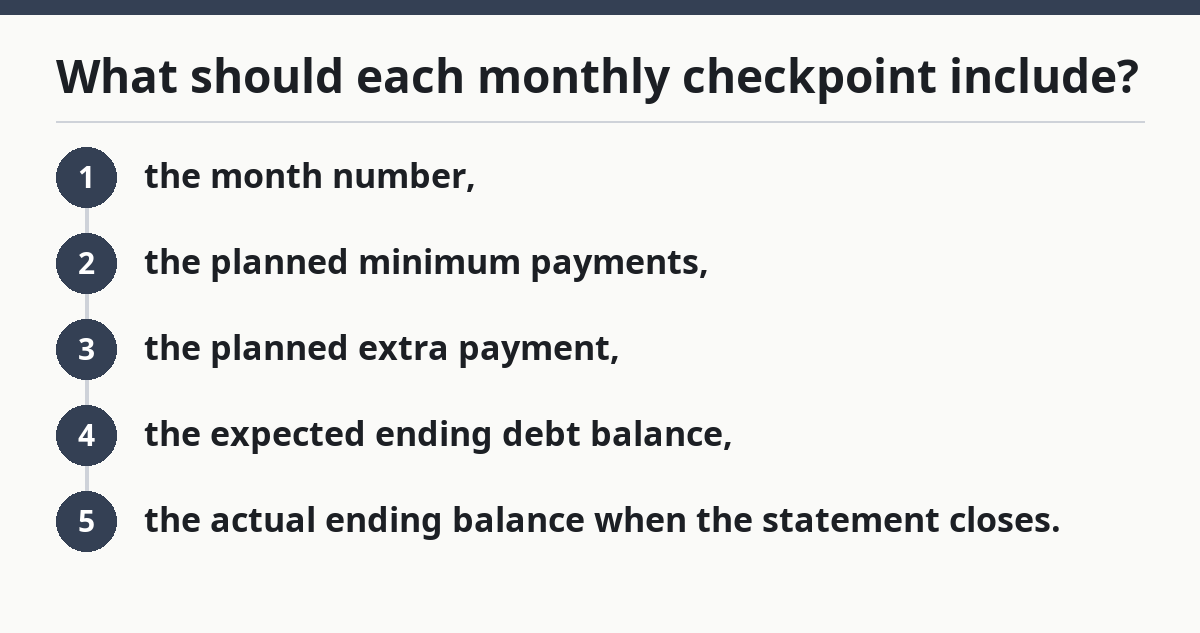
I would put five items in every monthly milestone line:
- the month number,
- the planned minimum payments,
- the planned extra payment,
- the expected ending debt balance,
- the actual ending balance when the statement closes.
That last item matters because a payment only counts once it posts, and interest changes can shift the number before you review it. If you are working with a revolving balance such as a credit card, the statement close date is often a better checkpoint than the calendar month-end. If you are paying an installment loan, the due date may be the cleaner marker. Pick one and use it consistently for all 12 months.
A good monthly checkpoint also includes one note about the cause of any gap. For example: “Paid the base amount, but the extra payment moved to next week because a repair bill landed.” That note is not self-criticism. It is the only way to tell whether a single missed payment was a one-time hiccup or a pattern.
The mistake many people make is building a milestone that only says “pay down debt.” That is too vague to use. A useful milestone tells you what amount should be gone, by when, and how you will know it happened. If a monthly checkpoint cannot be checked against a statement or account balance, it is not a milestone yet.
A second useful habit is to keep the numbers visible in the same format for all 12 months. If month 1 shows dollars paid and month 2 shows percentages, the plan becomes harder to follow than the debt itself. Consistency is the feature here, not sophistication.
How do I build the 12-month timeline without guessing?
You build the 12-month timeline by working backward from the debt goal and forward from your monthly cash flow at the same time. That keeps the plan grounded in numbers you can actually repeat.
Start with the debt balance you want to reduce. Then subtract the amount you can realistically send each month after minimums and essentials. What remains is the timeline pressure: if the balance falls fast enough, your 12 monthly milestones can be equal; if not, the milestones need to be weighted toward months with more room, such as months with a bonus, tax refund, or seasonal income spike if you already know one is coming.
Use the same formula for each month:
- starting balance,
- minus minimum payments,
- minus extra payment,
- equals projected ending balance.
Then compare that projected balance with the actual statement balance after each cycle. If the balance is dropping more slowly than expected, do not assume the plan failed. Check for one of three causes: interest charges are higher than you expected, a payment posted late, or the extra payment was smaller than planned. Each cause needs a different fix.
A 12-month debt timeline should also account for irregular bills. Annual insurance premiums, school expenses, and car maintenance can knock out a month’s extra payment if they are not already built into the budget. A milestone plan that ignores those costs is not disciplined; it is incomplete.
Because the timeline is working, the best sign is not speed. It is predictability. If each monthly milestone tells you what happened, why it happened, and what the next month requires, the plan is doing its job. If the numbers change every month for reasons you never wrote down, the timeline is too loose.
One practical rule helps: keep the plan to one calendar year unless the debt size and monthly surplus clearly justify a different horizon. Stretching the milestones too far can make the target feel blurry. Compressing them too much can make the extra payment unrealistic. A 12-month frame is a planning tool, not a promise.
What are the mistakes that make monthly milestones fail?
Monthly milestones fail when the numbers are vague, the timing is sloppy, or the extra payment is treated like a guess instead of a commitment.
Building milestones from hope instead of a balance sheet: This means the monthly target has no connection to the actual debt balance — use your latest statement and recalculate after each payment cycle.
Making every month identical when income is not: This can create false failure in low-income months — use a seasonal timeline with lighter and heavier checkpoints if your pay varies across the year.
Forgetting payment timing: A payment sent on the 29th may not post before month-end, which can distort the checkpoint — verify statement close dates and due dates before you set the calendar.
Setting an extra payment that crowds out essentials: This can force you back into new debt when an emergency hits — reduce the monthly milestone until it fits a realistic budget with a buffer.
Changing the payoff method every few weeks: Switching between avalanche and snowball can make progress hard to measure — choose one method and keep it steady for the full 12 months unless a serious change in rates or balances requires a review.
Skipping the review step after a missed month: One missed payment can become three if you do not adjust the timeline — recalculate the next two milestones as soon as you know the gap.
Each of these mistakes has the same underlying cost: the plan stops being measurable. Once that happens, it is hard to tell whether the debt is shrinking, stalling, or just moving around on paper. Monthly milestones only work when they stay tied to actual account data.
When should the standard 12-month plan change?
The standard 12-month plan should change when the debt picture no longer matches the assumptions behind the plan.
Your debt has a variable interest rate: This means the balance may not shrink at the pace you expected — review the timeline after each statement and accept that the monthly target may need to move.
You are dealing with overdue accounts or collection action: This changes the risk level and may involve legal or credit consequences — get qualified help before relying on a self-made milestone plan.
You cannot cover minimum payments from normal income: This means the plan is not a progress tool anymore; it is a warning sign — pause the milestone chart and address the budget gap first with qualified guidance if needed.
Your income changes from month to month: A fixed extra payment may be unrealistic — build a flexible milestone plan with higher targets in strong months and lower ones in weak months.
Your debt includes secured obligations or tax-related debt: Missing payments can have consequences beyond interest — check local rules and speak with the relevant professional before setting a timeline.
You are trying to use milestones as a substitute for a broader plan: If the debt amount is large enough that the monthly surplus barely makes a dent, the 12-month structure may be too narrow — extend the horizon or rework the budget so the milestones are based on real capacity.
The point of changing the plan is not failure. It is fit. A milestone system only helps when the numbers are honest and the timing matches your actual cash flow. If the structure is forcing false confidence, it is the wrong tool in that form.
What does a useful monthly milestone look like in practice?
A useful monthly milestone looks like a line item you can check in under 2 minutes. It says what month you are in, what payment you planned, what balance you expected, and whether the account actually moved that far.
A simple version might be written like this:
- Month 1: minimum payments plus agreed extra payment; expected balance after statement close; mark done if the balance falls as planned.
- Month 2: repeat the same structure; compare actual balance to projected balance.
- Month 3: adjust for any previous shortfall if needed.
- Months 4 through 12: continue the same pattern, with the timeline updated only when the debt balance or cash flow changes.
The useful part is not the wording. It is the discipline of checking the same things every month. That makes progress visible even when the balance drops slowly. A reader who wants the debt goal to feel manageable does not need a prettier spreadsheet. They need a timeline that answers one question each month: did the extra payment and the minimums move the debt balance where I expected?
A bad milestone asks for too much emotion and too little data.
Drafted with AI; not yet reviewed by a person.