Last updated: November 19, 2026
Debt milestone rewards should usually be free or very low-cost, not cash-heavy, because the goal is to reinforce progress without slowing the debt payoff goal. If a reward turns into a new expense, the celebration can quietly undo the milestone it was meant to honor. This is information, not financial advice; for your own situation, a qualified adviser can help.
I write about personal finance and behavior change, so I’m looking at debt milestone rewards the way a budget has to work in real life: the reward has to motivate you, fit inside the month, and not pull money away from the next payment. The right choice depends on how tight the budget is and how easy it is for spending to snowball.
Key takeaways
- Free celebrations usually win when cash flow is tight or debt is the main priority.
- Small budget rewards can work if they are planned in advance and stay inside a fixed line item.
- Money-based rewards are only useful when they are truly tiny and cannot trigger a spending spiral.
- A good reward marks the milestone without competing with the payoff plan.
- If a reward needs borrowing, it is the wrong reward.
The real difference between money rewards and free rewards
Free rewards win for most people because they protect the budget while still giving the brain a clear “done” signal. Money-based rewards only make sense when the amount is small, already budgeted, and unlikely to become a bigger purchase.
That distinction matters because debt repayment is already asking for delayed gratification. A celebration should reduce friction, not add another decision. A free reward can be a night off from cooking, a long walk in a favorite park, a movie from a streaming service you already pay for, or an at-home ritual that costs nothing. A money reward, by contrast, requires you to spend from the same pool that funds groceries, utilities, and debt payments.
Here is the practical split: if you are still feeling pressure every pay cycle, free wins. If you have a separate, written celebration budget and the milestone is large enough to justify a planned treat, a small cash-based reward can work as long as it stays bounded and you consider advice from a qualified financial professional or another trusted adviser. The danger is not the dollar amount alone; it is the habit of letting a “small” reward expand into takeout, shopping, or a second purchase because the milestone feels like permission. For budgeting guidance, see the Consumer Financial Protection Bureau’s budgeting resources and NerdWallet’s debt payoff advice.
A debt milestone reward should do one job: it should reinforce the behavior that got you there. It should not compete with the next payment, and it should not require explanation to the credit card balance. That is why a no-cost celebration often beats a cash reward even when the cash reward looks harmless on paper.
For a broader framework on pacing and checkpoints, the hub on debt payoff planning milestones is the right companion piece.
Free celebrations are the strongest choice when cash is tight

Free celebrations win when the budget is already doing hard work, because they give you the emotional payoff without draining the account. That makes them the safer default for anyone in a strict debt payoff goal, especially if the month already has variable expenses.
The strength of a free reward is simple: it creates a reward loop with almost no financial drag. A mark on a calendar, a handwritten note, a phone wallpaper, a special playlist, an afternoon at the library, or a favorite sunrise walk can all serve as a milestone marker. The point is not the item; the point is the signal. The brain responds to completion cues, and a visible celebration helps a difficult habit feel real.
This option is especially useful if your debt payoff strategy already asks for concentration. A milestone celebration that costs $0 cannot turn into a budget argument. It also avoids the common trap of “I worked hard, so I deserve this” turning into repeated discretionary spending. That trap is expensive because it rarely stays at one event. A free celebration has no spillover unless you add one.
Free rewards are also flexible. They work at any stage of the journey, from the first $500 paid off to a larger balance crossing a major threshold. A 30-minute celebration can be as meaningful as a whole evening if it is deliberate. That matters because people often underestimate how much relief comes from naming the win instead of waiting for the debt to disappear.
The downside is obvious: some people find free rewards too flimsy if they are already tired and discouraged. If a no-cost celebration feels like “doing nothing,” it may not create enough emotional payoff. In that case, the answer is not to spend more automatically. It is to make the ritual more concrete—specific time, specific place, specific action—before deciding money is necessary.
Money-based rewards only work in narrow situations
Money-based rewards win only when the amount is pre-decided, modest, and separated from the debt payoff budget. If those three conditions are not true, the reward is too risky for most people.
A small spending reward can be useful when the milestone is unusually meaningful and the celebration itself is part of a long-term plan. For example, a budgeted reward line can make sense if you know exactly what it is for, you have already covered essentials, and you are not using debt to fund it. The structure matters more than the category. A reward that is written into the budget is different from an impulse purchase made because a balance dropped.
The upside is emotional clarity. Some people need a tangible marker that feels more substantial than a free ritual. A small purchase, if planned, can make the milestone feel recognized in a way that a low-effort celebration does not. It can also be easier to share with a partner or household when everyone sees a concrete, agreed-upon reward.
The weakness is that money rewards can blur the line between celebration and setback. A purchase may seem small at the checkout screen but still strain a tight month. It can also become a pattern: one reward for every milestone, then one reward for every rough week, then one reward because the reward itself “didn’t feel special enough.” That is how a celebration becomes part of the problem.
Money-based rewards are also a poor fit if your debt payoff goal is emotionally fragile. If seeing cash leave the account creates stress, a paid reward may trigger guilt right after pride. The milestone then loses its purpose. In those cases, a free celebration is not a compromise; it is the smarter fit.
The honest side-by-side

Free rewards usually win on budget protection and long-term consistency, while money rewards win only on tangibility and specialness. The decision changes when the celebration itself is likely to create new spending or when the milestone is big enough to justify a planned line item.
| Criteria | Free celebration | Money-based reward | Winner for this condition |
|---|---|---|---|
| Budget impact | No cash leaves the account | Money leaves the account | Free celebration, when the budget is tight |
| Risk of overspending | Very low if it stays simple | Higher if one purchase becomes several | Free celebration, when impulse spending is a concern |
| Emotional punch | Can be strong if intentional | Often feels more tangible | Money-based reward, when the milestone feels flat |
| Ease of repeating monthly | Very easy | Harder to sustain | Free celebration, for frequent milestones |
| Fit for strict debt payoff goals | Excellent | Weak unless pre-budgeted | Free celebration, when debt reduction is the main priority |
| Need for planning | Low | Higher, because it must be capped | Free celebration, for busy or stressed months |
| Social shareability | Can be personal or shared | Easier to show as a gift or treat | Money-based reward, when shared ritual matters |
| Chance of guilt later | Low | Higher if the reward strains cash flow | Free celebration, if money stress is high |
| Works with zero discretionary cash | Yes | No | Free celebration, when every dollar is assigned |
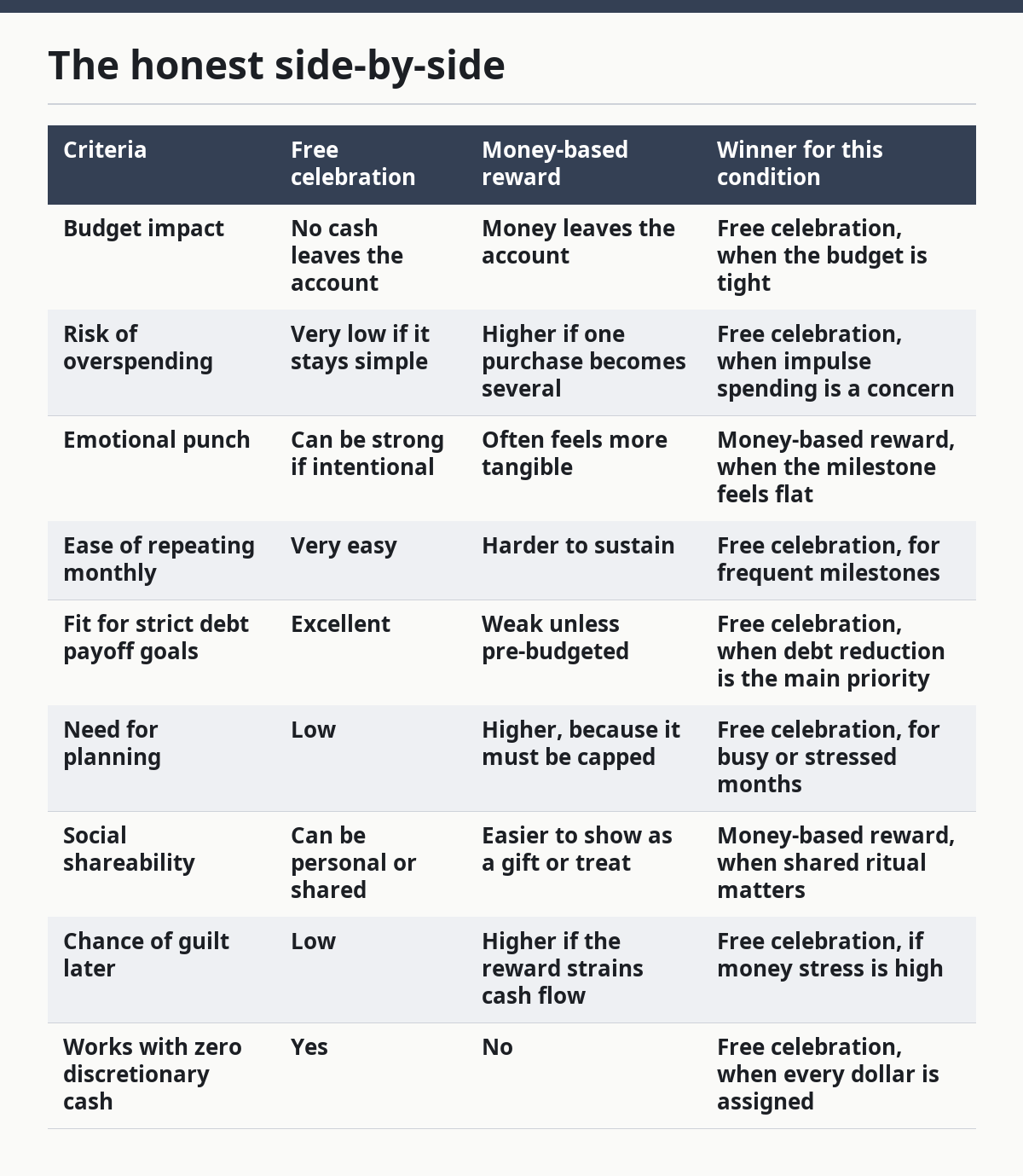
The table points to the same conclusion: the more fragile the budget, the more the free option wins. The more carefully contained the reward, the more a small paid treat can fit. That said, the paid option is never the default. It has to earn its place.
What a good debt milestone reward looks like in practice
The best debt milestone reward is small enough to feel clean and specific enough to feel real. That can be a movie night at home, an hour at a favorite park, a special coffee made from what is already in the kitchen, or a handwritten certificate you keep with your budget notes.
A good reward shares three traits. First, it has a clear start and end, such as one evening or one afternoon. Second, it does not create a second bill later, such as a subscription you do not already have. Third, it is tied to the milestone itself, not to general exhaustion. That distinction matters because fatigue is constant, but a milestone is a specific event.
Some people do better with symbolic rewards than with consumable ones. A notebook entry, a savings tracker colored in, or a dated photo of the moment can be surprisingly motivating because it turns progress into evidence. Others need a sensory cue: a favorite meal cooked at home, music, a candle you already own, or a phone-free hour. The right form is the one you will remember without checking your bank app again.
A bad reward is anything that invites drift. A “quick” shopping trip, a restaurant meal that doubles the bill, or a reward that requires you to explain the overspend after the fact all work against the purpose. If the reward needs justification, it is probably too expensive. If it requires credit, it is the wrong reward.
That is why debt milestone rewards should be treated like part of the budget, not a loophole in it. The celebration should confirm the plan, not argue with it.
When to reconsider the choice entirely
You should step back from both reward types if the celebration is masking a bigger money problem. That happens when a milestone feels like a license to loosen the plan, when rewards are happening so often they crowd out payments, or when the budget has no room for either option.
There are a few exception scenarios where the overall verdict flips. If you have a genuinely separate celebration fund, a very small paid reward can be appropriate because it is already accounted for. If your debt payoff goal is dragging and the process feels emotionally flat, a more visible but still bounded paid reward may help mark the progress. If you are sharing finances with a partner or family and a ritual matters to the household, a planned paid celebration can strengthen buy-in. If even a tiny purchase creates guilt or triggers a second round of spending, money rewards stop being useful and the free option should stay in place. If you are unsure, consult a qualified financial adviser before changing the plan.
The flip side matters too. If a free celebration starts to feel punishing, it is not because free rewards are bad; it is because the ritual is too vague. Make it specific before abandoning it. A 20-minute walk with a podcast, a favorite dessert already in the house, or an evening with a book can be enough when the structure is clear.
For debt payoff milestone rewards, I would not make the choice based on what feels more exciting. I would make it based on what keeps the budget intact. That is the real test. A celebration that damages the next payment is not a reward; it is leakage.
The verdict: which one to choose and why
Choose free rewards if your budget is tight, your debt payoff goal is still under pressure, or you tend to overspend once you start celebrating. Choose money-based rewards only if they are tiny, pre-budgeted, and unlikely to grow into a larger purchase. Neither if the reward would require borrowing, delay a payment, or make the milestone feel like permission to drift.
That is the cleanest rule for most people: free first, paid only with a cap. The point of a milestone is reinforcement, not financial self-sabotage. If the celebration helps you keep going, it works. If it costs progress, it misses the point.
What are good debt payoff rewards?
Good debt payoff rewards are simple, specific, and low-risk. A free walk, a movie night at home, a favorite meal from ingredients already in the kitchen, or a printed progress note can all work. The best rewards create a clear sense of completion without opening a new spending chain or disrupting the next payment. For practical budgeting context, the Consumer Financial Protection Bureau and NerdWallet both offer debt payoff guidance.
Should debt milestone rewards cost money?
They do not need to cost money, and in many cases they should not. A free reward is usually the better choice when cash flow is tight or when spending tends to expand after a celebration. A small paid reward can fit only if it is already in the budget and stays small enough not to affect the debt payoff plan. For a written budgeting framework, see the CFPB’s budgeting resources.
How do I celebrate without hurting my budget?
Celebrate with a planned ritual that has a zero or near-zero cost and a clear time limit. Pick one thing in advance, such as a special evening at home, a walk, a playlist, or a note you save with your budget tracker. If the celebration needs a checkout screen, make sure the amount is already assigned in your budget and does not compete with essentials.
Drafted with AI; not yet reviewed by a person.