Last updated: November 19, 2026
Quick Answer: In a cash flow first debt plan, protect essentials first, pay all minimums next, and use only leftover cash on the debt with the most immediate penalty risk. How to Prioritize Debt Payments When Cash Flow Comes First is about preventing a cash crunch that creates fees, missed rent, shutoffs, or new borrowing.
Key Takeaways
- Cash flow first helps prevent a small shortage from becoming a bigger one.
- Rank essentials first, then minimums, then extra payments by the cost of missing them.
- Rent, groceries, and essential utilities come before extra debt payments; minimums come next when due dates are on time.
- Pause the usual order if it would cause a missed essential bill, a missed minimum, or too little cash for timing mistakes.
This is information, not financial advice. A qualified adviser should be consulted for your own situation, especially if you are behind, facing collections, or balancing debt with irregular income.
Who this applies to, and what has to be in place first
This applies to someone whose main risk is running out of usable cash before the next paycheck, invoice, or benefit payment. That might mean irregular income, a temporary pay cut, seasonal work, family leave, or a month where rent, groceries, and utilities are crowding out everything else. It also applies when debt payoff matters, but a missed rent payment or overdraft would cause more damage than slower debt reduction.
The plan assumes three things are already true: you know your monthly due dates, you can list every debt with its minimum payment, and you can see the cash you expect to have in the next 2 to 4 weeks. If those are not clear, the order of payment will be guesswork. The first job is not optimization; it is keeping enough money available to cover rent, groceries, utilities, transportation, and the minimum payment on each debt.
This is not the right tool if you are already choosing between food and electricity, or if you are using debt to cover basic living costs every month. In that case, the priority may be a hardship plan, a payment arrangement, or a qualified adviser who can help sort out the whole budget. A cash flow first debt plan works best when there is still some room to manage, even if the room is small.
For related planning, the hub on [debt payoff and irregular income management] can sit alongside this guide.
What a cash flow first debt plan actually does
A cash flow first debt plan keeps you from turning a temporary shortage into a bigger one. It treats liquidity — the cash you can access quickly without scrambling — as the first constraint. Liquidity means money available now, not money you expect later in the month; if you are unsure how much cushion to keep, a qualified financial professional can help you set one. The Consumer Financial Protection Bureau explains why timing and available cash matter when bills and income do not line up. See CFPB’s budgeting and cash-flow guidance.
The logic is simple. A debt payment that is technically “best” on paper is not best if it leaves you short on rent, groceries, or utilities before the next income date. Missing a minimum payment can trigger late fees, penalty interest, a returned-payment charge, or collection calls. Missing rent or a utility bill can create a harder problem than carrying a slightly larger debt balance for another month.
This approach is different from payoff methods that focus only on speed, such as the avalanche method, which targets the highest interest rate first, or the snowball method, which targets the smallest balance first. Those can be useful when cash flow is stable. Here, the first rule is to avoid a cash starvation cycle, where debt payments force new borrowing, overdrafts, or late essentials. The Federal Trade Commission also notes that debt management depends on handling bills in a way you can actually sustain; see FTC consumer advice on debt.
The trade-off is real: a cash flow first plan may slow the total debt payoff timeline. That is the price of keeping your household stable enough to continue paying at all. It is wrong for someone who is trying to maximize long-term interest savings without a liquidity problem, because the method deliberately gives up some payoff efficiency in exchange for stability.
How do I prioritize debt payments without running out of cash?
You prioritize debt payments by ranking essentials first, then minimum payments, then any extra payment by the consequence of missing it. Start with the money that must stay available between now and the next income date, then build payment timing around that gap.
- List every cash outflow due before your next income date. Include rent, groceries, utilities, transit, child care, insurance that is due, and each debt minimum payment. Write the exact due date next to each item. Verify that the list covers at least 30 days, or one full pay cycle if your income is weekly. If a bill is missing, the plan is incomplete.
- Hold back a small cash buffer before making extra debt payments. Keep enough to absorb timing slippage, bank processing delays, or a surprise copay. A buffer of even a few days of essential spending is more useful than an aggressive extra payment that empties the account. If the account would go near zero before the next paycheck, the buffer is too thin.
- Pay essentials that protect shelter, food, heat, and work access first. Rent or mortgage, groceries, electricity, heat, water, phone service needed for work, and transportation to work come before extra debt principal. Verify that these bills will clear on or before their due dates. If a lender payment is chosen instead of rent or utilities, the plan has been ranked incorrectly.
- Make every minimum payment next. A minimum payment is the smallest amount the lender requires to keep the account current. Pay each minimum by its due date, even on debts you intend to pay off later. If you cannot cover all minimums, the problem has moved from prioritization to hardship, and the plan needs outside help or negotiation.
- Use payment timing to protect cash flow. Schedule due dates just after income arrives when possible, and avoid bunching several payments into the same 2-day window. A due date that falls 5 days before payday is a cash flow problem even if the amount is small. If you can move a due date, the problem improves without changing the debt balance.
- Direct any extra cash to the debt that creates the most immediate damage if ignored. For some people that is an account with a past-due notice, a loan that will charge a fee, or a debt tied to a repossession or utility shutoff risk. The point is not “best interest rate”; the point is “what becomes expensive or dangerous first.” If two debts have the same consequence, the one with the higher required payment usually deserves attention first because it drains cash faster.
- Check the account after each payment cycle. Reconcile the balance, pending payments, and the next 14 days of essentials. Look for overdraft risk, an upcoming annual fee, or a bill that hit earlier than expected. If you finish the cycle with less cash than planned, the payment order needs to be loosened, not tightened.
- Rebuild the order when income changes. If a shift is cut, a client pays late, or overtime disappears, re-rank the next 2 to 4 weeks immediately. Do not wait for the whole month to “normalize.” A plan built for a stable paycheck can fail fast when timing changes by even 7 days.
A worked rule of thumb is this: essentials first, then minimums, then any extra only after the cash cushion for the next income gap is protected. That is the heart of a cash flow first debt plan. It is a timing system, not a moral judgment about which debt is “good” or “bad.”
For a practical benchmark, many people should think in terms of the next 1 pay period, not the next 12 months. If paying an extra $200 today means you cannot cover groceries and a utility bill before Friday, the extra payment is too early. If you can make the extra payment and still leave enough to absorb a delayed paycheck, then the timing works.
Which bill should come first: rent, groceries, utilities, or debt?
Rent, groceries, and essential utilities come before extra debt payments, while debt minimums come before extra principal only when the minimums are due on time. That is the cleanest order for cash flow protection.
The reason is practical, not emotional. Rent protects housing. Groceries protect day-to-day functioning. Utilities keep power, heat, water, and communication working. Minimum debt payments prevent late fees, penalty rates, collections, and account damage. Extra principal payments reduce balance, but they do not usually stop immediate disruption if cash runs short.
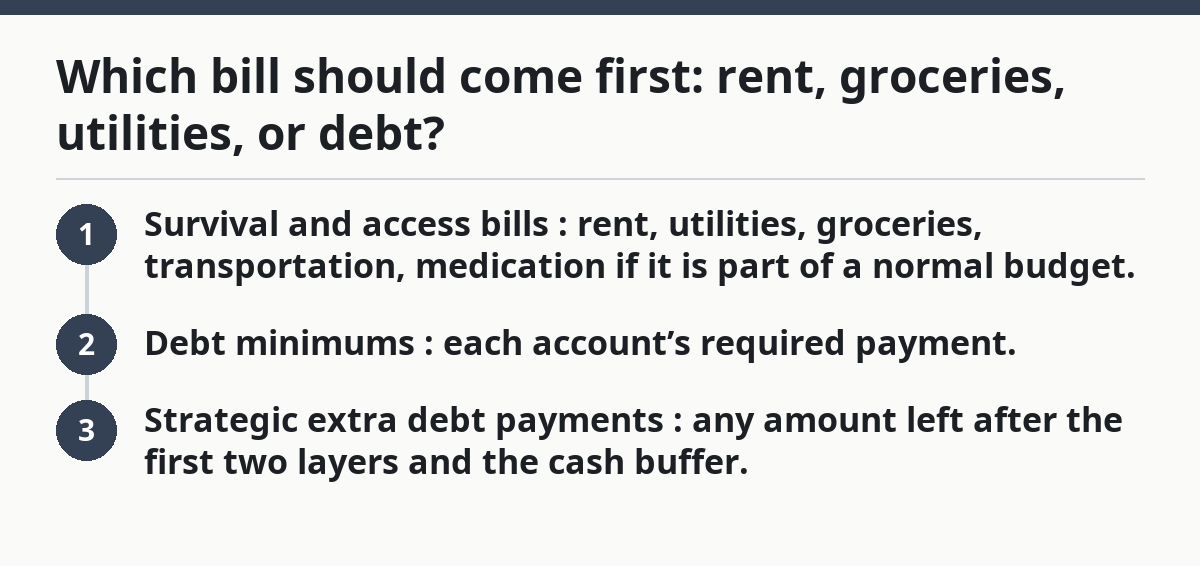
A useful way to think about the order is in layers:
- Survival and access bills: rent, utilities, groceries, transportation, medication if it is part of a normal budget.
- Debt minimums: each account’s required payment.
- Strategic extra debt payments: any amount left after the first two layers and the cash buffer.
That order may change if a debt has a near-term consequence more severe than a utility bill. A car payment that prevents repossession may outrank a credit card extra payment because the car may be needed to work; if the choice is close, consult a professional and review the loan terms carefully. A utility bill with shutoff risk can outrank almost any extra debt payment because a shutoff can damage the household immediately.
The mistake many people make is paying the debt that looks most urgent on a statement, not the bill that causes the worst cash-flow damage if ignored. A statement is not a calendar. A due date, a shutoff notice, or a repossession risk is what changes the order.
If a person has only enough cash for essentials and minimums, that is enough for the plan to work. It is not enough for aggressive payoff, but it is enough to stay current and avoid the spiral that comes from missing a payment and then borrowing to fix it.
When should I stop following the standard order?
Stop following the standard order when the plan would cause a missed essential bill, a missed minimum, or a cash balance that leaves no room for timing errors. In those cases, the standard order is the wrong tool, not a failed one.
You cannot cover all minimum payments this month: The plan no longer fits the cash you have — contact lenders or creditors about hardship options, payment deferral, or due-date changes, and get a qualified adviser involved if the gap is large or recurring.
Rent, utilities, or food money is at risk: Cash flow is too tight to support extra debt payments — pause all extra principal payments until the essentials are safe again.
A debt is already past due or in collections: The account may need a different response than normal prioritization — deal with the most immediate collection or shutoff risk first, and ask about repayment terms before sending extra money elsewhere.
Your income changes by week or month: A fixed monthly ranking may fail — switch to a shorter planning window, often 1 to 2 weeks, and review each incoming payment before assigning it.
You are relying on one debt payment to “make room” for another bill: That is a sign the plan is collapsing under timing pressure — stop extra payments and rebuild the cash schedule around the next due dates.
You are tempted to use another loan, overdraft, or cash advance to fund debt payments: The plan is no longer protecting cash flow — stop and re-check whether the payment should be delayed, reduced, or negotiated instead of financed.
The key point is that cash flow first does not mean debt always wins. It means the next payment decision should prevent the next cash shortfall. If the usual order cannot do that, the order has to change.
Common mistakes that break cash flow
The most common mistake is sending extra money to debt before the essentials are fully covered. That often creates a new hole in 7 to 14 days, which then gets filled with overdrafts, card swipes, or late bills. The correct alternative is to protect the next income gap first, then pay extra only from true surplus.
Another mistake is treating all debts as equal because they are all “bad.” Some debts create faster damage than others. A past-due utility bill with shutoff risk is not the same as a credit card balance that is still current. The correct alternative is to rank by consequence, not by guilt.
A third mistake is ignoring payment timing. Two bills due on the same day can be harder to handle than the same total spread across 10 days. The correct alternative is to move due dates where possible and schedule payments around payday, not around habit.
A fourth mistake is paying only the debt that has the smallest balance or highest interest without checking whether the account has a minimum that will hit before the next paycheck. That can cause a missed minimum on a different account, which then adds fees and stress. The correct alternative is to make every minimum the floor, then work above that floor.
A fifth mistake is using an extra payment as a substitute for a cash buffer. That feels productive, but it often leaves the account too thin for groceries, transit, or an unexpected $25 charge. The correct alternative is to hold a small reserve before accelerating payoff.
A sixth mistake is waiting for the “perfect” month. That month rarely appears when income is irregular. The correct alternative is a repeatable 1-month or even 2-week review cycle that adjusts with real cash, not ideal cash.
What changes when income is irregular or the month is already tight?
The plan changes from monthly ranking to payment-window ranking, and that usually means a 2-week or pay-period view instead of a full calendar month. When income is irregular, the order of bills should be based on the next cash arrival, not on what a spreadsheet says the month should look like.
The first adjustment is to match due dates to income dates wherever possible. A bill due 3 days after payday is easier to manage than the same bill due 8 days before payday. If a lender allows date changes, that can improve the whole system without changing the debt itself.
The second adjustment is to split the month into survival blocks. For example, one block may cover rent and groceries, another may cover utilities and minimums, and the third may be the leftover amount for extra debt. If a block fails, you stop the extra-payment layer and keep the first two layers intact.
The third adjustment is to treat windfalls cautiously. A tax refund, bonus, or side-income payment should first repair the next cash gap before it is assigned to debt. That does not mean ignoring debt payoff; it means not spending tomorrow’s grocery money in the name of today’s progress.
This approach is especially useful for freelancers, commission workers, tipped workers, and people whose hours swing by the week. It is less useful for someone with a stable paycheck and enough room to keep essentials, minimums, and a cash buffer on schedule.
Drafted with AI; not yet reviewed by a person.