Last updated: November 19, 2026
Quick Answer: A practical starting point is to budget debt payments from your lowest reliable month, then use a separate buffer from higher months to cover the gap. For a commission budget, a workable rule is to keep debt payments as fixed as possible after essentials are covered and a cash reserve exists for the off-season.
If you are building the Best Way to Budget Debt Payments on Commission or Seasonal Pay, start with the lowest reliable month and build up from there. The method is most useful when income swings predictably across the year and you need debt payments that can survive slow periods.
Who this works for—and who should use a different approach
This approach fits people with sales commission, seasonal jobs, or work tied to a predictable peak season and off-season, such as retail, tourism, farming, or contract sales cycles. It assumes you know your monthly debt minimums, your basic living costs, and roughly how your pay pattern behaves across the year, even if the exact dates vary. The method also assumes your debt is already in repayment, not in default.
It works best when the income swing is predictable over 3 to 12 months. That is different from income that changes every month with no pattern. If your pay is mostly random, you need a different cash-flow system than a commission budget built around a seasonal cycle.
This is also the wrong tool if you are already missing minimum payments, getting collection notices, or using one credit card to cover another. In that case, the budget is not the first problem; the payment structure is. A formal debt review, creditor negotiation, or local debt-counselling service may be the better next step, depending on where you live and what kinds of debt you hold.
The goal here is simple: keep debt payments steady enough that lenders are paid on time, while avoiding a budget that collapses in the off-season. That means planning from the bottom of your income cycle, not the top. It also means using budget categories that separate essentials, debt, and true surplus so the good months do not get swallowed by day-to-day spending.
For a broader framework on irregular income, I’d pair this page with the hub on debt payoff and irregular income management, then come back here for the commission and seasonal-pay version of the plan.
How do I build a commission budget that can survive the off-season?

You build it by setting debt payments from your low month first, then funding a separate reserve from higher months. The reserve is what keeps the payment plan alive when sales slow or seasonal work ends.
Start with a 12-month view if you can. A smaller 6-month view can work for a short season, but a year is better when the sales cycle repeats annually. List three numbers for each month: take-home pay, essential spending, and minimum debt payments. Essentials usually include housing, utilities, food, transport, insurance, and any required childcare. Debt minimums include the contractual minimums on credit cards, personal loans, student loans, and other debts that require regular payment.
Then calculate your low-income month. Use the month with the smallest reliable take-home pay in the cycle, not an optimistic average. The reason is simple: the budget must survive the weakest month. Average income planning is still useful, but only after the floor is known.
From there, create two debt numbers:
- Base debt payment: the amount you can pay every month, even in the off-season.
- Extra payment target: money you can send only when income is above the floor.
The base payment should fit inside the low month after essentials. If it does not, the plan is too tight. Reduce the extra payment, trim a budget category, or revise the debt order. Do not build a plan that depends on a perfect sales month showing up on time.
The key check is whether a 1-month delay in commission would still leave enough cash for essentials and minimum debt payments. If the answer is no, your budget needs a larger buffer before any extra debt payoff.
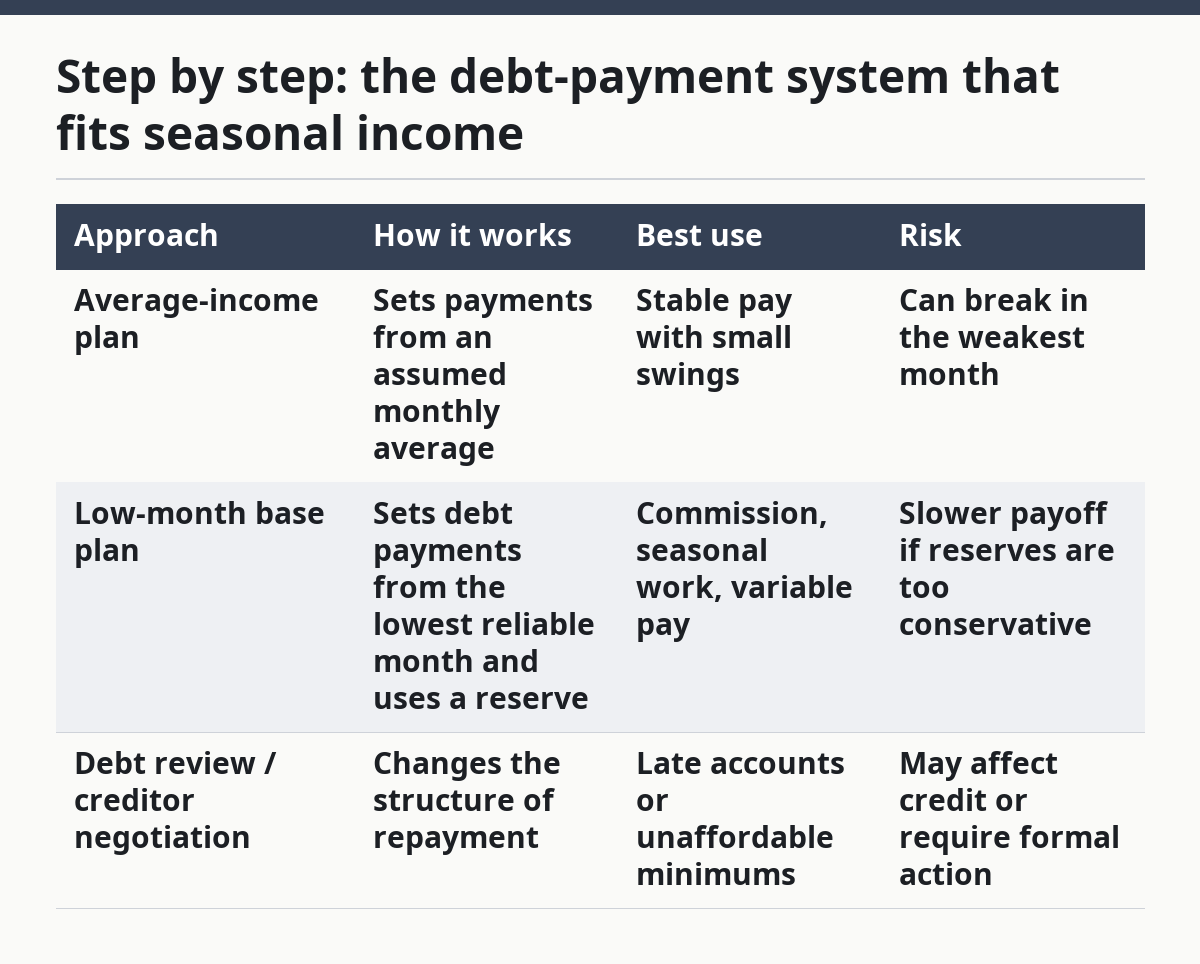
Step by step: the debt-payment system that fits seasonal income
Start by separating your money into three buckets, then assign debt payments only after essentials and reserves are covered. This is the core operating method for commission and seasonal pay.
| Approach | How it works | Best use | Risk |
|---|---|---|---|
| Average-income plan | Sets payments from an assumed monthly average | Stable pay with small swings | Can break in the weakest month |
| Low-month base plan | Sets debt payments from the lowest reliable month and uses a reserve | Commission, seasonal work, variable pay | Slower payoff if reserves are too conservative |
| Debt review / creditor negotiation | Changes the structure of repayment | Late accounts or unaffordable minimums | May affect credit or require formal action |
- Map your income cycle for 6 to 12 months. Write down each month’s expected take-home pay, including base salary, commission checks, bonuses, and seasonal spikes. Verify that each figure is cash you can actually spend after tax and payroll deductions. If you are using gross income instead of net income, the plan will overstate what is available.
- List fixed debt minimums and essential bills on one page. Put every minimum debt payment beside rent or mortgage, utilities, food, transport, insurance, and any required minimum savings for bills that arrive yearly. Verify the total against your low-income month. If the total exceeds that month’s income, the plan is not workable without changes.
- Set a monthly base payment at the low-month level. Choose one payment amount that you can make in every month of the cycle. For example, if one month is lean and the next is strong, the base should still fit the lean month. Verify that this amount leaves room for essentials and at least a small cash buffer. If it forces you to borrow just to pay debt, it is too high.
- Create a separate reserve for the gap months. Move a set portion of high-month income into a reserve account until it covers at least one lean month of debt minimums and essentials. Verify that the reserve is not being mixed with spending money. If the reserve is tapped for dining out, gifts, or upgrades, the system is leaking.
- Split extra debt payments from regular spending money. Send only true surplus to debt, after the reserve contribution and next month’s essentials are protected. Verify that extra payments do not reduce your ability to handle a 2- to 4-week commission delay. If they do, lower the extra payment first.
- Use due dates, not mood, to schedule payments. Put minimums on autopay for the amount you know will clear, then pay extra manually from high months. Verify that your account balance stays above the payment date. If autopay can overdraft your account during a slow month, the timing is wrong.
- Recalculate after each peak season or sales cycle. Compare actual income to projected income every 30 days or at the end of each season. Verify whether the reserve is growing, flat, or shrinking. If you keep missing the low-month target, the budget assumptions are too generous.
- Adjust one variable at a time. Raise the base payment, lower a category, or change the reserve rule—not all three at once. Verify the effect for one full cycle before making another change. If several changes happen together, it becomes impossible to know what fixed the problem.
The most useful version of this system is boring: the base payment happens automatically, the reserve builds in good months, and the extra payoff only happens when the math allows it. That is what keeps the plan stable through a full sales cycle or seasonal slowdown.
What should I check before I choose a payment amount?

You should check whether the payment still works if one good month does not arrive. That is the real test for any commission budget.
The first check is the gap between your low month and your required spending. If essentials plus minimum debt payments already use nearly all of your low month, there is little room for extra payoff. In that case, the honest move is not to force a larger payment. It is to lower the base, cut spending, or change the debt order.
The second check is your due-date pattern. A debt payment due on the 1st can be risky if your commission usually lands on the 15th or later. A payment due right after your biggest seasonal bill can also create pressure. In that case, timing matters as much as amount. Many lenders allow due-date changes, but availability and rules differ by lender and country. For consumer budgeting and repayment basics, see the Consumer Financial Protection Bureau and MoneyHelper guidance on managing payments and prioritising essentials.
The third check is whether your reserve is separate from spending money. A reserve that sits in the same account as daily spending tends to disappear. A separate savings account or a clearly labeled sub-account makes the boundary visible. If you cannot tell at a glance which money is for debt and which is for groceries, the system is too loose.
The fourth check is whether your debt minimums are all current. If they are already late, then a budgeting method alone may not be enough. Delinquent debt often needs a different plan because fees, penalties, and collection activity can alter the monthly numbers.
The fifth check is whether your off-season has a known length. A 2-month slowdown is very different from a 6-month one. The longer the dry spell, the more conservative the base payment has to be. A seasonal worker with a short winter lull can usually carry a stronger base than someone whose busy season lasts only 4 months.
When does the standard approach stop working?
The standard approach stops working when the income gap is too large, the debt is already past due, or the budget depends on future sales that are not committed yet. In those cases, a commission budget on its own is the wrong tool.
Your minimum debt payments are higher than your low-month surplus: this means the numbers do not fit — reduce spending, increase income where possible, or get qualified help before the next due date.
Commission arrives too late to meet due dates: this means timing, not amount, is the problem — ask about due-date changes or a temporary payment arrangement.
You are using debt to cover essentials every month: this means the budget is already underwater — stop adding extra payoff and focus on stabilising cash flow first.
Your season is shrinking or ended unexpectedly: this means the old average income is no longer reliable — rebuild the budget from the newest 3 to 6 months, not last year’s peak.
You have variable income plus irregular medical, tax, or business expenses: this means the cash buffer needs to cover more than debt — separate those costs before assigning extra to repayment.
Your lender has already sent collections or default notices: this means the plan may need formal negotiation — debt advice, creditor contact, or legal guidance may be more appropriate than a DIY budget.
When any of these show up, the failure is usually not discipline. It is structure. A tighter budget cannot fix a payment schedule that depends on money arriving at the wrong time.
Common mistakes people make with seasonal budgeting
The biggest mistake is using average income as if it were guaranteed income. That creates a budget that looks fine on paper and breaks in the off-season. The better alternative is to anchor the plan to the lowest predictable month, then treat average income as a guide for extra payoff only.
A second mistake is making the debt payment too large because one strong month feels normal. That can work for 30 days and fail for the next 60. The correct alternative is a base payment that survives the weakest month, plus an extra-payment rule that only activates after the reserve is funded.
A third mistake is putting all cash in one account and hoping self-control will do the rest. It usually will not. The consequence is accidental spending, overdrafts, or a reserve that never really exists. The fix is to separate the reserve from the spending account, even if that separation is just a labeled sub-account.
A fourth mistake is paying extra on debt before covering irregular bills that arrive once or twice a year, such as insurance renewals or tax payments. The result is a new cash crisis later. The alternative is to budget those costs as monthly categories, even if the bill itself is annual.
A fifth mistake is treating one good season as proof that the plan is now “safe.” Seasonal income can change fast. The better approach is to review the plan after every peak season and compare actual numbers against projected numbers.
A sixth mistake is ignoring interest rates, fees, or payoff order while only chasing the highest monthly payment. If a debt has a high rate, extra payments can matter more there than on a lower-rate balance, but the right order depends on the full picture and your own risk tolerance. If that choice is unclear, a qualified adviser can help you sort it out without breaking the cash-flow plan.
What does a good commission budget look like in practice?
A good commission budget survives a weak month without new debt. It does not need perfect income to keep minimums current. It keeps essentials, debt minimums, and reserve contributions in separate budget categories, then uses the leftover money for extra payments only after the base is protected.
In practice, the signs are visible. The reserve account grows during peak season instead of disappearing into lifestyle inflation. Minimum payments clear on time even when commission slips by a few weeks. The off-season still feels tight, but not chaotic. That is what “working” looks like: controlled, repeatable, and boring enough to continue.
The best result is not the fastest payoff. The best result is a repayment plan that still works after a delayed check, a slow sales quarter, or a shorter season than expected. For that reason, a commission budget is not built to impress on paper. It is built to survive a bad month.
If the budget cannot do that, it needs another pass, not more optimism.
Key takeaways
- Build the plan from your lowest reliable month, not your strongest one.
- Treat debt minimums as fixed obligations and extra payoff as optional.
- Keep a separate reserve for the months when sales slow or the season ends.
- Use due dates, account timing, and cash flow together; the amount alone is not enough.
- If debt is already late or essentials do not fit the low month, the standard budget needs help.
How do I budget commission income?
Start with net income, not gross income, and map the low month first. Then set a base debt payment that still works after essentials, and treat anything above that as extra only after the reserve is funded. If the numbers do not fit, the payment is too high for the cycle.
How do seasonal workers pay debt?
Seasonal workers pay debt by matching payments to the whole season, not just the busy weeks. The usual method is a low-month base payment, a reserve from peak season, and a separate category for annual bills that do not arrive monthly.
Drafted with AI; not yet reviewed by a person.