Last updated: November 19, 2026
Debt consolidation and payoff tools help in different ways: consolidation simplifies multiple debts into one payment, while payoff tools help you attack balances faster without changing the underlying loans. This guide explains how each works, when each one helps, and when both can make a bad situation worse. Quick Answer: if your current minimums are still manageable, payoff tools can be the lower-cost route; if you need one payment to stay current, consolidation may help. This article on Debt consolidation and payoff tools — The Complete Guide covers both paths and the trade-offs between them. I write from personal finance knowledge, but this is information rather than financial advice; a qualified adviser should review your own situation before you act.
Key takeaways
- Consolidation can reduce payment chaos, but it does not erase debt and can stretch repayment if the term is longer.
- Payoff tools do not change the loan itself; they change the order, size, or timing of payments.
- The right choice depends on interest rates, fees, discipline, and whether your cash flow is stable enough to support a fixed plan.
- If your debt problem is driven by spending, a new loan can become a reset button that fails twice.
- Free calculators, nonprofit counseling, and lender disclosures matter more than flashy marketing.
If you are staring at credit cards, personal loans, or medical bills and want one answer, the first question is not “Which tool is best?” It is “Can I make the current minimums without missing rent, utilities, or food?” If the answer is no, the problem is a cash-flow crisis, not a spreadsheet problem. That changes the order of moves. A debt consolidation loan, balance transfer card, debt management plan, avalanche calculator, and snowball tracker are all tools. None of them fixes a budget that cannot carry the current load.
Debt consolidation and payoff tools are not the same thing
Debt consolidation and payoff tools solve different problems, and mixing them up leads to bad decisions. Consolidation changes the structure of your debt by rolling several balances into one new account or payment. Payoff tools keep the debt as is, but help you choose a smarter repayment path or track progress. That difference matters because a lower monthly payment can be helpful while a faster payoff plan can save interest, and the two goals do not always point in the same direction.
A consolidation method usually involves a new credit product or repayment arrangement. Common examples include a personal loan, a balance transfer card, a home equity line of credit, or a nonprofit debt management plan. These can reduce the number of due dates and may lower the interest rate, but they can also add fees, collateral risk, or a longer repayment term. If a balance transfer card charges a transfer fee and offers a promotional rate for 12 to 21 months, the math depends on whether you can clear the balance before the promo ends.
Payoff tools are different. An avalanche method targets the highest interest rate first. A snowball method targets the smallest balance first. A calculator estimates how extra principal changes the payoff date. A payment calendar keeps you from missing a due date. These tools do not replace a loan. They help you use the loan, or your existing debts, in a disciplined way.
The biggest mistake is using a consolidation product as if it were a cure. For a safer view of debt options, the Consumer Financial Protection Bureau explains payoff planning and repayment basics at https://www.consumerfinance.gov/consumer-tools/debt-payoff/ Consult a qualified financial professional if you are unsure whether a consolidation move fits your budget. It is a reorganization. If your spending stays the same and the new payment is just low enough to feel comfortable, the debt can come back in a new form. That is why any consolidation decision should be paired with a payoff plan, not left on autopilot.
Which payoff tool actually changes the outcome?
The payoff tool that changes the outcome most often is the one you can follow for 12 to 36 months without drifting. If you need motivation, the snowball approach often works because early wins come quickly. If you need to pay the least interest, the avalanche approach usually wins because it attacks the highest-rate debt first. If you need structure, a payment calendar or auto-pay setup can help prevent late fees and missed due dates, and you should consult a qualified financial professional if your situation is complex. For a consumer-level explanation of repayment planning, the Federal Trade Commission’s debt guidance is useful: https://consumer.ftc.gov/articles/dealing-debt
The two most common payoff methods
Snowball wins when motivation is the bottleneck. It tells you to pay extra on the smallest balance first while making minimum payments on everything else. When a balance disappears, you roll that payment into the next smallest debt. The advantage is psychological: one account closes faster, which can help people who have stalled for months. The weakness is financial: if a small balance has a low rate and a larger balance has a high rate, the snowball can cost more in interest over time.
Avalanche wins when interest cost is the bottleneck. It tells you to pay extra on the highest-rate balance first. That usually reduces total interest more than snowball, especially when credit cards with double-digit rates are involved. The weakness is emotional: the highest-rate debt may also be the largest balance, so progress can feel slow. If the plan makes you quit after two months, the theoretical savings do not matter.
A payoff calculator is often the most useful tool when the question is “How much faster will I be debt-free if I add $50, $100, or $250 a month?” That kind of calculator is useful because it shows the cost of delay and the effect of extra principal. Many legitimate calculators let you compare methods and insert existing balances, rates, and minimums. The exact figures matter because a 15% card and a 24% card behave very differently over 18 months. For a formula-driven decision, the Consumer Financial Protection Bureau’s debt payoff guidance is a solid place to sanity-check assumptions: https://www.consumerfinance.gov/consumer-tools/debt-payoff/
Who should use payoff tools, and who should skip them
Payoff tools are for someone who can already meet minimum payments and wants a structured path out of debt. They are especially useful if you have several accounts at different APRs, scattered due dates, or a tendency to send random extra payments without a plan. They are also a good fit if you refuse to take on new credit and want to work with what you already owe.
Payoff tools are not the answer if you are missing minimums, facing collections, or relying on new debt to pay old debt. They also fall short if your income is unstable and your monthly surplus disappears every other month. In that case, a budget reset or counseling session matters more than a payoff ranking. A tool cannot create money that is not there.
The practical judgment is simple: use payoff tools when debt is expensive but still manageable. Skip them when the debt is already pushing out essentials.
When consolidation is the right move
Consolidation wins when the main problem is complexity and you can qualify on favorable enough terms to make the move worthwhile. It is not automatically cheaper. It is useful when multiple payments, different due dates, and varying rates make the debt hard to control. A single payment can reduce missed due dates and make the balance easier to track. If the new rate is lower and the term is not so long that interest balloons, consolidation can improve cash flow without changing your total debt amount.
The best-known options each solve a slightly different problem. A personal loan replaces revolving balances with an installment loan, which gives you a fixed payment and a fixed end date. A balance transfer card can be powerful when you can clear the debt inside the promotional period, but the promotional window is finite and transfer fees are common. A nonprofit debt management plan can negotiate payment concessions with participating creditors, though it usually closes the credit cards included in the plan and may affect how you use credit while enrolled. A home equity loan or line of credit may offer lower rates, but the home becomes collateral. That is a serious trade-off, not a footnote.
For official consumer guidance on debt management plans and how they differ from debt settlement, the Federal Trade Commission’s consumer page is useful: https://consumer.ftc.gov/articles/dealing-debt
Consolidation is not for someone who wants to “get rid of debt” without changing behavior. It is also a poor fit if the only reason to consolidate is a lower required monthly payment. A longer term can make the payment feel easier while increasing the total cost. That can be a legitimate choice if cash flow is tight, but it should be made with eyes open, not by accident.
The biggest hidden cost is relapse. If you consolidate three cards into one loan and then run the cards back up, you can end up with the loan plus fresh revolving debt. That is why consolidation works best when the cards are closed, frozen, or tightly controlled after the move.
The honest side-by-side
The best choice depends on whether you need structure, lower interest, or a way to stay current. Consolidation usually wins on simplification. Payoff tools usually win on cost control. If the debt is already manageable, payoff tools tend to be the cleaner move. If the debt is chaotic and multiple due dates are causing late fees or missed payments, consolidation can be the better first step.
| Criteria | Consolidation | Payoff tools | Winner for [condition] |
|---|---|---|---|
| Number of payments | Turns several debts into one new payment | Keeps all existing accounts | Consolidation for people juggling 3+ due dates |
| Interest structure | May lower APR, but not always | Does not change APR | Consolidation if the new rate is truly lower |
| Total cost risk | Can rise if the term is longer or fees are high | Can fall if extra principal is targeted well | Payoff tools when you can add extra each month |
| Monthly cash flow | Often easier on the budget | Depends on existing minimums | Consolidation when minimums are crowding essentials |
| Discipline requirement | Lower daily tracking, but new spending risk is real | Requires ongoing follow-through | Payoff tools for people who can stay disciplined |
| Credit impact | Can help or hurt depending on product and behavior | Usually no new account needed | Payoff tools if you want to avoid new credit |
| Speed to debt freedom | Can be faster or slower | Can be faster or slower | Payoff tools for people who can attack one balance hard |
| Collateral risk | Possible with home-backed loans | None | Payoff tools if collateral is unacceptable |
| Best use case | Reorganizing messy debt | Prioritizing repayment | Consolidation for chaos; payoff tools for optimization |
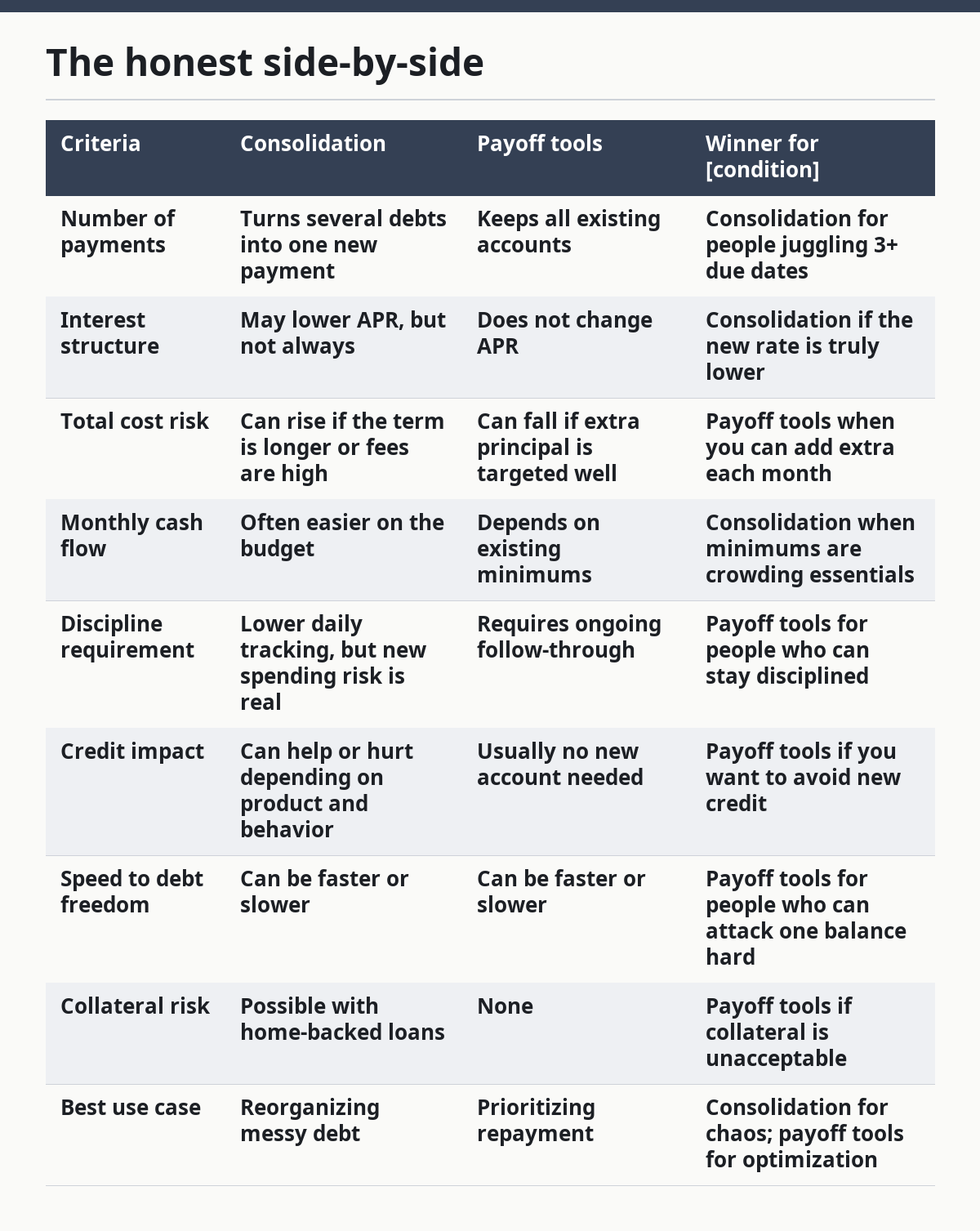
That table hides an important point: the “winner” changes with the condition. A balance transfer card can be a smart consolidation tool if you pay it off during the promotional window, but a bad one if the fee and post-promo rate overwhelm the benefit. A snowball plan can be motivating, but if the highest-rate debt is large, the interest cost may be meaningfully higher. None of this is a moral judgment. It is a trade-off.
The clearest pattern is this: consolidation is a packaging decision, while payoff tools are a behavior decision. Packaging can buy time. Behavior decides whether the time helps.
How to choose based on your exact situation
Choose consolidation if the debt stack is unmanageable at the calendar level: too many due dates, too many rates, too many missed payments, and enough stable income to support a new fixed plan. If you can lower the required monthly payment without extending the pain forever, consolidation may give you breathing room. That is especially true when your current setup is causing late fees or overdrafts because payments are scattered through the month.
Choose payoff tools if the debt is organized but expensive. If all minimums are current and you can direct extra money somewhere each month, the payoff method matters more than a new loan. The avalanche method is often the stronger financial choice when high APR cards are the main problem. The snowball method is often the stronger behavioral choice when momentum is weak and the monthly budget is tight but workable.
The exact numbers in your own accounts determine the result. A personal loan with a fixed APR, a 0% balance transfer card with a transfer fee, or a debt management plan with creditor concessions can each beat your current setup, but only on the right terms. Check the current fee schedule and terms before moving anything. A 3% transfer fee, for example, can be worth it on a large balance with a high rate, but not on a small balance you can erase quickly. You do not need a complicated model to see that; you need a calculator and your statements.
The best first step is usually not the product. It is the inventory: balances, APRs, minimums, due dates, fees, and whether any debt is secured by collateral. Once that list is complete, the better option usually becomes obvious.
When you should not use either option
Neither consolidation nor a payoff plan is the right first move if the real issue is income shortfall, job instability, or a payment shock from a recent life event. If minimums are already missed and you are choosing between debt payments and basics, the priority is survival budgeting, creditor contact, and possibly nonprofit counseling. A new loan or new payment plan can make the math look cleaner while the real problem stays unsolved.
Neither option is a good fit if you are considering tapping home equity to rescue unsecured debt but have no reliable way to stop the debt cycle. The collateral risk can be severe if your income falls or expenses rise. That is a serious trade-off, and one that should be discussed with a qualified professional before you move.
Neither option works well if you keep borrowing after every payment milestone. Paying off a card and then using it again creates the same problem with a fresh face. Consolidation makes this risk more dangerous because it can free up credit lines that look available again. A payoff plan can also fail if you treat every small victory as a reason to relax the budget.
For people who are already in collections, facing lawsuits, or behind on multiple secured debts, the decision path is different. That is the point where legal protections, creditor negotiation, and local consumer-debt rules matter. Those rules differ by country and sometimes by state or province, so there is no universal script that fits every case.
The verdict: which one to choose and why
Choose consolidation if you have multiple debts, stable income, and a new payment structure that clearly lowers complexity without hiding extra cost in a longer term or risky collateral. Choose payoff tools if your debts are current, your cash flow is steady enough to make extra payments, and you want the lowest-cost path to elimination. Neither if you cannot cover essentials, are already relying on new debt to keep old debt current, or need legal or counseling help because the problem has moved beyond simple repayment.
That is the hard call: consolidation is the cleaner first move for messy debt, while payoff tools are the better first move for manageable debt. If the debt is already overwhelming your budget, a calculator will not save you. If the debt is manageable, a new loan may only rearrange the furniture.
Exception scenarios where the answer flips
The overall verdict flips in four situations.
First, a balance transfer card can beat every other option if the promotional period is long enough, the transfer fee is modest relative to the balance, and you can realistically erase the debt before the standard rate applies. A 0% offer is not magic; it is a timer. If you need 18 months and can finish in 15, that can be a strong setup. If you need 30 months and the offer lasts 12, it is the wrong tool.
Second, a debt management plan can be the best choice if your creditors are willing to cooperate and the plan lowers payments enough to keep you current without taking on new credit. That kind of plan is often a better fit than a personal loan when your credit is already bruised and you need structure more than flexibility.
Third, payoff tools flip the choice when your debt is mostly high-interest revolving debt and you have enough monthly surplus to add even a modest extra amount. In that case, an avalanche plan plus automatic payments can beat the hassle of refinancing. The savings come from discipline, not from a new contract.
Fourth, neither option should be your first move if the debt is mixed with a broader money problem, such as unstable housing costs, irregular income, or medical bills that may still change. When the numbers are still moving, the first job is to stabilize the ground under them. Only then does consolidation or payoff strategy make sense.
A practical way to decide this week
Start with a one-page debt inventory: creditor, balance, APR, minimum payment, due date, and whether the debt is secured. That is the single most useful document in the whole process. Then ask three questions: Can I keep up with minimums? Can I add extra money each month? Would one payment make my life easier without making the debt more expensive overall?
If the answer to the first question is no, look at counseling, creditor contact, and income/budget fixes before anything else. If the answer to the second is yes, use a payoff tool before adding a new account. If the answer to the third is yes and the terms are honest, consolidation may help. The decision is not mysterious. It is arithmetic plus behavior.
The search for the “best” tool usually misses the real issue. The best tool is the one that fits your budget, your discipline, and your timeline. The wrong tool can make debt more expensive, more complicated, or both. The right one makes the path visible, then gets out of the way.
Drafted with AI; not yet reviewed by a person.