Last updated: November 19, 2026
Quick Answer: a debt payoff side hustle is usually most effective when it starts quickly, has low startup costs, and sends every extra dollar to one debt target while minimum payments stay current. This guide explains how to choose a debt payoff side hustle, how to turn extra cash into debt reduction, and where the traps are.
Key takeaways
- A debt payoff side hustle works best when it adds cash without creating new debt, taxes surprises, or high startup costs.
- The right choice depends on your time, energy, local demand, and whether you need money this week or can wait a month or two.
- Simple service work usually beats product-based ideas for debt payoff because it starts faster and needs less upfront spending.
- The most useful plan is boring on purpose: earn, separate the money, cover taxes if needed, and make extra principal payments on one debt at a time.
- If debt is already causing missed payments, collection calls, or eviction risk, income boosts alone may not be enough; a qualified financial adviser or nonprofit credit counsellor should be part of the plan.
This is information, not financial advice. A qualified adviser should review your own situation, because debt rules, taxes, and benefit thresholds differ by country and change often.
What a debt payoff side hustle is actually for
A debt payoff side hustle is extra income that exists for one job: to create margin fast enough to attack debt without making the rest of life unstable. It is not a hobby, a second career, or a vague “make more money” project. It works when the side income is easy to track, easy to separate from regular spending, and not so time-consuming that it causes job burnout or missed bills.
For the Debt Payoff Side Hustles: The Complete Guide, the best use case is income you can start using within days rather than months. That makes service work, task-based work, and skills you already have more useful than ideas that need inventory, a website, or paid ads. If a side hustle needs you to spend $500 before it makes the first dollar, it is already less attractive for debt reduction than something that needs a phone, transport, or a laptop.
The point is not to “replace” your salary. The point is to give your budget a second stream so extra payments can happen every week or every pay cycle. That matters because debt payoff is about consistency, not drama. Even a modest extra amount can help if it arrives predictably and is not absorbed by impulse spending.
A generic article usually misses the ugly middle: taxes, variable hours, platform fees, and the way a side hustle can quietly become a second source of stress. The real goal is not just income. It is usable income.
Which side hustles work best for debt payoff?

The best debt payoff side hustles are the ones with low startup costs, quick payout cycles, and no inventory risk. Service-based work usually wins here because it turns time into cash without tying money up in stock, equipment, or shipping. That includes cleaning, pet sitting, tutoring, moving help, lawn care, freelance admin work, delivery driving, house sitting, and task apps, depending on what is available where you live.
Service work has one major advantage: cash flow begins fast. That matters when the debt goal is immediate. If you can start with a borrowed tool, a license you already have, or a skill you already use at work, the path to extra debt payments is shorter. It also keeps the “break-even” problem small. A side hustle that needs constant supply restocking can eat a lot of the money it was supposed to generate.
There is a trade-off. Service income is often irregular. Weekends may be busy while weekdays are slow. Some jobs are physically demanding. Some platforms take fees, and some local markets are already crowded. If the work is unreliable, the payoff plan needs to assume lean months, not just busy ones.
Product-based side hustles are usually weaker for debt payoff unless there is a clear, preexisting skill and a clear market. Handmade goods, print-on-demand, and resale can work, but they often require more setup, more patience, and more working capital. That delay can be a problem when the debt balance is already dragging on monthly cash flow.
The practical test is simple: if the side hustle cannot produce net cash in a few weeks, it may be better as a long-term income project than a debt payoff tool.
How do I choose the right one for my situation?
The right side hustle depends on how quickly you need money, how many hours you actually have, and how much physical or mental energy you can spare. A person with two school-age children, a full-time job, and no car needs a very different plan from someone who can do evening delivery shifts or weekend labour. The wrong answer is the hustle that sounds impressive but collapses after two weeks.
Start with four filters:
- Startup cost — If it needs more than a small amount of money to begin, it should be examined carefully.
- Time to first payout — Faster is better when debt is active.
- Skill match — Existing skills reduce friction and learning time.
- Sustainability — If it makes the rest of life unstable, it may backfire.
A good match is often a boring one. Someone who types well may earn more reliably from transcription, proofreading, basic bookkeeping, or virtual assistant work than from chasing trendy gigs. Someone with a truck may do better moving small loads or hauling junk. Someone with a flexible schedule may prefer gig delivery. Someone with childcare constraints may need remote work that can be done in blocks of 30 to 60 minutes.
The wrong fit is easy to spot once the excitement fades. If the side hustle requires a long onboarding process, expensive gear, special permits, or daily availability you do not have, it is not a debt payoff tool. It is a liability in disguise.
A useful rule is to avoid any option that needs debt to start. If the side hustle itself requires a loan, a credit card balance, or recurring purchases before it earns, the math should be treated with caution and reviewed by a qualified adviser if the amounts are meaningful. For debt decisions and consumer-credit questions, consumer protection guidance such as the U.S. Consumer Financial Protection Bureau and equivalent local regulators can help explain the risks.
The honest side-by-side: service work vs product work

Service work wins for most debt payoff plans because it starts faster and carries less financial risk. Product work can scale better later, but it is usually a slower route to the first extra payment. That difference matters more than most generic articles admit.
| Criteria | Service work | Product work | Winner for this condition |
|---|---|---|---|
| Startup cost | Usually low if you already have the skill, transport, or tools | Often needs inventory, samples, materials, or a storefront setup | Service work for low cash on hand |
| Time to first payout | Often quicker because the work can begin after basic setup | Usually slower because setup and selling come before income | Service work for urgent debt payoff |
| Cash flow predictability | Can be steady if demand is local or recurring | Can be lumpy and dependent on sales cycles | Service work for monthly budgeting |
| Scalability | Limited by hours and energy | Can scale if the product sells without extra labor every time | Product work for long-term growth |
| Risk of losing money first | Lower if overhead stays small | Higher if stock, ads, or returns eat into margin | Service work for risk control |
| Skill transfer | Often uses skills from ordinary work or home life | May need design, sourcing, or marketing skills | Service work for beginners |
| Tax complexity | Can still be complicated, but recordkeeping is usually simpler | Can involve inventory, shipping, and more deductions to track | Service work for simpler admin |
| Burnout risk | Can be high if it adds evening and weekend labour | Can be high if fulfillment, customer service, and admin pile up | Tie; depends on the person |
| Best use case | Immediate debt reduction | Building a longer-term second income stream | Service work for debt payoff now |
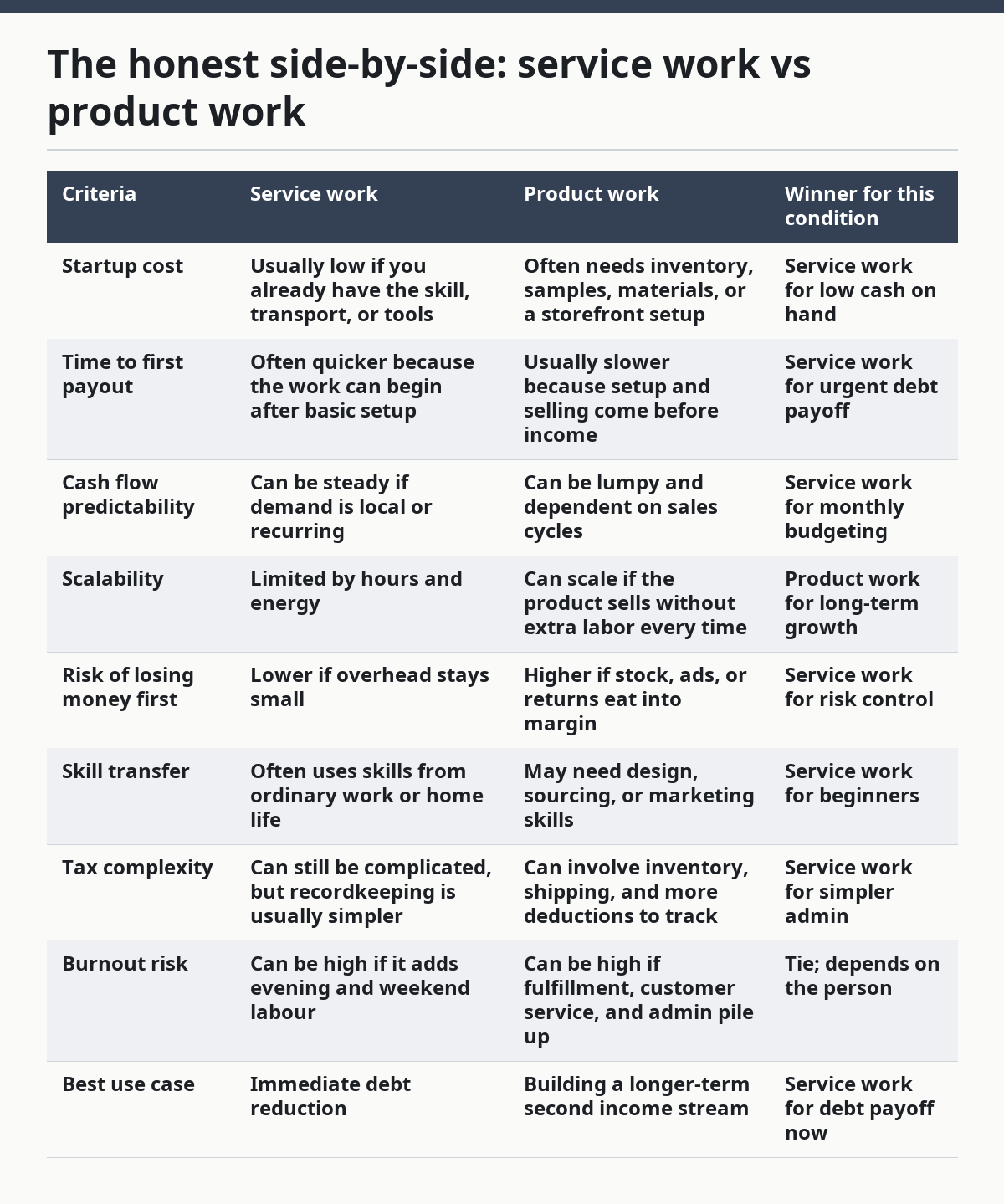
The important takeaway is not that product work is bad. It is that product work is usually the wrong first move when debt is the main problem. A side hustle should reduce pressure, not add inventory risk and delayed cash.
A generic comparison often ignores the hidden costs: platform fees, fuel, wear and tear, supplies, shipping, and the time spent on admin. Those costs matter because debt payoff is about net income, not gross income.
How to turn side income into actual debt reduction
Extra income only helps debt payoff if it is directed on purpose. The cleanest method is to separate the money the moment it arrives and assign it a job before it blends into daily spending. Without that step, side income tends to vanish into groceries, takeout, subscriptions, and “small” purchases that are hard to remember later.
A simple structure works well:
- Keep minimum payments current on every debt.
- Choose one debt target at a time.
- Send extra money to that target, not across all balances.
- Track side income separately from regular pay.
- Save a small buffer for tax withholding, fees, or irregular expenses if the work is self-employed.
The debt target can be the smallest balance or the highest-rate balance, depending on the repayment method the reader is using. The side hustle itself does not change that choice; it just creates the extra payment. What matters is consistency. A side income that lands in a separate account and is transferred on a schedule is much easier to use than cash that sits in the main checking account.
Taxes deserve attention because side income is not always “spendable” in full. In many countries, self-employment income can create tax obligations, and the rules differ by country and year. A reader should check local rules or ask a tax professional before assuming every dollar is available for debt. The IRS and other national tax authorities publish guidance on self-employment tax and recordkeeping, and readers should consult a local professional for their own situation.
One more warning: do not use side income to justify new debt. A common failure pattern is taking on extra work, then buying a car, phone, or equipment upgrade because “the side hustle is paying for it.” That turns debt payoff into debt cycling.
What about taxes, records, and deductions?
Taxes, records, and deductions can decide whether a side hustle feels helpful or miserable. Even small amounts of side income should be tracked from the beginning, because memory is a terrible accounting system. A notebook, spreadsheet, or budgeting app is enough if it records date, client or platform, amount received, and any related expense.
The exact tax treatment depends on country and local rules, so there is no universal threshold or universal deduction list. A freelancer in one country may need to set aside money from every payment; a part-time worker in another may only need to report income at tax time. That is why the reader should check the local tax authority or a qualified tax adviser rather than guessing, and the IRS Self-Employed Individuals Tax Center is one example of an authoritative source that explains basic recordkeeping and reporting concepts.
Two records matter most:
- Income records — what came in, when, and from where
- Expense records — supplies, fees, mileage if applicable, software, and other work-related costs
The reason is simple: debt payoff should use net profit, not gross deposits. A side hustle that brings in money but quietly burns through it in fees, fuel, or shipping is not as useful as it first appears.
There is also a practical tax risk with cash work. If payments are not recorded, it becomes harder to know whether the side hustle is truly helping or just creating confusion at tax time. Clarity is worth more than a vague sense of “extra money.”
When side hustles are not the right answer
A side hustle is not the right answer if the debt problem is already severe enough that the household is missing rent, defaulting on loans, facing collection action, or using one debt to pay another. In those cases, extra income can help, but it may not be enough on its own. The debt may need formal restructuring, hardship support, a nonprofit credit counsellor, or another regulated solution.
It is also the wrong answer when the person is already close to burnout. A second job can worsen fatigue, reduce performance in the main job, and make money decisions worse. If the side hustle becomes a source of panic, sleep loss, or family conflict, the cost may exceed the benefit.
A reader should also step back if the side hustle depends on heavy driving, heavy lifting, late-night work, or unsafe conditions. A small amount of extra debt reduction is not worth a larger injury risk or a job loss.
The blunt truth is that not every debt problem is a “make more money” problem. Sometimes the budget needs surgery, not a second shift. A qualified financial adviser or nonprofit debt counsellor can help judge that difference.
The exception scenarios that change the verdict
The general verdict favors service work, but there are clear exceptions. Those cases matter because a generic article that ignores them gives the wrong answer to the wrong person.
- The person already has a product with proven demand. If a reader already makes something that sells regularly without much extra advertising, product work may beat service work because the setup is already done and the item can scale.
- The person has almost no spare hours but can build slowly. A product-based project may fit better if the person can invest tiny blocks of time now for larger future payoff later.
- The person has a specialized skill that commands higher rates. A freelancer with existing clients, a license, or a technical skill may earn more from remote services than from local labour, even if the setup takes longer.
- The person needs immediate cash and already has tools or transport. In that case, local service work usually wins because it can start quickly and does not require inventory.
These exceptions do not cancel the main recommendation. They narrow it. The right side hustle is the one that fits the reader’s actual constraints, not the one that sounds best on a list.
The verdict: which path to choose and why
Choose service work if the goal is to create extra debt payments as quickly as possible, with low startup cost and limited risk. Choose product work if there is already a proven product, enough time to build slowly, and a clear path to selling without taking on new debt. Neither is right if debt is already causing missed essentials, because that needs a stronger plan than a side hustle alone.
That call is deliberate. Debt payoff rewards speed, simplicity, and net cash. Service work usually gives those three things sooner. Product work can still be useful, but it is more often a second-stage income project than a first-stage debt solution.
How much side income is enough to matter?
Enough side income matters when it changes the payment schedule, not when it merely feels helpful. Even a small, regular amount can shorten a payoff timeline if it is directed to one balance and not dispersed across everyday spending. The exact threshold depends on the debt size, interest terms, and the household budget, so there is no honest universal number to promise.
The better question is whether the side hustle can be repeated. A one-time burst of cash may cover a bill, but it does not change the long-run pattern. A recurring weekly or monthly amount is what turns a side hustle into debt reduction.
That is why consistency beats occasional hustle intensity. Two or three repeatable hours each week may be more useful than a bursty project that exhausts the person and stops after a month. The best debt payoff side hustle is the kind that survives real life.
What should a beginner do first?
A beginner should start by listing available time, physical limits, current skills, and local demand, then choose the simplest option that can begin quickly. If the first idea needs money upfront, a long setup, or a hard-to-explain learning curve, it is probably not the best first move.
A practical first step is to test one side hustle for 30 days with a fixed schedule and a clear income target. That test should include recordkeeping, tax awareness, and a plan for where the money goes the moment it lands. If the hustle cannot produce usable net income in that window, it deserves a second look before more time is spent on it.
The real goal is not to become “busy.” The goal is to create repeatable debt payments without making the rest of life harder.
Is it better to focus on earning more or spending less?
Both matter, but a side hustle solves the earning side first. If spending is already out of control, new income can disappear fast. If the budget is already tight but stable, extra earnings can make a meaningful difference without a full lifestyle overhaul.
The strongest approach is often mixed: cut obvious waste, keep the main budget stable, and use the side hustle strictly for debt reduction. That combination protects the extra income from being swallowed by routine spending.
Can a side hustle replace a full-time job?
A side hustle can supplement income, but it should not be treated as a guaranteed replacement for full-time work. Income from side work is often variable, and access to benefits, job security, and predictable pay can be hard to replace. If a person is thinking about leaving a job, that decision should be reviewed carefully with a qualified financial adviser or career professional.
For debt payoff, replacement is usually the wrong first goal. The better goal is to use the side hustle as a pressure valve while the main job stays the anchor.
How do I know if I’m choosing the wrong hustle?
The wrong hustle usually has one or more of these signs: it needs too much startup money, takes too long to pay, depends on perfect conditions, or creates more stress than the debt relief is worth. If it requires constant motivation just to break even, it is probably not a good debt payoff tool.
Another warning sign is vague income. If you cannot explain how money is made, how often it is paid, and what the net amount might be after costs, the idea is too fuzzy to trust with debt reduction. Clarity is part of the strategy.
The best debt payoff side hustle is not glamorous. It is the one that gets cash moving, stays manageable, and does not create a new financial problem while trying to solve the old one.
Drafted with AI; not yet reviewed by a person.