Last updated: November 19, 2026
Quick answer: a monthly extra income checklist for debt payoff turns irregular money into a repeatable routine, and the goal is to move each month’s extra cash to debt before it disappears. If you are juggling taxes, benefits, or multiple debts, a qualified adviser can help.
Key takeaways
- A monthly checklist works best when it starts with a calendar, not a big income idea.
- Track every extra dollar in an income log before it is spent elsewhere.
- Send each extra payment with a clear purpose, then verify that it hit the right debt.
- Review the same few numbers every month so the routine stays repeatable.
- If extra income is unstable, treat it as a bonus stream rather than a guaranteed payment plan.
Who this checklist is for
This checklist is for someone who wants a repeatable monthly action sequence, not a one-time side hustle brainstorm. It assumes you already have a debt you want to pay down, a basic budget, and at least one place where extra money can be parked for a few days before it is sent as an extra payment. It also assumes you can use a calendar, a simple income log, and your lender’s payment portal.
This is not the right tool if the problem is that your core bills are already overdue every month. In that case, extra income may help later, but the first issue is cash flow stability. It is also not a substitute for tax planning if your extra income is taxable where you live. Country rules, minimums, and filing thresholds vary, so the tax side should be checked locally.
The real use of this page is consistency. A $50 payment that arrives every month is often more useful than a bigger amount that shows up once and vanishes. The checklist turns the process into a set of dated actions: earn, log, reserve, send, confirm, review.
If you want the broader framework around side income and debt snowballing, the hub on debt payoff side hustle and income boosters can sit alongside this page. This article stays focused on the monthly sequence.
What the monthly extra income checklist actually does

The checklist keeps extra income attached to debt payoff before that money gets absorbed by ordinary spending. It does that by creating one fixed monthly loop: identify the income source, set the date it lands, record it in an income log, route it to a specific debt as an extra payment, and review the result at month-end.
The point is not to chase the highest-paying idea every month. The point is to make the same mechanics work for whatever income arrives: a weekend shift, a freelance invoice, a marketplace sale, a seasonal bonus, or a one-off gig. The method stays the same even when the source changes.
A good checklist has three moving parts. First is the calendar, which tells you when to expect money and when to act. Second is the income log, which tracks gross amount, fees, taxes withheld if any, and net amount. Third is the extra payment itself, which should be targeted rather than vague. “Extra to debt” is too loose. “Extra $120 to Card A on the 15th” is usable.
The trade-off is simple: this method is administrative work. If you dislike tracking or you need immediate cash for essentials, the routine can feel slow. It also does not make unstable income magically reliable. A month with no extra income is still possible, so the plan should be built to flex without breaking.
How do I build a monthly extra income checklist?
You build it by assigning one task to each week of the month and one decision to each dollar that comes in. The checklist below uses a 4-week rhythm, but the exact dates can shift with your pay cycle or invoice cycle.
- Map the month on a calendar. Mark every expected income date, payment due date, and review date in a 30-day or 31-day view. Verify that the dates do not overlap in a way that would force an extra payment before cash arrives. If your calendar has no buffer of at least 3 to 5 days, the plan is too tight.
- Name the income source for the month. Pick one primary source, such as overtime, tutoring, freelance work, delivery shifts, or selling unused items. Verify the source can realistically produce a net amount you can track. If the source depends on a long delay or uncertain payout, consider treating it as unconfirmed income until paid and, if needed, consult a qualified professional about how to plan around the delay.
- Estimate net income, not gross income. Write down the amount after platform fees, withholding, mileage, or other direct costs. If a platform takes a fee, record the expected net in dollars, not the headline payout. A mismatch between gross and net is a common reason extra payments get shorted.
- Create a dedicated holding place. Use a separate savings subaccount, envelope, or clearly labeled ledger entry for debt money. Verify the money stays untouched until the extra payment is sent. If it keeps getting mixed with grocery or rent money, the system is not isolated enough.
- Schedule the extra payment before the month gets busy. Set the payment date for 1 to 3 business days after cash lands, or earlier if the lender posts same-day. Verify whether the creditor counts the payment as principal-only or regular payment first. If the extra money is misapplied, the debt balance may not drop the way you expect.
- Record every receipt in an income log. Note date, source, gross amount, fees, net amount, and where the money was sent. A simple spreadsheet or notebook is enough. If you cannot tell where one dollar came from, the log has failed.
- Send the extra payment with the right instruction. If your lender allows it, specify that the amount should go toward principal or the chosen debt. Verify the payment confirmation number and the posted balance. If the payment posts to the wrong debt or only counts toward the next regular due date, correct it right away.
- Check the balance after posting. Confirm the principal or statement balance dropped by the expected amount, minus any interest that accrued in the meantime. If the balance does not move as expected, the issue may be payment timing, fee allocation, or a pending status that has not cleared.
- Reset the checklist for the next month. Carry forward what worked, remove what did not, and set one improvement for the next cycle. If the same step keeps failing two months in a row, the process needs a simpler structure, not more force.
A practical example makes the sequence easier to use. If a freelance job pays on the 18th, the log gets updated that day, the money sits in the holding account for 2 business days, and the extra payment is sent on the 20th or 21st. The month-end review then checks whether the balance moved, whether the lender posted it correctly, and whether the source should stay on the calendar next month.
What should go into the income log?

The income log should record the facts that decide how much debt money you really have. At minimum, that means date earned, source, gross amount, direct fees or costs, net amount, and the debt payment it will support. If you are using a spreadsheet, one row per payment or gig is enough.
A useful income log also includes a status column: expected, received, reserved, sent, and confirmed. That makes it easier to see where money is stuck. A log without status often looks complete while the cash is still sitting unassigned.
Use the log to separate income ideas by month, not by fantasy. A seasonal task in December may not belong in March. A weekend-only task may not fit a month when your schedule is already crowded. The log should show which sources are recurring and which are one-offs. That helps you judge whether the stream can support a regular extra payment or only an occasional lump sum.
The log is also where people discover hidden drag. A side job that looks useful at first may lose value after platform fees, travel, supplies, or taxes. The numbers do not have to be huge to matter, but they do need to be honest. A small net amount sent every month is better than a large gross amount that never becomes debt reduction.
For a starting standard, keep the log for 12 months. That gives enough history to spot patterns without turning the system into a bookkeeping job. If the log becomes too detailed to maintain, reduce it to the fields that actually affect the payment.
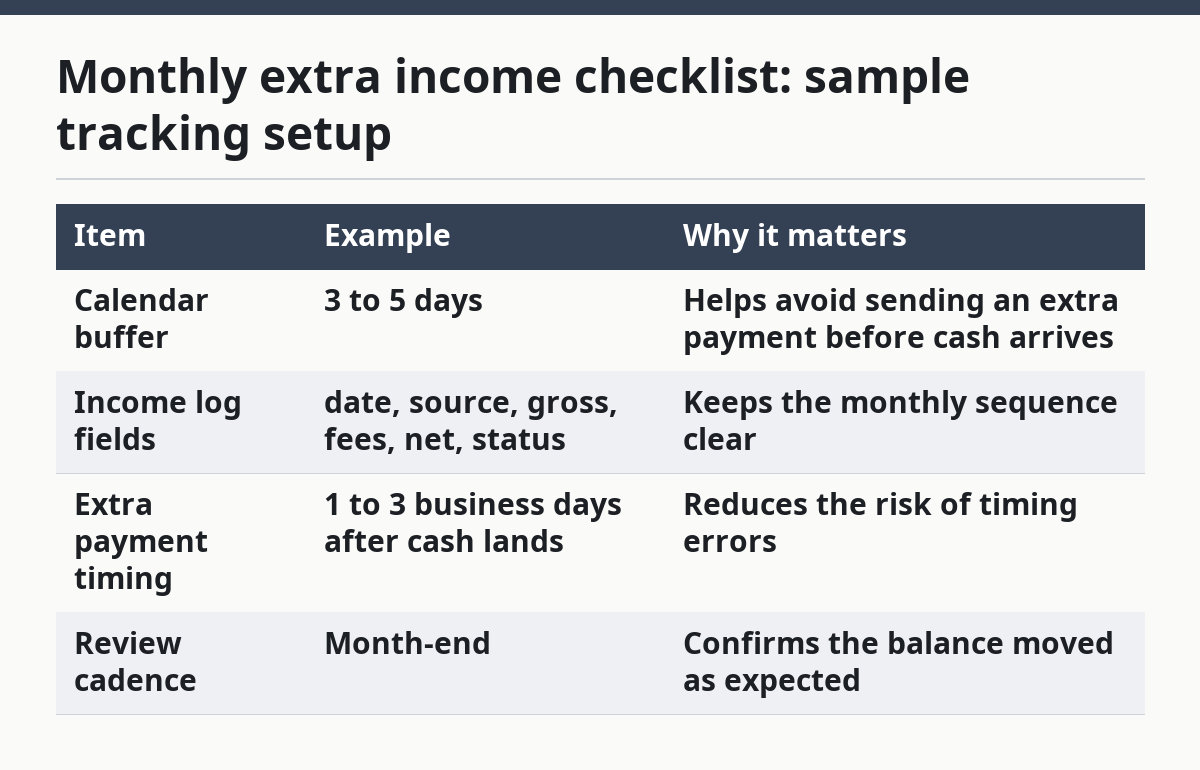
Monthly extra income checklist: sample tracking setup
| Item | Example | Why it matters |
|---|---|---|
| Calendar buffer | 3 to 5 days | Helps avoid sending an extra payment before cash arrives |
| Income log fields | date, source, gross, fees, net, status | Keeps the monthly sequence clear |
| Extra payment timing | 1 to 3 business days after cash lands | Reduces the risk of timing errors |
| Review cadence | Month-end | Confirms the balance moved as expected |
How do I keep making extra debt payments every month?
I keep the monthly loop small enough to repeat even when income changes. The secret is to separate planning from execution: the calendar sets the date, the log captures the money, and the extra payment closes the loop.
A stable routine usually has one fixed review point each month, often near the end of the billing cycle. At that review, I check four things: what came in, what was reserved, what was paid, and what still needs attention. If the same debt has been targeted for 3 months in a row, I confirm that the lender is applying extra payments where intended. If not, I change the payment instructions instead of increasing the amount.
A simple monthly rhythm can look like this:
- Week 1: update the calendar and confirm the month’s income source.
- Week 2: log any money received and move it to the holding place.
- Week 3: send the extra payment once funds clear.
- Week 4: review the posting, note the remaining balance, and set the next month’s target.
The main risk is treating extra income as if it will always arrive on time. It may not. That is why a repeatable checklist should allow a zero-income month without breaking the entire debt plan. If no extra money lands, the checklist still has value because it shows the gap clearly.
When the standard checklist does not fit
The standard checklist does not fit when the cash flow is too unstable, the debt is already in distress, or the extra income has strings attached. In those cases, the routine needs a different shape.
Your income lands in large, unpredictable chunks: the timing is uncertain — use a longer review window, such as every 2 weeks, and keep the holding period longer before sending an extra payment.
Your extra income is taxable and not yet set aside: the net amount is unknown — reserve the estimated tax portion first, then log only the spendable balance for debt.
Your lender charges a fee for certain payment methods: the extra payment could shrink at the source — switch to the lowest-cost method the lender accepts and verify that the payment still posts correctly.
Your debts are in collection, default, or legal action: the normal payoff sequence may not apply — get qualified advice before sending money where it could be misallocated.
Your monthly essentials already depend on that extra income: the money is doing two jobs — use a more conservative plan and do not schedule extra payments that could leave rent, utilities, or food short.
The source is seasonal rather than monthly: the plan needs a different cycle — build a 3-month or 6-month reserve inside the log, then apply payments only when the reserve reaches a usable level.
These are not signs of failure. They are signs that the monthly checklist needs adjustment, or that a different debt strategy is a better fit. The mistake is forcing a weekly or monthly pattern onto money that does not behave that way.
The mistakes that interrupt debt payoff
The most common mistake is counting gross income as debt money. That can leave the extra payment short once fees, mileage, supplies, or withholding are removed. The fix is to log net income only and move the gross number out of decision-making.
Another mistake is sending the payment without confirming where it will go. Some lenders apply payments to the next due amount first, then interest, then principal, unless you instruct them otherwise. If the extra money does not reduce the balance the way you expected, the payment method or instructions need to be checked.
A third mistake is skipping the calendar. Without a date, extra income becomes a vague intention. The result is missed payment windows and money that drifts into ordinary spending. A dated plan beats a good intention every time.
A fourth mistake is mixing debt money with everyday cash. When the extra money sits in the same account as groceries, fuel, and subscriptions, it becomes hard to tell what is truly available. A separate holding place is the cleanest fix.
A fifth mistake is chasing too many sources at once. Two or three income streams may look efficient, but they can become hard to track if each one has a different payout date, fee structure, and confirmation rule. One reliable stream with a clear log is often easier to manage than several noisy ones.
A sixth mistake is failing to review the result. If a payment posts late, misses principal, or gets absorbed by a fee, the same problem can repeat for months. A 10-minute month-end check can prevent that.
What a good month looks like
A good month looks boring in the best way: the calendar was updated, the income landed, the log was filled in, the extra payment was sent, and the balance moved by the amount you expected. Nothing has to be dramatic for the system to work.
A practical benchmark is whether you can repeat the same process next month without rebuilding it from scratch. If the answer is yes, the checklist is doing its job. If every month requires a new workaround, the system is too complex.
The end goal is not perfect predictability. It is a repeatable pattern that turns extra income into debt reduction before the money gets lost. That is why the checklist matters more than the individual idea. A single income source can change, but the sequence should stay the same.
How do I know the month-end review is complete?
The month-end review is complete when the money has been logged, the payment has cleared, and the balance has been checked. I also want a short note on what changed this month: source used, net amount, and whether the payment timing worked.
Drafted with AI; not yet reviewed by a person.