Last updated: November 19, 2026
Quick answer: A debt is usually too small to worry about first when its minimum payment, interest, and paperwork do not meaningfully block the rest of your plan; in practice, that often means a balance you can verify, carry for now, and leave alone without fees or cash-flow strain. This page breaks that call into a simple check, so you can judge the balance, the account, and the trade-off before you move on in How to Tell If a Debt Is Too Small to Worry About Before the Rest of Your Plan.
Key takeaways
- A debt can be “small” in dollars and still matter if it has a high minimum payment or a due date that strains your cash flow.
- A tiny balance may be worth leaving alone if it is easy to pay, won’t trigger a fee, and does not add stress or clutter.
- Account closure, credit report effects, and autopay settings can change the result more than the balance size itself.
- The right question is not “Is this debt tiny?” but “Does this balance interfere with the rest of my plan?”
- This is general information, not financial advice; a qualified adviser should be consulted for your own situation.
Picture this: you’ve got one balance that looks harmless, and you want to know if it can wait while you handle the bigger parts of your plan. The answer depends on the minimum payment, the balance size, and whether the account creates any extra cost or mess. The sections below show you how to tell, and the Consumer Financial Protection Bureau explains why account terms matter as much as the balance itself.
What counts as a small debt balance?
A small debt balance is one that is small relative to your monthly budget, the account’s minimum payment, and the rest of your debt list. There is no universal dollar line that works in every country or for every lender.
That matters because a $200 balance can be a nuisance on one account and a non-issue on another. The number alone does not decide it, and the same is true in the CFPB’s debt guidance and Experian’s credit-report explanations.
- If the minimum payment is tiny and easy to cover, the balance may be “small enough” to leave for later.
- If the minimum payment is still a strain, the balance is not really small in practice.
- If the account has fees, a variable rate, or a pending closure issue, the balance deserves more attention than its size suggests.
The truth is, people often confuse “small balance” with “low priority.” Those are not the same thing. A small balance can still create stress, hurt cash flow, or keep an account open when you’d rather simplify things.
For a broader view of how balances and payment habits affect your plan, the CFPB’s debt collection and budgeting pages are a useful starting point, while debt payoff prioritization shows how to sort debts once you know the size is only part of the story.
How do I know if a debt is too small to worry about?
A debt is too small to worry about first when you can cover its minimum payment, it does not create a fee problem, and it does not block a cleaner plan for the rest of your balances. That is the practical test, and a qualified adviser should be consulted if the account has side effects you do not understand.
Here’s the catch: “too small to worry about” does not mean “ignore it forever.” It means the balance is not the next thing that needs your attention, according to the CFPB and your lender’s rules.
Use this check in order:
- Write down the balance. Note the exact amount, the account type, and the next due date. Verify that the amount is current, not a rounded guess. If you do not know the balance to the dollar, the problem is not small enough to judge yet.
- Find the minimum payment. Look at the statement or online account and find the required amount for this month. Verify whether autopay is on. If you cannot cover the minimum from normal cash flow, the debt is not “small” in the way that matters.
- Check the interest charge. Look for the annual percentage rate, or APR, on the statement. Verify whether the balance is accruing interest each day or on a monthly cycle. If interest is still adding up and you are paying only the minimum, the balance may deserve more attention than its size suggests.
- Check for fees or penalties. Look for late fees, overlimit fees, or a deferred-interest clause. Verify the trigger date and the amount. If one missed or late payment would create a fee, the debt is not low-maintenance.
- Check the due date gap. Compare this due date with the rest of your bills over a 30-day window. Verify whether this account causes a tight cash week. If it crowds rent, utilities, or food, the balance needs a more careful plan.
- Check the account role. Ask whether this is a credit card, store card, installment loan, or medical bill. Verify whether paying it off would close the account, change your available limit, or simplify the number of active bills. If the account has side effects, the balance is not just a balance; consult a professional if you are unsure how the rules apply.
- Check the mental load. Notice whether this one account keeps you from starting the rest of the plan. Verify whether it creates dread, confusion, or repeated reminders. If the stress is disproportionate, it may be worth clearing for the sake of account simplification.
A balance that passes all seven checks is usually the kind you can leave for later. A balance that fails even one or two may deserve earlier attention, so the safest move is to confirm the facts with the lender or a qualified adviser when the answer is not obvious.
What matters more than the dollar amount?
The minimum payment and the account’s side effects usually matter more than the raw balance. A $50 debt with a low minimum payment can be easy to ignore for now, while a $300 balance with a tight due date can derail your month, and the CFPB’s guidance supports looking at the whole account picture rather than the number alone.
This is why the word “small” can fool people. A balance can look small on paper and still be awkward in real life.
Look at these three signals:
- Cash flow fit: Can you pay the minimum without cutting essentials?
- Account impact: Does the balance keep the account open or create a closure issue?
- Admin burden: Does the account add another login, another due date, or another statement to track?
That last one sounds minor, but it adds up. One extra bill is easy; five extra bills can turn into missed dates and avoidable fees.
On the flip side, a small balance that is already on autopay, carries no fee risk, and fits cleanly into your month is often not the thing to worry about first. It is just a line item, and debt payoff prioritization is where that judgment usually gets sorted.
When should a tiny balance still get attention?
A tiny balance still gets attention when it creates a fee, a report issue, or a cleanup problem. The dollar amount is not the only thing that matters, and that is why a small balance can still move up the list.
Use this list as a stop sign:
- A late fee is near: If one missed due date would trigger a charge, the balance is no longer low-risk.
- The account may close: If paying it off would shut the account, you need to know whether that changes your available credit or your plan.
- The statement keeps changing: If interest, fees, or new charges keep appearing, the balance is not really finished.
- The account is hard to manage: If you keep forgetting the login or due date, the account may deserve cleanup now.
- The balance causes real stress: If the mental load is bigger than the dollar amount, that is part of the cost.
These situations are common with older cards, store accounts, and small medical or utility balances. They are not rare edge cases. They are the moments when a balance that looks tiny becomes the one that keeps dragging on, and Experian plus the CFPB both note that account status can matter in ways the sticker price does not show.
You also want to watch the credit report angle. A paid-off account can still show up for a while, and an open account can affect your total number of active lines. Reporting rules differ by country and by lender, so do not assume the same result everywhere, and check the issuer’s written policy or the CFPB’s general guidance before you act.
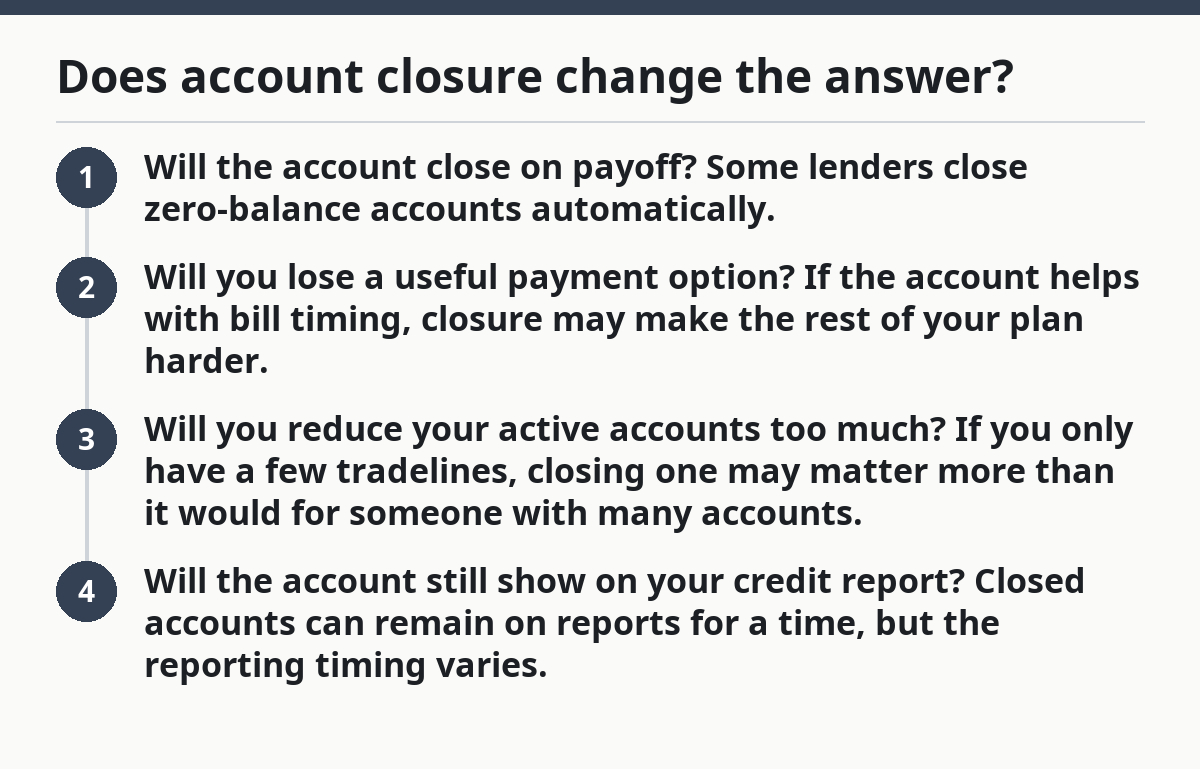
Does account closure change the answer?
Yes, account closure can change the answer because the balance is only part of the story. If paying off a small balance will close the account, you should care about what that means for your records and your monthly setup.
A closed account is not automatically bad, and an open account is not automatically better. The real issue is whether closure simplifies your life or creates a new problem.
Here’s what to check before you rush to finish a tiny balance:
- Will the account close on payoff? Some lenders close zero-balance accounts automatically.
- Will you lose a useful payment option? If the account helps with bill timing, closure may make the rest of your plan harder.
- Will you reduce your active accounts too much? If you only have a few tradelines, closing one may matter more than it would for someone with many accounts.
- Will the account still show on your credit report? Closed accounts can remain on reports for a time, but the reporting timing varies.
If closure helps you simplify, a small balance may be worth clearing sooner. If closure removes a helpful account you intended to keep active, the balance may not be the main decision, so compare the lender’s rules with the rest of your plan before deciding.
This is one place where a qualified adviser or a lender’s written rules can matter, because the effect depends on your full profile, not just the amount owed, and the CFPB is the best public reference for general consumer-credit questions.
How do I decide in 10 minutes?
You can decide in 10 minutes by checking four things in order: the minimum payment, the due date, the fee risk, and the account role. That gives you a practical answer without building a full spreadsheet, and it keeps How to Tell If a Debt Is Too Small to Worry About Before the Rest of Your Plan tied to the facts rather than a guess.
Use this quick process:
- Pull the statement for the account.
- Find the balance and the minimum payment.
- Mark the next due date on a calendar.
- Check whether a late fee, penalty rate, or closure rule applies.
- Ask whether paying this off would make the rest of your plan easier.
- Ask whether leaving it alone would create stress or confusion.
- Decide whether the account is a “later” item or a “clean it up now” item.
A good result is simple: you know why the balance is low priority, not just that it feels small. If you cannot explain the reason in one sentence, you probably do not know enough yet, and the CFPB’s consumer tools can help you check the basics before you move on.
What people get wrong about small balances
The most common mistake is treating a small balance as harmless even when the minimum payment is a stretch. That can lead to late fees, missed due dates, and a messier month than expected, so a professional opinion is worth getting if the numbers are tight.
Other mistakes show up fast:
- Ignoring the due date. The consequence is a late fee or a mark on the account. The fix is to calendar the date and set autopay if you can cover it.
- Focusing only on the balance. The consequence is a bad priority call. The fix is to compare balance, fee risk, and minimum payment together.
- Assuming closure is always good. The consequence is losing an account you meant to keep open. The fix is to check the lender’s closure rules first.
- Forgetting about new charges. The consequence is that a “small” balance stops being small. The fix is to stop using the account while you clear it, if that fits your plan.
- Letting stress do the sorting. The consequence is that you spend energy on the wrong bill. The fix is to use the same checklist every time.
None of this requires perfect math. It requires a consistent filter, plus a source check or a professional if your account has unusual terms.
When does the standard answer not apply?
The standard answer does not apply when the account has special terms, irregular billing, or reporting rules that make the balance behave differently. That includes deferred interest, accounts in dispute, and bills that can change after the statement date, so the safer move is to verify the terms before deciding.
Use a different lens in these cases:
- Deferred-interest offers: A small remaining balance may still matter if a promo period ends and unpaid interest is added. Check the expiration date and the full payoff amount.
- Disputed charges: If the balance includes something you dispute, the number on the statement may not be the right number to judge yet.
- Medical or utility bills: These can have different collection timing and reporting behavior than a standard revolving account.
- Shared accounts: If another person also uses the account, your decision affects more than your own budget.
- Multiple small balances: Five tiny balances can add up to a real admin burden even if each one looks harmless alone.
In these cases, the question is not “Is it tiny?” The question is “Does this account have a rule that changes the cost of waiting?”
The verdict on a small debt balance
A small debt balance is too small to worry about first when the minimum payment is easy, the fee risk is low, the due date fits your month, and the account does not complicate the rest of your plan. If any of those pieces break, the balance is no longer just “small.”
That is the judgment call this page is built to make. A small balance is not automatically the right thing to ignore, and it is not automatically the right thing to rush. It earns its place by how it behaves in your budget and your account list, not by the number alone, and the CFPB’s consumer-credit guidance is a good general reference when you want to check the basics again.
When is a debt too small to prioritize?
A debt is too small to prioritize when the minimum payment is manageable, there is no near-term fee risk, and paying it now would not improve the rest of your month. That can be true even if the account still has a balance on it.
If the payment is easy and the account is stable, the debt can usually wait. If it keeps creating noise, stress, or fees, it is no longer a “small” problem in practical terms.
Should tiny balances be paid off early?
Tiny balances should be paid off early only when they simplify the plan or remove a fee risk. A small balance with a due date problem, a closure issue, or a high stress level may be worth clearing sooner than its size suggests.
If none of those apply, leaving it for later can be reasonable. The goal is a cleaner plan, not a race to zero on every line item.
Does a small debt still matter in a payoff plan?
A small debt still matters in a payoff plan if it changes cash flow, adds fees, or affects account simplification. A small balance can be the easiest bill on paper and still be the one that causes the most friction.
If it does not interfere with your next step, it may stay in the background for now. If it does, it belongs back on the main list, and that is where the answer to How to Tell If a Debt Is Too Small to Worry About Before the Rest of Your Plan becomes obvious.
Drafted with AI; not yet reviewed by a person.