Last updated: November 19, 2026
Quick Answer: Pause extra debt payoff only when that money is needed to cover essential bills, keep at least the minimum payment, or stop a cash problem from turning into late fees and extra interest charge. This guide shows how to check that decision without guessing.
You can’t fix a cash crunch by starving the rest of your budget.
Key takeaways
- A debt payoff plan should pause only when the cash you’d send to debt is needed for basics or to avoid a missed minimum payment.
- The key test is simple: if money is tight enough that rent, food, utilities, transport, or the debt minimum are at risk, the payoff push needs a break.
- A cash buffer is not the same as extra spending money; it’s the money that keeps the month from breaking.
- Temporary pressure is different from a long-term budget problem, and the next move depends on which one you have.
- This is information, not financial advice. A qualified adviser can help with your own situation.
Who this applies to — and what it assumes
This applies to someone already making regular debt payments and wondering if extra money should stay in the debt payoff plan or be redirected for a while. It assumes you know your monthly income, your fixed bills, and the minimum payment due on each debt. It is part of How to Know When to Pause Debt Payoff and Use the Money Elsewhere.
It also assumes the problem is temporary or uncertain, not a full reset of your finances. A one-month cash squeeze is not the same as a year of unstable income. If you’re choosing between debt payoff and a long-term emergency-fund plan, that is a different question and belongs on a different page.
The money term you need here is cash buffer: the amount left after the essentials are covered, plus a little room for timing gaps. If the buffer is thin enough that one late utility bill or car repair would force a missed debt payment, the plan needs a pause. That is the whole point.
A debt payoff plan is not a promise to send every spare dollar to creditors. It is a plan to avoid missed payments, late fees, and a spiral of damage. If the choice is between extra principal and groceries, the answer is not complicated.
This is where the plan bends.
What this page does and doesn’t cover
This page covers the decision point for a temporary cash crunch: when to slow or pause extra debt payoff and use the money elsewhere for now. It does not tell you how to rank debts, how to build a full emergency fund, or how to handle a missed paycheck without missing payments.
For the broader budgeting context, the hub on debt payoff planning and budgeting belongs before or after this decision, not inside it. That keeps the question clean: is the extra debt money needed elsewhere this month, yes or no?
Two outside references are worth keeping nearby for terms and payment rules: the U.S. Consumer Financial Protection Bureau’s debt collection and credit card guidance, and your country’s own consumer finance regulator or banking association. Payment rules, late-fee policies, and protections vary by country and by lender.
How do you know the debt payoff plan should pause?
You know it should pause when the next dollar to debt is needed to protect essential expenses or keep every account current. That’s the test, not how uncomfortable you feel about slowing down.
Picture this: your rent is due in 5 days, the utility bill is higher than expected, and the only place the gap exists is the extra amount you were sending above the minimum payment. That extra should usually stay in the checking account until the month stops wobbling.
The goal is not to abandon the plan. It is to stop one problem from becoming three. A temporary pause can protect against late fee charges, overdraft charges, and the kind of missed payment that makes the next month harder.
Use this simple check:
- Are food, housing, utilities, transport, child care, or insurance at risk this month?
- Is any debt payment in danger of missing its due date?
- Would moving the extra payment now keep the account current and the lights on?
- Is the shortfall temporary, or do the numbers keep breaking every month?
If the answer to the first or second question is yes, the payoff plan should usually pause. If the answer to all four is no, the extra money can probably stay where it is.
That’s the line.
What should you check before you move the money?
The right check is not “Do I feel worried?” It is “Do I have enough to cover the essentials and every debt minimum before the next paycheck or income deposit arrives?” That question beats guesswork every time.
For example, a 3-day buffer can be enough to spot an unexpected bill before you send extra money to debt. If the money survives the waiting period, it is more likely to be truly available.
Before you redirect a dollar, look at these items in order:
- Essential bills first: rent or mortgage, food, utilities, transport, medicine, insurance, and child care.
- Minimum payment next: every debt account needs at least its required minimum by the due date.
- Cash buffer last: whatever remains should cover timing gaps, fees, and one small surprise.
Now, you might be wondering whether a tiny surplus means you should keep paying extra. Sometimes yes, but only if the surplus is real. A balance that looks healthy today can vanish if one bill is due before your next paycheck. That’s how people get tricked into a false cushion.
A good check uses actual dates, not a monthly average. Write down the next 30 days and mark every due date. If your essential bills cluster in the first 10 days and your income lands on day 15, the timing alone may justify holding cash back. The problem is often the calendar, not the budget.
For many people, a 72-hour hold helps. Put the extra debt amount in the bank account for 3 days before sending it anywhere. If a bill, transfer, or fee shows up in that window, the money was already needed elsewhere. If nothing changes, the debt plan can continue.
Timing tells the truth.
How do you pause debt payoff without making the month worse?

You pause the extra payment without making the month worse by keeping the account current and the cash visible. If the lender allows payment changes through an app or portal, adjust only the extra portion and leave the minimum payment intact. If autopay is set to pull the full amount, change it before the cutoff date in the account terms.
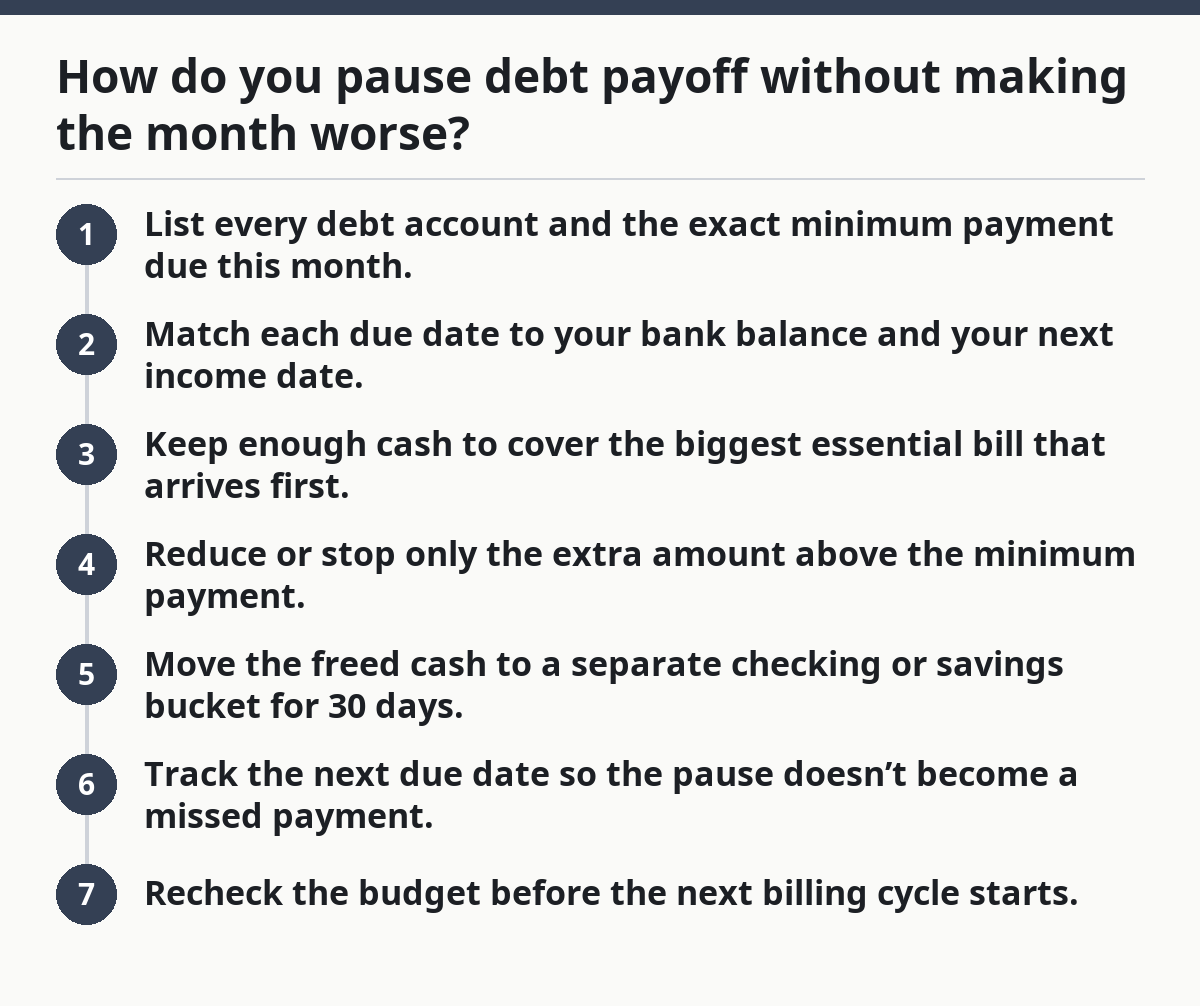
Use this sequence:
- List every debt account and the exact minimum payment due this month.
- Match each due date to your bank balance and your next income date.
- Keep enough cash to cover the biggest essential bill that arrives first.
- Reduce or stop only the extra amount above the minimum payment.
- Move the freed cash to a separate checking or savings bucket for 30 days.
- Track the next due date so the pause doesn’t become a missed payment.
- Recheck the budget before the next billing cycle starts.
The point of the separate bucket is simple: if the money disappears into ordinary spending, the pause solves nothing. If it stays visible, you can reuse it for food, rent, or the next minimum payment without confusion.
A problem shows up fast when the account is overdrawn, the lender reverses a payment, or a partial payment still triggers a fee. Those are signs the process is too loose. Tighten the dates, keep a larger buffer, or stop making changes until the month is stable.
Sloppy timing costs money.
When should the pause end?
The pause should end when the cash buffer can absorb the next normal cycle without threatening essentials. That usually means the current month is settled, the next minimum payments are already covered, and no late fee risk sits on the horizon.
Picture this: the bills for the month are covered, the account is no longer drifting toward zero, and the next due dates are visible on the calendar. You now need a rule for turning the debt payoff plan back on.
Look for these signs that the hold can end:
- The next rent, utility, and transport bills are already funded.
- The minimum payment due dates are covered with room to spare.
- The account is no longer one surprise away from a missed payment.
- The temporary shortfall has passed, such as a one-off repair or a delayed invoice.
- The checking account stops dipping below the amount needed for essentials.
If the pressure came from one event, the pause should end when that event is paid for or passed. If the pressure is repeating every month, the issue is not a pause; it is a budget mismatch. That is not a debt-payoff question anymore.
Restarting the plan does not have to mean returning to the old level all at once. If the cash buffer is still thin, the safer move is often to restart with a smaller extra amount and watch the month for one full billing cycle. That keeps the plan alive without pretending the problem vanished.
Restart slowly.
What mistakes do people make here?
The biggest error is treating extra payoff as untouchable. That can turn a temporary squeeze into a fee cycle, and fees are expensive because they crowd out next month’s basics. The right alternative is to protect essentials first and keep the minimum payment current; the CFPB’s guidance on payment timing and fee consequences is a good place to check the basic rules, and a qualified adviser can help with your own situation.
Common mistakes include:
- Skipping the minimum payment: this can trigger late fees and damage the account; the fix is to cut only the extra amount, not the required one.
- Emptying the cash buffer: this leaves no room for timing gaps; the fix is to keep a visible reserve for essentials.
- Ignoring due dates: this causes avoidable misses even when the monthly total looks fine; the fix is to map bills on a calendar.
- Using the pause for loose spending: this makes the break temporary in theory but useless in practice; the fix is to earmark the cash for a named bill or bill window.
- Resuming too fast: this puts the account back under stress; the fix is to wait until one full cycle is stable.
A small pause is not failure. A missed payment because the pause was not managed is the real failure. The difference is mostly calendar discipline and honesty about the cash buffer.
One practical standard helps: if you cannot say exactly which bill the money is protecting, you probably should not move it yet. That rule is simple, and it prevents a lot of regret; if the decision is not obvious, consult a qualified financial professional and check your lender’s rules.
Clarity beats optimism.
When does the standard rule not fit?
The standard rule needs modification when timing, not spending, is the core problem. A freelancer who gets paid on the 10th and 28th may need a larger operating buffer than someone with the same monthly total and a biweekly paycheck. A household with annual insurance premiums or school fees also needs to look past the neat monthly average.
Picture this: your income changes from week to week, your bills are due in uneven chunks, or a one-time expense lands after you already committed the month’s cash. The normal advice still helps, but it needs adjustment.
In those cases, the question is not “Should I keep paying extra on debt?” It is “Can I keep the account current through the next payment cycle without draining the money needed for bills that come before income?” That is a timing question, not a discipline question.
Another edge case is when a creditor has a payment plan, hardship option, or due-date change already in place. If the minimum payment has been adjusted or temporarily reduced, the pause decision changes with it. Read the lender terms carefully, because a modified plan can change the size of the safe cash buffer.
If the cash shortfall is recurring and not just temporary, stop treating the pause as a short break. That pattern usually means the budget needs a larger reset, and the debt payoff plan alone cannot solve it; a qualified adviser can help you judge whether the problem is temporary or structural.
Recurring shortfalls need a different fix.
How do I know the pause is the right size?
The pause is the right size when it covers the actual gap and no more. If the money needed elsewhere is $200 because of a utility bill, a co-pay, or a transport repair, then the pause should protect that $200 and whatever extra is needed to keep the minimum payment safe. Do not turn a temporary gap into a blank check.
A useful check is this: after essentials and minimums are covered, is there still a small cushion left for a second surprise? If yes, the pause may be too large. If no, the pause may be too small. The point is to keep the budget from skating on ice that’s too thin.
Watch for these signs that the pause has grown too big:
- The cash stays untouched for more than one full billing cycle.
- The original emergency is already paid.
- The money starts looking like free spending cash.
- The debt plan never restarts because the decision is now habit.
A pause should end when the gap it was meant to cover is gone. If it doesn’t, the plan has stopped being temporary. That’s the line between a useful break and a stalled payoff schedule.
Temporary means temporary.
Should I pause debt payments if I lose income?
Yes, if losing income makes it hard to cover essentials or a minimum payment. The first step is to protect housing, food, utilities, transport, and any required debt minimums before sending extra money to debt. If the income drop is serious or ongoing, a qualified adviser can help you sort the next move for your situation.
Drafted with AI; not yet reviewed by a person.