
Last updated: November 19, 2026
Quick answer: debt payoff communications work best when you get the payoff amount in writing before you pay, and you keep the full paper trail for at least the final quote, payment proof, and closure notice. Debt payoff communications are the letters, emails, calls, and records you use to make a debt payoff plan clear, accurate, and hard to dispute. Good communication protects you from missed dates, fee surprises, and credit-report errors. The guide below shows what to say, what to ask for, and what to keep on file in Debt payoff communications — The Complete Guide.
Information only, not financial advice: debt rules, collection practices, and creditor policies vary by country and change often, so a qualified adviser should review your own situation before you act. For consumer debt collection rules, see the CFPB’s debt collection overview and the FTC’s debt collection guidance: https://www.consumerfinance.gov/consumer-tools/debt-collection/ and https://consumer.ftc.gov/articles/dealing-debt-collectors
Key Takeaways
- Use writing first. A paper trail makes it easier to prove what was agreed, when it was agreed, and who said it.
- Ask for the exact balance, the payoff date, and whether interest or fees can still change the total.
- Keep every reply, reference number, and screenshot in one place.
- A settlement, hardship plan, or payoff quote can sound final and still fail if you do not get the terms in writing.
- If a collector or lender gives conflicting answers, stop and escalate in writing before you send money.
Picture this: you want the debt gone, but every answer you get sounds slightly different, and one missed detail could cost you fees or leave a balance behind. The fix is clear, documented payoff communication that gets the numbers, dates, and terms in writing before money moves. The sections below settle what to ask, who to contact, and how to avoid the mistakes that trip people up.
What debt payoff communication actually covers

Debt payoff communication is the set of messages that turn a vague intention into a clean, recorded transaction. It covers payoff quotes, settlement offers, hardship plans, confirmation letters, and dispute messages. The point is simple: you want proof, not promises.
Picture this: you owe a lender, a card issuer, or a collector, and each one may use different wording for the same thing. One may call it a payoff amount, another a reinstatement quote, and another a settlement figure. Those words are not interchangeable, and the wrong one can leave money on the table.
- Payoff quote: the amount needed to clear a debt on a specific date.
- Settlement offer: an agreement to accept less than the full balance, if the creditor agrees.
- Hardship plan: a temporary payment arrangement, often with changed due dates or fees.
- Confirmation letter: written proof that the account was closed, settled, paid in full, or placed on a plan.
- Dispute letter: a written challenge to an error in the balance, dates, ownership, or reporting.
A generic article often skips the biggest risk: a payoff amount can change after the quote date. Interest may keep running, fees may post, or the quote may expire in a few days. If the communication does not name the date it applies to, the number is only half-useful.
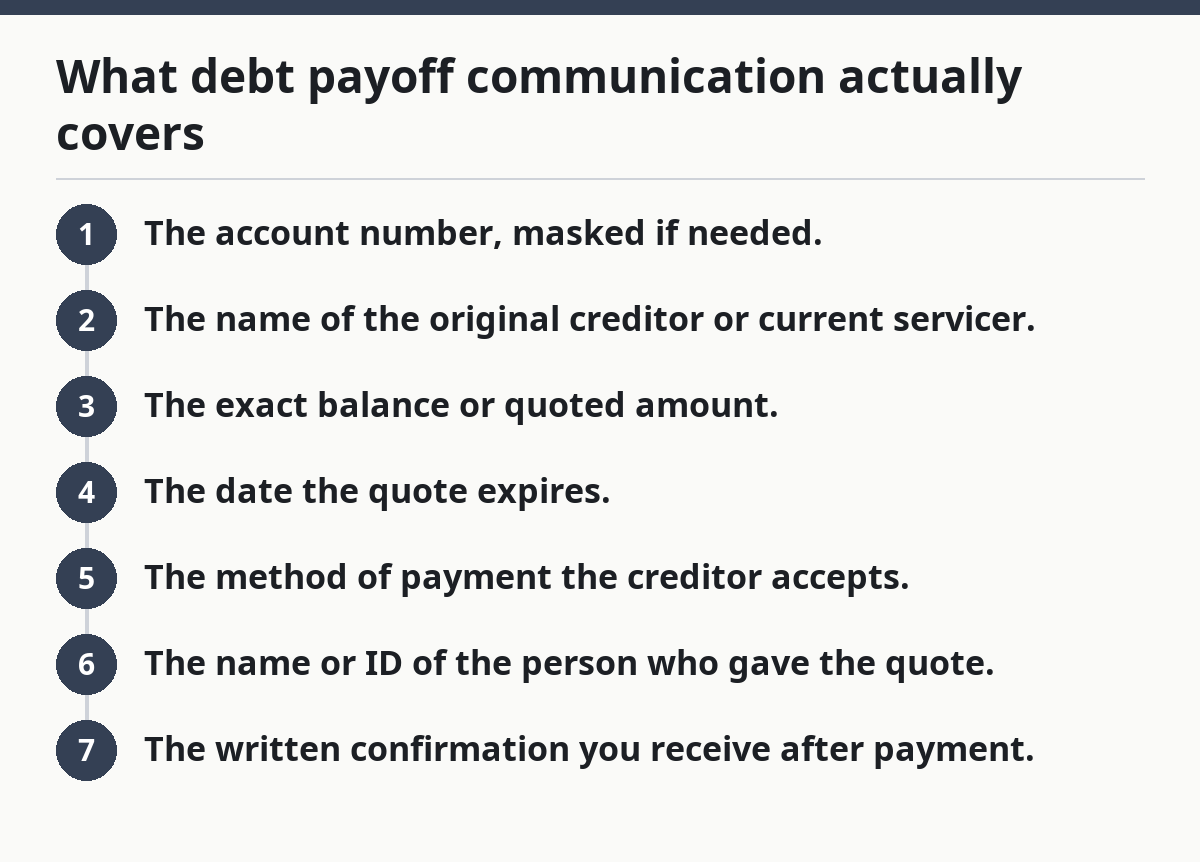
A smart communication file usually includes:
- The account number, masked if needed.
- The name of the original creditor or current servicer.
- The exact balance or quoted amount.
- The date the quote expires.
- The method of payment the creditor accepts.
- The name or ID of the person who gave the quote.
- The written confirmation you receive after payment.
If a balance matters to your budget, do not rely on a phone call alone. Ask for the same terms by email or letter. That one step cuts down on confusion later.
Which debt payoff communication should happen first?
The first message should ask for a written payoff quote, because you cannot plan around an oral number. If the account is already in collections, the first message may also need to ask who owns the debt and where to send payment.
Picture this: you are ready to wipe out the balance, but you do not know whether the number includes interest through today or through next week. That missing detail can change the plan. The first job is to pin down the quote, the date, and the contact point.
Use a short, direct request. Keep it plain.
- Ask for the payoff amount as of a specific date.
- Ask whether the quote includes interest, late charges, and collection fees.
- Ask how long the quote stays valid.
- Ask for written confirmation before you submit money.
- Ask for the exact mailing address or portal if you are paying by check, transfer, or online bill pay.
If the debt is disputed, add that in the same message. A dispute and a payoff request are not the same thing, but they can live in the same file. The payoff request sets the amount; the dispute preserves your objection to any error in the balance or reporting.
For a consumer debt account, the Consumer Financial Protection Bureau explains how debt collection communication works and what information collectors must give in a validation notice. The Federal Trade Commission also has practical guidance on avoiding debt collection mistakes. Those are useful starting points, but local rules may differ by country and sometimes by state or province.
A strong first message should include:
- Your full name and the account number.
- The date you are writing.
- A request for the payoff amount in writing.
- A request that any fees or interest after that date be shown separately.
- A request for a written receipt or closing letter after payment.
The truth is, a vague first message invites a vague reply. Specific asks get specific answers.
How do you ask for a payoff amount without creating confusion?
You ask in writing, name the exact date, and tell the creditor what you need separated. Therefore, the most common mix-up is avoided when the quote is tied to one date and one account.
Picture this: you send a quick message that says, “What do I owe?” The reply comes back with a balance, but no date, no fee breakdown, and no clue whether it will change by the time you pay. That is how people end up short by a few dollars and stuck chasing another statement.
A better request sounds like this:
Please send the payoff amount for account [masked number] as of [date].
Please show whether the figure includes interest, late fees, collection costs, or other charges.
Please confirm the payment method you will accept and the date the quote expires.
Please send written confirmation once the account is paid in full.
That wording matters because it forces the creditor to answer the parts that actually change the number. If the account is with a servicer rather than the original lender, ask whether the quote comes from the current owner of the debt or from an agent. That distinction can matter if a later dispute arises.
Now, you might be wondering what to do if the creditor only speaks by phone. The answer is to use the call for details, then follow up in writing the same day. Write down the time, the name of the person, the department, and the reference number.
A clean communication log should track:
- The date and time of every call.
- The name or ID of the representative.
- The exact words used for the balance.
- The promised follow-up date.
- The reply you received afterward.
Do not send money until the written quote matches the amount you plan to send. If the creditor says the figure will change daily, that is not a problem by itself. It just means you need a fresh quote right before payment.
Settlement, hardship, and full payoff: what changes in the message?
The message changes because each outcome carries a different legal and financial meaning. A full payoff closes the account. A settlement may close it for less than the full balance. A hardship plan may keep the account open while changing the payment terms.
Picture this: you are behind, and the collector offers a deal that sounds helpful. A written deal matters more than a verbal one. The difference between “paid in full” and “settled” can show up on statements, tax forms, and credit reporting, depending on local rules.
For a full payoff, the key phrases are:
- payoff amount
- paid in full
- final payment
- account closed
- written receipt
For a settlement, the key phrases are different:
- accepted as full settlement
- remaining balance waived
- no further collection on the settled amount
- how the account will be reported
- whether the settlement must be paid by a specific date
For a hardship plan, ask:
- whether the rate changes
- whether fees stop
- whether the due date changes
- whether the account stays open
- what happens if one payment is missed
A settlement message should never be vague. If the creditor wants a lump sum, ask for the exact amount, the deadline, and the written statement that the rest will be forgiven or waived if that is part of the deal. If that wording is missing, the “deal” may not mean what you think it means.
The best part is that you can ask for all of this before you pay a cent. In many cases, getting the terms in writing is the safest way to reduce the chance of a dispute later.
A solid settlement or hardship communication should include:
- the account number
- the proposed amount or plan
- the date by which you can pay
- a request for written acceptance
- a request for final reporting language after payment
Do not confuse kindness with clarity. A friendly collector can still send a sloppy letter, and a polite lender can still leave out a key term. The paper matters more than the tone.
What should you keep in your records?
You should keep everything that proves the balance, the terms, and the result. That means the original letters, the emailed quote, the call log, the payment confirmation, and the final closure notice if you get one.
Picture this: months later, a statement appears with a leftover balance, or a collector says the account is not closed. Without records, you are left arguing from memory. With records, you can point to dates, names, amounts, and agreed terms.
A useful debt payoff file often includes:
- the original bill or statement
- the payoff quote
- the settlement or hardship letter
- proof of payment
- screenshots of online messages
- the final receipt or closure notice
- any credit-report dispute letter tied to the account
A paper trail also helps if the debt is sold. An account can move from one company to another, and old messages may not follow cleanly unless you saved them. If the new owner questions the amount, the old records can show what was already agreed.
Keep your records in two places if you can. One digital folder and one paper copy is better than one stack of loose email threads. Use file names that make sense at a glance, such as:
- 2026-03-14 payoff quote
- 2026-03-18 settlement acceptance
- 2026-03-21 payment receipt
- 2026-04-02 closure letter
If the account is on your credit report, save the report itself and any dispute results. Credit reporting rules vary by country, but mistakes are common enough that a clean file can save hours later.
What can go wrong even when the plan sounds right?
A lot can go wrong, and most of it starts with one missing sentence. The usual problems are expired quotes, partial payments that do not satisfy the deal, and collectors who fail to confirm the account status in writing.
Picture this: you make the payment on time, but the creditor says the quote expired the day before. Or you paid the number you were given, yet the account still shows a balance because interest kept running. These are the kinds of problems that make written terms matter.
Common failure points:
- The payoff quote did not list an expiration date.
- The amount included only part of the fees.
- The payment method caused a delay in posting.
- The settlement letter did not say the rest would be waived.
- The collector accepted money but did not update the file.
- The account was transferred before confirmation arrived.
A lot of readers miss one simple risk: a payment can post after the deadline even if you sent it before the deadline. If the creditor requires cleared funds by a certain date, mail delay or bank processing time can matter. Ask how long the payment method takes to settle before you rely on it.
If the creditor will not put the terms in writing, that is a serious warning sign. You may still choose to pay, but you should understand that you are giving up leverage without proof. The safer move is to pause and escalate in writing.
A short escalation message can say:
- the prior date and reference number
- the amount you were quoted
- the exact term that is missing
- the correction you need before paying
That message is not rude. It is defensive bookkeeping. Financial systems run on records, not memory.
What are the exceptions that change the right approach?
The right approach changes if the debt is disputed, time-limited, or tied to a special program. In those cases, the first message should not be a plain payoff request alone.
Picture this: the debt may be too old to collect in some places, the balance may include a billing error, or the lender may be offering a formal assistance program. Each scenario changes the words you should use and the risk of paying too soon.
Exception scenarios:
- You dispute the balance. Start with a dispute letter and ask for validation before you discuss payment.
- The debt is in a hardship or relief program. Ask for the program terms, the end date, and the effect on interest or fees.
- The account is very old. Ask how local laws affect collection and whether payment could affect your rights. Those rules differ by country and sometimes by region.
- The debt was sold. Ask for proof that the current company owns the debt and is authorized to collect.
If any of those apply, the payoff message should be slower and more careful. A rushed payment can weaken your position if the balance is wrong or the collector is not the proper one.
The best practice is simple:
- Identify the debt type.
- Check whether there is a dispute.
- Ask for the right written proof.
- Pay only after the terms are clear.
On the flip side, if the balance is current, undisputed, and the creditor has already given a written payoff quote, the process can be straightforward. The communication then becomes a checklist job rather than a negotiation.
Debt payoff communications: the practical alternatives and when they fit
Different debt payoff communications fit different situations, and the right choice depends on whether you need speed, proof, or a dispute record. A written letter gives the cleanest record. An email is often faster. A phone call can help you gather details, but it should not be the only record. For example, if a collector gives a payoff figure on March 14 and says it expires on March 21, that date should appear in writing somewhere before you pay.
Start with the debt payoff communications that match the risk. If the debt is simple and current, email may be enough to request the quote and confirm the receipt. If the debt is disputed, a mailed letter gives you a stronger record of what you asked for and when you asked for it. If the account is under a hardship program, keep both the program terms and the payment confirmations together so the timeline is easy to prove later.
The format also matters when you are dealing with a lender versus a collector. A lender may already have the account history, while a collector may need you to confirm the original creditor, the account number, and the balance basis. Those details are not just administrative. They can change who is allowed to answer, what number is valid, and whether a later balance dispute will be accepted.
Why debt payoff communications are worth doing carefully
Debt payoff communications are worth doing carefully because the cost of a mistake can be larger than the time it takes to get one more written line. A quote that misses fees, a payment that posts late, or a settlement letter that leaves out a waived balance can create a second round of calls and letters. In a 2023 FTC report, consumers reported losing more than $10 billion to fraud overall, which is one reason precise written records matter whenever money moves. In this topic, a few extra lines can prevent a much larger headache later.
The payoff process is often less about persuasion than precision. A clear request can produce a clear answer, and a clear answer can prevent a dispute after payment. That is especially true when the account number, the date, the amount, and the reporting language all need to line up. If one of those pieces is missing, the file is harder to defend.
The honest verdict on debt payoff communication
Choose written communication if you want proof, fewer surprises, and a clean record of what was agreed. Choose phone calls only as a way to gather details, then confirm everything in writing. Neither is enough if the balance is disputed, the debt has been sold, or the terms are changing fast.
Picture this: you have the money, the quote, and the desire to be done. What finishes the job is not speed. It is a message trail that matches the final payment and the final status.
Here is the practical verdict:
- Choose written-first communication if the debt is current, the payoff amount is available, and you want a record you can keep.
- Choose a careful dispute-first approach if the balance looks wrong, the collector changed, or the account history is unclear.
- Choose neither fast payment nor informal promises if the creditor refuses to put the terms in writing.
That is the line. A clean payoff is built from dates, amounts, names, and confirmations—not from hope.
How do you follow up after you pay?
You follow up by asking for a final receipt, a zero balance, or a closure letter as soon as the payment clears. If the debt was settled rather than paid in full, ask how the account will be reported and when the final update should appear.
Picture this: the money is gone, but the record still says you owe something. Because of that, the follow-up closes the loop.
A good post-payment message asks for:
- confirmation that the payment posted
- confirmation of the new balance
- the final account status
- the date the account will be updated in records
- a copy of the closing or settlement letter
If the creditor says it can take several business days or longer to update, keep that answer in your file. If the account later appears wrong, the timeline matters.
Do not assume silence means success. Silence may just mean processing delay. The account should end with a document that matches the payment you sent.
FAQ
What is the most important thing to ask for in debt payoff communication?
The most important thing to ask for is the payoff amount in writing with a date attached to it. That one detail tells you what the number means and how long it stays valid. Without it, the balance can change before you pay.
Is a phone call enough to settle a debt?
A phone call is not enough by itself. It can help you gather details, but the terms should be confirmed in writing before you send money. If the agreement matters, the paper trail matters more.
What should a settlement letter say?
A settlement letter should say the exact amount, the deadline, and what happens to the remaining balance. It should also say how the account will be reported after payment, if that is part of the deal. If those points are missing, ask for a corrected letter.
What if the collector gives me a different amount later?
If the amount changes later, stop and ask for a fresh written quote before paying. Interest, fees, or timing can change the figure, but the new amount should still be stated clearly. Do not rely on memory or a past call note alone.
Should I keep records after the account is paid?
Yes, keep the records after payment because the account can still be disputed later. Save the quote, the proof of payment, and the final receipt or closure notice. If the debt shows up again, those papers are your best defense.
Drafted with AI; not yet reviewed by a person.