Last updated: November 28, 2026
Quick answer: if one surprise would force borrowing within 30 days, pause extra debt payments and keep the debt snowball and emergency fund plan focused on a starter cash cushion. This is information, not financial advice; a qualified adviser should be consulted for your own situation, because debt rules and cash needs differ by country and by household.

Key takeaways
- A debt snowball works best when cash is steady enough that one repair or bill does not force new debt.
- A small emergency fund protects the plan from being derailed by an unexpected expense.
- The right pause point is about risk, not willpower: if one missed paycheck would push you back to borrowing, extra payments may be too aggressive.
- Keeping a little cash can slow payoff for a while, but it can also stop a costly restart later.
- The goal is not to choose debt payoff or savings forever; it is to keep both moving without breaking the budget.
Who should pause extra payments?
You should pause extra debt payments when the budget is too tight to absorb a normal surprise without borrowing again. The debt snowball method depends on steady monthly payments, and a bare checking account can turn one flat tire, medical bill, or job delay into a new balance fast.
This applies best to a reader who already knows the snowball order, has a basic budget, and is making minimum payments on all debts. It does not fit someone who is behind on minimums, facing collection action, or dealing with a known large bill in the next few weeks. A snowball only works if the cash flow under it is stable enough to keep going for months, not just 1 payday.
Because of that, the emergency fund matters because it acts as a minimum safety cushion. A good cushion is not a wish list; it is the amount of cash that keeps the debt plan from breaking when life gets normal-but-annoying. The Consumer Financial Protection Bureau has basic budgeting guidance that fits this idea, and the FDIC explains why insured savings accounts are used for cash reserves in its deposit insurance resources.
If a reader has large, irregular expenses or income that swings every month, the snowball may need a slower pace from the start. That is not failure. It is the cost of making the plan survivable.
How does a small emergency fund fit into the debt snowball?
A small emergency fund sits beside the debt snowball so that a shock does not force the whole plan to restart. In plain terms, the fund is the cash buffer, and the snowball is the extra amount going to the smallest debt after minimums are covered.
Therefore, the trade-off is simple. Extra debt payments cut interest and shorten payoff time, but every extra dollar sent out of the account is a dollar that cannot catch a surprise. If the fund is empty, the next unexpected expense can land on a credit card, which adds a second debt while you are trying to erase the first.
A savings account is the usual place for this cash because it keeps the money separate from checking and easy to reach. That separation helps with discipline. It also makes the buffer less tempting to spend on non-urgent purchases that are not emergencies.
The common mistake is treating the emergency fund as a reward that comes only after all debt is gone. That can work on paper and fail in real life. A debt payoff plan that cannot survive a single repair bill is fragile, and fragility is expensive. For a general budgeting baseline, the CFPB and FDIC resources above support keeping separate cash reserves, but a qualified adviser should be consulted before changing your own payoff order.
When should extra debt payments stop?
Extra debt payments should stop when the next unexpected expense would almost certainly send the budget back to borrowing. That is the point where protection matters more than speed.
For example, here is a simple way to judge it: if you would have to use a credit card, loan, or overdraft for a normal surprise, the snowball is too exposed. A small cash reserve lowers that risk. The question is not whether the fund is “perfect”; it is whether it is enough to keep the plan alive.
| Situation | What it usually means | Better move |
|---|---|---|
| No cash cushion at all | One surprise can create new debt | Pause extra payments and build a starter emergency fund |
| A small buffer exists, but it would not cover a basic repair or short income gap | The plan is still fragile | Slow the snowball and keep adding cash |
| The budget is steady and the fund can cover a real, ordinary surprise | The plan is less likely to break | Resume extra debt payments |
| Minimum payments already strain the month | The issue is not the snowball pace, it is the budget | Rework the budget before adding extra payments |
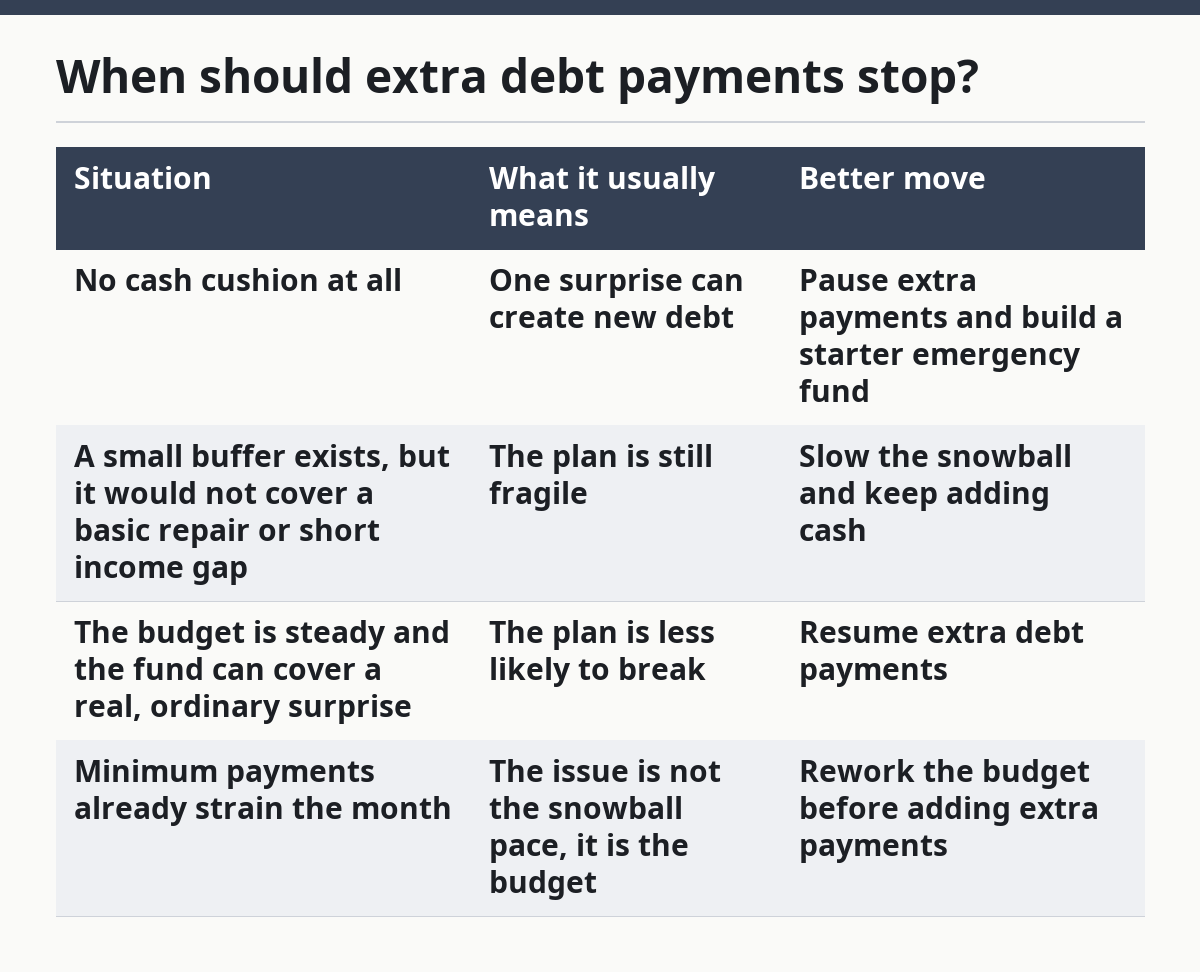
In particular, think in categories, not exact numbers. If your savings can handle a modest car repair, a higher utility bill, or a short delay in income without creating new debt, then restarting the snowball may make sense. If it cannot, then the emergency fund still needs more protection.
This is where many generic guides go wrong: they treat every extra payment as “good” and every savings dollar as “slow.” In practice, the wrong kind of speed can backfire. A restart after a setback usually costs more than a short pause, so it is worth checking your cash cushion with a qualified adviser if the trade-off is unclear.
How do you decide step by step?
You decide by checking cash, risk, and budget order in that order. The point is to protect the plan before you push it harder.
- List every minimum debt payment and due date. Write down the exact amount for each debt on paper or in a notes app, then verify that the total fits inside one normal month of income. If the minimums already exceed the budget, the problem is not the snowball; the problem is cash flow.
- Set aside a starter emergency fund in a separate savings account. Move cash out of checking so it is not spent by mistake, and keep it easy to access for an unexpected expense. If the account is mixed with spending money, the buffer is too weak to count.
- Pause extra payments when one surprise would force borrowing. Decide that a flat tire, medical co-pay, or income gap should not send you back to a card balance. If that would happen, the snowball is moving too fast for your cash base.
- Keep paying all minimums on time. Missing a minimum hurts the plan more than pausing the extra snowball amount. If minimums are late now, stop the extra payment immediately and fix the timing problem first.
- Choose one monthly cash target before restarting. The target should be enough to make the next ordinary surprise less dangerous, even if it is not a large reserve yet. If the target is vague, the pause can stretch too long.
- Review the budget for one full month. Check whether groceries, transport, and bills still fit after the pause. If the budget still breaks, the issue is spending pattern, not just debt strategy.
- Restart the snowball only after the cushion is real, not imagined. Put extra money back toward the smallest debt once the emergency fund can handle a normal shock without new borrowing. If restarting means draining the fund again, the pause ended too early.
- Recheck after any income change or new bill. If pay drops, a child care cost appears, or a deductible comes due, reset the decision. A debt plan that ignores a new fixed expense is likely to fail within 30 days.
The verification step matters because the decision is not emotional. It is mechanical: can the budget absorb life, or not? If not, more debt payments are the wrong move for now.
When should I stop extra debt payments to save cash?
Because the budget is the real test, stop extra debt payments when the emergency fund is too small to absorb a likely surprise without new borrowing. That is the cleanest trigger.
A few specific situations point to a pause:
Your checking account hits near-zero before the next paycheck: this means one delay or fee could start a debt spiral — pause the snowball and build a cash buffer first.
You have minimums covered but no spare money after basics: this means the budget has no shock absorber — redirect the extra payment into savings until the month stops feeling one bill away from trouble.
You expect a known but irregular cost within the next 1 to 3 months: this means the next “surprise” is already visible — keep cash on hand instead of sending every extra dollar to debt.
You rely on overtime, tips, or variable income: this means next month may be smaller than this month — keep a larger cushion than a fixed-paycheck household would need.
You have already used credit to cover a recent surprise: this means the plan is fragile right now — pause extra debt payments until the fund can prevent another borrow-and-repeat cycle.
The consequence of ignoring these signs is not just slower payoff. It is often a full reset: new balances, higher stress, and extra months of minimum payments. A short pause can be cheaper than a long recovery.
What mistakes slow the snowball down?
People usually slow themselves down by chasing speed at the wrong time. The debt snowball is simple, but simple does not mean careless.
Skipping the emergency fund entirely: the plan looks fast until one bill interrupts it — keep a small cash reserve in a savings account first.
Using the emergency fund for non-urgent spending: the buffer disappears when you need it most — separate emergency cash from routine money and use it only for real surprises.
Restarting extra payments before the cushion is rebuilt: the payoff gains feel good, but the next setback can put you back in debt — wait until the cash reserve can handle a normal shock.
Pausing minimums instead of extra payments: this creates late fees and damage to the plan — protect the minimums first and cut only the extra amount if possible.
Making the decision without a budget: no budget means no clear trigger for stopping or restarting — track income and fixed bills before choosing the next step.
Thinking one rule fits every household: a family with unstable income needs a different cash cushion than a salaried worker — adapt the plan to the real month, not an ideal one.
Ultimately, the correct alternative is usually modest, not dramatic: keep the snowball, but give it a small airbag. That is often enough to prevent a minor problem from becoming a new debt.
What if your situation does not fit the standard rule?
The standard rule needs changes when income, debt, or household costs are unusual. A debt snowball is a method, not a law.
If income varies month to month, the emergency fund should be treated as part of the debt plan from the start, not as a later luxury. If you support children, pay irregular medical bills, or have long gaps between paydays, the safety cushion should be stronger before extra payments become aggressive.
If you are already behind on minimums, the question changes. The first job is to stop the account from falling further behind, because late fees and missed payments can do more damage than a paused snowball. If you are facing eviction, collections, or any urgent legal issue, this is no longer a simple payoff decision; get qualified help for the full situation.
If you are close to finishing the smallest debt, a tiny pause may still be worth it if the emergency fund is empty. Losing a few weeks of extra payments is usually cheaper than restarting the whole plan after a setback. That is a trade-off many readers miss, but it is not universal; in some households, the cheapest plan is the one that survives the next 90 days, not only the next 30.
FAQ
Should I build an emergency fund before snowballing?
Usually, yes, at least a small one. A starter emergency fund lowers the chance that a normal surprise sends you back into debt. If your budget is already tight, pausing extra payments long enough to create that buffer can make the snowball more durable, even if it slows payoff for a while.
How much savings is enough before I restart the snowball?
Enough to handle a normal unexpected expense without borrowing again. The exact amount depends on your budget, income pattern, and where you live, because limits and costs vary by country and household. If a modest repair or short income gap would still wipe out the account, the cushion is probably too thin to restart.
When should I stop extra debt payments to save cash?
Stop extra payments when the next surprise would likely force new debt. If your savings are too small to cover a routine repair, a higher bill, or a short delay in income, the debt snowball and emergency fund balance is too fragile. In that case, keep making minimums and move the extra money into the emergency fund until the buffer is stronger.
Drafted with AI; not yet reviewed by a person.