Last updated: November 28, 2026
Quick answer: yes—if your regular pay covers minimums, you can send 100% of side hustle money, tips, and commission income to your smallest debt, after a small cash cushion is covered. In a debt snowball with variable income streams, the clean way is to treat your regular pay as the base budget and send variable income to debt in a set order; because situations vary, consult a qualified financial professional or adviser for your own situation.
What is the rule with variable income?
The rule with variable income streams is to give every extra dollar a job before it lands in your checking account. In a debt snowball with variable income streams, your base budget should cover rent, food, utilities, insurance, and all minimum debt payments, then irregular money such as side hustle pay, tips, and commissions goes to the next debt on your list. This is information, not financial advice; a qualified adviser should be consulted for your own situation.
That approach matters because variable income is easy to spend by accident. A commission check can feel like “found money,” but it is still income that can be planned in a budget. The same is true for tips and side hustle payments that arrive on different days each month. For broader budgeting basics, see the Consumer Financial Protection Bureau, which explains how to assign income to expenses.
The debt snowball method itself is simple: list debts from smallest balance to largest, pay minimums on all of them, and aim every extra payment at the smallest balance first. This page stays focused on where variable income fits inside that system, not on the full method. For the broader framework, the debt snowball method pillar belongs on your reading list.
A good fit here is a reader who has a regular paycheck plus uneven add-on income. A poor fit is someone whose base income does not cover minimum payments or basic bills. In that case, the problem is not the snowball order; the problem is the budget.
Key takeaways
- Use regular pay to hold the budget steady, then direct uneven income to debt on purpose.
- Keep minimum payments and basic bills covered before you assign any extra dollars.
- Side hustle money, tips, and commissions can all count, but only after you decide the rule in advance.
- A small cash buffer can stop a low-income week from breaking the plan.
- The method can fail if variable income is treated as spending money instead of planned money.
How do I put side hustle money into the snowball?
Side hustle money goes into the snowball after the month’s required bills and minimum debt payments are covered. The practical move is to set a rule for each payment: for example, transfer it to the target debt within 24 hours or on the next business day, rather than leaving it in checking where it can blur into daily spending.
A simple order helps:
- Build a budget from your regular income first. List fixed bills, groceries, gas, and every minimum debt payment.
- Pick one “target debt,” usually the smallest balance in the snowball.
- Decide what counts as extra income before the month starts. Side gig pay is one example.
- Keep a small buffer in checking if your income swings hard from week to week.
- Move the side hustle money to the target debt as soon as it clears.
- If the month already feels tight, hold the extra until the next scheduled debt payment instead of scattering it across categories.
- Check at the end of the month whether the debt payment plan still works without forcing late fees.
- If the side hustle income becomes steady enough to predict, fold part of it into the base budget and keep only the truly extra amount for debt.
The main thing to verify is whether the base budget still covers essentials without the side hustle. If it does not, the problem is cash flow, not discipline. A warning sign is using side gig money for regular spending and then scrambling to cover the minimum payment later.
This works best when the side hustle pays in small bursts. A 20-dollar delivery payout, a 75-dollar freelance deposit, or a 300-dollar weekend shift can all go to the same target debt. The exact dollar amount does not matter as much as the rule. For related budgeting help, see how to make a budget.
What should I do with tips and commissions?
Tips and commissions should follow the same rule: give them a default destination before the month starts. Tips are often daily or weekly, while commissions may arrive once a month or on a less predictable schedule, but both belong in the variable-income bucket.
The difference is timing. Tips tend to be smaller and more frequent, so they can disappear into food runs, rideshares, and small purchases. Commissions can be larger, which makes them useful for a snowball payment, but they can also create a false sense of room in the budget. If your commission is based on sales, refunds, chargebacks, or delayed payroll, treat it as uncertain until the money is actually in the account, and consult a qualified professional if you are unsure how your pay works.
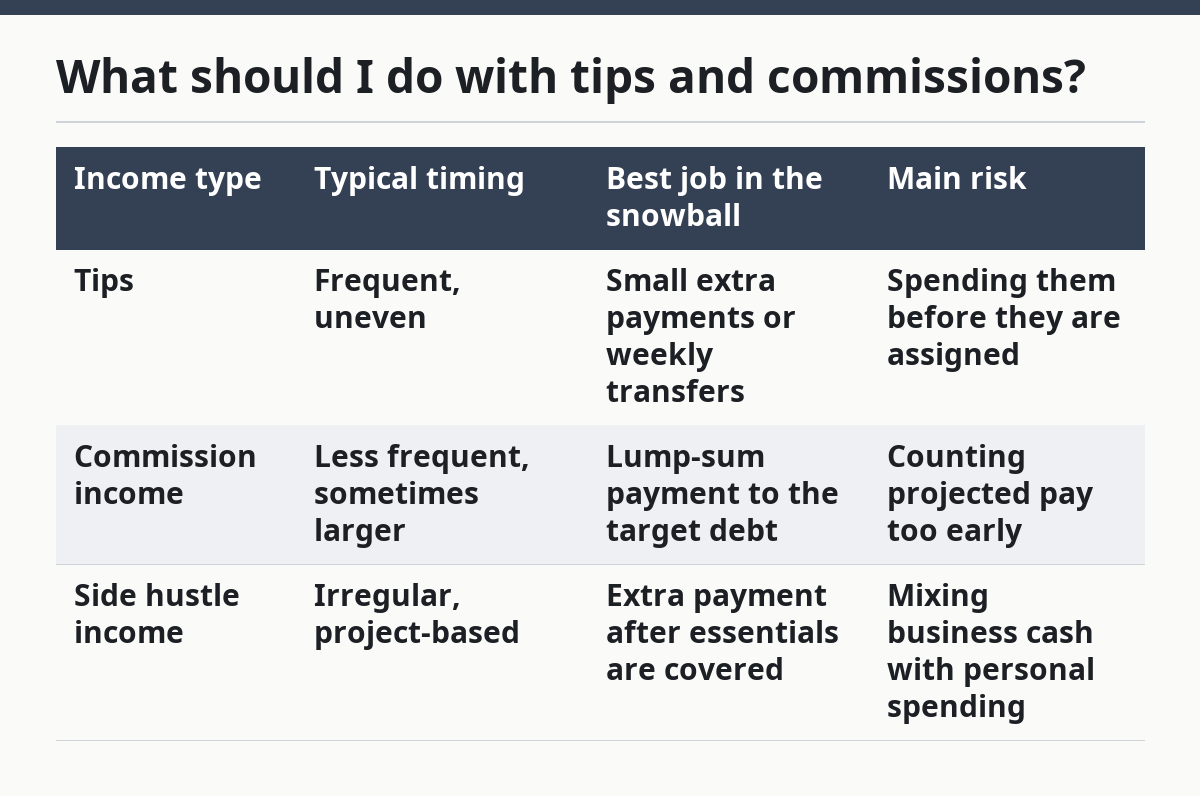
A useful comparison looks like this:
| Income type | Typical timing | Best job in the snowball | Main risk |
|---|---|---|---|
| Tips | Frequent, uneven | Small extra payments or weekly transfers | Spending them before they are assigned |
| Commission income | Less frequent, sometimes larger | Lump-sum payment to the target debt | Counting projected pay too early |
| Side hustle income | Irregular, project-based | Extra payment after essentials are covered | Mixing business cash with personal spending |
If you want a simple rule, use this: when the money is in hand, send it to debt; when it is only expected, do not count it as if it already exists. That keeps the budget honest. It also keeps you from promising yourself a payment that never shows up.
The hard part is not the math. It is the delay between earning the money and deciding where it goes. A 5-minute transfer habit fixes that better than a complicated spreadsheet. For commission-pay basics, the U.S. Department of Labor explains wage and pay issues that can affect timing.
How do I build a budget around uneven income?
You build a budget around uneven income by budgeting from your lowest dependable income, not your best month. That means the budget must work even if tips are thin, commissions are delayed, or the side hustle is quiet for 2 weeks. If the plan only works in a strong month, it is too fragile for a debt snowball.

Start with your must-pay items: rent or mortgage, utilities, groceries, transportation, insurance, and every debt minimum. Then mark any remaining room as variable. A base budget should not depend on a hoped-for bonus week.
A practical setup is this:
- Use regular pay to cover fixed expenses first.
- Set a separate line for irregular income.
- Assign each extra dollar the moment it arrives.
- Keep a tiny buffer if your income varies by week or pay cycle.
- Review the budget after one full month, then adjust the base only if the pattern is stable.
The point of the budget is not to predict every dollar. It is to stop variable income from wrecking your debt plan. A budget with no room for uncertainty usually fails the first time a tip shift is slow or a sales commission lands late.
One solid reference for general budgeting structure is the Consumer Financial Protection Bureau’s budgeting guidance. It is a useful public resource for basic money organization, even though your own numbers will depend on your income pattern and country. For a broader money framework, see budgeting basics and emergency savings guidance.
What mistakes make this fail?
The biggest mistakes are treating variable income like free money, counting it before it arrives, and spreading small payments across too many debts. Each one weakens the snowball by making the plan harder to follow and easier to quit.
Here are the most common errors:
- Using side hustle money for small wants first. The consequence is that debt payoff gets the leftovers, which are often nothing. The alternative is to assign the money to debt the same day it lands.
- Budgeting commission income before it clears. The consequence is a fake surplus and a cash shortfall when sales change or payroll shifts. The alternative is to budget only what has been received.
- Letting tips drift into day-to-day spending. The consequence is that frequent small income never turns into a meaningful payment. The alternative is to transfer tips on a schedule, such as daily or weekly.
- Sending tiny amounts to many debts at once. The consequence is slow progress and no visible win. The alternative is to keep minimums on all debts and push extra money to one target.
- Ignoring a cash cushion. The consequence is a low-income week that forces a missed payment or overdraft. The alternative is a small buffer in checking before you accelerate debt payments.
- Changing the rule every month. The consequence is confusion and no habit. The alternative is to keep one written rule for 3 months before you judge it.
A debt snowball depends on momentum. Variable income can help that momentum, but only if the flow is predictable in one place: your rule. If the rule keeps changing, the snowball turns into guesswork. For a similar payoff strategy, see debt avalanche vs. snowball.
When should I stop and use a different plan?
You should stop using this exact setup when your variable income is too unstable to cover basic bills, minimum payments, or a required buffer. In that case, the problem is not debt order; it is survival cash flow.
Use a different approach in these situations:
Your minimum payments already strain the budget: This means extra income is patching holes, not accelerating debt payoff — pause extra snowball payments and focus on keeping accounts current.
Your income changes wildly from week to week: This means a fixed extra-payment schedule may fail — hold variable income in a buffer until you can forecast it better.
You keep missing due dates because money arrives late: This means timing, not effort, is the issue — use payment dates that match your actual income flow and protect the minimums first.
Your side hustle has business costs you have not tracked: This means gross income is not the same as usable cash — separate earnings from expenses before assigning money to debt.
Your commissions can be clawed back, reversed, or delayed: This means projected income is risky — count only cleared pay and ignore promises in your debt plan, and consult a qualified professional if your pay structure is unclear.
You need emergency savings and debt payoff at the same time: This means the budget has to serve two goals — decide with a qualified adviser how to split extra cash between resilience and payoff.
A useful test is simple: if one slow pay cycle can knock the whole plan off track, the plan is too tight. A debt snowball should create control, not monthly panic. For debt and savings tradeoffs, see emergency fund basics from the CFPB.
What does a good result look like?
A good result looks like a budget that can absorb uneven income without needing a full reset every month. That means your minimum payments are covered from dependable income, your variable income has a standing job, and your target debt gets extra money whenever side hustle pay, tips, or commission income shows up.

The signs are practical, not dramatic. You know where the next extra dollar goes. You know which debt gets the snowball payment. You do not need to rethink the plan every time a shift is slow or a commission lands on a different day.
A good result also means fewer arguments with yourself. Instead of asking, “Can I use this money?” you already answered that question in the budget. That is the real gain from a written rule.
This is the kind of system that fits a reader with a steady paycheck plus irregular income on the side. It is not ideal for someone who wants flexibility without structure, or for someone whose essentials are already under strain. The method works when the rule is simple enough to repeat.
Should I use variable income for the snowball or savings?
Use variable income for the snowball only after your minimums and basic bills are covered, and keep a small buffer if your cash flow is shaky. If your account balance falls too low between paydays, a small savings cushion can prevent late fees and overdrafts. A qualified adviser can help you decide the split for your own situation.

How do I decide where commission money goes?
Decide before the commission arrives, then follow the rule when the money clears. If your budget is stable, commission money can go straight to the target debt in the snowball. If the commission is uncertain, delayed, or needed to keep the month on track, it should not be treated as extra until it is actually paid, and you should consult a professional if your pay timing is unclear.

Can tips be part of the debt snowball?
Yes, tips can be part of the debt snowball if you treat them as assigned money, not spending money. Because tips are often small and frequent, they work well as a steady stream into the target debt. The key is to move them on a schedule so they do not disappear in daily purchases, and to check with a qualified professional if your income varies enough to change the plan.
Drafted with AI; not yet reviewed by a person.