Last updated: November 28, 2026
Quick Answer: In most cases, the debt snowball during a new job transition can be restarted in 1 to 2 pay cycles by protecting minimum payments, confirming the first paycheck date, and then rebuilding the extra payment on the new pay schedule. The debt snowball during a new job transition works best when you treat the gap like a reset point: protect your minimum payments, map the first paycheck date, then rebuild the snowball on the new pay schedule.
Key takeaways
- A job change does not erase the debt snowball; it changes the timing and the size of the next step.
- The first job-related question is cash flow, not motivation: when does the first paycheck land, and what bills hit before then?
- Minimum payments come first. The extra snowball amount comes back only after the new budget is clear.
- If benefits, withholding, or pay dates changed, the old payment calendar may no longer fit your life.
- A restart works best when it is small, dated, and automatic rather than “whenever I catch up.”
What changes during a new job transition?
A new job transition changes your cash flow, not your debt list. The debt snowball method still starts with the smallest balance, but the old payment schedule may no longer match your new paycheck timing, benefits waiting period, or first full month of pay.
That matters because the snowball runs on rhythm. If your last job paid on the 15th and 30th, but the new one pays every 2 weeks, the dates that used to work may now leave a bill due before money arrives. The fix is to rebuild the budget around the new pay cycle before you send extra money to debt.
The transition period is also where people get tripped up by one-off changes. A new job can mean a gap before the first paycheck, a different deduction pattern, or a benefits waiting period for health coverage or retirement contributions. Those changes affect how much cash is actually usable in the first 1 to 2 pay periods.
For background on payroll timing and deductions, the U.S. Department of Labor explains wage-payment rules, and the IRS explains how withholding affects take-home pay. See the U.S. Department of Labor and IRS Tax Withholding Estimator. If the idea of the debt snowball itself is new, the debt snowball method hub explains the basic payoff order. This page stays focused on the transition itself: what to do before the first paycheck, how to reset payment dates, and how to restart without losing momentum.
What should I check before my first paycheck arrives?
You should check your payment dates, minimums, and cash reserves before the first paycheck arrives so you know which bills can wait and which cannot. The goal is a 1-page map of the next pay period, not a perfect annual plan.
Start with the due dates for every debt payment, then mark the first paycheck date and any gaps between them. If a minimum payment lands before the first paycheck, that bill needs a clear source of cash now, not later. If all due dates fall after the first paycheck, the transition is much easier.
Next, list the basic budget items that cannot move: rent or mortgage, utilities, food, transport, and required insurance. Then check whether the new job changes anything else, such as a 401(k) deduction, health premium, or tax withholding. Those items can shrink take-home pay even when the gross salary looks stronger.
Use a simple check: if your budget has fewer dollars than expected in the first 30 days, the snowball is paused, not broken. What indicates a problem is trying to make an extra debt payment before you know which 2 or 3 bills need to clear first. That is how people miss a minimum payment and create a bigger mess than the job change itself.
How do I restart the debt snowball after changing jobs?
You restart the debt snowball after changing jobs by rebuilding the minimum-payment floor first, then adding the extra snowball payment back once the new paycheck pattern is stable. A restart is often best when it starts small, because the first 1 or 2 pay cycles are about timing, not speed.
-
Write down every debt balance and minimum payment. Use the current statement amount, not a memory estimate, and list the due date beside each one. Verify the smallest debt is still the first target. If a balance changed, the old order may no longer be right.
-
Mark the first 2 paycheck dates on a calendar. Put the exact payday on your calendar or budgeting app, then confirm whether the first check is delayed because of onboarding, payroll cutoff, or a partial pay period. If you do not know the date, the restart plan is too early.
-
Cover the bills that land before that first paycheck. Use cash on hand for minimums and unavoidable expenses that fall in the gap. Verify that each payment has a source. If one payment depends on “the next check” and the next check is not confirmed, that bill is at risk.
-
Set a temporary budget for the first 1 pay cycle. Keep the budget short and specific: bare essentials, minimums, and no extra debt payment unless the math is clear. Verify that the total fits the new take-home pay. If the numbers only work by assuming overtime or a future bonus, the budget is not ready.
-
Restart automatic minimums first. If payments were paused or rerouted during the transition, restore the minimums before the extra snowball amount. Verify each creditor has the right date and amount. If the due date now lands too close to payday, adjust the date with the creditor rather than forcing a late payment.
-
Bring back the snowball amount after the first full paycheck cycle. Add the extra payment only after you see the real deposit, not the offer letter. Verify there is room after essentials and minimums. If the first full cycle is tighter than expected, shrink the extra payment instead of skipping it entirely.
-
Keep the smallest-debt focus, but update the amount. A job change can make the old extra-payment number unrealistic, so the snowball may restart at a smaller figure. Verify that the amount is repeatable for at least 2 months. If you have to “find” the money every month, the plan is too fragile.
-
Track one target date for the next review. Choose a date after 2 paychecks, then check whether the budget holds and the payment cadence feels normal. Verify that no bill is drifting late. If the schedule still feels unstable at that review, the issue is timing, not discipline.
The point is not to restart at full speed on day 1. The point is to restart in a way that survives the new job’s actual pay rhythm.
Should I pause the snowball when the pay schedule changes?
You should pause the extra snowball payment if the new pay schedule creates a real gap, but you should not pause the minimums unless the debt issuer has already approved a change. The snowball is flexible; the minimum payment is the line that keeps the account current.
A common mistake is treating the whole debt plan as all-or-nothing. That turns a short transition into a long setback, and if the situation feels hard to sort out, a qualified financial counselor can help. If the first paycheck is delayed by 1 cycle, the right move is usually to protect the essentials and keep minimums current, then resume the snowball when cash flow returns. For general debt guidance, the Consumer Financial Protection Bureau is a useful source.
This is also where a simple budget earns its keep. A new job can change take-home pay even when the salary looks better on paper. If your budget has to absorb a different commute, new payroll deductions, or a benefits waiting period, the extra snowball payment may need to shrink for a month or two.
Use a comparison like this:
| Option | What it does | Main benefit | Main drawback |
|---|---|---|---|
| Pause only the extra snowball payment | Keeps minimum payments moving, stops the extra payoff amount | Protects your payment history | Slows the debt payoff pace |
| Pause the whole debt plan | Stops minimums and extra payments | Frees cash right away | Raises the risk of late fees, missed payments, and stress |
| Restart at a smaller extra payment | Keeps momentum with a reduced amount | Easier to sustain through the transition | Feels slower than the old pace |
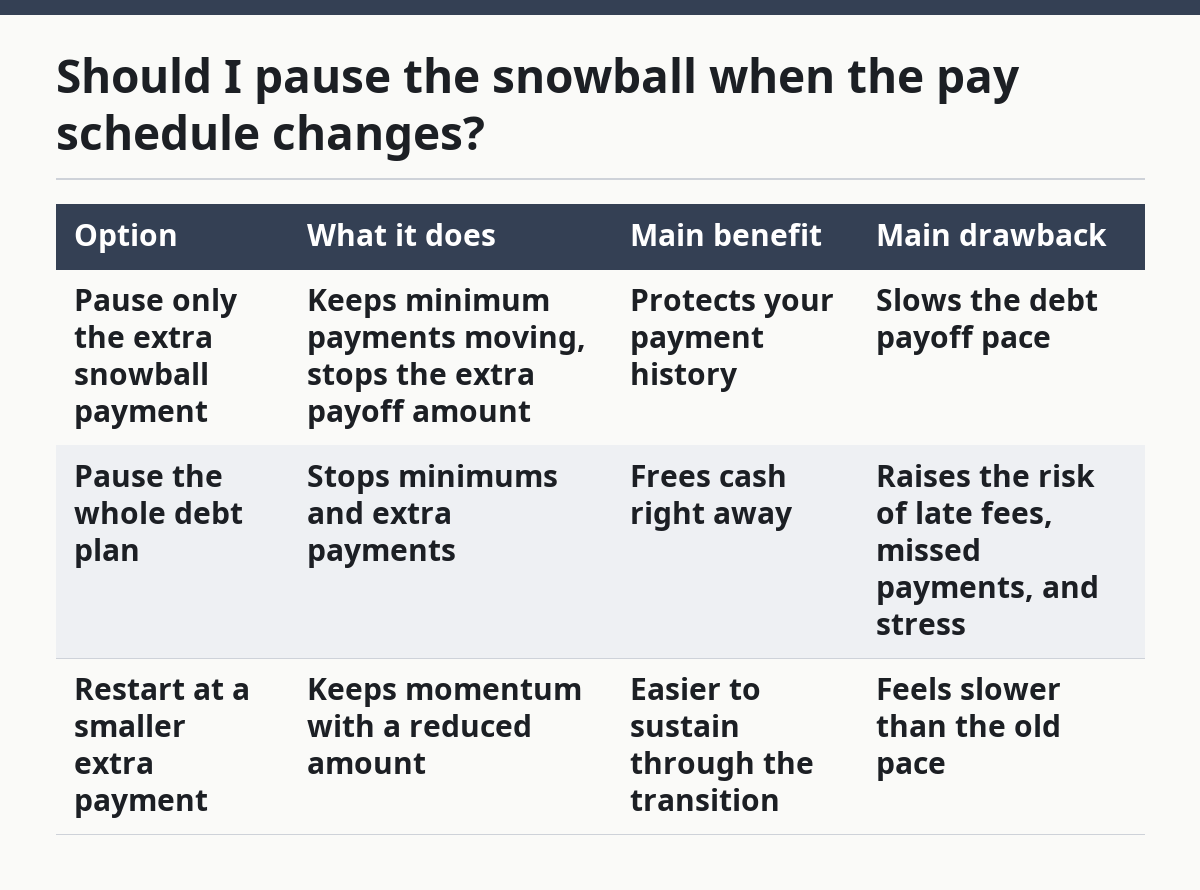
If the choice is between a smaller snowball and a missed minimum, the smaller snowball is the better fit. If the choice is between a late payment and a temporary pause, the temporary pause is usually the less damaging of the two.
What mistakes do people make during the reset?
People usually make 4 debt-snowball mistakes during a job transition, and each one has a different cost. The reset works best when the mistake is named plainly, because most of them are timing errors rather than math errors.
- Using the old paycheck date in the new budget. The result is a bill due before money arrives. The better move is to rebuild the calendar around the new payroll cycle and confirm the first deposit date.
- Restarting the extra snowball before minimums are safe. The result is a late fee or a missed account. The better move is to restore every minimum payment first, then add the extra payment back later.
- Assuming take-home pay will match the offer letter. The result is a budget that looks fine on paper but fails in real life. The better move is to wait for the actual paycheck and the actual deductions.
- Changing 3 or 4 things at once. The result is confusion about what caused the cash gap. The better move is to change one thing at a time: payment dates, then minimums, then extra payoff amount.
- Stopping the budget because the job is “temporary” in your mind. The result is drift. The better move is a short budget for the first 30 days, then a review after 2 paychecks.
- Ignoring benefit or deduction changes. The result is less cash than expected and a snowball that feels too ambitious. The better move is to check payroll deductions before deciding the next extra payment.
The biggest cost here is not that the debt snowball breaks. It is that the transition turns into a vague waiting period, and vague waiting periods are where money leaks.
When does the standard approach not fit?
The standard debt snowball approach does not fit every job change, and 5 situations call for a different pace or outside help. In those cases, the issue is not motivation; it is that the payment system itself needs a new setup.
The first paycheck is delayed past several debt due dates: that means the gap is bigger than a normal budget adjustment — contact creditors about due-date changes or other options before you miss a payment.
Take-home pay is lower than expected because deductions changed: that means the old snowball amount is too high — rebuild the budget around the real net pay, not the offer letter.
Benefits do not start right away: that means one or more monthly expenses may temporarily rise — keep the debt plan simple until the new health or retirement deductions are clear.
A debt payment is already behind before the job change: that means the transition is not the only issue — address the overdue account separately and do not assume a restart alone will fix it.
Your budget only works if you skip essentials or use borrowed money: that means the plan is unstable — reduce the extra snowball payment and recheck the numbers before moving ahead.
For more on the basic structure, the debt snowball method hub covers the payoff order itself. This page is about the reset point, and the reset point should be honest about what the new pay cycle can and cannot support.
How long does the restart take?
The restart usually takes 1 to 2 pay cycles to feel stable, because that is long enough to see the real paycheck pattern and the real bill timing. The exact pace depends on when the first paycheck lands, when benefits begin, and whether any debt due dates need to shift.
A good result is not “I pay the full snowball amount immediately.” A good result is “the minimums are current, the first paycheck is accounted for, and the extra payment fits the new budget without guesswork.” That is the difference between a temporary reset and a broken plan.
Track the result with 3 checks. First, no minimum payment is late. Second, the budget works with actual net pay, not expected pay. Third, the extra debt payment can repeat in the next cycle without stress. If all 3 are true after the first full paycheck, the plan is back on track.
If one of those checks fails, the answer is usually not to quit the snowball. It is to shrink the extra payment, move a due date, or wait one more pay cycle before increasing it again. That slower restart is often the more durable one.
What should I do before my first paycheck arrives?
You should protect the bills that come due before payday and set the snowball on hold until the first deposit clears. The goal is to avoid a cash crunch in the first 7 to 14 days of the new job.
Start by listing the debts and essentials due before that paycheck, then assign each one a clear payment source. If the new job created a gap, do not assume the next check will solve every bill at once. A short gap is easier to manage when it is written down in order.
Then decide what the restart point will be. For many people, that is the first full paycheck after the new job starts, not the first day of work. Once that check arrives, the budget can be rebuilt around real numbers instead of estimates.
The safest next step is simple: keep minimums current, pause the extra snowball if needed, and restart the plan only after the new paycheck rhythm is visible. That keeps the debt snowball during a new job transition useful without pretending the transition month looks like any other month.
Should I pause my snowball when I start a new job?
Pause the extra payoff amount if the new pay schedule makes the budget tight, but keep minimum payments current if you can. A new job often changes the timing of money, not the need to pay debts. If the first paycheck is delayed or smaller than expected, a short pause is usually better than forcing a payment that causes a miss later.
How do I restart debt snowball payments after changing jobs?
Restart by confirming the first paycheck date, covering minimum payments first, and then adding the extra snowball payment back at a level that fits the new budget. The first 1 or 2 pay cycles are the test. If the payment amount is hard to repeat, make it smaller before you make it bigger.
What should I do before my first paycheck arrives?
Map every bill that lands before payday, then decide which ones use cash on hand and which ones need a date change or temporary pause. The first paycheck can only do so much, especially if benefits or deductions changed. A written plan for the first 30 days is better than guessing from memory.
Drafted with AI; not yet reviewed by a person.