Last updated: November 19, 2026
Key Takeaways
- Debt payoff cash flow means you control payment timing so the plan fits your month.
- A payoff plan fits cash flow when it follows your pay schedule, bills, and a surprise buffer.
- Essentials and minimums come first; extra payments come after.
- A monthly payoff cash flow plan works when it matches your pay rhythm and one funding rule.
Debt payoff cash flow is the gap between what comes in each month and what debt payments, bills, and living costs leave behind. Quick answer: the goal is to protect rent, food, and utility money first, then direct any remaining cash to debt. Managing debt payoff cash flow: The Complete Guide shows how to set the order, protect the cash you need, and keep paying debt without creating new debt.
I write about consumer credit, budgeting, and repayment plans, so I know the traps that make a “debt snowball” or “debt avalanche” fail in real life. This is information, not financial advice; a qualified adviser should review your own situation. The Consumer Financial Protection Bureau also advises checking whether a payment plan fits your budget before you commit. Consumer Financial Protection Bureau
What debt payoff cash flow actually means
Debt payoff cash flow means you control the order and timing of payments so the plan fits your month, not the other way around. Picture this: your paycheck lands, bills hit on different dates, and the card issuer wants a payment before payday. The job is to keep cash available for essentials while still sending extra money to debt. A workable plan has one job: make the month predictable.
The key is simple: cash flow is not just income minus debt. It is income minus rent, utilities, food, transport, insurance, minimum payments, and the small costs that show up every week. If the leftover amount is not steady, debt payoff becomes a stop-start cycle. The Federal Reserve has noted that many households face uneven cash flow, which is why timing matters as much as totals. Federal Reserve
A lot of generic advice gets this wrong. It tells you to “throw every spare dollar at debt” without checking whether the spare dollars are real or just temporary. That can backfire fast when car repairs, school fees, or medical bills show up in the same month. In practice, a plan that ignores timing can fail in a single 30-day cycle.
Use this test:
- If a payment date causes overdrafts, the plan is too tight.
- If you miss a minimum payment to make an extra payment, the plan is unsafe.
- If you need a credit card for groceries while paying off another card, the flow is broken.
- If your extra payment comes from money already promised to other obligations, stop and reset.
How do I set up a debt payoff plan that fits my cash flow?
A debt payoff plan fits your cash flow when it uses your actual pay schedule, your real bills, and a buffer for surprises. Start with the dates, not the balances. The right plan is built around timing first and payoff speed second. A simple list can show where the pressure lands.
Here’s the catch: many people know their total debt but not the day each bill clears. That gap creates late fees, overdrafts, and stress. A plan that looks good on paper can still fail if five bills hit before your second paycheck of the month. The CFPB recommends checking due dates and account terms before you set your payment order. Consumer Financial Protection Bureau
Use this order:
- List every paycheck date and amount you can rely on.
- List every fixed bill date: rent, phone, insurance, loan minimums, and subscriptions.
- Add variable basics: groceries, gas, transit, child care, and medicine.
- Mark the minimum payment for each debt.
- See what remains after essentials.
- Decide how much extra you can send without touching your emergency buffer.
- Put the extra payment on one debt and repeat each month.
A useful rule is to build around your weakest month, not your best one. If a month with a smaller paycheck still works, the system is more likely to hold. If it only works in a “good” month, it is too fragile. A 30-day cash flow test is more useful than a hopeful annual average.
What comes first: minimums, essentials, or extra payments?
Essentials and minimum payments come first; extra payments come last. Picture this: you’ve got three bills due this week, a paycheck on Friday, and a card balance that keeps growing interest. The safe order is essentials first, minimums second, extra payoff third. That order keeps the plan from collapsing under fees.
That order matters because missed minimums can trigger fees, penalty interest, or credit damage depending on the account and local rules. The exact rules vary by country and lender, so read the loan or card terms before you assume a grace period exists. The CFPB explains that late fees and penalty rates can apply when payments are missed. Consumer Financial Protection Bureau
A practical priority stack looks like this:
- Housing, food, heat, power, transport, and medicine.
- Minimum payments on every debt.
- Taxes or other non-discretionary obligations, if they apply.
- Small cushion for timing gaps.
- Extra debt payments.
The truth is, “extra payment” money is not debt money until the basics are covered. If your budget keeps collapsing at the end of the month, the problem is usually cash timing, not self-control. A tighter payoff schedule will not fix a missing buffer. Even a $100 surprise can break a plan that has no margin.
One more point: if a debt has a very high interest rate, that does not mean you should skip minimums on other accounts. The penalty for a missed payment is often worse than the interest difference you were trying to beat. Paying all minimums on time protects the plan from compounding damage.
How to build a monthly payoff cash flow plan
A monthly payoff cash flow plan works when it matches your pay rhythm and uses one clear funding rule for the extra money. Picture this: some months have two paychecks, some have three, and bills still arrive like clockwork. The best plan can turn a messy calendar into a repeatable routine. A 12-month view can help, but the monthly plan is where the payment actually happens.
Start by making a one-page cash flow sheet for the month. Put income at the top, then all fixed bills, then regular variable costs, then debt minimums. Whatever is left becomes the debt payoff amount for that cycle. A one-page sheet is easier to keep updated than a long spreadsheet.
Try this structure:
- Income by date.
- Fixed costs by due date.
- Variable costs by category.
- Minimum debt payments.
- Extra debt payment target.
- Buffer left after every payment.
This is where many people get tripped up. They set one monthly debt number and then spend from it before the payment goes out. If the extra money is not parked in a separate checking account or sinking fund, it tends to disappear. Separating the money by purpose can stop accidental overspending.
The best part? You can make the plan more stable without paying more overall. Move due dates closer to payday where the lender allows it, or align payments so the largest bills land right after income. If that is not possible, keep a small timing cushion in the account so a due date does not hit an empty balance. Even a modest cushion can reduce stress by one billing cycle.
One caution: do not treat an expected refund, bonus, or side-income payment as if it were already in hand. A cash flow plan only works with money that is actually available. Expected money is not available money. If you are unsure how to treat irregular income, consult a qualified financial professional and check the CFPB’s budgeting guidance. Consumer Financial Protection Bureau
Which payoff method works best for cash flow?
The best payoff method for cash flow is the one that leaves enough breathing room to keep the plan running every month. Picture this: two debts, one with a tiny balance and one with a much higher rate, both demanding money from the same paycheck. The method that fits your budget best is the one you can keep paying without raiding essentials.
The snowball method sends extra money to the smallest balance first. That can help cash flow because one account disappears sooner, which reduces the number of payments you juggle. The downside is that it may cost more in interest over time than a rate-first plan.
The avalanche method sends extra money to the highest-rate debt first. That usually makes the math cleaner on paper because expensive interest is attacked early. The downside is psychological: if the highest-rate balance is large, the plan can feel slow, and slow plans get abandoned.
Use the comparison below as a cash flow lens, not a moral one.
| Criteria | Snowball | Avalanche | Winner for this condition |
|---|---|---|---|
| First debt to finish | Smallest balance | Highest interest rate | Snowball for motivation and quick wins |
| Long-term interest cost | Often higher | Often lower | Avalanche for math-driven payers |
| Number of open accounts | Can drop faster | May stay higher longer | Snowball when bill clutter is the problem |
| Best fit for tight budgets | Good if wins keep you engaged | Good if you can stay consistent | Depends on your discipline and margin |
| Risk of giving up | Lower for some people | Higher if progress feels slow | Snowball when morale is fragile |
| Cash flow simplicity | Easier sooner | Can stay complex longer | Snowball for fewer moving parts |
| Best for irregular income | Works if smallest balance is manageable | Works if high-rate balance is stable | Avalanche when you can keep minimums safe |
| Best for high rates | Not ideal | Stronger | Avalanche when interest cost matters most |
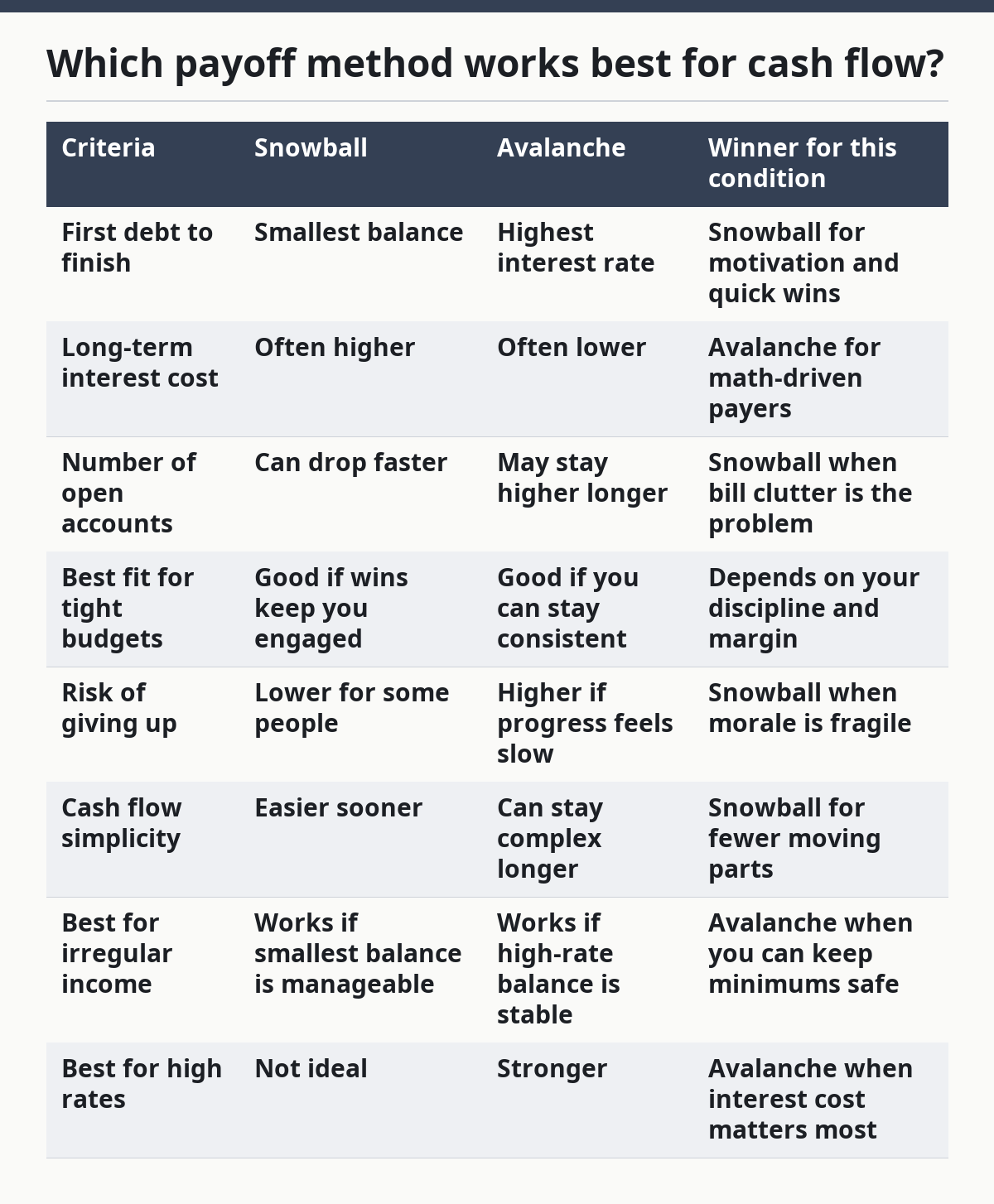
A lot of articles pretend one method is always better. That is wrong. If you need quick psychological wins to keep the plan alive, the snowball often works better. If you can handle a slower start and want the numbers to favor you, the avalanche is usually stronger. NerdWallet and the CFPB both note that the better method depends on motivation, rate, and consistency. NerdWallet Consumer Financial Protection Bureau
Snowball vs avalanche for debt payoff cash flow
Snowball helps cash flow by shrinking your list of payments faster; avalanche helps cash flow by reducing the drag from interest more efficiently. Picture this: you are juggling three minimums, one small personal loan, and two cards, and your margin is thin. The method that removes a monthly payment sooner can make the whole budget feel lighter. In many households, that matters more than a theoretical savings chart.
Snowball is often easier when your cash flow is messy. One closed account means one less due date, one less app alert, and one less chance to miss a payment. That matters when your income is irregular or your schedule changes from week to week. A smaller list of bills can also make it easier to track in a single calendar.
Avalanche is often better when the debt burden is large enough that interest is eating your progress. If you keep paying the same amount every month, the higher-rate balances can consume cash that should have gone to principal. Over time, that can stretch the plan out. In a high-rate environment, the interest savings can be meaningful.
Here’s a practical way to choose:
- Pick snowball if you are likely to quit without visible wins.
- Pick avalanche if you can stick to a slower start and want lower interest pressure.
- Pick neither if you cannot keep minimums current.
- Pick a hybrid if your highest-rate debt is also your smallest balance.
The hybrid is often overlooked. You can keep minimums on everything, pay off one small balance to free up a payment, then switch to rate-first. That gives you both a quick cash flow lift and a smarter long-run structure. For some budgets, that 1-account reduction changes the whole month.
What if my income changes from month to month?
If your income changes month to month, the plan needs a base budget, not a perfect budget. Picture this: you work variable shifts, freelance, or run a business, and the money lands in uneven chunks. The solution is to budget from your low-income month, not your best one.
That means you build the plan around the amount you can usually rely on, then treat the rest as variable surplus. The surplus can go to extra debt payments only after essentials and minimums are covered. This keeps you from overcommitting in a strong month and falling short in a weak one. If the extra money is uncertain, it should stay out of the core plan.
A simple variable-income system:
- Set a floor income number based on a conservative month.
- List the must-pay items that fit under that floor.
- Keep a holding account for any extra income.
- Pay debt from the holding account only after the base month is safe.
- Roll extra money forward if a weak month is coming.
This is where a cash buffer matters most. A buffer is not a luxury for variable income; it is the thing that keeps debt payments from bouncing when work slows down. Without it, you end up borrowing to make the debt plan look good. A cushion of even one bill cycle can help prevent a missed due date.
The best part is that variable income does not mean no progress. It means progress comes in steps, not straight lines. Some months the extra payment is large. Some months it is only the minimums plus a little more. The plan still works if it is built for the real rhythm of your money. The CFPB’s budgeting tools are designed to help households map irregular income to bill dates. Consumer Financial Protection Bureau
When does debt consolidation help cash flow?
Debt consolidation helps cash flow when it lowers the number of payments or smooths the due dates without making the debt harder to manage later. Picture this: several cards, several due dates, and a monthly budget that feels scattered. Consolidation only helps if it makes the payment pattern easier, not just smaller on paper. A single monthly due date can simplify the calendar.
A single payment can reduce clutter. That can help if you keep missing due dates because the calendar is crowded. It can also help if the new loan has a fixed schedule that fits your paycheck dates better than the old accounts did. In 2023, the average credit card APR tracked by the Federal Reserve remained in the high teens, so rate changes can matter. Federal Reserve
The catch is that consolidation can also create a false sense of relief. If you close the old balances and then charge them back up, the cash flow problem gets worse. The monthly payment may look cleaner, but the total debt burden grows. A 2024 CFPB advisory also warns that debt relief products are not all the same, so terms matter. Consumer Financial Protection Bureau
Watch for these trade-offs:
- Fewer payments can simplify the month.
- A longer term can lower the payment but raise total interest.
- A fixed due date can help if your income is predictable.
- Fees, collateral, or stricter terms can create new risk.
If the numbers only work because the new payment is stretched out for years, the cash flow fix may be temporary. And if the plan depends on using the freed-up credit line, it is not a payoff plan. It is a reset of the same problem. Consolidation should reduce pressure, not expand room to borrow.
The honest side-by-side
The best payoff cash flow setup is the one that keeps essentials safe while still reducing debt at a pace you can maintain. Picture this: you have enough money to make progress, but not enough to survive a mistake. In that situation, stability beats speed.
Below is the side-by-side that matters most for real budgets.
| Criteria | Snowball | Avalanche | Winner for [condition] |
|---|---|---|---|
| Emotional momentum | Faster visible wins | Slower visible wins | Snowball for people who need encouragement |
| Interest savings | Usually weaker | Usually stronger | Avalanche for high-rate debt |
| Cash flow relief from fewer bills | Earlier | Later | Snowball when due-date clutter is the issue |
| Best fit for irregular income | Easier to stick with | Strong if disciplined | Snowball for shaky cash flow |
| Best fit for large debt loads | Can be slower overall | Often more efficient | Avalanche when rates are high |
| Risk of stopping mid-plan | Lower for some users | Higher if progress feels flat | Snowball when motivation is fragile |
| Administrative simplicity | Becomes simpler faster | May stay complex longer | Snowball for calendar stress |
| Long-run math | Not usually optimal | Usually stronger | Avalanche for long horizons |
The verdict is plain: snowball wins for people who need fast visible progress to keep the budget alive; avalanche wins for people whose biggest problem is interest drag and who can stay steady. Neither method solves a budget that spends more than it earns. If the cash flow does not work, the method alone will not fix it.
What debt payoff cash flow mistakes should I avoid?
The biggest mistake is using debt payments to hide a cash problem. Picture this: you move money around, delay bills, and count on next month to be better. That is not a payoff plan; it is a delay tactic. A payment plan should reduce stress, not postpone it.
A second mistake is ignoring timing gaps. Even if your budget balances on paper, a due date before payday can cause fees. A third mistake is sending extra money before setting aside enough for groceries, fuel, prescriptions, or school costs. The “extra” category only exists after basics are funded.
Avoid these errors:
- Paying extra before minimums are safe.
- Using an emergency fund to make a debt plan look tighter than it is.
- Relying on refunds, bonuses, or tax returns as the core of the plan.
- Keeping too many due dates on the same week.
- Closing an account and then reusing the freed-up credit.
- Assuming one good month proves the budget works.
Here’s the catch: the same mistake can hide for months if your income is high enough. Then one small disruption breaks the plan. A broken plan often starts with optimism and ends with fees. Even a $50 or $100 gap can become expensive if it repeats.
The fix is boring but effective. Build for the worst ordinary month, keep a small buffer, and watch the due dates as closely as the balances. That is how cash flow stays steady long enough for payoff to matter. If the pattern keeps failing, reconsider the whole structure before you add more pressure.
When should you rethink the plan completely?
You should rethink the plan completely if minimums are already hard to meet, if essentials keep getting skipped, or if new borrowing is filling the gap every month. Picture this: the payment plan looks organized, but your account balance keeps falling short before the month ends. That is the point to pause and rebuild.
A plan should fit the life you actually have. If rent, food, or utility bills are being sacrificed to send extra money to debt, the strategy is too tight. If you are using one debt to pay another, the plan is not solving the problem. A tighter budget is not a fix when it breaks on day 18.
Three signs the plan needs a reset:
- You cannot cover minimums without overdrawing.
- You keep using credit for ordinary spending.
- Your income pattern changed and the budget was never updated.
If one of those is true, the next step is not “try harder.” It is to rebuild the cash flow sheet from scratch, including dates, not just amounts. In some cases, a consumer credit counselor, local nonprofit adviser, or licensed financial professional can help you review options for your country and situation. Some nonprofit counselors can also help you compare repayment approaches.
That last point matters. Debt rules, debt relief options, and creditor practices vary by country and can change. A generic internet plan can only go so far. A local source can confirm whether your payment order is realistic under your rules.
FAQ
How much extra money should go to debt each month?
The extra amount should be whatever remains after essentials, minimums, and a small buffer are covered. There is no universal number because income timing, family size, and debt terms differ. If the extra payment causes overdrafts or missed bills, it is too high.
Should I pay debt right after payday or wait until the due date?
Paying right after payday often helps cash flow because the money is set aside before it gets spent. That can reduce the chance of accidental overspending. If a due date is close to payday, timing the payment right after income can also protect you from late fees, depending on the lender’s rules.
Is it better to pay one debt off fast or split extra payments?
Paying one debt off fast is usually better for cash flow because it removes one payment from the calendar. Splitting extra payments can slow the moment when your monthly obligations shrink. If your budget is shaky, fewer open accounts often makes the plan easier to keep.
What if I can only make minimum payments?
Minimum payments are the starting point, not the finish line. If that is all you can do, the focus should shift to protecting essentials, avoiding new borrowing, and finding ways to widen the margin. A qualified adviser or local nonprofit credit counselor can help you review options for your area.
Can I use savings to speed up debt payoff?
You can, but only if the savings are not needed for emergencies, taxes, rent, or near-term bills. Emptying the cushion can turn one problem into two. If you use savings, rebuild the buffer as soon as the budget allows.
Drafted with AI; not yet reviewed by a person.