
Last updated: November 25, 2026
The best debt payoff system is the one you can stick with for months at a time, and for most people that means either the debt snowball or the debt avalanche. Snowball wins when motivation is the real problem; avalanche wins when interest cost is the main problem. This is general information, not financial advice, and a qualified adviser should review your own situation.
Key takeaways
- Debt payoff systems are just rules for which balance gets extra money first.
- The snowball method pays the smallest balance first, even if it has a lower rate.
- The avalanche method pays the highest-interest balance first, which usually reduces total interest.
- The best system is not the one that sounds smartest on paper; it is the one you will keep using after month 2.
- If cash flow is unstable, the simplest system often beats the mathematically perfect one.
What is a debt payoff system?
A debt payoff system is a repeatable rule for sending extra money to one debt while making minimum payments on the rest. The point is not to change your whole budget every month; the point is to remove decision fatigue.
Two common systems get most of the attention: snowball and avalanche. The snowball method targets the smallest balance first, then rolls that payment into the next debt. The avalanche method targets the highest interest rate first, then repeats the process.
The Consumer Financial Protection Bureau explains debt management and payoff planning in plain terms, and the FTC also warns people to be careful with debt relief offers that sound too easy to be real. See the CFPB’s debt collection and debt help resources and the FTC’s debt relief guidance:
https://www.consumerfinance.gov/consumer-tools/debt-collection/
https://consumer.ftc.gov/articles/debt-relief-scams
How does the debt snowball method work?
The debt snowball method works by clearing the smallest balance first so the borrower gets a quick win. That first paid-off account frees up a minimum payment that can be moved to the next smallest balance, so the payment grows like a snowball.

This method is best for people who need visible progress. A balance of $500 feels smaller than one of $5,000, even if the interest rate is worse. That psychological win matters because a plan that feels impossible gets abandoned.
The weakness is simple: the smallest balance is not always the most expensive debt. If a small balance carries a high rate, snowball can cost more interest than avalanche. That trade-off is the reason snowball is often a motivation tool rather than a math-first tool.
Snowball is not for someone who already has strong repayment habits and wants the lowest possible interest cost. It is also a poor fit if the debts are all similar in size, because the early wins are less dramatic.
How does the debt avalanche method work?
The debt avalanche method works by attacking the highest interest rate first, because that balance is the most expensive to carry. Minimum payments still go on every debt, but all extra money goes to the costliest account until it is gone.

This method is the cleanest choice when the borrower can stay disciplined without needing quick emotional wins. If rates are very different, avalanche usually makes the most financial sense because high-interest debt grows faster than low-interest debt.
The weakness is that the first payoff can take longer. That slower start is where people quit. A borrower who needs visible progress every month may find avalanche emotionally flat, even if it is stronger on paper.
Avalanche is not the best fit when the borrower keeps switching plans after 30 days. It is also a bad match if minimum payments already strain the budget, because the system does not fix a cash flow problem by itself.
Snowball vs. avalanche: what is the real difference?
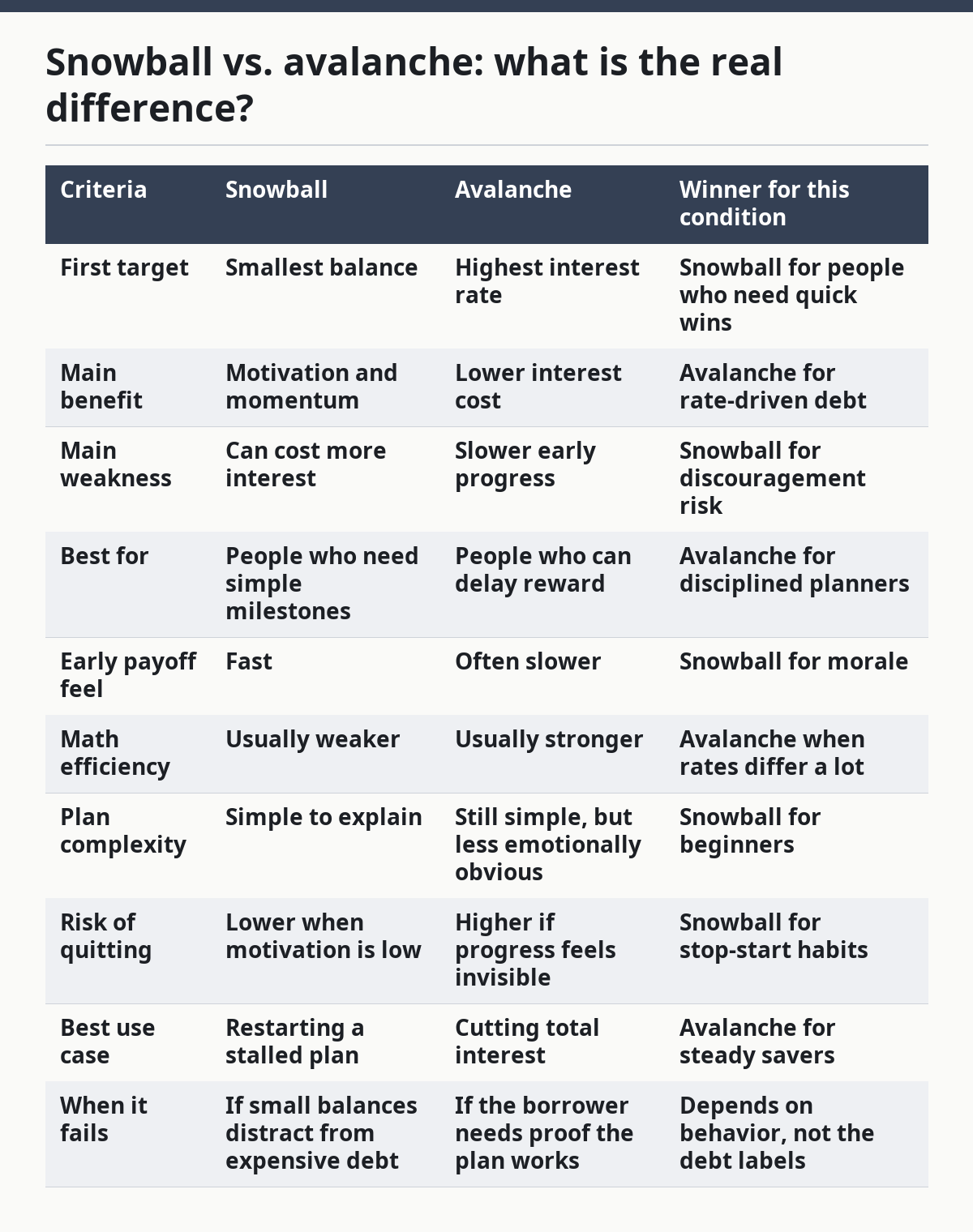
The real difference is that snowball buys motivation while avalanche buys interest savings. Both systems use the same core move: pay minimums on all debts and direct extra money to one target. The target changes, and that changes the result.
| Criteria | Snowball | Avalanche | Winner for this condition |
|---|---|---|---|
| First target | Smallest balance | Highest interest rate | Snowball for people who need quick wins |
| Main benefit | Motivation and momentum | Lower interest cost | Avalanche for rate-driven debt |
| Main weakness | Can cost more interest | Slower early progress | Snowball for discouragement risk |
| Best for | People who need simple milestones | People who can delay reward | Avalanche for disciplined planners |
| Early payoff feel | Fast | Often slower | Snowball for morale |
| Math efficiency | Usually weaker | Usually stronger | Avalanche when rates differ a lot |
| Plan complexity | Simple to explain | Still simple, but less emotionally obvious | Snowball for beginners |
| Risk of quitting | Lower when motivation is low | Higher if progress feels invisible | Snowball for stop-start habits |
| Best use case | Restarting a stalled plan | Cutting total interest | Avalanche for steady savers |
| When it fails | If small balances distract from expensive debt | If the borrower needs proof the plan works | Depends on behavior, not the debt labels |
Who should use snowball?
Snowball wins for someone who needs progress to stay engaged. If the main problem is not knowledge but follow-through, a fast first payoff can matter more than a cleaner spreadsheet.
This method also works well when debts are small and scattered. A borrower with 5 accounts, each within a similar range, may care more about clearing one statement than optimizing every dollar of interest. The method is easy to explain to a partner, too, because the rule stays the same every month: smallest balance first.
Snowball is not for someone obsessed with efficiency. If the borrower can stay consistent for a year without extra motivation, then a math-first plan may be better. Snowball is also weaker when one small balance carries a very high interest rate, because paying that off early may save more than chasing the smallest balance.
The best way to think about snowball is this: it is a behavior plan first and a math plan second. That is why it can work so well for people who have already tried a stricter system and quit.
Who should use avalanche?
Avalanche wins for someone who wants the most direct path to reducing interest cost. If the borrower can keep making the same monthly payment for 12 months or more, the higher-rate-first rule is hard to beat.
It is especially useful when debts have very different rates. A credit card at a high rate and a lower-rate installment loan should not be treated the same way if the borrower can stay disciplined. Avalanche tells the borrower where the extra money does the most work.
The downside is emotional, not mathematical. A balance can look “stuck” for a while if the minimum payment is small and the target debt is large. That can make the plan feel slow, and slow plans get abandoned.
Avalanche is not ideal for someone who needs fast reinforcement. It is also not the best choice when the borrower is already overwhelmed and needs a simple first win before any math matters.
Which debt payoff system should you choose?
Choose snowball if you need quick wins to keep going. Choose avalanche if you can stay steady and want the more interest-conscious plan. Neither is right if the budget is so tight that minimum payments are already hard to cover.
The cleanest rule is this: use the system that matches your behavior, not your ego. Many people say they want the most efficient method, then quit because it feels slow. A less efficient plan that actually gets finished is better than a perfect plan that dies in month 2.
There is one more practical point. A payoff system works only after minimum payments are current and the borrower has a budget that leaves room for extra principal. Without that, the system is a label, not a solution.
When should you switch systems?
Switch systems when the current one keeps failing for the same reason. If snowball is not creating enough momentum, or if avalanche keeps feeling too slow to continue, the issue is usually behavior, not the debt list.

A switch can also make sense after a big life change, such as a lower income, a new expense, or a debt refinance. If the payment landscape changes, the old method may no longer fit. Rates and terms can change by country and by lender, so the better method can change too.
The mistake to avoid is switching every month. A 1-month trial does not tell you much. Give the system time to show whether it helps you make repeated payments without drifting off course.
What makes a debt payoff plan fail?
A debt payoff plan usually fails because the monthly payment is too ambitious, too vague, or too easy to ignore. The method matters, but the budget matters more.

The common failure is treating debt payoff like a one-time decision instead of a recurring habit. A plan needs a clear target, a fixed extra payment, and a rule for what happens after one debt disappears. If those pieces are fuzzy, the borrower will drift.
Another failure is using payoff speed as the only goal. A plan that ignores basic cash needs can collapse the first time a car repair or medical bill shows up. That is why many people need a small buffer in the budget before they can stick to a payoff system for long.
A final failure is not checking the fine print on each account. Interest rate type, payment due date, and any lender rules can affect the payoff order. Those details matter, and they can vary by lender and country.
FAQ
Is debt snowball better than debt avalanche?
Debt snowball is better for motivation; debt avalanche is better for interest cost. If a borrower keeps stopping and starting, snowball may work better in real life even though it is not the most efficient on paper.
Can I use a debt payoff system with just 2 debts?
Yes, 2 debts are enough for either system. The rule is simpler with only 2 balances, and the difference between snowball and avalanche is easier to see when the comparison is small.
Does a debt payoff system work if my income changes?
It can, but the plan needs to match the new cash flow. If income drops or becomes irregular, the payoff amount may need to shrink so minimum payments stay current.
Should I pay off the smallest debt first if the interest rate is higher on another debt?
Only if you need the emotional win badly enough to justify the trade-off. That is the core snowball choice: faster progress versus lower interest cost.
What is the most common mistake with debt payoff systems?
The most common mistake is choosing a system that sounds smart but feels impossible to keep using. A method that stops after a few weeks does not beat a simpler plan that runs for months.
Drafted with AI; not yet reviewed by a person.