
Last updated: November 20, 2026
Pay the smallest balance first, then roll that payment into the next debt. That is the simplest order for most people who want quick wins, fewer bills, and a plan they can stick with. If interest is crushing you, the interest-first method can save more money, but the small-debt order is easier to finish.
People who read about the debt snowball method usually want one plain answer: which balance comes first, and what happens after that? This guide gives that order, shows when it works best, and spells out the cases where a different order makes more sense.
Key takeaways
- Start with the smallest balance you can wipe out first, even if it is not the highest-rate debt.
- Keep paying minimums on every other debt so nothing slips behind.
- When one balance is gone, add its payment to the next smallest debt.
- This method wins when motivation is the real problem, not math alone.
- If one debt has a much higher interest rate and you can stay disciplined, the interest-first method can be the smarter pick.
What order should I use?

The simplest order is to pay the smallest debt first, then move to the next smallest balance after the first one is gone. That order gives a fast win, which matters because a zero balance changes the feel of the whole plan.
Here is the basic sequence:
- List every debt balance.
- Keep making the minimum payment on all of them.
- Put every extra dollar toward the smallest balance.
- When that debt is paid off, roll that payment into the next smallest balance.
- Repeat until the last balance is gone.
This is the classic debt snowball method, and the Federal Trade Commission and Consumer Financial Protection Bureau both offer debt-management guidance that supports organized repayment instead of random extra payments. The CFPB’s debt collection and debt management resources are a good starting point, and the FTC’s consumer advice on debt can help you spot options and avoid traps:
https://www.consumerfinance.gov/consumer-tools/debt-collection/
https://consumer.ftc.gov/
The main benefit is psychological, not mathematical. One paid-off account means one fewer bill, one fewer due date, and one more monthly payment available to attack the next debt. The main drawback is that it may cost more in interest than paying the highest-rate debt first.
Why does the smallest balance come first?
The smallest balance comes first because it is the fastest debt to erase, and speed builds momentum. A balance that disappears in a few months feels more real than a balance that shrinks slowly for a year.
That speed matters if you have tried before and stalled. A long repayment plan can feel endless when the balance barely moves. A small win creates proof that the plan works, and that proof can keep you from quitting after the first hard month.
This order is not the cheapest on paper in every case. If one of your balances carries a much higher interest rate, the math may favor paying that debt first. Still, the smallest-balance order can be the better choice when the problem is follow-through, not information.
The simple rule is this: use the snowball order if you need momentum to stay on track. Use an interest-first order if you are already disciplined and can keep going without the emotional boost.
Is the debt snowball better than paying highest interest first?

The debt snowball is better for motivation, while the highest-interest method is better for interest savings. That is the real split, and it changes which method fits your life.
| Criteria | Smallest balance first | Highest interest first | Winner for this condition |
|---|---|---|---|
| Main goal | Fast payoff wins | Lower total interest | Depends on your goal |
| Emotional payoff | Very strong | Slower to feel progress | Smallest balance first |
| Math efficiency | Less efficient in some cases | Usually more efficient | Highest interest first |
| Ease of follow-through | Simple and sticky | Can feel slower | Smallest balance first |
| Best for overwhelmed beginners | Yes | Sometimes too abstract | Smallest balance first |
| Best for disciplined planners | Can work | Often better | Highest interest first |
| Risk of quitting early | Lower for many people | Higher if progress feels invisible | Smallest balance first |
| Best if one debt is tiny | Strong fit | Not needed | Smallest balance first |
| Best if one debt has a very high rate | Weak fit | Strong fit | Highest interest first |
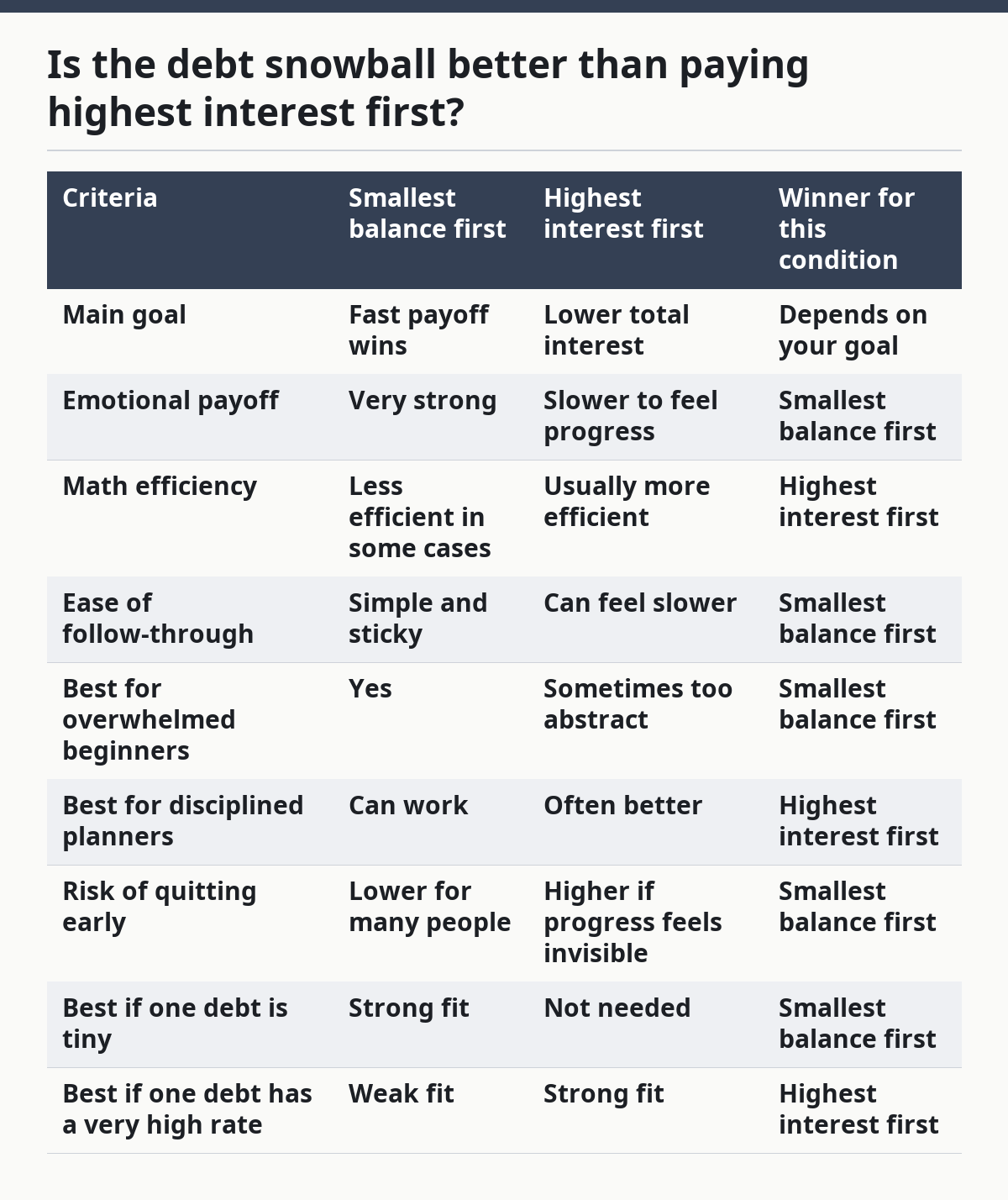
The smallest-balance method wins when the human side of debt is the problem. If the reader keeps losing steam, the faster win matters more than squeezing out the last bit of interest savings.
The highest-interest method wins when every dollar of interest matters and the repayment plan will still get followed. A person with steady habits and a clear budget may do better with that order. A person who needs visible progress, though, often does better with the snowball.
How do I know which debt counts as the “smallest”?
The smallest debt is the one with the lowest remaining balance, not the one with the lowest monthly payment. That distinction matters because payment size and balance size are not the same thing.
A debt with a $25 minimum payment can still be smaller than one with a $60 minimum payment. Focus on what is left to pay off, not on what the bill asks for each month. If two balances are close, either one can go first, but pick one and stay consistent.
A good order list looks like this:
- Debt A: smallest balance
- Debt B: next smallest balance
- Debt C: next smallest balance
- Debt D: largest balance
Keep all minimums current while you attack Debt A. Once Debt A is gone, add that full payment to Debt B. That rolling payment is the engine of the snowball.
The main mistake is switching back and forth. If you keep changing the target, you lose the momentum that makes this method work. A clean list matters more than a perfect list.
What should I do with extra money each month?
Extra money should go straight to the current target debt, not spread thin across every balance. That is how the snowball grows.
If you get a refund, a bonus, or a month with lower expenses, add that money to the smallest balance first. Even a small extra payment can shorten the time to the first payoff and get you to the next stage sooner. The point is not to make the plan fancy. The point is to make the next payoff happen faster.
It also helps to avoid creating false freedom after the first debt is gone. The moment a balance disappears, it is tempting to relax and spend the freed-up payment elsewhere. That move slows the plan down. Roll the old payment into the next debt instead.
A simple budget line for this method can look like:
- Minimums on all debts
- Extra payment to one target debt
- No new debt if possible
- Same target until it is gone
This is where the method becomes visible. The payment does not stay the same after a payoff; it grows. That growth is the whole point.
When does the small-debt order not make sense?
The small-debt order does not make sense when one balance has a much higher interest rate and the person can stay disciplined without needing quick wins. In that case, interest costs can pile up while the smallest debt gets eliminated first.
It also breaks down if the smallest debt is tiny but the person keeps adding new balances. A method that relies on momentum will fail if new debt keeps entering the list every month. The plan needs a stop on fresh borrowing, or at least a serious pause.
Another weak spot is a household that cannot keep minimum payments current. If the budget is already stretched past the limit, the issue is not repayment order alone. The answer may need a hardship plan, a call to creditors, or a consumer credit counselor approved by a trusted nonprofit.
The snowball method is not for someone looking for the mathematically perfect route at all costs. It is for someone who needs a plan that is simple enough to follow on a tired Tuesday night.
Which order would I use in real life?
The small-debt order is the one I would use if the goal is to clear balances fast in a way that feels doable. It gives the fastest visible win, and that first win can make the rest of the plan easier to finish.
Choose the smallest balance first if the list is long, the progress feels slow, or the reader has quit other repayment plans before. Choose the highest-interest balance first if the debts are under control, the budget is stable, and the main goal is interest savings. Neither method fixes a budget that is already broken.
Choose the smallest balance first if motivation is the weak point. Choose the highest-interest balance first if math matters more than morale. Neither if minimum payments are already impossible, because that calls for a different solution than an order list.
The best order is the one that will still be followed three months from now. A perfect plan that dies in week two helps no one.
What are the exceptions where I would switch plans?
The plan flips in a few specific cases, and those cases matter more than a generic rule. A small-balance-first order is not sacred.
One exception is a debt with a very high interest rate that is much costlier than the others. If the reader can stay steady, paying that one first can save real money over time.
A second exception is a balance so small that it can be erased almost immediately with one extra payment. In that case, the snowball and the interest-first plan may point to the same account anyway.
A third exception is a person who has already proved they can stick to a long budget without needing emotional wins. That person may prefer to aim at the highest-rate balance and ignore the psychology piece.
A fourth exception is a situation where a creditor is offering a hardship option, settlement path, or other repayment arrangement. In that case, the order of balances may matter less than the terms of the deal. Consumerfinance.gov is a solid place to review general debt and repayment guidance before making that call.
What should I do first this week?
The first step is to write down every debt, its remaining balance, and its minimum payment. That list is the starting point for the whole plan.
Then sort the balances from smallest to largest. Pick the smallest one and decide how much extra money can go to it every month. If there is no extra money yet, the next move is to find it in the budget before changing the order.
A short, usable checklist:
- List all balances
- Keep every minimum payment current
- Choose the smallest balance first
- Send all extra money there
- Roll that payment forward after payoff
That is the simplest order, and it works because it is easy to repeat. Repetition matters more than elegance when the goal is to clear debt and stay sane while doing it.
FAQ
Should I pay off the smallest debt or the highest interest rate first?
Pay off the smallest debt first if you need momentum and quick wins. Pay off the highest-interest debt first if you are focused on reducing interest and can stick with the plan without losing motivation. The right choice depends on whether discipline or morale is the bigger issue.
Do I still make minimum payments on every other debt?
Yes, keep making minimum payments on every other debt while you attack the target balance. Missing a minimum can create late fees, damage your payment history, and make the whole plan harder to finish. The snowball only works if the rest of the list stays current.
What if my smallest debt is only a little smaller than the next one?
Either one can go first if the balances are close, as long as the order stays fixed after that. The goal is not mathematical perfection. The goal is to create a clear first win and keep moving.
Can I use the snowball method if I have student loans, cards, and a car loan?
Yes, the method can include different kinds of debt as long as you know the remaining balances and minimum payments. The order still starts with the smallest balance, not the most annoying bill. If one debt has special terms, review those terms carefully before making extra payments.
What if I cannot afford the minimums?
If the minimums are already out of reach, the order of payoff is not the main problem. The next step is to look at a hardship plan, a credit counselor, or other consumer debt help before trying to snowball anything.
Drafted with AI; not yet reviewed by a person.