
Last updated: November 18, 2026
Quick answer: if you need a visible win within 30 to 90 days, the debt snowball method can be the better choice for low motivation because it creates progress you can see. This is information, not financial advice, and a qualified adviser should be consulted for your own situation. The debt snowball method fits people who already make minimum payments and need momentum more than perfect interest math.
Key takeaways
- The debt snowball method works best when your real problem is follow-through, not ignorance.
- Small balance wins can make the next payment feel easier to start.
- A plan that looks best on paper can still fail if it does not survive a low-energy month.
- If you are behind on bills, facing collection calls, or unsure which debts have special rules, pause and get qualified help.
- A debt tracker matters because progress you can see is easier to repeat than progress you only feel.
Who is this for?
The debt snowball method is for someone who can make minimum payments but needs a plan that feels winnable within 30 to 90 days. It assumes you already know your debt list, the minimum payment on each account, and that your budget has at least a little room above those minimums.
This is a behavioral tool, not a math contest. “Behavioral fit” means the plan matches how you actually act under stress, low energy, or a busy week, which is often the real problem. If you are already consistent and enjoy tracking interest rates, a different payoff order may suit you better.
However, it is not the best fit if your debts are so tangled that you cannot tell which ones are current, which ones are late, and which ones have penalties or special terms. In that case, the first job is to sort the list, not to choose a payoff order.
For context, this page sits under the broader hub on choosing the right debt payoff method, because the debt snowball method is one option in a larger decision. The question here is narrower: when low motivation changes the answer.
Why does motivation change the best method?
Motivation can change the best method because a plan you abandon after 2 months saves less than a plan you actually finish. The debt snowball method can beat a pure “lowest interest rate first” approach when the emotional payoff of a small win keeps you moving.
A math-only approach optimizes interest costs, but it can feel flat. You may pay the right bill first and still see little change in your life for months, especially if the account is large. That gap between effort and visible progress is where many people quit.
Therefore, a debt snowball gives you a short feedback loop. You pay the smallest debt first, then roll that freed-up payment into the next one. The result is a clear before-and-after moment: one balance disappears, one minimum payment disappears, and one account stops taking mental space.
That matters most when your debt tracker is doing more motivational work than your spreadsheet. A tracker is a simple list or app that shows balances shrinking and debts crossing out. If crossing off one $500 balance keeps you paying for the next 6 months, that behavioral gain can matter more than shaving a little interest from the first account.
How do I use the snowball without losing steam?
You use the debt snowball method by making the plan easy to start, easy to see, and hard to forget. The goal is not to build the most elegant spreadsheet; it is to build a system that survives ordinary life.
- List every debt with its minimum payment. Write each balance, due date, and minimum on one page or one tracker. Verify that every account appears once, and check for any missing bill that could trigger a late fee if ignored.
- Keep all minimum payments current. Pay the minimum on every debt on time before sending extra money anywhere. Verify that no account is about to go late, because a late payment breaks momentum fast and can add stress you do not need.
- Choose the smallest balance to attack first. Sort debts by balance, not by interest rate, and pick the one with the lowest remaining principal. Verify the target is truly the smallest debt, because one missed account can make the whole plan feel confusing.
- Set one fixed extra amount. Pick a specific dollar amount above the minimums and send it to the smallest debt every month. Verify the amount fits inside your budget, because a number that only works on a perfect month is a weak plan.
- Use automatic payments for the minimums. Schedule the minimums so they happen without a daily decision. Verify the draft dates happen before the due dates, because one missed transfer can drain your motivation for the week.
- Track the smallest debt until it is gone. Mark the balance down after every payment and cross it out when it reaches zero. Verify the tracker is visible enough to see often, because if you do not look at it, it cannot help your habit.
- Roll the freed payment into the next debt. When the first debt is gone, add its old payment to the next smallest balance. Verify the new total is larger than before, because the snowball depends on visible growth from one payoff to the next.
- Review the plan every 30 days. Check whether the tracker is still helping or whether the target debt no longer feels meaningful. Verify that the method still feels doable for the next month, because a stalled plan needs adjustment, not guilt.
Because of that, this is where the debt snowball method earns its place: it turns one finished debt into the fuel for the next one. The first win can matter a great deal, but if you are dealing with anxiety, overwhelm, or a complex budget, consider getting professional guidance before relying on motivation alone.
When is the snowball a better fit than pure math?
The debt snowball method is a better fit when your main barrier is behavior, not arithmetic. If you know what to do but do not keep doing it, the method that produces early wins is often the one you can stick with.
| Situation | Snowball fit | Math-only fit |
|---|---|---|
| You need quick proof that the plan is working | Strong | Weak |
| You lose interest after a month with no visible change | Strong | Weak |
| You enjoy optimization and keep to a plan | Weak to moderate | Strong |
| You are trying to build a paying habit | Strong | Moderate |
| You want the lowest-interest order no matter what | Weak | Strong |
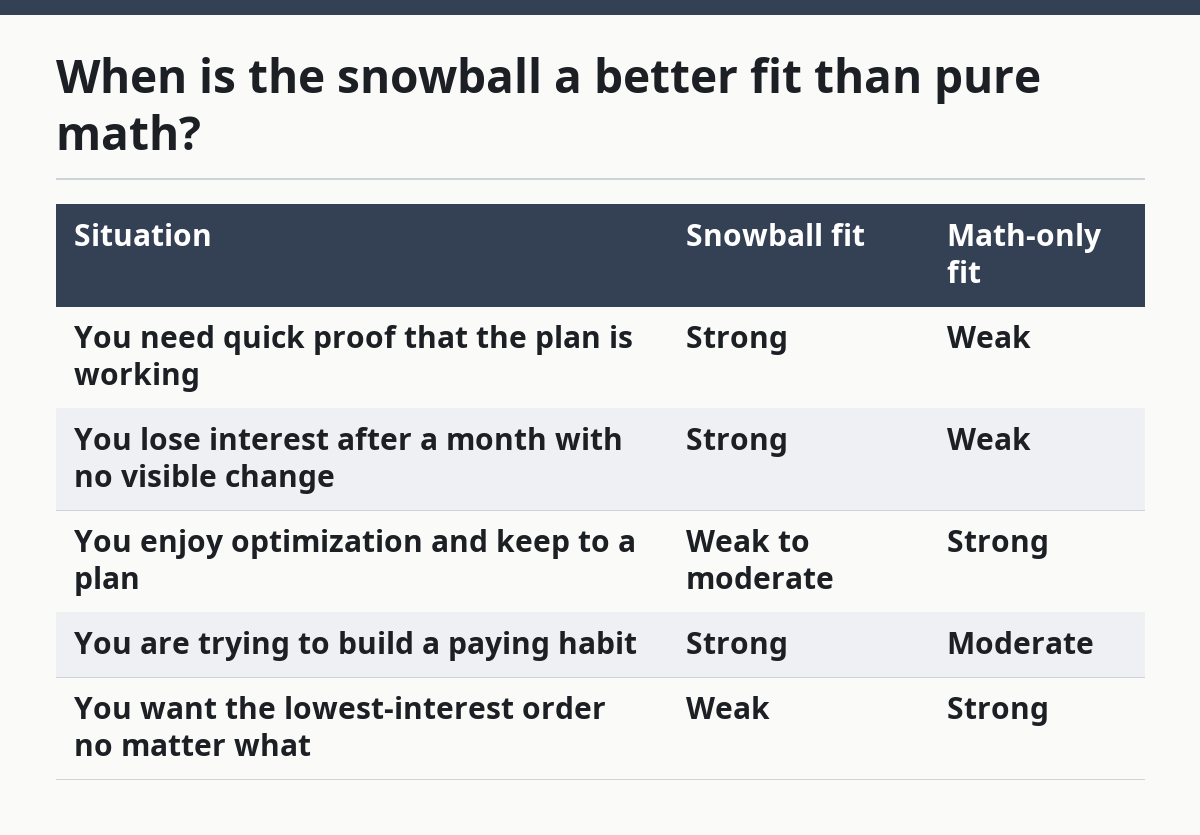
The key trade-off is simple: the debt snowball method can cost more in interest than a strict rate-based approach, but it may reduce the chance that you quit. That trade-off is real, and it is why this method is not for someone who already follows a payoff plan well without much effort.
It also helps when the smallest debt is emotionally loud. A tiny balance can be the one that keeps nagging you every time you check your account list. Removing that one item can make the rest of the list feel manageable.
What mistakes make the snowball fail?
The debt snowball method fails when the system gets too hard to follow or too vague to reward. The method itself is simple; the mistakes are usually about execution.
Skipping minimum payments: That turns a payoff plan into a delinquency problem — keep every minimum current first, then add extra to the target debt.
Picking the “most annoying” debt instead of the smallest balance: That can stretch the first win too far out — sort by balance so the first payoff comes sooner and builds momentum.
Setting an extra payment you cannot repeat for 3 months: That creates a false start — choose an amount that fits a normal month, not a perfect one.
Not using a debt tracker: That makes progress feel invisible — use a simple written list, spreadsheet, or app so each balance shrink is easy to see.
Changing targets every time you feel impatient: That breaks the habit loop — stay with one debt until it is gone, then move the full payment to the next one.
Also, one more common mistake is treating the method like a moral test. It is not. If debt stress is affecting your mental health or daily functioning, talk with a qualified professional; for general consumer debt guidance, the Consumer Financial Protection Bureau and the Federal Trade Commission both offer practical information.
When should I stop using it?
You should stop using the debt snowball method when the method is no longer the right tool for your debt situation. That does not mean you failed; it means the problem changed.
You are missing minimum payments: That signals the plan is too strained — get qualified help and focus on preventing new late marks first.
Your debts include special terms you do not understand: That means the list may not be simple enough for a snowball order — pause and review the terms before sending extra payments.
You cannot keep the smallest debt in the plan for 2 or 3 months: That suggests the target is not realistic — shrink the extra payment or rework the budget.
The tracker no longer motivates you: That means the behavioral payoff is gone — switch to a different order or a different tracking method before the plan goes stale.
Your situation becomes more urgent than motivation: That means the question is no longer “what keeps me going?” — seek qualified advice for your own situation and deal with the urgent issue first.
The debt snowball method is a tool for motion. If the tool stops producing motion, it is time to change the tool, not force the same one harder.
What does a good result look like?
A good result looks like one balance disappearing, then the next debt shrinking faster than the first did. The early win does not need to be dramatic; it needs to be visible enough that you keep the habit for another 30 days.
You should be able to point to three things: minimum payments are current, one debt is gone, and the freed payment is now going to the next target. If those three pieces are present, the plan is doing its job.
A good result also has fewer decisions. Once the tracker and automatic minimums are set, you should not need to rethink the plan every week. The more often you restart the mental debate, the more likely you are to stall.
That is the debt snowball method’s real advantage for low motivation: it reduces the number of choices you must make while debt payoff is still hard. For many people, that is worth more than perfect interest efficiency.
What should I check before choosing it?
You should check whether your real problem is motivation, cash flow, or confusion. If the issue is motivation, the debt snowball method can help. If the issue is not enough money to keep all minimum payments current, the method will not fix that.
Check three things first: every debt is listed, every minimum is affordable, and the first target can disappear in a reasonable stretch of time, such as a few months rather than years. If any of those checks fail, the plan needs more work before you start.
It also helps to compare the debt snowball method against the rest of the choices in the hub on choosing the right debt payoff method. That broader decision matters because one method can fit the same person at one stage and stop fitting later.
For a general money reference point, the U.S. Consumer Financial Protection Bureau and the Federal Trade Commission are useful places to cross-check terms and payment concepts. Country rules differ, so use the guidance that matches your own location.
Choosing the right debt payoff method can help you compare the snowball with other approaches. Debt avalanche vs. debt snowball explains the interest-rate trade-off. How to make minimum payments on time covers the basics of staying current. Debt payoff tracker template can make progress easier to see.
Is the snowball method better if I keep quitting?
Yes, if quitting is the main problem, the debt snowball method is often the better fit because it gives you an early payoff target. A small win in the first few months can make the next payment feel possible. If you still cannot keep the plan going, the issue may be the budget, not the order.
How do small wins help debt payoff?
Small wins help because they prove the plan is working before the finish line is far away. Crossing off one balance removes a bill, reduces clutter, and gives the tracker a visible payoff. That makes the next payment less abstract and often easier to repeat.
When should I stop using the snowball method?
Stop using the debt snowball method when it stops helping you act. If minimum payments are getting missed, your debts have terms you do not understand, or the first target is dragging on too long, the method is no longer doing its job. At that point, review the bigger picture and get qualified help for your own situation.
Drafted with AI; not yet reviewed by a person.