Last updated: November 19, 2026
Quick Answer: use windfall money to catch up first if any account is past due; use it to get ahead only after every account is current and your next monthly payment is covered.
That is the central choice in How to Decide Whether to Use a Windfall to Catch Up or Get Ahead on Debt, along with the trade-off between fixing arrears and making extra principal payments.
Key Takeaways
- A windfall can stop late fees, collection calls, and missed-payment marks when bills are already behind.
- Once every account is current, extra money can reduce principal and give you more room in future months.
- The right move depends on the status of each debt, not just on the size of the tax refund, bonus, or gift money.
- This is information, not financial advice; for your own situation, a qualified adviser can help you sort tax, contract, and cash-flow rules.
Who this applies to, and what it assumes
This applies if you have windfall money from a tax refund, bonus, or gift money and you need to choose between catching up on debt or paying ahead on debt.
It assumes you already know your balances, your due dates, and which accounts have a past due balance versus which are current.
Picture this: you have a $1,200 bonus sitting in your checking account, one card is 18 days late, and the rest are current. You do not need a fancy payoff model first; you need a clean order of operations.
That is the job here.
If you have a mortgage, student loan, medical bill, auto loan, or credit card, the basic question is the same: is any account behind right now, and what happens if you do nothing for 30 days?
If the answer involves late fees, shutoff risk, or collection letters, the windfall is doing damage control before it is doing progress.
I’m not giving personal financial advice here. Money rules vary by country, lender, and contract, and tax treatment can change too; for your own case, consult a qualified adviser.
The Consumer Financial Protection Bureau and the Federal Trade Commission both publish plain-language debt guidance if you want a second source.
Should a windfall go to missed payments first?

Yes—if an account is already behind, the windfall usually goes there first because minimum payment catch-up stops the account from getting worse.
That does not mean every dollar should vanish into old balances; it means you fix the immediate leak before you pour extra water into the bucket.
Picture this: you have enough to bring one account current, but not enough to wipe out the whole balance. The point is to restore the account to current status, cover any next due amount, and avoid adding a second month of trouble.
That is a narrower goal than “pay off debt,” and it should be.
Use this order:
- List every account with its current balance, minimum due, due date, and whether it is past due. Verify you have the latest statement, not last month’s memory. If a due date moved after autopay failed, the wrong date can mislead you.
- Mark the accounts that are behind by one payment cycle or more. Verify whether the lender treats the account as late, delinquent, or in collections, and consult the lender or a qualified adviser if you are unsure. The account dashboard or statement often says so.
- Bring past-due bills current first. Pay the amount needed to clear the arrears, plus any fee already posted, if the lender requires it. Verify that the account shows current, not “pending” or “promise to pay.” If the system still shows past due after 2 to 5 business days, something did not post correctly.
- Cover the next minimum due on every other debt. Verify the windfall is enough to keep the rest current through the next cycle. If it is not, the windfall is too small to solve the whole problem, so split it carefully.
- Only then think about extra principal. Principal is the amount you still owe before interest is added. Verify that any extra dollar is labeled as principal-only or extra payment; otherwise, some lenders may hold it for the next cycle instead.
- Keep one cash buffer if needed. If using the full amount would leave you unable to pay rent, food, or utilities in the next 30 days, stop. Verify the windfall does not create a new shortfall.
- Get written confirmation. Save screenshots or receipts. Verify the posting date and remaining balance, and consult the lender or a qualified adviser if the math is unclear. If the math is unclear, ask before paying.
The catch is simple: a late account has a cost attached to time.
Extra principal does not fix that.
What if every bill is current already?
Then the same windfall can go to extra principal, because getting ahead matters once the account is already stable.
That means paying more than the required amount so the balance falls faster, which may reduce future interest charges over time if the loan allows extra principal payments without penalty.
Picture this: your cards and loans are current, your next due dates are covered, and the windfall is sitting idle in checking. The choice is no longer rescue versus progress; it is progress versus flexibility.
That is a different decision.
Here’s the catch: getting ahead is not always the same as saving money. Some loans have prepayment penalties, some cards have no meaningful benefit from tiny extra payments, and some debts should stay liquid because you may need the cash within 30 to 60 days.
A windfall that gets locked into a loan can be awkward if your car repair arrives next week.
Check these before you send extra money:
- Is there a prepayment penalty? If the loan contract charges for early payoff, that can change the math. Verify the fee in the promissory note or loan agreement.
- Can you direct the payment to principal? If not, the lender may apply it to the next due date first. Verify the payment instructions on the website or statement.
- Do you still have a cash buffer? If paying ahead leaves you unable to handle one normal month of bills, you may have solved the wrong problem.
- Is the debt fixed-rate or variable-rate? A fixed rate gives a clearer picture of the benefit. A variable rate can move, and that matters.
You do not need to choose between “all in” and “do nothing.”
A partial extra principal payment can be enough to matter if the account is already current.
How to decide, step by step

Yes—you can make the call in a short worksheet if you rank the accounts by status before you rank them by balance.
This is the cleanest way to choose between catch-up and get-ahead without guessing.
Picture this: you have $2,000 in tax refund money, two current accounts, and one bill that is 12 days late. You are staring at the total and wondering whether the bigger move is emotional or mathematical.
It is procedural.
- Separate the windfall from your regular cash. Put the tax refund, bonus, or gift money in one account or sub-bucket for 24 hours. Verify you are not mixing it with rent or grocery money. If the money already has a purpose attached, that is a problem.
- List all debts with due dates. Write the minimum due, past-due amount, and next due date for each account. Verify the statement date, because a 15-day-old balance can be wrong. If you cannot find the minimum due, stop and get the latest bill.
- Flag any account that is late. Mark every past due balance, missed payment, or account in collections. Verify whether late fees, returned-payment fees, or shutoff risk apply. If the account is behind, it goes to the front of the line.
- Calculate the catch-up amount. Add the overdue amount and any required fee. Verify the lender’s rules for reinstatement or cure, because some accounts need more than one missed installment. If the cure amount is unclear, ask before paying and consult the lender or a qualified adviser if needed.
- Check next month’s survival. Make sure you can still cover food, housing, transport, and the next round of minimum payments for 30 days. Verify the leftover cash is enough to avoid creating a new shortfall. If not, do not drain the account.
- Compare the extra principal option. If all accounts are current, ask whether extra principal reduces interest and whether the loan accepts principal-only payments. Verify the instructions in writing. If the lender will not apply the extra to principal, the benefit may be smaller than you expect.
- Choose the split. If one account is behind, cure it first and send any remainder to the highest-cost current balance or hold it as cash. Verify the split on each confirmation screen. If you are unsure, a bad allocation can leave the late account still late.
- Confirm posting within 2 to 5 business days. Check that the account status changes as expected. Verify no payment was reversed or misapplied. If the status does not change, contact the lender immediately.
A simple rule works here: behind first, current second, extra principal last.
That is not glamorous, but it is clean.
When should you stop and do something else?
You should stop when the windfall is too small to fix the problem it is supposed to solve.
In those cases, forcing extra debt payments can make the next month worse, not better.
Picture this: the bonus would clear one late card, but it would leave you short on rent or utilities. The debt is still a problem, but cash flow is the bigger one right now.
That changes the answer.
One missed payment is already in collections: the account may need a cure amount, not just a minimum payment — contact the lender before you send money.
You cannot cover next month’s basics: the windfall is needed for survival cash — hold some back instead of draining it.
The account has a prepayment penalty: extra principal may cost more than it saves — read the loan terms before paying ahead.
The lender will not apply extra to principal: your extra money may just sit in the next payment bucket — ask for a principal-only payment method.
The bill is disputed: you may be paying a number you do not owe — get the statement corrected first.
Your debt is tied to a shutoff or repossession notice: timing matters more than optimization — act on the notice first and confirm the cure amount.
Sometimes the standard answer does not fit because the debt is not the only risk on the table.
In that case, cash protection beats elegance.
The mistakes people make with windfall money
People usually make the wrong move because they confuse balance size with urgency.
A $500 late account can be more pressing than a $5,000 current balance if the smaller one is already costing fees.
Picture this: you get a gift money deposit and decide to “make progress” by sending it to a big loan while a card is still late. It feels responsible in the moment.
It can still be the wrong move.
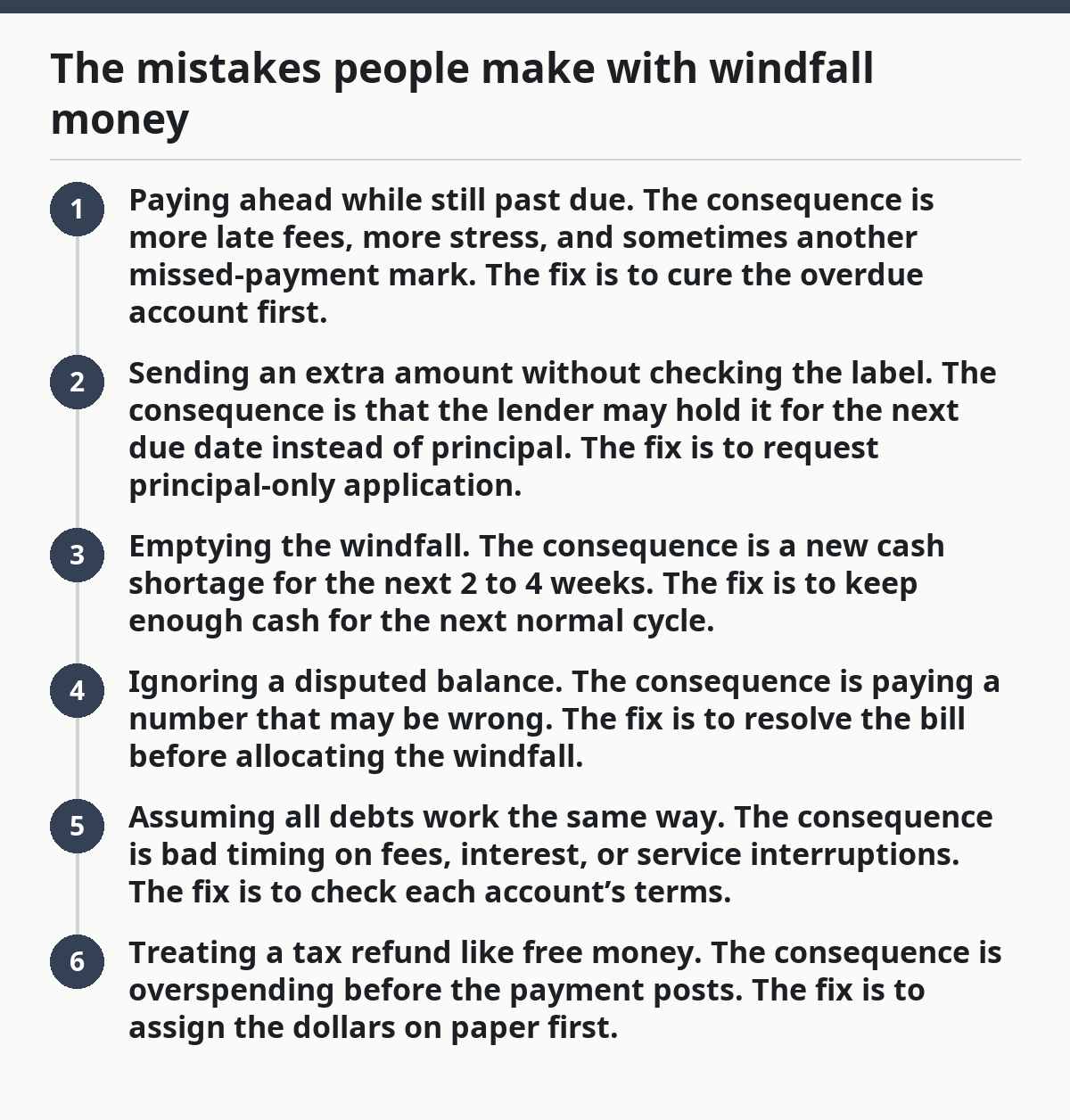
- Paying ahead while still past due. The consequence is more late fees, more stress, and sometimes another missed-payment mark. The fix is to cure the overdue account first.
- Sending an extra amount without checking the label. The consequence is that the lender may hold it for the next due date instead of principal. The fix is to request principal-only application.
- Emptying the windfall. The consequence is a new cash shortage for the next 2 to 4 weeks. The fix is to keep enough cash for the next normal cycle.
- Ignoring a disputed balance. The consequence is paying a number that may be wrong. The fix is to resolve the bill before allocating the windfall.
- Assuming all debts work the same way. The consequence is bad timing on fees, interest, or service interruptions. The fix is to check each account’s terms.
- Treating a tax refund like free money. The consequence is overspending before the payment posts. The fix is to assign the dollars on paper first.
The truth is, windfall money is useful only when it has a job.
Without a job, it disappears fast.
Edge cases where the usual rule changes
The usual rule changes when the debt has special terms or when the windfall is part of a larger cash event.
Those cases need a finer split than “catch up first” or “pay ahead first.”
Picture this: you receive a bonus, but it lands in the same month as annual insurance, school costs, or a move. The debt choice is no longer isolated.
It lives inside the rest of your budget.
- Secured debt with a repossession or foreclosure notice: the cure deadline matters more than interest savings. Verify the exact amount needed to stop the process and prioritize that before extra principal elsewhere.
- Debts with deferred interest or promotional terms: a lump sum may need to meet a very specific payoff amount before the promo ends. Verify the deadline and the remaining balance in writing.
- Multiple overdue accounts: if you cannot cure all of them, start with the one carrying the harshest consequence, then the one with the nearest deadline. Verify each lender’s late-fee policy.
- Debt settlement or hardship plans: extra money can sometimes disrupt a negotiated plan. Verify whether the agreement allows lump-sum payments before sending one.
- Business debt mixed with personal debt: keep the accounts separate if possible. Verify which money belongs to which bucket before allocating it.
- Windfall is smaller than one monthly minimum: use it to reduce the most immediate damage, not to pretend the whole problem is solved. Verify what remains due after the payment posts.
For a broader framework on balancing debt, cash flow, and budgeting, the hub on debt payoff planning and budgeting can sit next to this guide.
This page is about the one-time allocation decision, not the overall budget.
Drafted with AI; not yet reviewed by a person.