
Last updated: November 19, 2026
Quick answer: a debt payment hardship letter is usually 1 page, with 1 specific request, 1 short explanation, and 1 to 2 proof documents. A clear, brief letter with proof and a specific request works better than a long apology. The steps below settle what to include, how much detail to give, and how to follow up after you mail it. This guide explains how to write a Debt Payment Hardship Letter in a way a creditor can review quickly.
Key takeaways
- State the problem, the request, and the timeline in plain words.
- Attach enough proof to support the claim, but not your whole life story.
- Ask for one form of relief at a time if you want a clean answer.
- Send the letter to the right mail address and keep copies of everything.
- Follow up in writing so you can track what the creditor said.
This is information, not financial advice. For your own situation, especially if several debts are involved, a qualified adviser should be consulted; the Consumer Financial Protection Bureau also advises borrowers to contact creditors or servicers early and keep records of the request. CFPB FTC
Who this letter is for — and who should use something else
Picture this: you’re staring at an account statement, a due date is close, and you need a written way to ask for temporary help without making the situation worse. This guide is for a borrower who wants to send a hardship letter to a creditor, a lender, or a servicer and already has basic account details in hand. It assumes you know your account number, the balance or minimum due, and the current mailing address.
A hardship letter is the right tool when the problem is real but temporary: reduced hours, a medical bill, a move, a short gap in income, or another documented setback. It is not the right tool if you need a full debt strategy, if you do not know who owns the account, or if the debt is already in a stage where a different process applies. In those cases, a different page in the debt payoff communication and negotiation hub fits better.
Here’s the catch: the letter only helps if the facts match the request. If you ask for a three-month change, but your documents show a long-term drop in income, the creditor may want a different plan.
Before you start, gather:
- your account number and creditor name
- a recent account statement
- the mail address for the hardship or billing department
- proof of the hardship
- the specific relief you want
What should a hardship letter say?

A hardship letter should say what changed, how it affects your ability to pay, and exactly what you want the creditor to do. The first paragraph should do that in 3 to 5 sentences, not in a page of backstory. The cleanest letters read like a request, not a plea.
Use the real terms the creditor uses. A hardship program is the lender’s process for temporary relief, and a payment plan is a revised schedule for repaying the debt. If the creditor offers a forbearance, deferment, reduced payment, or due-date change, ask for the one that matches your problem.
A useful letter usually includes:
- your full name and mailing address
- account number
- date
- a short explanation of the hardship
- the specific relief request
- the date you want the change to start
- a list of attached documents
- a polite close asking for a written response
A simple format helps the reviewer find the account fast. It also keeps the request to one page.
A hardship letter should usually stay to 1 page. If the situation is complex, use a second page for documents, not for drama.
How much detail should you give?
Give enough detail to prove the hardship, but not so much that the letter becomes hard to read. One short paragraph of facts is usually enough for the body of the letter. The creditor needs a reason to review the request, not a full medical or family history.
The best level of detail is specific and bounded, not exhaustive. Say that your income dropped after a job change, that you were out of work for a period, or that an expense changed your budget. If you can point to dates, do it. If you cannot, keep the timeline honest and simple.
A good rule is this: include what explains the hardship, then stop. If a detail does not help the creditor understand the request or match the documents, leave it out. Too much detail can create confusion, and confusion can slow review.
Use these details only if they matter:
- date the hardship started
- whether it is temporary or ongoing
- whether you can make a smaller monthly amount
- when you expect your situation to improve
- what you can pay during the hardship period
Leave out:
- blame
- long emotional history
- unrelated debts
- promises you cannot keep
- anything you would not want copied into the file
How do I write the letter step by step?

You write the letter by keeping it short, specific, and easy to verify. The goal is a clean file that a creditor can read in one pass and route to the right team without guessing. A hard copy is still common, so format it like a business letter and keep the tone steady.
- Put your contact details at the top. Include your name, address, phone number, email, the date, and the creditor’s mail address. Verify the account number is on every page. If the number is missing or wrong, the letter can stall in processing.
- Name the hardship in one sentence. Say what changed and when, in plain words. Verify that the sentence matches your proof. If the story in the letter and the documents do not line up, the reviewer may question the request.
- State the exact relief you want. Ask for one change, such as a temporary reduced payment or a short pause, and name the start date if you know it. Verify the request is realistic for your budget. If you ask for something vague, the creditor may reply with a generic denial or a standard offer.
- Give a short reason for the request. Explain why the current amount no longer fits your budget. Keep it to 2 to 4 sentences. If the explanation runs long, cut it back. Long letters often bury the point.
- List the documents you are enclosing. Name the account statement, pay stub, benefit letter, bank record, or other proof. Verify each item is readable and current. If the copies are blurry or outdated, the creditor may ask again and delay the review.
- Ask for written confirmation. Request a letter or email showing the decision and the new terms, if any. Verify the mailing address or email for responses. If you skip this, you may not have a record of what was agreed.
- Sign and date the letter. Use your usual signature and include the date you sent it. Verify the letter is signed on every page if the creditor asks for that. An unsigned letter can be set aside without review.
- Make and store copies. Keep one copy of the letter, one copy of every attachment, and proof of mailing. Verify you can find them again if the creditor says the file is missing. Without copies, follow-up gets messy fast.
The truth is, the documents matter as much as the wording. A neat letter with no proof often gets a slower answer than a simple letter with clear attachments.
What proof should you send with it?
Send proof that matches the hardship and nothing more. The right document depends on the reason for the request, and different creditors may ask for different items. A recent account statement helps the reviewer locate the account; proof documents explain why the current terms are too hard.
Common attachments include a pay stub, unemployment notice, benefit letter, medical bill, rent increase notice, or bank statement. If the hardship involves a change in household income, include the document that shows the change. If it involves a one-time bill, show the bill and the date it was due.
Do not send original documents unless the creditor asks for them. Send copies, and black out account numbers on unrelated pages if needed. Keep the copy set identical to what you mailed.
A simple attachment list can include:
- one recent account statement
- one proof document for the hardship
- one page listing your requested relief
- a self-addressed note with your account number
If the creditor’s hardship program has a form, use it. A form can speed review because it asks for the exact fields the lender wants. If no form exists, your letter should do the job.
Where do I send it, and how do I keep proof?
Send it to the mail address the creditor gives for hardship, billing disputes, or account servicing, not to a random branch. The right address matters because a general mailbox can add days or weeks. If the creditor has a secure upload portal, a fax number, or a dedicated servicing address, check the creditor’s instructions or ask a professional if you are unsure which channel is safest for your account.
Use a mailing method that gives you proof of delivery or at least proof that you mailed it. Keep the receipt, tracking number, and a copy of the envelope if you can. If you fax the letter, keep the confirmation page. If you upload it, save the confirmation screen or reference number.
Write down the date you mailed it, the address used, and the person or department you contacted. A simple log is enough.
Keep this record set:
- a dated copy of the letter
- copies of all attachments
- proof of mailing or delivery
- the name of the department used
- notes from any follow-up call
Here’s the catch: if the creditor later says it never received the letter, your record set is what keeps the conversation moving.
What mistakes make a hardship letter weaker?
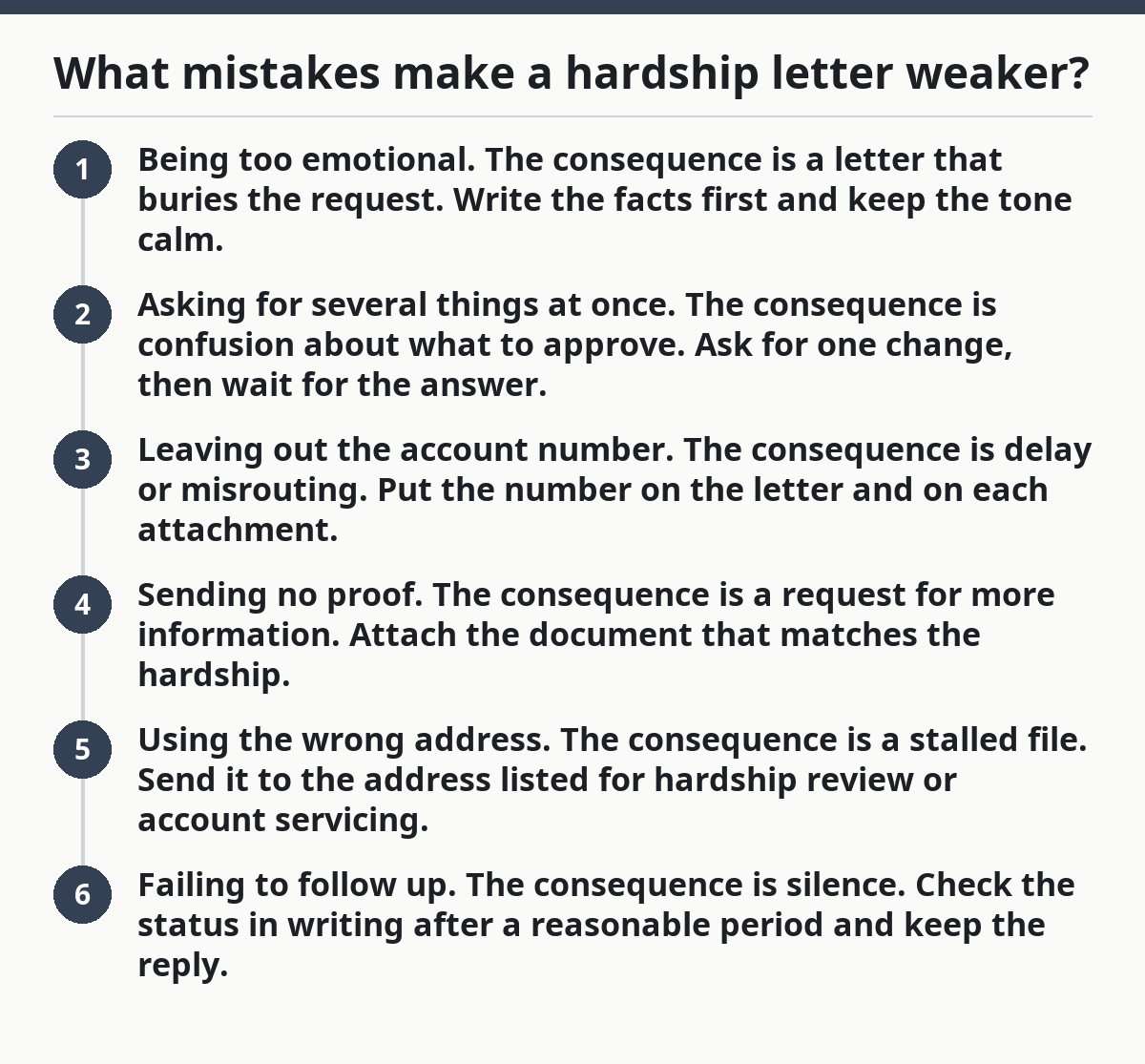
A weak hardship letter is usually too vague, too long, or sent without proof. Those mistakes do not just look sloppy; they can slow review or lead to a generic denial. Most of the time, the fix is simple.
- Being too emotional. The consequence is a letter that buries the request. Write the facts first and keep the tone calm.
- Asking for several things at once. The consequence is confusion about what to approve. Ask for one change, then wait for the answer.
- Leaving out the account number. The consequence is delay or misrouting. Put the number on the letter and on each attachment.
- Sending no proof. The consequence is a request for more information. Attach the document that matches the hardship.
- Using the wrong address. The consequence is a stalled file. Send it to the address listed for hardship review or account servicing.
- Failing to follow up. The consequence is silence. Check the status in writing after a reasonable period and keep the reply.
A 15-minute review can save you a week of back-and-forth. That is often enough time to catch a missing date, a wrong address, or a vague request.
When does the standard approach not fit?
The standard letter is the wrong tool when the debt is in a different stage or the request is not really temporary. In those cases, the letter can still be part of the record, but it may not solve the underlying problem.
The hardship is long-term and not temporary: the request may need a different repayment structure — ask for review of longer-term options rather than a short pause.
The creditor has already assigned the account to collections: the servicing path may have changed — send the letter only if that collector or servicer tells you to, and keep the record.
You do not know who owns the account: you may be writing to the wrong place — find the current creditor or servicer first.
The account statement shows a disputed balance: the issue may be billing accuracy, not hardship — separate the dispute from the relief request.
The creditor asks for a specific form or portal: ignoring the form can slow everything down — use the required process before you mail a free-form letter.
On the flip side, if your situation is clearly temporary and documented, a straightforward hardship letter is often the cleanest first step.
What should happen after you send it?
After you send the letter, you should track the date, wait for a written response, and be ready to restate the request if the creditor asks for more documents. A reply may come by mail, email, or portal message, and the terms can vary by creditor. Read the whole response before you assume the request was accepted or denied.
If the creditor asks for more proof, send only what it asked for. If it offers a payment plan, read the new amount, the due dates, and whether missed payments cancel the arrangement. If the answer is unclear, ask for it in writing.
Do not rely on a phone note alone. Keep the follow-up in writing so you can track the exact decision and any new deadline.
A follow-up note can be short:
- confirm the date you sent the hardship letter
- restate the account number
- ask whether the file is complete
- request the written decision and next steps
This page is one piece of the larger debt payoff communication and negotiation process, not the whole strategy. The letter starts the record. The follow-up keeps it usable.
What should I include in a hardship letter?
Include your account number, a short explanation of the hardship, the exact help you want, and copies of any supporting documents. Keep the request specific and readable. A one-page letter is often enough if the account details and proof are clear.
How do I ask for lower payments in writing?
Ask for a reduced monthly amount and say when you want it to start. State that the request is due to a temporary hardship and list the document that supports it. Keep the wording direct so the creditor can route it to the right hardship program or review team.
Can I use a hardship letter for credit cards and loans?
Yes, if the creditor or servicer accepts written hardship requests. Different accounts can use different review rules, so the response may not be the same for a card, auto loan, mortgage, or personal loan. Check the account’s own mailing address and any form the creditor requires.
Should I send proof with a hardship letter?
Yes, if you have it and it matches the reason for the request.
Drafted with AI; not yet reviewed by a person.