
Last updated: November 19, 2026
Key Takeaways
- An emergency debt payment plan covers a short cash-flow disruption, not a long-term debt problem.
- Build a short-term budget by matching available cash to the next 7 to 14 days of due dates.
- Protect the bills most likely to cause immediate harm first, then fit the rest around them.
- During a family emergency, trim the plan to this week’s essentials and contact creditors before the due date.
A short emergency can still throw off debt payments, rent, and utilities at the same time. This guide to How to Keep Debt Payments on Track During a Temporary Emergency shows how to sort bills, talk to creditors, and avoid missed payments until life steadies.
What an emergency debt payment plan is for

An emergency debt payment plan is for a temporary disruption: a few days, a few weeks, or another short stretch where cash flow is tight but not gone. It assumes you still have some income, a checking account, and a list of due dates for debt, rent, and utilities.
This page is information, not financial advice. If your situation is tied to taxes, court orders, or a formal insolvency process, a qualified adviser should look at your specific case. The same is true if you are unsure which bills have legal penalties for missing them; for general federal consumer guidance, see the CFPB and, if debt collection is involved, the FTC.
Picture this: you’re handling a family emergency, and your usual routine is gone for a week. You still need to keep rent, utilities, and debt due dates from colliding, and you need a plan that fits the next 7 to 30 days.
- This is not a long-term debt makeover.
- It is not a plan for a job loss that has already wiped out income.
- It is for people who need to stay current while the emergency is still unfolding.
The rest of this guide focuses on the questions readers usually ask first: what to pay, what to delay, what to tell creditors, and how to keep one missed date from turning into three. For broader budgeting help, see our budgeting basics and debt payoff recovery.
How to build a short-term emergency budget without losing track
You build a short-term emergency budget by listing your money in the order it must leave, then matching it to the next 7 to 14 days of due dates. Do not start with categories like “good debt” and “bad debt.” Start with what keeps the lights on, the home secure, and the account in good standing; if you are unsure how to rank a bill, a qualified adviser can help you sort the legal and financial risks.
Picture this: you’re staring at a pile of bills and a phone reminder that your card, loan, and rent are all due before the end of the month. You need a cash-first plan that shows what must be paid now, what can wait a few days, and what needs a call today.
The truth is:
- List every fixed bill with its exact due date. Include debt, rent, utilities, insurance, and any autopay items. Verify the dates in your bank app or billing portal. If you cannot find a date, that bill is a risk.
- Mark the essentials first. Put rent, electricity, water, gas, phone, and internet at the top if they are needed for safety, work, or communication. If one of these is already past due, that is a warning sign.
- Check the cash you can actually use. Use the balance in your checking account and any income expected before the earliest due date. Do not count money that is already spoken for or uncertain.
- Set aside enough for essentials before debt. If your emergency fund has any room, use it for the bills that prevent the biggest disruption. A $200 cushion is useful only if it is still there on the due date.
- Group debts by timing. Separate due in 3 days, due in 7 days, and due later this month. This reduces the chance of a missed date caused by bad memory, not bad math.
- Choose the minimum acceptable action for each account. For a credit card, that may be the minimum payment. For a loan, it may be the scheduled installment. Verify the amount in the statement, not your memory.
- Leave a small buffer in checking. Even a small leftover amount can stop overdrafts, which often cost more than the original payment problem.
- Write the plan where you will see it twice a day. A paper list on the fridge, a phone note, or a calendar alert works. If the plan lives in one unread email, it is already failing.
A short-term budget works when it answers one question fast: “What leaves my account before the next paycheck or deposit?” If that answer is fuzzy, the emergency plan will be fuzzy too.
Which debts to protect first during a short emergency

You protect the debts that can trigger the fastest damage first, then handle everything else around them. That usually means the bill that risks a shutoff, eviction, repossession, or a fee that snowballs quickly.
Picture this: you have $500 available, three debt due dates, and a utility notice on the counter. You do not have room to “be fair” to every bill in the same way; you need a temporary triage order that keeps the most serious consequence off the table.
Specifically:
- Housing and utilities that affect basic living. Rent or mortgage, electricity, water, heat, and any bill tied to keeping the home usable.
- Debts with near-term penalties. A missed card payment can bring fees and interest changes; a missed loan installment can trigger more serious collection steps.
- Bills tied to income or communication. Phone and internet matter if they are needed to work, access banking, or contact creditors.
- Anything with a hard cutoff date. If a bill is due before your next likely deposit, it rises in priority.
- Debts already in default or collection. These can still matter, but a current account usually deserves protection first during a short emergency.
The goal is not to erase every debt decision. It is to keep the accounts that create the biggest immediate fallout from slipping first. A reader who tries to make all debts equal in a crisis usually ends up missing the one that mattered most.
On the flip side, a bill with a high balance is not always the first bill to pay. The biggest balance is not the same thing as the nearest threat. For more on consumer rights around late payments and collections, the CFPB and FTC are useful starting points.
How do I keep paying debt during a family emergency?
You keep paying debt during a family emergency by shrinking the plan to the bills that matter this week, then using direct contact with creditors before the due date passes. A short call or secure message is better than silence, and if the account is complicated or legal notices are involved, a qualified adviser can help you decide what to say.
Picture this: you are spending hours at a hospital, a funeral home, or a care facility, and your normal bill-paying routine has disappeared. You still need a way to protect due dates, rent, and utilities without pretending the emergency is over.
Once that reality is clear, use this sequence:
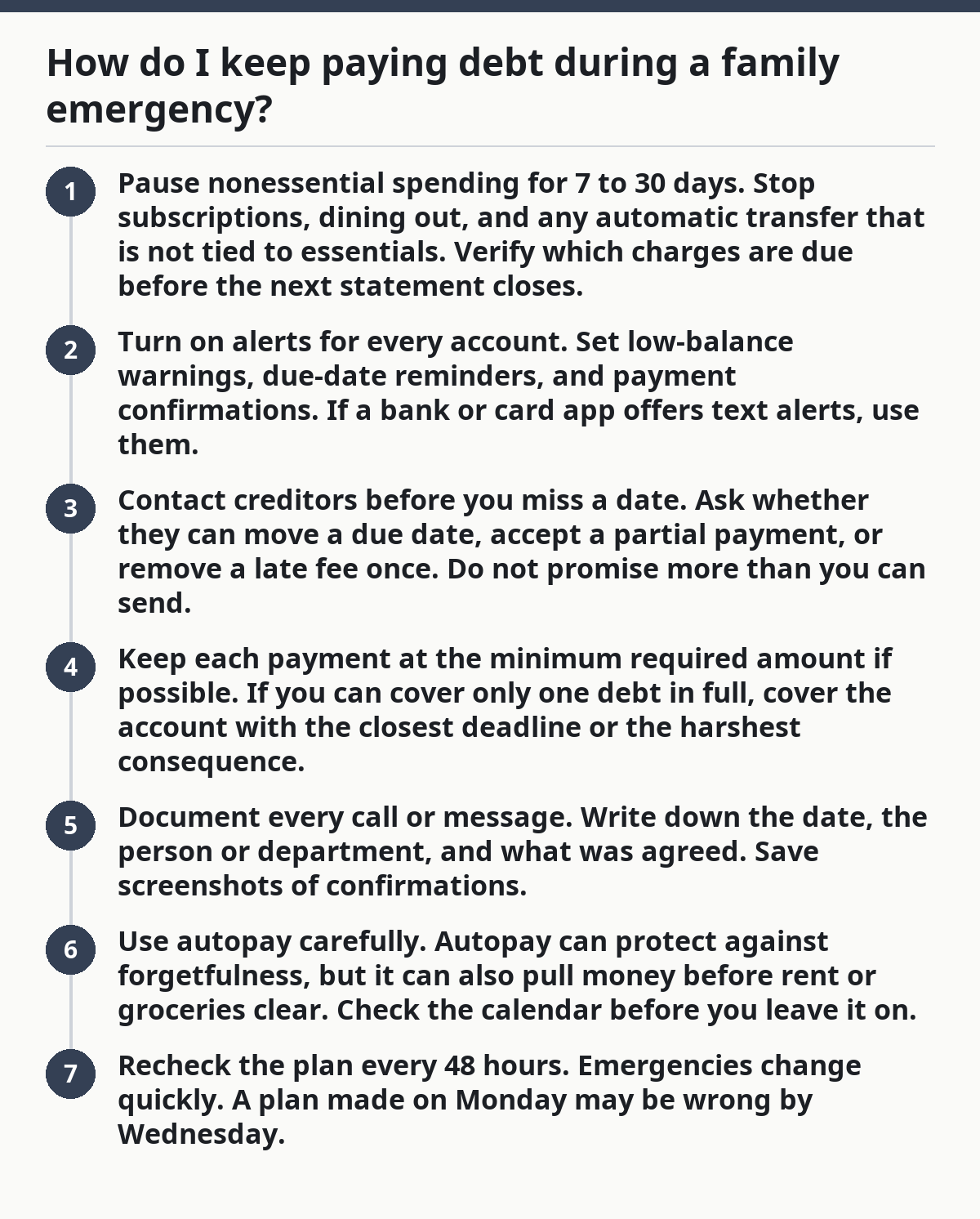
- Pause nonessential spending for 7 to 30 days. Stop subscriptions, dining out, and any automatic transfer that is not tied to essentials. Verify which charges are due before the next statement closes.
- Turn on alerts for every account. Set low-balance warnings, due-date reminders, and payment confirmations. If a bank or card app offers text alerts, use them.
- Contact creditors before you miss a date. Ask whether they can move a due date, accept a partial payment, or remove a late fee once. Do not promise more than you can send.
- Keep each payment at the minimum required amount if possible. If you can cover only one debt in full, cover the account with the closest deadline or the harshest consequence.
- Document every call or message. Write down the date, the person or department, and what was agreed. Save screenshots of confirmations.
- Use autopay carefully. Autopay can protect against forgetfulness, but it can also pull money before rent or groceries clear. Check the calendar before you leave it on.
- Recheck the plan every 48 hours. Emergencies change quickly. A plan made on Monday may be wrong by Wednesday.
Contacting creditors early does not erase a debt. It can, however, keep a temporary crisis from turning into a fee stack, a closed account, or a missed payment mark. For sample consumer guidance on contacting creditors and collection issues, see the CFPB and Nolo’s debt collection resources.
What to check before going further
You check four things before the due date arrives: the balance, the date, the payment method, and the cash in checking. If one of those is wrong, the plan is not ready.
Picture this: you have made a list, but the emergency is still active and your inbox is filling up. Now you need a fast review that catches the kind of mistake that happens when you are tired, distracted, or moving between places.
Use this checklist:
- Exact due date: confirm the date on the creditor site or statement. A date written from memory is not enough.
- Minimum amount due: check whether the amount changed after fees or interest.
- Payment method: confirm which account or card will be used, and whether the transfer takes one business day or more.
- Available balance: make sure the account holding the payment has enough money at the time it will clear, not just when you schedule it.
- Holiday and weekend timing: a due date on Friday can behave differently than one on Monday if the payment path takes time.
- Autopay status: make sure you know what is already set to leave automatically so you do not double-pay or bounce an account.
A good short-term plan often fails because of timing, not because of total debt. A payment that is “scheduled” but not yet cleared can still miss the creditor’s cutoff. That problem is especially common with transfers started late in the day or right before a weekend.
If any check is uncertain, treat it as a risk and act sooner. In a short emergency, waiting for perfect timing often costs more than sending a smaller but on-time payment.
The mistakes people actually make, and what they cost
The biggest mistakes are not complicated. They are usually timing errors, silence, and treating every bill as equal when the calendar says otherwise.
Picture this: you are juggling one emergency, two apps, and five deadlines. One wrong move can create a new fee, an overdraft, or a missed due date that takes weeks to fix.
Common errors include:
- Waiting too long to call the creditor. The consequence is that you lose the chance to ask for a change before the due date passes. The better move is to contact them as soon as the emergency affects cash flow.
- Paying the largest balance first. The consequence is that a smaller but more urgent bill can trigger fees or shutoff notices. The better move is to rank bills by timing and penalty, not size alone.
- Assuming autopay will handle everything. The consequence is a bounced payment or an overdraft if the linked account is short. The better move is to review every automatic withdrawal before the next cycle.
- Skipping utilities to cover debt. The consequence is that housing and basic living costs become harder to manage. The better move is to protect essentials first, then fit debt around them.
- Using the emergency fund with no plan. The consequence is that the money disappears on scattered expenses. The better move is to assign every dollar to a bill before it leaves checking.
- Ignoring confirmation after paying. The consequence is that you may not notice a failed transfer until the account is already past due. The better move is to verify that the payment posted, not just that you clicked submit.
A temporary emergency punishes disorganization more than it punishes modest spending cuts. If the plan is simple enough to follow on a bad day, it is more likely to work.
When the standard approach does not apply
The standard approach stops working when the emergency is no longer short, the bills are already in default, or the calendar no longer gives you enough breathing room.
Picture this: the emergency is stretching past a few weeks, and the same due dates keep coming around. At that point, a short-term emergency debt payment plan may not be enough on its own, because the problem is no longer just timing.
Stop using this approach alone if:
Your next several due dates are already impossible: the gap between cash and bills is too large — shift to a fuller debt and cash-flow review with a qualified adviser.
You have received a shutoff, eviction, repossession, or lawsuit notice: the consequence is a legal or service deadline — get qualified help and respond to the notice immediately.
Your income has stopped, not just shifted: the consequence is that short-term triage will run out — use the separate job-loss process on this site instead of stretching this page’s method.
Payments are already late across multiple accounts: the consequence is that late fees and collection calls may already be in motion — make a recovery plan, not just a current-month plan.
You cannot tell which bill is secured and which is discretionary: the consequence is that a wrong choice could put housing or utilities at risk — get help sorting the accounts before more money leaves.
This is where a generic “just budget harder” article breaks down. If the emergency has moved beyond a brief disruption, the right answer is a broader plan, not more pressure on the same one.
For a deeper framework on recovery after a setback, see the hub on debt payoff recovery and setback management.
What a good result looks like after the emergency passes
A good result is not “every bill was perfect.” It is that the emergency ended without a cascade of missed dates, service shutoffs, or avoidable fees that outlast the crisis.
Picture this: the emergency is easing, and your accounts are still standing. You now have a clean record of what was paid, what was delayed, and which creditors already saw a temporary change.
A solid outcome usually looks like this:
- No surprise misses. Every account had a due-date decision before the cutoff.
- Essentials stayed intact. Rent and utilities remained workable, or at least were addressed early enough to avoid a bigger problem.
- Creditors were told early. Even a short call often prevents the worst damage from silence.
- You kept records. Notes, screenshots, and confirmations make the next step easier.
- You know what to fix next. Maybe autopay timing needs adjusting, or maybe the emergency fund needs a refill before the next cycle.
The short-term plan often teaches one practical lesson: calendar control matters as much as dollar control. If the dates are visible and the essentials are protected, the debt plan has a chance to survive the rough week.
Drafted with AI; not yet reviewed by a person.