
Last updated: November 19, 2026
Quick answer: you can restart debt payoff after falling behind on payments in 3 steps. Bring one account current, keep the rest on minimums, and set up a payment calendar and autopay system you can repeat. The steps below show how to restart debt payoff after falling behind on payments without trying to fix every balance at once.
Key Takeaways
- Start by stopping new damage, then choose one account to reopen first.
- Bring past-due balances current before you spread extra money around.
- Put payment due dates, minimum payments, and autopay in one place you can check fast.
- Watch credit reports for the result of missed payments, but fix the cash flow first.
- If several accounts are delinquent, restart the plan in layers instead of trying to solve everything in one day.
This is information, not financial advice. Personal debt rules, late-fee rules, and reporting timelines vary by country and by lender, so a qualified adviser should be consulted for your own situation. For official consumer guidance, see the Consumer Financial Protection Bureau and the Federal Trade Commission.
Who this applies to, and what you need in hand
This applies if you missed one or more payments, your debt payoff plan stalled, and you want a practical way to restart without chasing every account at once. You need your latest statements, login access for each account, a list of due dates, and the minimum payment for each debt. If you do not have those, the first job is to gather them, because guessing leads to another missed due date.
You also need a clear view of which accounts are past due — meaning the required amount was not paid by the due date — and which are still current. A current account can usually stay on autopay while you focus on the one that slipped. A delinquent account may need a catch-up payment or a call to the servicer before you move on.
Because of that, a restart plan is not the same as a payoff plan from day one. It is a recovery sequence. The goal is to stop the bleeding, get the accounts back on a regular rhythm, and then resume extra principal payments if your budget still has room.
How do I restart debt payoff after getting behind on payments?

You restart by stabilizing the accounts in order, not by trying to fix every balance in one sitting. The debt payoff restart plan works best when you choose one first account, make the required catch-up payment, then rebuild your payment rhythm around the remaining due dates.
- List every debt on one page. Write the creditor name, balance, minimum payment, due date, and current status for each account. Use a notebook, spreadsheet, or notes app — one page, not five. Verify that you know which account is current, which is 30+ days late, and which has already been sent to collections. If you cannot tell, that is a problem because the next move depends on status.
- Mark the account most likely to do more harm first. Pick the debt with the nearest due date, the highest fee risk, or the one already reporting late. In many cases that is the account with the oldest missed payment date. Verify that the account is still open and that a normal payment will be accepted online or by phone. If the lender says the account is restricted, you need the servicer’s payment instructions before sending money.
- Bring the first account current. Pay the overdue amount required to satisfy the missed cycle, plus the minimum due now if the lender requires both. The exact formula differs by creditor and country, so check the statement or servicing site before you submit. Verify that the payment posts and that the account shows current, pending, or promised status in writing. If the amount still shows as past due after the payment clears, follow up right away.
- Keep all current accounts on minimums only for the moment. Put the rest of the debts on standard minimum payments, not extra principal, until the first account is stable. Verify that each autopay date lands at least a few business days before the due date, since weekend and holiday processing can push a draft. If any account has no autopay set, that is a weak spot.
- Set one tracking system for due dates. Add every due date to a calendar with a 3-day reminder and a 7-day reminder. Use the same format for each account. Verify that the reminders hit your phone or email before the funds leave your checking account. If the reminders are buried in an app you never open, they will not help.
- Rebuild the payment rhythm from your checking balance backward. Look at payday timing, rent, and recurring bills, then place debt drafts after the cash arrives and before the next fixed bill. If possible, leave a buffer in the account so one small timing delay does not trigger another missed payment. Verify that the buffer is large enough to cover at least one minimum payment. If not, the schedule is still too tight.
- Resume extra payoff only after the restart holds. Wait for one full billing cycle with no new misses before sending extra money beyond minimums. Then direct extra dollars to the chosen target account, usually the highest-cost or most urgent one, depending on your broader plan. Verify that the extra payment is applied the way you intended — to principal, not as an early next payment. If the creditor applies it differently, change the instruction in the portal or by phone.
- Check the result on your credit reports. Pull your reports from the official source available in your country and confirm that the late status, if any, is reported correctly. This does not repair the account, but it tells you whether the lender’s records match yours. Verify the account numbers, status codes, and dates. If the report is wrong, dispute only the error that is documented.
You do not need a perfect overhaul to restart. You need the first account current, the rest on minimums, and a payment calendar that keeps the next miss from happening.
Which account should I reopen first?
The first account to reopen is usually the one with the nearest harm, not the one with the biggest balance. If one account is already past due, that account often goes first because another missed cycle can create fees, new delinquency, or a sharper credit-report mark.
Picture this: you have three debts, two are current, and one is 18 days late. You do not have to solve all three today. You need to know which one needs cash first, which one can wait until the next payday, and which one can stay on autopay while you fix the damage.
A simple order helps:
- Past-due account first if it is still open and can be brought current.
- Current account with the next nearest due date if the overdue one is already in collection or frozen.
- Any account on a shaky autopay setup if the draft date is close to a low bank balance.
That choice is not about emotion. It is about stopping the next negative mark and keeping the plan alive. If you spread a small amount across four accounts, you may keep none of them safe.
On the other hand, do not use the “largest balance first” method just because it sounds disciplined. That method can work inside a healthy payoff plan. It is weaker when the main problem is a missed payment cascade and you need to stop immediate damage.
What should I check before I send the first catch-up payment?

You should check the account status, the amount due, the posting rules, and the due date on the statement before any money leaves your checking account. That sounds obvious. It is not obvious when you are stressed and trying to fix three things at once.
Look for these items on each statement or servicing page:
- Past-due amount
- Minimum payment
- Next due date
- Late fee already charged
- Whether autopay is still active
- Whether the account accepts partial payments
If the creditor has a grace period, note it, but do not rely on it as a plan. Grace periods vary by product and lender. If a fee has already posted, ask whether a catch-up payment will stop additional late charges or simply move the account back to current after the next cycle.
Also check whether the account is on credit reports yet. A missed payment can show up after a reporting cycle, not instantly. That means the payoff restart sequence needs to fix the account itself first, then the report trail, not the other way around.
For people who want a wider recovery framework, the hub on debt payoff recovery and setback management is the next stop after this page.
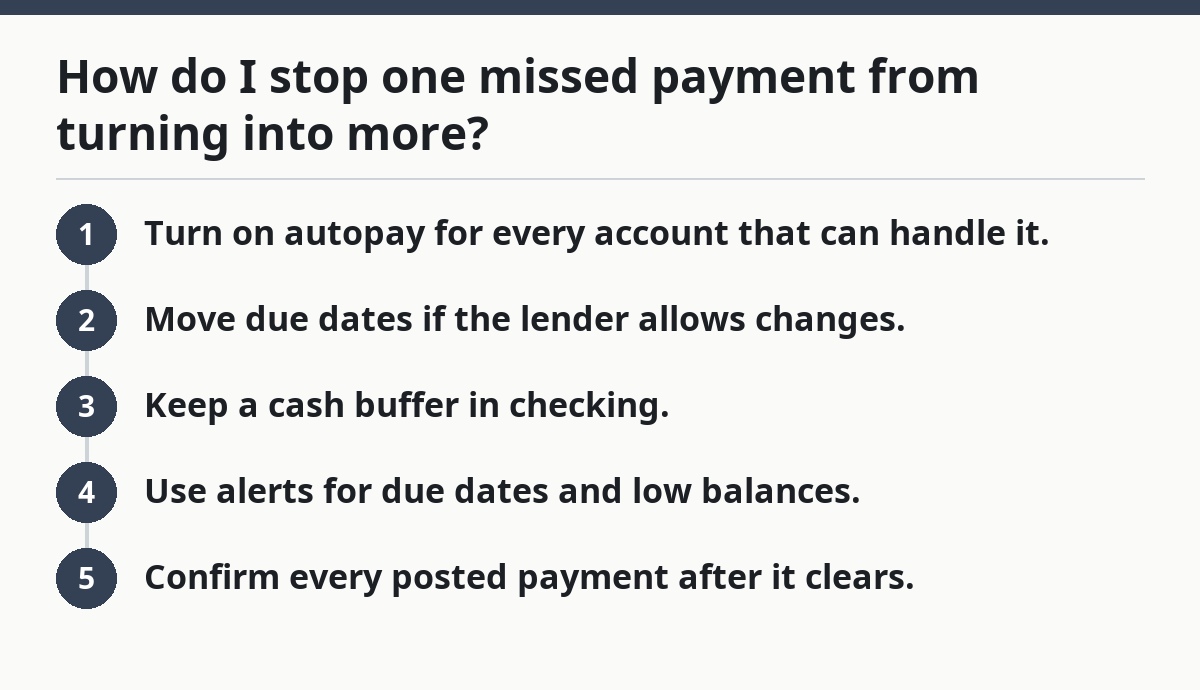
How do I stop one missed payment from turning into more?
You stop the chain by putting a hard wall between the missed account and the rest of your bills. One missed payment often turns into two when the bank balance is too tight, the due dates cluster together, or the payment method is still set to manual reminders only.
Picture this: the first miss happened because the money was late, the second because you forgot the new due date, and the third because you assumed the account would “fix itself” after one transfer. It rarely does. The fix is a system, not hope.
Use this sequence:
- Turn on autopay for every account that can handle it.
- Move due dates if the lender allows changes.
- Keep a cash buffer in checking.
- Use alerts for due dates and low balances.
- Confirm every posted payment after it clears.
Autopay is not perfect, but it is better than memory when the stakes are high. A draft that runs on the wrong day can still cause trouble, so check the calendar against your income cycle and keep a cushion of at least one minimum payment if you can.
The truth is, missed payments often snowball because the system is set up for a normal month, not a bad one. The repair is to make the month less fragile.
When does the standard restart plan stop working?
The standard restart plan stops working when the account is no longer in ordinary delinquency or when the cash flow gap is too wide for minimum payments alone. In those cases, the right next step is different, and trying to force the usual sequence can make things worse.
The account is in collections: the original lender may no longer handle day-to-day payments — follow the collector’s written instructions and confirm who legally owns the debt before sending money.
The lender has restricted the account: online payment may be blocked or limited — get the servicing department’s exact payment method and reference number before you send anything.
The minimum payment is bigger than your realistic monthly cash flow: the restart plan cannot hold — you need a broader budget change, not a tighter reminder app.
Several accounts are overdue at once: the damage is already spreading — restart the most urgent account first and keep the others on their required minimums until you have a stable cycle.
A payment was made but not posted: the account can still show late — keep the receipt, confirm the posting date, and contact the servicer if the status does not change.
The due dates are all clustered inside the same 7-day window: one paycheck can get hit too hard — ask whether any creditor will change the due date so the bills spread out.
This is the point where outside help can matter, especially if the account terms are unfamiliar or the creditor’s notices are unclear. A qualified financial professional can help you sort the sequence for your own numbers and rules.
What are the mistakes people actually make?
The most common mistake is paying the wrong account first because it feels urgent, not because it does the most good. That can leave the actual problem account untouched for another cycle. The better move is to rank accounts by status, due date, and reporting risk.
Other common errors:
- Splitting one small payment across many debts. This often leaves every account short. The alternative is to bring one account current, then move to the next.
- Ignoring the minimum payment while chasing extra payoff. That turns a restart into a bigger miss. The alternative is minimums first, extras second.
- Trusting reminders alone. A reminder does not move money. The alternative is autopay plus alerts.
- Not checking how a payment posts. Some creditors apply extra dollars to future installments instead of principal. The alternative is to confirm application rules in the portal or by phone.
- Waiting for the credit report before acting. The report lags. The alternative is to fix the account, then check reporting.
A small error in timing can cost a full billing cycle. That is why the restart plan is about sequence, not just effort.
How long does it take to get back on track?
It usually takes at least one full billing cycle to know whether the restart plan is holding. That means the first test is not whether you feel caught up today; it is whether the next due date passes without another miss.
If you brought one account current and set the others to minimums and autopay, the next 30 days tell you a lot. You’ll see whether the checking balance is stable, whether reminders fire at the right time, and whether the lender posts payments correctly. If any of those break, the plan needs a reset.
A good result looks like this:
- No new late fee on the same account
- Autopay drafts on the right dates
- One clear target account for extra payments
- No confusion about minimums versus extra principal
- A checking balance that survives the month
That is a workable recovery, not a perfect one. Perfect is not the goal. Stable is.
What should I pay first after I miss a debt payment?
Pay the account that can cause the most immediate harm first. If one account is already past due, that one usually comes before the others because it can trigger more fees, a worse status, or more reporting damage.
If two accounts are equally urgent, use the nearest due date and the account terms to break the tie. Then keep the rest on minimums so the problem does not spread.
How do I restart debt payoff after getting behind on payments?
Restart by making one account current, keeping the rest on minimums, and setting a payment rhythm you can repeat. That means checking due dates, turning on autopay where possible, and watching the next billing cycle closely.
Drafted with AI; not yet reviewed by a person.