
Last updated: November 19, 2026
Key Takeaways
- Make a brief request for short-term relief and ask which options fit your account.
- Ask for the smallest change that solves the problem and state how long you need it.
- Gather only documents that support the request and show the timeline.
- Get the change in writing before you count on it.
A temporary payment change with a creditor starts with a direct ask, clear dates, and a written record. How to Talk to Creditors When You Need a Temporary Payment Change starts with a hardship request, a due date change, or a short-term payment plan before you miss a due date. The Consumer Financial Protection Bureau says contact the lender or servicer as soon as you think you may miss a payment. The steps below settle what to say, what to gather, and how to track the agreement.
Who this applies to, and what you need before you call

This applies to you if a bill is about to come due and you need a short-term fix, not a new long-term debt plan. It assumes you know your account statement, your usual due date, and roughly what change you need for the next 1 to 3 billing cycles. This is information, not financial advice; for your own situation, a qualified adviser can help you judge the trade-offs.
Picture this: you have a card, loan, or utility bill due soon, and you can make a different arrangement if someone on the other end approves it. You do not need perfect paperwork to start. You do need the basics in front of you, because a vague call usually ends with “call us back later.”
Have these details ready before you dial:
- Your account number and name exactly as shown on the statement
- The amount due and the next due date
- The reason for the short-term change, stated in one sentence
- The amount or timing you are asking for
- A pen or notes app for the agent’s name, time, and reference number
However, some creditors can move a due date, some can offer a hardship program, and some can only note the account and route it to another team. The first call is often about finding the right door, not getting a final yes.
What should I say on the phone?
You should make a short, plain request and ask the creditor to tell you what short-term options are available. Start with the account, the problem, and the change you want. Do not tell a long story. A 2-minute script usually works better than a 10-minute explanation.
Use this kind of wording:
“I’m calling about account [number]. I need a temporary change to my monthly bill because of a short-term hardship. Can you tell me whether you offer a hardship program, a due date change, or a short-term payment plan?”
Then keep the conversation focused:
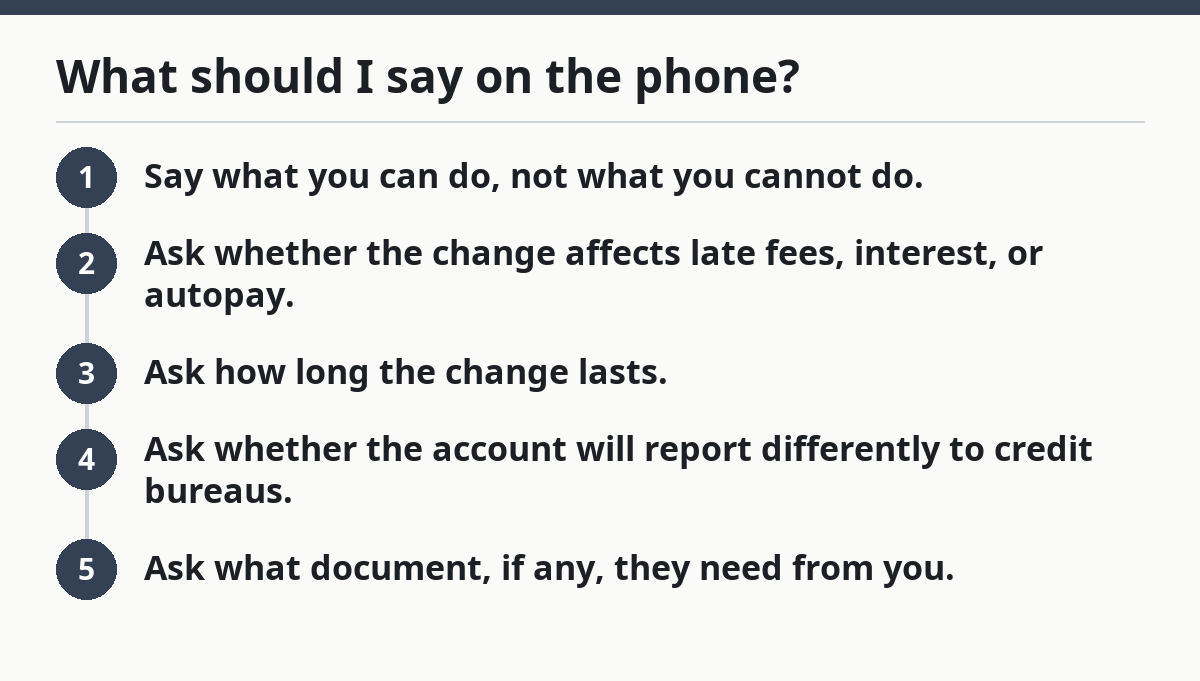
- Say what you can do, not what you cannot do.
- Ask whether the change affects late fees, interest, or autopay.
- Ask how long the change lasts.
- Ask whether the account will report differently to credit bureaus.
- Ask what document, if any, they need from you.
The key term is hardship request: a request for temporary relief because your current cash flow does not match the bill cycle. That can mean a later due date, a reduced amount for a set period, or a pause on one or more charges, depending on the creditor’s rules. It is not the same as ignoring the bill.
A good call ends with one clear next step. If the agent cannot approve anything, ask for the department name, the reference number, and the best time to call back. If the response is vague, that is a warning sign that the account may need a supervisor or a different channel.
How do I ask for the right temporary relief?

You should ask for the narrowest change that fits the problem and say how long you need it. A request that is too broad often gets bounced; a request tied to a date is easier to process. Think in terms of one billing cycle, one due date move, or a set number of weeks.
Use this order of asks:
- Due date change if your income lands a few days later than the bill.
- Temporary payment plan if you can pay, but not on the current schedule.
- Hardship program if the creditor has a named process for short-term relief.
- Late fee waiver if the account is already close to delinquent.
- Hold on collections activity only if the creditor’s policy allows it.
Ask one direct question at a time:
- “Can my due date be moved to the 15th?”
- “Can you set a 60-day temporary plan?”
- “Do you have a hardship program for 1 to 3 months?”
- “Will the account stay current while this change is active?”
Then verify the details:
- the start date
- the end date
- the new monthly amount, if any
- whether the old due date still matters
- what happens after the temporary period ends
If the rep offers a change that stretches far beyond the short-term problem, slow down. A longer plan can help, but it may also turn a temporary issue into a formal debt arrangement with different terms. Ask for the exact trade-off.
What documents should I gather before I ask?
You should gather only what supports the request and proves the timeline. For many creditors, that is enough. A call without paperwork can still work, but a file with clean dates usually moves faster.
Bring or prepare:
- A recent account statement
- A calendar showing the next 30 to 90 days
- Proof of the temporary issue if the creditor asks for it, such as a pay stub, benefit letter, medical bill, or notice from an employer
- A list of other bills with their due dates, if the creditor wants to see your budget gap
- Your preferred callback number and email
Some hardship programs ask for documents right away; others only ask after the initial call. If the creditor has a secure upload portal, use it after checking whether the portal is intended for this account or this request. If not, ask how they want documents sent and whether they need the last 4 digits of the account number on every page. If you are unsure, a consumer lawyer or credit counselor can help you avoid sending the wrong records.
Send only what they request unless they ask for a full packet. A clean 3-page set is better than a 20-page dump with no label.
How do I get the agreement in writing and track it?
You should get the change in writing before you rely on it. A phone promise is useful, but a written notice or message in the account portal is the record that matters if the next bill comes out wrong. Ask for it during the call, not after the first missed date.
Confirm these points in writing:
- the new due date
- the new amount, if one was set
- how long the change lasts
- whether fees or interest are paused, reduced, or unchanged
- whether the account stays current or becomes a special status
- what happens after the temporary period ends
Keep a simple log with four columns: date, person you spoke with, what they said, and the reference number. A basic note in your phone is enough. If the creditor emails terms, save the email and take a screenshot.
If the written terms are different from the call, question the written version and call back right away. Check the portal, the email, or the letter against what was said on the phone. Consumer Financial Protection Bureau guidance on complaints and account records makes clear that you should keep copies of communications and dispute errors promptly. A due date change that never made it into the system is not a real change.
For a broader recovery plan, the hub on debt payoff recovery and setback management can help once this temporary issue is settled.
When should you stop the DIY approach and get help?
You should stop and get qualified help when the request stops being temporary or the account is already too far along. This is a money topic with real consequences, so don’t guess if the problem has become bigger than a short-term fix.
The account is already in collections: The original creditor may no longer control the terms — contact the current collector and ask what can be changed, then get the agreement in writing.
You have a court notice or lawsuit papers: The matter may now involve legal deadlines — do not rely on a phone call alone.
The creditor says the account is no longer eligible for hardship relief: The standard route is closed — ask what formal process remains and whether another department handles appeals.
The bill is already past due by more than one cycle: A temporary change may no longer be enough — ask for the specific department that handles delinquent accounts.
You cannot explain a realistic short-term timeline: The creditor may see the request as open-ended — pause and gather dates before calling again.
The terms would create a plan you do not understand: Hidden fees, interest changes, or a status change can matter — ask for the full written terms before agreeing.
That is the line: a temporary payment change is for a short bridge, not a long-term fix. If the account has crossed into formal collections, legal action, or a larger debt problem, the call script changes.
What mistakes do people make, and what do they cost?
You should avoid vague asks, missing dates, and verbal-only agreements. These are the errors that turn a reasonable request into a late fee, a missed follow-up, or a denied hardship review.
-
Calling without the statement in front of you.
You may quote the wrong due date or balance, and the agent may reject the request. Use the statement or online account page before you dial. -
Asking for “help” with no specific change.
The creditor may offer generic advice instead of a real solution. Ask for a due date move, hardship program, or temporary plan. -
Not asking how long the change lasts.
A 30-day fix can end before you expect it. Verify the end date. -
Skipping the written confirmation.
If the system does not reflect the change, the next bill can still show the old terms. Save the email, letter, or portal message. -
Assuming every creditor works the same way.
Credit card issuers, auto lenders, student loan servicers, and utilities often use different rules. Ask for the specific process on that account. -
Agreeing to something you did not fully hear.
You may end up with fees, interest, or a new payment structure you did not plan for. Ask the rep to repeat the terms slowly.
The fix is simple but not small: keep the ask narrow, record the terms, and check the account after the call. That 10-minute follow-up can save you from a messy billing surprise.
What if the creditor says no?
You should ask for the next option, not argue the first answer. No on one form of relief does not always mean no to every form of relief. Some teams can move a due date but not lower the amount; others can offer a short extension but not a formal hardship program.
If the answer is no, try this sequence:
- Ask whether another department handles hardship requests.
- Ask whether the creditor can move the due date instead of changing the amount.
- Ask whether you can submit documents for a second review.
- Ask what wording would make the request eligible.
- Ask whether the account will be reviewed again after the next statement closes.
If the creditor will not help, do not keep repeating the same call in the same words. Gather the missing document, note the rejection reason, and decide whether a different channel makes sense. A secure message, a mailed request, or a supervisor review may be the next step if the creditor offers it. Sometimes it is not.
The best part? A short, calm call often gets you farther than a long apology. The creditor needs facts, dates, and a clear proposal. Give those, and you give the request a real chance.
What do I say when I call a creditor for help?
You should say who you are, which account you’re calling about, and the temporary change you need. A simple script works best: “I need a short-term change because of a hardship. Can you tell me whether you offer a hardship program, a due date change, or a temporary payment plan?” Keep it short, then ask for the written terms.
Can creditors change my due date temporarily?
Yes, some creditors can move a due date temporarily, but policies vary by company and account type. Ask whether the change is temporary or permanent, how long it lasts, and whether it affects fees, interest, or your account status. If they agree, get the new date in writing before the next billing cycle closes.
What should I ask for if I need lower payments for a while?
Ask for the narrowest short-term option that fits your calendar. A hardship program, temporary payment plan, or fee relief may be available depending on the creditor’s rules. Ask how long the change lasts, what the new amount is, and what happens when the temporary period ends.
Do I need paperwork before calling a creditor?
No, but paperwork helps. A recent account statement, your due date, and one document that supports the temporary hardship can make the call easier. If the creditor asks for proof, send only what they request and keep a copy of everything you submit.
Drafted with AI; not yet reviewed by a person.