Last updated: November 19, 2026
A deferred interest promotion can make a payoff estimate look smaller than the bill you’ll actually face. Quick Answer: in a deferred interest offer, the real payoff target is 0 by the promo deadline, not the current balance alone. This article on the Debt payoff calculator for deferred interest offers: how to avoid a surprise payoff amount shows how to estimate the promo balance, the interest charge risk, and the date that can change everything.
Who this is for, and what it assumes
This applies if you have promotional financing that postpones interest during a set period, such as a store card or special financing plan that says “no interest if paid in full by” a deadline. You need your current balance, the promo end date, and the statement terms that show whether interest is deferred or waived.
This is information, not financial advice. Rates, minimum payments, grace rules, and retroactive interest terms vary by country and issuer, so a qualified adviser should be consulted for your own situation if the numbers are tight or the contract is unclear. If you can read a statement and count forward by months, you can use this guide.
You also need one more thing: the exact promo language. “Deferred interest” means interest may be added later if the promo balance is not paid in time. That is not the same as a 0% APR offer where unpaid interest does not get charged later.
Key takeaways
- A deferred interest deal can look cheap right up until the deadline.
- Your real target is not the current balance alone; it is the balance plus any unpaid promo charge risk.
- The payoff date matters more than a rough monthly payment guess.
- If the terms mention retroactive interest, the math changes fast.
- A calculator is only useful if it uses the promo end date, not just the APR.
What deferred interest changes in a payoff estimate
Deferred interest changes the estimate because the bill can jump at the end of the promotion if the balance is still unpaid. In a plain payoff calculator, the current balance is the main number. In a deferred interest plan, the deadline and the contract terms are part of the debt itself.
Picture this: you have a special financing balance with a promo ending in 6 months, and your statement shows a manageable monthly payment. That can still miss the mark if the promotion adds the whole deferred interest charge when the deadline passes. The calculator has to answer two questions, not one: “What is left?” and “What happens on the expiration date?”
Here’s the catch: some promotions apply interest only to the remaining promo balance, while others can assess interest on the full amount from the original purchase date. That second setup is the one that creates a surprise payoff amount. The difference is huge on paper, even when the monthly payment looks similar.
- Current balance: the amount still unpaid today.
- Remaining promo balance: the part of the balance that is still inside the promotional period.
- Interest charge: the finance charge added under the contract if the balance is not paid by the deadline.
- Retroactive interest: interest that gets added back to the start date if the promo is not satisfied in time.
If the terms are unclear, the calculator can only give a rough estimate. Not a promise.
How do I estimate payoff before the promo ends?
You estimate it by working backward from the deadline, then checking whether your payment plan clears the promo balance before the last eligible day. That means using the statement date, the promo end date, the minimum payment rule, and the amount you can actually pay each month.
Start with the contract language first. Look for “deferred interest,” “special financing,” “no interest if paid in full by,” or any sentence that mentions retroactive interest. Then write down the promo end date exactly as shown, not as a guess based on months. A deadline on the 15th is not the same as the end of that billing cycle.
- Find the promo end date. Copy the exact date from the cardholder agreement or statement. Verify whether it is a calendar date or the end of a billing cycle. If you only know the month, the estimate is too weak to trust.
- Note the current promo balance. Use the balance tied to the promotion, not the total card balance if other purchases are on the account. Verify whether returns, credits, or fees changed it. A mixed balance can hide the true payoff target.
- Check the minimum payment rule. Some plans require a fixed amount, while others use a percentage. Verify whether the minimum will clear the promo in time. If the minimum leaves a large balance after the deadline, the plan is too slow.
- Count the months left. Use full months and partial months separately. Verify how many payment dates remain before the promo ends. If your next statement closes after the deadline, your timing may already be off.
- Divide the promo balance by the remaining payments. This gives a rough monthly target before fees or future purchases. Verify that the resulting payment is realistic for your budget. If it requires an amount you cannot repeat each month, the calculator is lying by omission.
- Add any likely interest charge risk. If the contract allows retroactive interest, calculate as if the whole promo can be charged later unless paid in full. Verify that the payment plan still works under that worst-case reading. If the plan only works when interest never posts, it is fragile.
- Check for other balances on the same account. Separate promo and non-promo charges if your issuer does that. Verify which payments are applied first. If the card applies payments to lower-rate balances before promo balances, the estimate can miss the deadline.
- Build in a final cushion. Add one extra payment cycle, or enough to leave a small zero balance before the deadline, if the terms and budget allow it. Verify you are still within what you can pay without creating another debt. If the cushion breaks your budget, the plan needs a different timeline.
A good estimate answers one question: will the promo balance be gone before the contract turns? If the answer is “maybe,” the calculator is not finished.
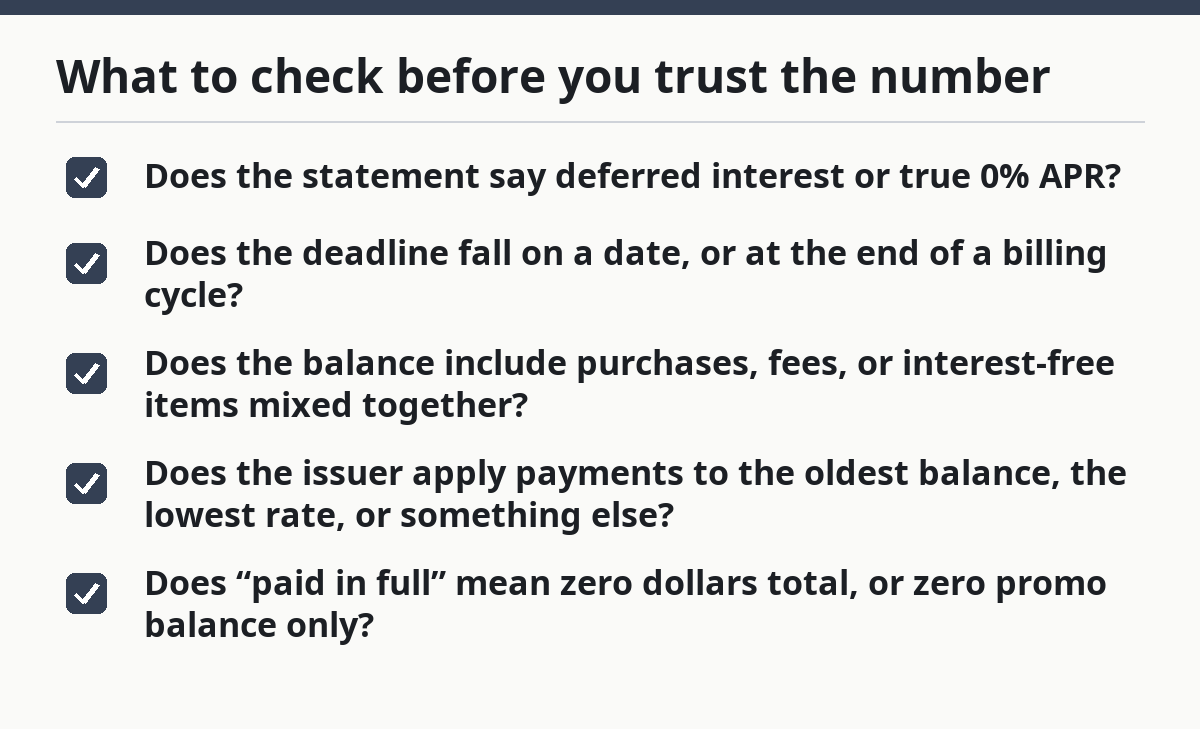
What to check before you trust the number
A payoff calculator is only as good as the contract details you feed it. If you skip the fine print, you may get a neat answer that fails at the deadline. The most common mistake is often treating deferred interest like ordinary interest, where partial progress always helps in the same way.
Picture this: you enter a balance into a calculator and it spits out a monthly payment. That number may still be wrong if the offer has a deferred interest clause, a minimum payment rule, or a special allocation rule that sends payments to the wrong bucket. The balance alone does not tell the whole story.
Two official sources are worth checking when the contract language gets fuzzy: the Consumer Financial Protection Bureau’s credit card resources at https://www.consumerfinance.gov/consumer-tools/credit-cards/ and the Federal Trade Commission’s credit and loans information at https://consumer.ftc.gov/credit-loans-and-debt. These pages do not replace your contract, but they can help you understand the terms in plain language.
- Does the statement say deferred interest or true 0% APR?
- Does the deadline fall on a date, or at the end of a billing cycle?
- Does the balance include purchases, fees, or interest-free items mixed together?
- Does the issuer apply payments to the oldest balance, the lowest rate, or something else?
- Does “paid in full” mean zero dollars total, or zero promo balance only?
If any of those answers is unclear, the calculator needs an assumption. Assumptions can be useful. They are never free.
The mistakes that create a surprise payoff amount
A surprise payoff amount usually comes from one of five errors, and each one is predictable. The danger is not the calculator itself; it is feeding it the wrong version of the debt.
Picture this: you are 2 payments away from the deadline and the balance looks close enough. Then the statement posts an interest charge you did not expect, or the promotion expires before the payment clears. That is how a manageable balance turns into a last-minute scramble.
-
Using the total card balance instead of the promo balance.
The consequence is a fake payoff target that is either too high or too low. The fix is to separate promotional purchases from other charges. -
Ignoring the exact deadline.
The consequence is missing the last day by one statement cycle. The fix is to use the promo end date, not the next due date. -
Assuming deferred interest works like regular interest.
The consequence is underestimating what can be charged later. The fix is to read whether unpaid promo interest can be applied retroactively. -
Making minimum payments only.
The consequence is a balance that survives past the promo period. The fix is to calculate the payment needed to clear the promo early enough. -
Adding new purchases to the same account.
The consequence is a mixed balance that muddies the payoff math. The fix is to stop new charges on that promotional account if the contract and your plan depend on a clean payoff count. -
Forgetting payment posting time.
The consequence is a payment that arrives after the deadline even though you sent it near the end. The fix is to verify processing cutoffs and mailing time well before the final date.
A calculator cannot fix these errors. It only reflects them.
When the standard payoff approach does not apply
The standard approach does not apply when the contract has a retroactive interest clause, when the account mixes multiple balance types, or when the last payment may not post before the deadline. In those cases, a simple monthly payoff plan is too thin to trust.
Picture this: your promotion ends in 30 days, the statement closes in 10, and your payment usually posts after the weekend. That is not a normal payoff case. It is a timing case, and timing can beat math.
Use a different approach in these situations:
The promotion ends within one billing cycle: one late posting can trigger the charge — pay earlier than the last day if the issuer allows it.
The account has both promo and non-promo balances: payment allocation can work against you — ask how payments are applied before relying on the calculator.
New purchases are still going on the card: the promo balance is no longer isolated — stop using that account for new charges if you need a clean payoff count.
The statement language says “if not paid in full”: the whole balance may be in play — calculate as if the full promo amount must clear, not just the recent statement balance.
You only know the balance, not the deadline: the estimate is incomplete — get the contract or statement that names the expiration date.
If the numbers still do not line up, the right move is not to guess harder. It is to slow down and get the terms in writing.
What a good calculator result looks like
A good result is not just “you will be paid off by then.” It is a result that names the deadline, the remaining promo balance, the monthly payment needed, and the margin you have before the promo ends.
Picture this: you type in a balance, a date, and a payment amount, and the output gives you a clean payoff month. That is useful only if it also tells you whether the last payment lands before the deadline and whether any deferred interest could still be charged later. A neat answer without timing is only half an answer.
A solid calculation has these traits:
- It uses the exact promo end date, not an estimate rounded to the nearest month.
- It separates the promotional balance from any other account balance.
- It shows whether the current payment plan leaves a zero promo balance before the deadline.
- It flags a leftover amount, even if that leftover is small.
- It assumes payment posting time matters, not just the day you click “pay.”
If your result says there will be even a small balance left after the deadline, treat that as a warning, not a rounding error. In deferred interest offers, small leftovers can be expensive. The best result is usually the boring one: the promo balance reaches zero with time to spare.
The questions people ask before the deadline
The questions that matter most are about timing, balance type, and what happens if the deadline slips. This is where the surprise payoff amount usually gets built.
Picture this: you are staring at a statement and trying to decide whether one extra payment is enough. The answer depends on the wording of the offer and how your issuer handles posting, not on the headline APR alone. That is why the calculator has to be built around the contract.
What is deferred interest?
Deferred interest is a promo setup where interest may be added later if the balance is not paid in full by the deadline. It is different from a simple low-rate or 0% APR offer because the unpaid interest can come back later, depending on the contract. The exact rules vary by issuer and country.
How do I estimate payoff before promo ends?
You estimate it by using the promo end date, the remaining promo balance, and the number of payments left before the deadline. Then you check whether the planned payment clears the full promotional balance with time to spare. If the contract allows retroactive interest, build the plan around zeroing the balance early, not on the last day.
What happens if I miss the deadline?
If you miss the deadline, the contract can add an interest charge according to its terms, and in some offers that charge is applied back to the original purchase date. The result is a bigger payoff amount than the one you were tracking. The exact outcome depends on the written offer, so the statement and agreement are the source of truth.
FAQ
What is deferred interest?
Deferred interest is a financing setup where interest is postponed during the promo period but can be charged later if the balance is not paid in full by the deadline. The wording matters because some offers charge interest only after the promo ends, while others can apply it retroactively. Read the contract, not just the monthly payment.
How do I estimate payoff before promo ends?
Use the promo end date, the remaining promo balance, and the number of payment dates left. Then calculate whether your planned payment clears the full promotional balance before the deadline.
Drafted with AI; not yet reviewed by a person.