Last updated: November 18, 2026
Quick Answer: use one bill calendar, keep at least 1 clear posting window between a debt payment and the next fixed bill, and place each payment after your paycheck lands. That is the core of how to line up debt payments with your bills so cash flow stays smooth, especially when minimum credit card payments and other debts land close together.
Key takeaways
- Put every bill due date, paycheck, autopay draft, and debt payment in one bill calendar before you change anything.
- Match payment dates to the day cash actually hits your account, not to the date a bill looks easiest on paper.
- Keep a small buffer between a debt payment and your next fixed bill so one delay does not trigger a chain reaction.
- If a due date shift would still leave the month tight, the problem is timing, not just scheduling.
- This is information, not financial advice; a qualified adviser should help with your own situation.
Who this helps

This helps if you already have regular bills, a paycheck, and at least one debt payment that competes with rent, utilities, or other fixed costs. It also fits readers who want a steadier monthly rhythm without changing the size of the payments themselves.
It is not the right fix if the problem is bigger than timing. If your bills are higher than your income most months, moving dates can buy breathing room, but it cannot create cash that is not there. According to Fig, 82% of Canadians have existing debt, and 18% of those with debt are not confident they can fully repay it; for people in that position, scheduling helps, but it may not solve the whole problem.
This approach also assumes you can list your dates and amounts with some accuracy. If one or more bills change every month, the bill calendar still works, but it needs more review than a fixed schedule would. The method is a fit for monthly cash flow smoothing, not for guessing your way through the month.
What goes on a bill calendar?
A bill calendar holds the dates that move money in and out of your account, including each bill due date, each paycheck date, each autopay draft, and each debt payment. That is the whole point: one view of the month instead of scattered reminders.
Start with fixed items first. Put rent, utilities, phone, insurance, loan payments, and credit card due dates on the calendar, then add your paycheck dates. If a payment clears the same day as a bill, mark that as a risk point, because same-day timing can still fail if the deposit posts late.
Then mark the dates that are already locked. Some bills may already be tied to a billing cycle, and some debt payments may already be drafted by autopay. The calendar shows where you have room to move and where you do not. A good calendar does not guess; it shows the gap between money coming in and money going out.
Keep this simple. One page, one month, one account if possible. If you need color, use only three categories: income, fixed bills, and debt payments. Too many labels make the calendar hard to read at a glance, which defeats the point.
How do you line up debt payments with your bills?
You line up debt payments with your bills by placing each debt payment after income arrives and before the next cluster of fixed bills drains the account. The goal is to keep your lowest balance from landing right before a bill due date.
-
List every fixed bill, every debt payment, and every paycheck on one monthly calendar. Use exact due dates and exact deposit dates, not approximate weeks. Verify that each item has a date next to it. If any date is missing, the schedule is not ready.
-
Identify the days when cash enters your account. Mark each paycheck date first, because those dates anchor the rest of the month. Verify that the paycheck lands before the largest bills or debt drafts. If a payment comes before the deposit, that is a timing problem.
-
Group bills that can stay where they are. Keep the bills that already fall just after payday in place, since those are the easiest to support. Verify that the account still has enough room after those bills. If the balance is thin, do not add another payment to that same window.
-
Move a debt payment toward the part of the month with the strongest cash balance. Put it after a paycheck and before the next wave of bills. Verify that there is enough time for the deposit to clear before the draft date. If the margin is only a day or two, the schedule is fragile.
-
Leave space between big outflows. Try not to stack a debt payment on top of rent, utilities, and another loan draft all in the same 24-hour stretch. Verify that one failed payment would not set off late fees on the next bill. If one miss would domino into three misses, the dates are too tight.
-
Check the minimums before you move anything else. Some debts have a required minimum payment, and missing it can create a problem faster than a flexible bill can fix. Verify that each minimum fits inside the month without pushing a necessary bill out of range. If it does not, the order needs revision.
-
Re-read the full month as a sequence, not a list. Start at the first paycheck and follow the money until the last bill. Verify that no point in the month relies on money that has not arrived yet. If you cannot trace the month from start to finish, the calendar is not finished.
-
Leave a small buffer around autopay. Autopay, which means a payment drafted automatically from your account, should not be placed so close to another bill that one slow posting causes an overdraft. Verify the account can cover the draft before it hits. If the balance depends on perfect timing, shift the payment date.
What should be moved first?
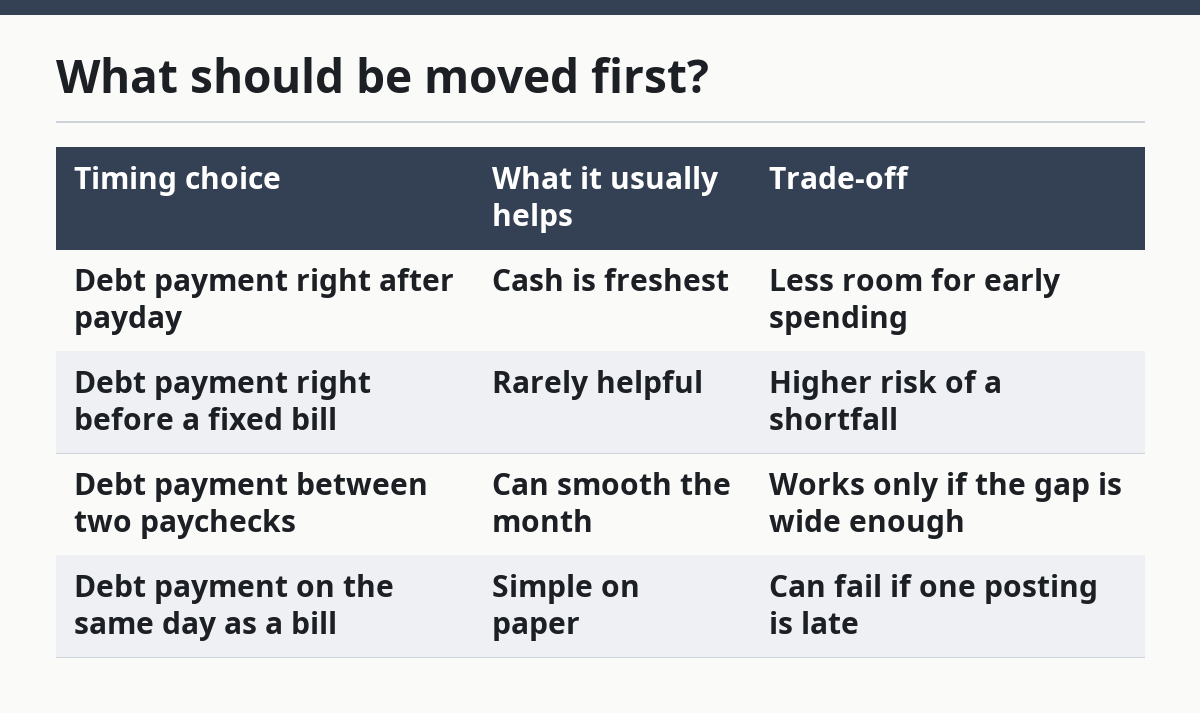
The first things to move are the dates that create the biggest mismatch between your paycheck and your bill calendar. A debt payment that lands just before payday is a better candidate for shifting than a fixed bill that is already in a stable spot.
The usual order is to protect housing, utilities, and other fixed essentials first, then line up debt payments around what remains. If you have a credit card payment due near the start of the month but your paycheck arrives later, moving the payment a few days can help the account breathe. That does not change the debt itself; it changes the stress on the account.
One useful test is whether a moved date reduces the number of zero-balance days. If the account stays positive for more of the month, the new timing is probably better. If the move just shifts stress from one week to another, the change may not be worth it.
| Timing choice | What it usually helps | Trade-off |
|---|---|---|
| Debt payment right after payday | Cash is freshest | Less room for early spending |
| Debt payment right before a fixed bill | Rarely helpful | Higher risk of a shortfall |
| Debt payment between two paychecks | Can smooth the month | Works only if the gap is wide enough |
| Debt payment on the same day as a bill | Simple on paper | Can fail if one posting is late |
When should you stop and rethink the schedule?
You should stop and rethink the schedule when the dates no longer fit the cash you actually have. A bill calendar can smooth timing, but it cannot fix a monthly gap that is already too wide.
One paycheck covers too many due dates: That means the month is crowded on one side and empty on the other — split the payments across the month or get help with the cash flow plan.
A debt payment would land before your paycheck clears: That means the draft could hit before the money is available — move the date or change the payment sequence.
One late payment would trigger another fee: That means the schedule has a domino effect — protect the bill with the highest consequence first.
Your minimum debt payments already crowd out basic bills: That means timing alone is not enough — the broader budget needs review with a qualified adviser.
You are relying on a same-day deposit and draft: That means the schedule has almost no margin — add a buffer of at least one clear posting window if the creditor allows date changes.
Your account balance changes too much to predict: That means a fixed calendar may not hold — use a simpler schedule and review it every month.
One important limit: if you have never filed taxes or it has been over 6 years since you filed, the IRS says you can pay another way when using Direct Pay with a bank account. That matters because the right payment route can affect whether a schedule works at all.
What mistakes cause the most trouble?
The most common mistake is scheduling debt payments by the calendar, not by cash arrival. A date that looks clean on paper can still hit before your paycheck, and that creates an avoidable shortfall. The fix is to schedule by account balance, not by habit.
Another mistake is treating all bills as equal. Rent, utilities, loan payments, and credit card bills do not all carry the same pressure, so they should not all be squeezed into the same day. When in doubt, consult a qualified professional or adviser about which bill can safely move first.
A third mistake is ignoring minimum payments. According to Fig, 43% of Canadians facing limited credit or debt repayment challenges are making minimum credit card payments, which shows how common that floor is; if you miss a minimum, the schedule can unravel fast. The correct move is to keep minimums visible in the calendar from the start.
A fourth mistake is letting autopay run without checking the draft date. Autopay can help with consistency, but it can also pull money on a day that is too tight. The better choice is to confirm the date, then confirm the balance, then leave room for posting time.
A fifth mistake is making the schedule too complex. If you need to check four apps to know what is due this week, the system is harder than the problem. One bill calendar should tell the story in under a minute.
What does a smooth month look like?
A smooth month leaves cash in the account before each fixed bill and does not depend on a last-minute transfer to avoid trouble. You should be able to look at the bill calendar and see, in order, when money enters, when it leaves, and which debt payment fits into the widest gap.
A good result is not perfection. It is fewer surprises, fewer tight days, and fewer payments that feel like a race against the clock. If the month still feels strained after the dates are aligned, the issue may be the size of the obligations rather than the timing.
This is why scheduling belongs inside the broader Managing debt payoff cash flow plan. The calendar handles the order of the month; it does not decide the long-term debt strategy.
How do I schedule debt payments around bills?
You schedule debt payments around bills by starting with paycheck dates, then placing each payment after money lands and before the next heavy bill cluster. The bill calendar shows where the cash gap is widest, which is usually the safest place for a debt payment. If that still leaves the month tight, the schedule needs another pass.
Can I move debt due dates to match payday?
You may be able to, but the rules vary by creditor and by country, so the request is worth checking directly with the lender or card issuer. A due date change helps only if it creates real breathing room between income and outflow. If the new date still sits too close to other bills, the problem is not solved.
What is the best payment order each month?
There is no single best payment order each month. The right order is the one that protects required bills first and places debt payments where the account has the most cash available. That usually means housing, utilities, and other fixed essentials stay ahead of discretionary spending, while debt payments fill the safer gaps. If the month is too tight for that order, a qualified adviser should help with the full plan.
Sources
- Internal Revenue Service, Direct Pay with bank account: https://www.irs.gov/payments/direct-pay
- Consumer Financial Protection Bureau, Automatic bill pay: https://www.consumerfinance.gov/consumer-tools/automatic-bill-pay/
- Fig, How to Manage Debt & Monthly Payments: https://fig.ca/en/resources/how-to-manage-debt-monthly-payments
Drafted with AI; not yet reviewed by a person.