Last updated: November 19, 2026
Quick Answer: If a temporary job loss or leave of absence will interrupt your income for 1 to 3 pay cycles, contact each creditor before the due date, ask about a lender hardship program, and line up the smallest payment you can make without draining cash you need for rent, food, and transport. This article on How to Handle Debt Payments After a Temporary Job Loss or Leave of Absence is information, not financial advice; a qualified adviser should be consulted for your own situation.
Key Takeaways
- Contact creditors early, keep essentials paid, and send only what current cash can safely cover.
- Check the account type, due date, and whether the lender offers deferral, forbearance, or a short-term reduced payment plan.
- Waiting until after the due date to ask for help is usually the costliest mistake.
- For account-rule questions, a qualified credit counselor, legal aid office, or financial adviser can help interpret your options.
Temporary income interruption changes the timing of debt payments, not the debt itself. The goal in How to Handle Debt Payments After a Temporary Job Loss or Leave of Absence is to avoid avoidable late fees, protect your account from going delinquent, and keep enough cash on hand to cover essentials while you are out of work or on leave.
If you already know your due dates, autopay settings, and how much cash you have until the next paycheck, you are ahead of the curve. If you do not know those numbers yet, start there before you ask for relief.
What this guide covers, and when it applies
This guide to How to Handle Debt Payments After a Temporary Job Loss or Leave of Absence applies to a short-term loss of pay from a layoff, furlough, unpaid leave, medical leave with reduced income, or a gap between jobs that is expected to be temporary. It assumes you have at least one recurring debt payment due within the next 30 days and need a plan for the next 1 to 3 months.
It does not assume you are trying to restructure all debts for the long term. It also does not answer broader questions about choosing which debt to pay first when cash flow is already tight, or how to build a rainy-day fund for irregular income. Those are separate problems with different trade-offs.
The right first move is usually not to stop paying everything at once. It is to map your due dates, see which accounts have grace periods or hardship options, and decide which payments can be reduced, deferred, or paused without making the situation worse.
A useful place to start is your own note of three things: the next due date on each debt, the minimum payment on each account, and the date your income is expected to restart. That simple snapshot tells you whether you need a 2-week bridge, a 30-day forbearance, or a longer hardship plan.
How should I handle debt payments after a temporary job loss?
You should handle debt payments after a temporary job loss by contacting creditors early, keeping essential bills stable, and making only the payments you can support from current cash. The sequence matters because once a payment passes the due date, the account can be marked late, and the options narrow.
Here is a step-by-step way to handle it.
- List every debt with its due date and minimum payment. Put the exact due date, the minimum amount, and whether autopay is on for each account on one page or one screen. Verify that you have the current month’s numbers, not last month’s statement. A problem is a missing or outdated balance, because a missed due date can trigger a late fee or late mark even if the account was otherwise current.
- Estimate your cash runway for the interruption period. Add up the cash you can actually use over the next 30 days, then subtract rent, groceries, utilities, transport, and any required insurance premiums. Verify the number after you account for irregular items such as a final paycheck delay or a paid leave check that arrives later than usual. A problem is treating uncertain income as available cash; if the numbers are unclear, consult a qualified adviser.
- Turn off autopay only where it would overdraft the account. If an automatic debit could bounce, suspend it before the processing cutoff, which can be days before the due date depending on the lender. Verify the change in the app or by written confirmation. A problem is leaving autopay on and creating a returned-payment fee on top of a late fee.
- Call or message each lender before the due date. Ask for the hardship or assistance department and say the interruption is temporary. Use plain terms such as “temporary income interruption,” “hardship program,” “deferred payment,” or “forbearance” if the account type uses them. Verify the exact offer, the start date, and whether interest still accrues. A problem is accepting a vague promise that does not change the account status.
- Ask for the smallest workable payment plan. If the lender will not defer the account, ask whether a reduced minimum payment plan is possible for 1 to 3 cycles. Verify whether the reduced amount keeps the account current or only slows the delinquency. A problem is assuming a partial payment counts as full relief when the lender treats it as a courtesy payment only; if the terms are unclear, consult a qualified adviser.
- Confirm the effect on interest, fees, and credit reporting. Find out whether late fees stop, whether interest continues to accrue, and whether the account will be reported as current, deferred, or in forbearance. Verify this in the written terms, not just the phone summary. A problem is agreeing to pause payments without knowing the long-term cost of added interest.
- Keep the most important due dates in front of you. Set calendar reminders 3 to 5 business days before each new deadline, even if the account is on hardship status. Verify that the reminders reflect the lender’s modified schedule, not the original statement date. A problem is assuming a deferral means “no action needed” until the account quietly becomes late again.
- Track every conversation in writing. Save the date, time, name or ID of the representative, and the terms you were given. If the lender sends a letter or secure message, keep it; if you are unsure what to retain, consult a qualified adviser. Verify that the written plan matches the verbal one. A problem is relying on memory if the account later shows a missed payment or added fee.
This approach works best when the interruption is measured in weeks, not many months, and when the creditor offers a formal hardship option. It is less effective if several accounts are already delinquent, because the response often shifts from hardship support to collections.
For general planning, the Consumer Financial Protection Bureau has plain-language guidance on dealing with debt collectors and managing payment problems, and the Federal Trade Commission explains how to check whether a debt is owed and how to communicate in writing.
What should I check before I ask for a hardship program?
You should check the account type, the exact due date, and whether the lender offers deferral, forbearance, or a short-term reduced payment plan. The wording matters because each term can change the way the balance grows and whether the account stays current.
A deferred payment usually means you do not have to make the scheduled payment for a set period, but the lender may add the skipped amount to later payments or extend the term. Forbearance usually means the lender temporarily pauses or reduces payments, often with interest still running. Those are not identical outcomes, and the name alone does not tell you the full cost.
Start with the account agreement, the current statement, and the lender’s hardship page. Many mortgage servicers, student loan servicers, credit card issuers, and auto lenders have different rules. A 30-day option on one account may be a 60-day option on another. That is why one generic plan does not fit every creditor.
Also check whether the account is secured or unsecured; if you are unsure how that changes the risk, consult a qualified adviser. Missing an auto loan, for example, can have different consequences from missing a credit card payment because collateral is involved. The same is true for a mortgage or a rent-related debt, where the deadline and default consequences can be stricter.
If your interruption came from medical leave or family leave, check whether payroll, benefits, or disability payments are delayed rather than absent. A paycheck that arrives 2 weeks late is a different problem from a full job loss, and your debt plan should match the timing gap, not the label.
What mistakes cost the most?
The most expensive mistake is waiting until after the due date to ask for help. Once an account is late, the lender may apply a late fee, report delinquency, or remove access to a low-friction hardship option.
Here are the errors that cause the most trouble:
- Keeping autopay on without enough cash: This can trigger a returned-payment fee and possibly a missed payment. The better move is to pause the debit before the cutoff and replace it with a manual plan.
- Assuming any partial payment solves the problem: A small payment may help with goodwill, but it may not stop a late mark. The better alternative is to ask whether the lender will treat it as a hardship payment, not just a courtesy payment; if you are unsure, consult a qualified adviser.
- Using every spare dollar on debt while cash is uncertain: That can leave you unable to cover food, transport, or rent. The better alternative is to preserve enough cash for essentials while keeping communication open with creditors.
- Trusting a phone call with no written follow-up: Verbal promises can be misunderstood or lost. The better alternative is to request a secure message, letter, or email summary; if the lender cannot provide one, ask a qualified adviser what to do next.
- Ignoring interest during deferment: Some programs pause payments but not interest. The consequence can be a larger balance later. The better alternative is to ask how interest accrues before you agree.
- Confusing “current” with “not being billed yet”: A deferral can look calm on the surface while the account is still governed by a new schedule. The better alternative is to verify the exact status code and new due date.
The common thread is simple: a temporary income interruption needs a payment response, not silence. Silence turns a short gap into a credit problem.
When should I stop and get qualified help?
You should stop handling it alone and get qualified help when the interruption is no longer short-term, the debt is already in collections, or the numbers no longer fit the timeline. On a money question, a qualified credit counselor, legal aid office, or financial adviser can help you interpret the account rules for your situation.
Stop and get help in these situations:
You have already missed one or more due dates: The account may already be delinquent — ask the lender for next-step options and, if needed, speak with a nonprofit credit counselor or legal aid office before taking the next action.
The lender says no hardship program is available: The account may need a different strategy — ask for the denial in writing and then review the next options with a qualified adviser.
You cannot cover essentials for the next 30 days: The problem is broader than debt payments — focus on immediate household stability and get help from a local benefits office, nonprofit counselor, or adviser.
The debt is secured by a car or home: Missed payments can affect collateral — get advice quickly because the consequences can be faster and more serious than on an unsecured account.
Your leave is turning into a longer income break: A 2-week fix may not work for a 3-month gap — ask for a structured repayment or relief plan instead of a one-time deferment.
You are juggling several creditors at once: The account-by-account approach may break down — bring the full list to a counselor who can help you review the whole picture.
That is the point where this guide stops being enough by itself. A temporary interruption is manageable when the timeline is short and the accounts are responsive; it becomes a different problem when the interruption stretches out or the debt is already past due.
What happens if I keep paying some debts and pause others?
You can do that, but only if the choice matches the lender’s rules and your cash reality. A minimum payment plan on one account may be the right move while another account is placed into forbearance or a deferred payment status.
The key is consistency. If you pay one account and neglect another, the neglected account can become the one that generates the late fee, collection notice, or credit reporting issue. That is why a written plan matters more than a general intention to “catch up later.”
A selective payment approach is usually best when:
- one account has a strict due date and no hardship option,
- another offers a formal temporary relief program,
- and your cash can cover only part of the month’s obligations.
It is usually the wrong tool when you are deciding by instinct each week. Random payments create confusion and make it harder to tell which account is safe and which one is drifting toward delinquency.
How do I know if the plan is working?
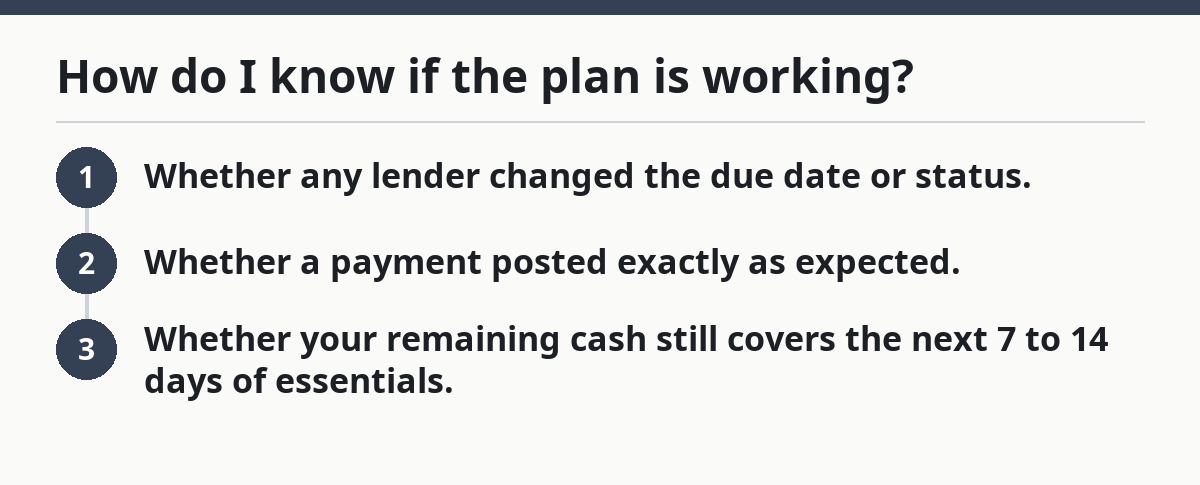
The plan is working if your accounts stay current, your cash does not hit zero before the next essential bill, and your new due dates are written down where you can see them. A good result is not “I paid everything perfectly.” It is “I avoided late status while keeping enough cash to live.”
Check three things each week for at least the first 4 weeks:
- Whether any lender changed the due date or status.
- Whether a payment posted exactly as expected.
- Whether your remaining cash still covers the next 7 to 14 days of essentials.
If any of those change, adjust quickly. A short-term income interruption often shifts from emergency mode to ordinary repayment once the next paycheck or leave payment arrives. If it does not, the problem has crossed into longer-term budgeting and deserves a different plan.
The point of the first response is not to solve the entire debt picture. It is to keep the account from slipping while you protect cash for basic living costs. That is the narrow job of this guide, and it is usually the right one for a temporary gap.
For broader planning later, the hub on debt payoff planning and budgeting is the right place to build a longer-range system.
What should I do with debt payments after losing a job?
Start before the due date, not after it. Contact each creditor, ask about a hardship program or forbearance, and confirm whether a deferred payment or reduced payment plan will keep the account current. If your cash is limited, pause autopay where needed and preserve money for essentials first.
Can I ask creditors for temporary relief?
Yes, and you should ask early. Many lenders have a lender hardship program for short-term payment problems, but the terms vary by account type and lender. Ask what happens to interest, fees, and the due date, and get the answer in writing if possible.
Drafted with AI; not yet reviewed by a person.