Last updated: November 19, 2026
Quick Answer: For Debt payoff boundaries and decision rules, a practical starting point is to keep 1 month of essential expenses in cash if your income is unstable, then send extra money to the highest-cost debt after minimums are covered. If your budget is steady, the same decision rule can lean more aggressively toward payoff. The Consumer Financial Protection Bureau and the Federal Trade Commission both emphasize prioritizing payments, avoiding delinquency, and keeping enough cash flow to avoid new borrowing. CFPB, FTC
In short: debt payoff boundaries are the rules that tell you when to keep paying extra, when to stop, and when a debt should be handled by a different plan entirely. Debt payoff boundaries and decision rules depend on interest rate, minimum required payments, cash reserves, tax treatment, and whether the debt is secured or unsecured, so if the situation is complex, consult a qualified financial professional. CFPB
Key takeaways
- Boundaries stop debt payoff from becoming a vague “pay everything as fast as possible” plan.
- A good rule considers interest rate, payment stress, emergency savings, and whether the debt can damage a home, car, or paycheck.
- Not every extra dollar should go to debt; some money should stay available for surprises and near-term bills.
- High-interest revolving debt usually deserves earlier attention than low-rate installment debt.
- If a debt is tied to a tax benefit, legal risk, or a hardship program, the decision can change fast.
- This is general information, not financial advice. A qualified adviser should look at the reader’s own situation before major money decisions.
I write about personal finance with the assumption that a rule should survive a bad month, not just a good one. Debt payoff boundaries and decision rules matter here because debt payoff advice often sounds simple until rent rises, hours get cut, or a car repair lands in the same week as a bill.
What debt payoff boundaries actually are
Debt payoff boundaries are the lines that separate “keep paying normally,” “throw extra money at this debt,” and “do not accelerate this debt without checking the trade-offs.” They are decision rules, not motivation. A boundary might be framed as “do not send extra principal to low-rate debt until the emergency fund has at least one month of expenses,” or as “pay any revolving balance above 20% annual interest first, after the minimums are covered.”
The point is to stop emotional decisions from driving a month-to-month budget. Without boundaries, a person can overpay one loan while ignoring a higher-cost balance, or rush debt repayment while leaving no cash for a car tire, a deductible, or a moved due date. That creates a fragile plan.
A strong boundary uses four facts: the debt’s interest rate, the required minimum payment, how stable the income is, and how painful a payment miss would be. A $200 monthly payment on a low-rate installment loan is not the same problem as a $200 minimum on a revolving balance that compounds interest daily or monthly. The structure matters as much as the balance.
This is also where generic “just pay it off faster” advice fails. A borrower with a 3.5% student loan, a 23.99% card balance, and $700 in checking should not treat all three debts the same without checking the full picture, and a qualified adviser can help test the boundary. The guide is about sorting those priorities with rules that can be repeated in a spreadsheet, a budget app, or on paper.
How do I decide which debt gets extra money first?

Put extra money toward the debt with the highest true cost, unless the debt’s structure, tax treatment, or hardship risk changes the order, and consult a qualified financial professional if you are unsure. That is the cleanest decision rule for most households, and it works better than choosing by balance size alone. CFPB
The “true cost” is not just the stated rate. It includes whether interest compounds monthly, whether fees are attached, whether a promotional rate is about to expire, and whether missing a payment triggers a penalty that changes the math. A small balance with a high penalty rate can deserve more attention than a larger balance with a fixed low rate.
Here is the practical version of the rule:
- Make every required minimum payment on time.
- Set aside enough cash to avoid immediate disruption, such as one unexpected utility bill or a needed car repair.
- Rank the remaining debts by effective cost and risk.
- Send all extra principal to the debt at the top of that list until its boundary changes.
That sounds mechanical because it should be. A decision rule works only when it can be repeated the same way in March and in November. If the rule changes every time the borrower feels stressed, it is not a boundary; it is a mood.
There is a real trade-off here. The highest-rate debt is usually the mathematical winner, but the smallest balance can sometimes be the behavioral winner if closing it removes a payment and simplifies the budget. That can help a person who is overwhelmed. The drawback is obvious: a balance-size strategy can cost more in interest than a rate-first strategy. So the boundary should be chosen on purpose, not by accident.
A useful check is this: if the debt has a rate you would never choose to borrow at today, it likely belongs near the front of the line. If the debt is cheap, fixed, and not threatening the budget, it may not.
The real difference between emergency savings and debt payoff
Emergency savings wins first when the next surprise would force new debt or a missed payment. Extra payoff wins first when cash reserves are already enough to keep the budget stable through a normal disruption.
That is the whole split in one sentence. The mistake many people make is treating all spare cash as debt money before they have a buffer, so a dental bill, job gap, or family expense sends them back to the card. That creates a loop: pay down, borrow again, repeat. CFPB
A boundary rule helps prevent that loop. The simplest version is this: if the household has no cash cushion at all, pause extra debt payoff until there is at least a small reserve in checking or savings. The exact amount depends on income volatility, rent, family size, and access to other resources. There is no universal dollar figure that fits every country or tax system, and rates and account rules vary widely by location and change over time.
The upside of keeping a buffer is stability. The downside is psychological, because holding cash while carrying interest-bearing debt can feel backward. But a cash buffer is not wasted if it prevents late fees, overdrafts, or a new loan at a worse rate, and a qualified adviser can help set the right cash target. In that sense, it protects the payoff plan itself.
Where this gets nuanced is low-income or irregular-income households. For someone paid weekly in a steady job, a small buffer may be enough to keep the plan intact. For someone whose income changes every month, a larger cushion may be the only thing that keeps debt from growing again. The decision rule should reflect that reality rather than a generic “use all extra money” slogan.
The boundary is not “save or pay debt.” It is “how much cash do I need so debt payoff does not become a false start?” That question matters more than the balance alone.
When should a debt be attacked aggressively, and when should it just be maintained?

Attack a debt aggressively when it has a high interest burden, a near-term rate reset, or a realistic chance of becoming unmanageable. Maintain it when the rate is low, the payment is predictable, and extra payoff would weaken the rest of the budget.
This is the section where a lot of advice gets too polite. Some debt should be treated as a budget emergency. Revolving balances with high annual percentage rates, variable-rate obligations that can jump, and debts that create compounding fees belong in that category. The reason is simple: the longer they linger, the more expensive they tend to become. FTC
Other debts are not emergencies even if they are annoying. A fixed-rate installment loan with a modest payment and no penalty for staying the course may not justify diverting every spare dollar. The borrower may get more stability by keeping that loan on schedule while building a buffer or handling a higher-cost debt first.
The trade-off is between speed and resilience. Aggressive payoff can reduce total interest and reduce the number of monthly obligations. But if it leaves the household unable to absorb a $300 or $500 surprise, the plan becomes brittle. That brittleness can lead to new borrowing, which cancels much of the benefit.
A useful rule of thumb is to ask three questions:
- Does the debt cost more than the return of any safe, easily accessible cash alternative available to the borrower?
- Would paying extra here force the borrower to skip something essential next month?
- Would missing this debt create a late fee, penalty, or legal problem that is hard to reverse?
If the answer to the first is yes and the other two are no, the debt is a stronger candidate for aggressive payoff. If the answer to the first is no, or the extra payment would destabilize the budget, aggressive payoff is less compelling.
There is a case where maintenance wins even when the rate is not ideal: when the debt is tied to a required life expense such as housing, transportation, or medical access. In that case, the borrowing choice is often less about optimization and more about avoiding a bigger problem. That is not a failure of discipline. It is a boundary.
The honest side-by-side
Use the rate-first rule for debt payoff when the numbers are the main problem. Use the stability-first rule when cash flow is the main problem. The table below shows how those two decision styles compare.
| Criteria | Rate-first payoff | Stability-first payoff | Winner for this condition |
|---|---|---|---|
| Primary goal | Reduce interest cost as efficiently as possible | Protect cash flow and avoid new borrowing | Rate-first when the budget is stable |
| Best match | Multiple debts with very different rates | Irregular income or frequent surprise expenses | Stability-first when income is uneven |
| Minimum payments | Always required, then extras go to the most expensive debt | Always required, but extra money may stay in cash longer | Rate-first when minimums are easy to cover |
| Emergency reserve | Can be smaller once the plan is stable | Built before aggressive extra payoff | Stability-first when reserves are thin |
| Behavioral simplicity | Moderate; requires tracking rates and balances | High; easier to follow in a volatile month | Stability-first for stressed households |
| Interest savings potential | Usually stronger over time | Usually weaker in pure math terms | Rate-first when cost is the main concern |
| Risk of re-borrowing | Lower if the plan fits the budget | Lower if cash reserves prevent setbacks | Tie; depends on discipline and income |
| Works with variable-rate debt | Yes, because the cost signal is clear | Yes, but only if the rate jump is not urgent | Rate-first when a reset is near |
| Works with a tight monthly surplus | Sometimes, if the surplus is predictable | Often, because it avoids overcommitting | Stability-first when the surplus is small |
| Good fit for the reader who wants one rule | Yes, if the reader likes clear ranking | Yes, if the reader needs flexibility | Depends on the reader’s cash flow |
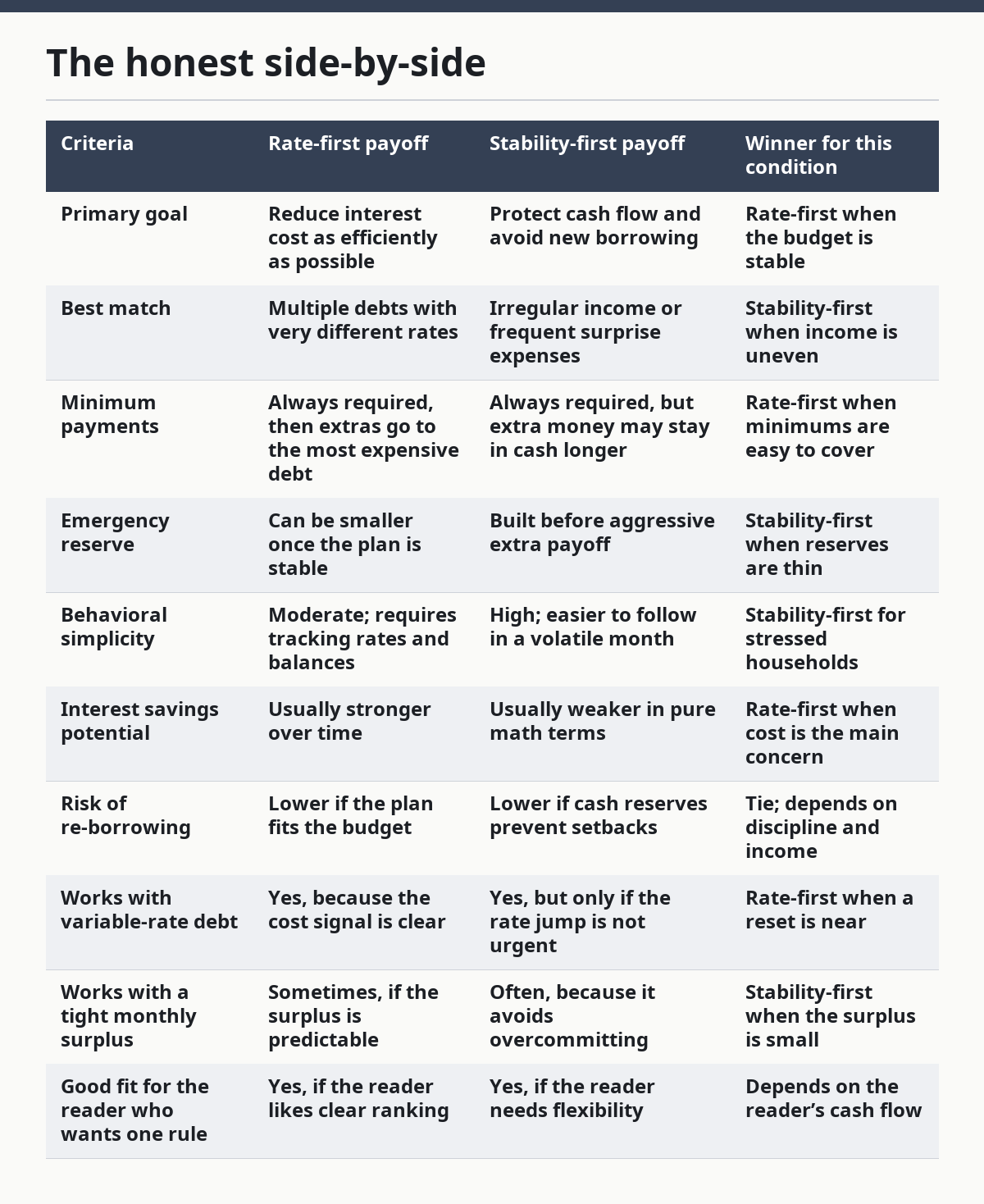
The table shows why this topic is not really about “best” debt payoff in the abstract. It is about which condition controls the decision. The winner changes when the household moves from stable to fragile, or from expensive debt to cheap debt.
A generic article often gets this wrong by pretending one sequence works for everybody. It does not. A rule that ignores income volatility is too strict for some readers and too loose for others. The better boundary is conditional: if the budget is steady and the debt is expensive, attack it; if the budget is fragile, protect the base first.
Which debts usually get priority under a clear boundary rule?
High-cost revolving debt usually gets priority, then debts with looming rate changes or penalties, then low-rate installment debt. That order reflects both math and risk.
The first category is debt that compounds fast enough to punish delay. The precise rate threshold varies by country and lender terms, so there is no universal cutoff that can be safely copied into every budget. A reader should compare the debt’s rate to the cost of leaving cash idle, to any promotional period ending soon, and to the consequences of missing payments. The important point is not the exact number; it is the gap between the debt’s cost and the household’s ability to safely hold cash.
The second category is debt that can change character soon. A promotional rate ending in a few months, a variable-rate loan that can reset, or a debt with penalty pricing deserves attention because the future cost may be much worse than the current one. Waiting for the statement to change is not a strategy.
The third category is debt with lower cost and stable terms. That includes many fixed-rate installment obligations that are already affordable within the monthly budget. These debts are often emotionally tiring, but they do not always justify the most aggressive treatment.
There are exceptions. A low-rate debt can move up the list if it is secured by an asset the borrower depends on, such as a car needed for work or a home. A debt with a low rate can also become a priority if it is close to delinquency and the borrower is at risk of fees, collection activity, or losing access. The consequences matter as much as the rate.
This is also where tax treatment can change the order. Some debts may have tax-deductible interest in certain jurisdictions, subject to rules that change often and are not universal. Because those rules vary, a borrower should not assume the after-tax cost is the same as the headline rate. That is one more reason to treat this as general information, not personal advice, and to consult a qualified adviser if the debt sits inside a tax-sensitive plan.
The boundary rule should be simple enough to use on a tired Tuesday, but not so simple that it ignores the cost of waiting.
What are the exception scenarios that flip the verdict?
The verdict flips when one of four things is true: the debt is about to become more expensive, the household is too fragile to accelerate payoff, the debt has legal or asset risk attached, or the borrower has a better use for cash under a qualified plan. That is where the clean rule stops being clean.
First exception: a rate reset or promotion ending soon.
If a balance is sitting on a temporary rate and the clock is close to expiring, the payoff boundary moves. The decision is no longer about the current rate alone; it is about the cost after the reset. A debt that looks manageable today may become the most expensive item in the stack within a billing cycle or two.
Second exception: a household with no usable cushion.
If paying extra would leave less than enough cash to survive a normal surprise without new borrowing, the boundary flips toward stability. That is true even if the debt is unpleasant. A fragile plan is a bad plan.
Third exception: debt that can trigger outsized consequences.
A secured obligation or any debt that can lead to immediate access problems needs its own rule. If missing or delaying a payment risks a car used for work, housing stability, or another essential asset, the priority can move ahead of a purely mathematical ranking. The loss from disruption can dwarf the interest saved by attacking a different debt first.
Fourth exception: the household has higher-priority goals with clear deadlines.
This could mean a near-term move, a tuition bill, or another obligation that cannot be financed cheaply later. The decision rule is not only about debt versus debt; it is about debt versus the next necessary obligation. If paying extra now would force a much more expensive problem later, the boundary should change.
These exceptions are not loopholes. They are the reasons a generic ranking system can fail. A good rule is written with escape hatches because real life has them.
What should I do if I want one rule that is easy to follow?
Use this rule: cover every minimum, keep enough cash to avoid immediate re-borrowing, then send extra money to the highest-cost debt unless that debt is about to become risky or expensive in a different way. That is the most useful one-line boundary for most readers.
The strength of this rule is that it is hard to abuse. It does not tell the reader to ignore savings, and it does not tell the reader to keep debt around forever for no reason. It also works across different debt mixes, from one card balance to several loans.
The weakness is that it is not emotionally neat. A borrower may prefer the feeling of wiping out the smallest balance first, because a closed account is visible progress. That can help motivation, especially when debt feels endless. But the drawback is that a balance-size approach can send extra money to a cheaper debt while a more expensive one keeps growing. A person should choose that path only if the motivational benefit is worth the cost.
A better version of the same rule is to set a monthly checkpoint. Once a month, review the rate on each debt, the available cash cushion, and any change in income. If nothing important changed, keep the same order. If one debt crossed a boundary — for example, a promotional rate expired or a payment became harder to cover — update the order immediately. That keeps the plan alive without turning every week into a new strategy meeting.
A reader who wants a single rule should avoid overcomplicating it with dozens of exceptions. But a rule that never gets reviewed can become outdated fast. The point is not perfect optimization. The point is a plan that survives ordinary life.
The verdict: which boundary rule to use and why
Choose the rate-first boundary if the household can cover minimums on time, has a small cash cushion, and carries at least one expensive balance that keeps costing more each month. Choose the stability-first boundary if income is irregular, savings are thin, or paying extra would push the household toward new borrowing. Neither if the debt situation is already in default, under formal hardship review, or tangled in legal, tax, or secured-asset issues that need professional advice.
That is the cleanest call. For most readers who are trying to decide where extra money goes, the best default is to protect a basic cushion and then attack the highest-cost debt. For readers whose income swings or whose bills are already tight, the better boundary is to keep cash available and prevent the next setback from becoming another loan.
The wrong choice is the one that sounds heroic but collapses in the next difficult month. A payoff plan should be tough enough to reduce debt and flexible enough to keep the lights on.
How do I know if my boundary rule is working?
Your boundary rule is working if debt balances fall without creating new late fees, new borrowing, or chronic cash shortages. If the plan lowers debt but leaves the household one surprise away from trouble, the rule is too aggressive.
A good checkpoint is to review the last 90 days. Did every minimum get paid on time? Did the checking balance stay positive? Did any payment force a skipped bill or a transfer from another debt? Did the highest-cost debt actually receive the extra money, or did the plan drift? Those questions matter more than how motivated you felt in week one.
The rule should also survive one setback. If a car repair, medical bill, or work interruption would instantly break the plan, the boundary needs adjustment. That does not mean the borrower failed. It means the plan was too tight for the real budget.
The strongest sign of a useful boundary is boring consistency. The borrower knows what happens to extra cash before the month starts, not after. That clarity makes debt payoff boundaries and decision rules easier to follow and prevents impulsive choices.
FAQ
Should I pay off debt before building savings?
No, not if paying extra would leave you unable to handle a normal surprise without borrowing again. A small cash cushion often protects the payoff plan itself, especially when income is irregular or the budget is already tight. The right balance depends on your situation, so a qualified adviser can help you set it.
Is it better to pay the smallest balance or the highest rate first?
The highest rate usually wins on cost, while the smallest balance can win on motivation. If the budget is stable and the rates are very different, the higher-rate debt is usually the better first target. If you need quick wins to stay on track, a smallest-balance approach may help, but it can cost more.
What if I can only make one extra payment a year?
Use that extra payment on the debt with the highest effective cost or the one most likely to become risky soon. A single annual lump sum should not go to a cheap balance by default if another debt is much more expensive or close to a rate reset. If you are unsure, a qualified financial professional can help you rank the options.
Can I ignore a low-rate loan and focus on cards first?
Yes, if the loan is stable, the payment is manageable, and the cards are costing much more. That is often the cleaner boundary because revolving debt usually punishes delay more heavily. The loan should stay on schedule, but it does not always need extra money first.
When should I stop using the same payoff rule?
Stop when the debt’s cost, your cash buffer, or your income changes enough that the old rule no longer fits. A rule that made sense six months ago can become wrong after a rate change, a job shift, or a new family expense. Review it regularly and get professional advice if the situation is complex.
Drafted with AI; not yet reviewed by a person.