Last updated: November 19, 2026
In short: fees, penalty rates, and fixed charges can make debt cost more than the APR suggests, so you need the full cost sheet—not just the headline rate. This guide on How to Spot Fees That Make a Debt More Expensive Than the Interest Rate Suggests shows you where those extra costs hide and how to check them. Quick answer: a 3% balance transfer fee or a $99 annual fee can make a “low-rate” debt cost more than it first appears.
Key Takeaways
- Debt can cost more than the APR suggests when fixed charges, penalty pricing, or transaction fees add to the balance or monthly amount due.
- Read the fee section, the rate-change rules, and the payment terms together to spot hidden costs.
- The biggest fees are the ones that recur, change the rate, or raise the starting balance.
- Fees change the real cost by increasing what you owe or the rate applied to it.
Who this is for, and what it assumes

This applies if you already have a loan, credit card, or line of credit and want to know why the balance feels harder to clear than the rate promised. It assumes you can read a bill, find an APR, and spot a fee line on a statement.
This is information, not financial advice. Rates, limits, and tax rules vary by country and change often, so a qualified adviser should look at your own situation before you act. If you already have missed payments, a frozen account, or a debt settlement offer, the math can change fast. For general fee and rate disclosures, see the CFPB’s credit card guides and the FTC’s balance transfer advice.
Picture this: you open a statement with a 19.99% APR, but the balance barely drops after a month of making the usual minimum. The reason is often not one thing; it is a stack of smaller charges that hit before interest even matters.
- APR tells part of the story.
- Fees tell the rest.
- The gap between them is where people get surprised.
A generic article usually stops at “watch for fees.” That is too vague. The better question is which fees change the payoff burden, how they show up, and which ones can make a debt more expensive even when the stated interest rate looks ordinary. The sections below do that work, and they fit the broader debt payoff prioritization hub without repeating it.
What makes a debt cost more than the APR suggests?
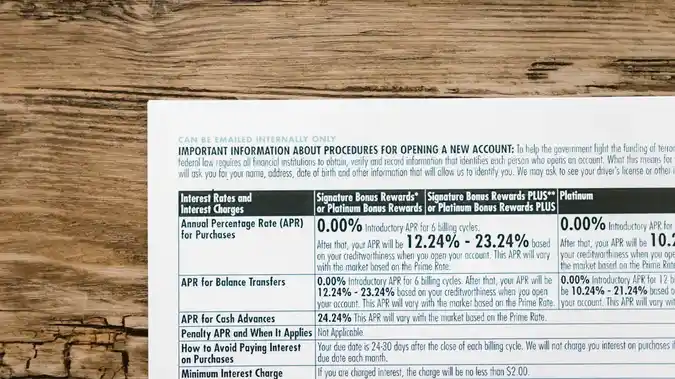
The debt costs more than the APR suggests when fixed charges, penalty pricing, or transaction fees add to the balance or to the monthly amount due. APR is an annual rate, but many debts also carry charges that are not part of that number in the way most borrowers expect. CFPB disclosures focus on this distinction, because a rate alone does not show the full cost.
Picture this: you compare two cards and see one with a lower APR. Then a $99 annual fee, a 3% balance transfer fee, and a missed-payment charge show up on the same account. The headline rate is no longer the whole story.
Here’s the catch: some charges hit once, some hit every year, and some hit only when you slip. They affect the real cost in different ways.
- Annual fees raise the cost just for keeping the account open.
- Late fees make one missed due date more expensive.
- Penalty APR can raise the rate after a problem.
- Balance transfer fees add to the amount you start with.
- Cash advance fees and convenience fees can do the same in other products.
A debt is more expensive than the APR suggests when the extra charges are either unavoidable or likely under your current habits. If you must keep the account open for access, that annual fee matters. If you have a shaky payment record, the late fee and penalty APR matter more than the posted rate. The FTC also warns that balance transfer fees can reduce the benefit of a teaser rate.
How do I spot the fees on a statement or offer?
You spot the fees by reading the fee section, the rate-change rules, and the payment terms in the same document, not separately. The key is to compare the cost lines against the APR line and the “what happens if” language. CFPB credit card agreements usually place this information in a few standard sections.
Picture this: you have a paper offer, a PDF, or a mailed statement in front of you. The fee names may be small, but they are usually grouped in a box titled “fees,” “pricing,” or “terms.” On some cards, the balance transfer fee sits in one box and the penalty APR sits in another.
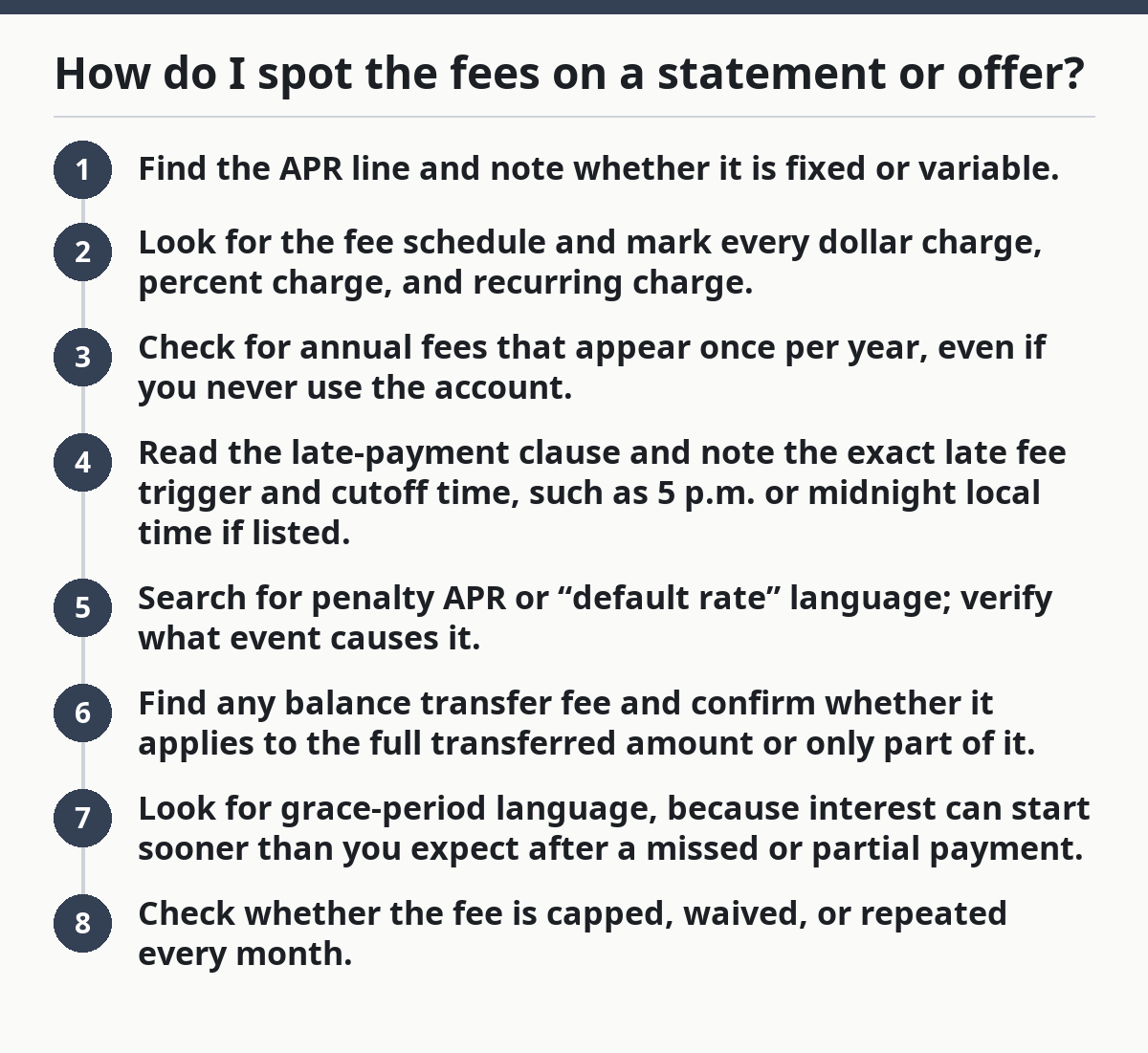
- Find the APR line and note whether it is fixed or variable.
- Look for the fee schedule and mark every dollar charge, percent charge, and recurring charge.
- Check for annual fees that appear once per year, even if you never use the account.
- Read the late-payment clause and note the exact late fee trigger and cutoff time, such as 5 p.m. or midnight local time if listed.
- Search for penalty APR or “default rate” language; verify what event causes it.
- Find any balance transfer fee and confirm whether it applies to the full transferred amount or only part of it.
- Look for grace-period language, because interest can start sooner than you expect after a missed or partial payment.
- Check whether the fee is capped, waived, or repeated every month.
If a fee is buried in a footnote, that is a problem. So is any term that says “we may change” without a clear trigger. When the document lists charges in different sections, you need both sections to understand the real cost.
Which fees matter most when debt is getting expensive?
The fees that matter most are the ones that either recur, change the rate, or increase the starting balance. A one-time charge can still hurt, but a recurring or penalty-linked charge usually does more damage over time.
Picture this: you are trying to figure out why a balance is shrinking slowly even though the interest rate looks manageable. One charge appears once a year, another shows up after a late payment, and a third gets added before the transferred balance even starts to accrue interest.
- Annual fee: a fixed cost for keeping the account open. On a card with a low APR, a yearly fee can erase much of the rate advantage if you carry a balance for months.
- Late fee: a charge for missing the due date or not making the minimum. Even one late fee can make the month’s cost jump.
- Penalty APR: a higher interest rate that can apply after a missed payment or another default event. This can make future interest much more expensive than the original APR.
- Balance transfer fee: a percentage charge added when moving debt to a new account. It raises the amount you owe from day one.
On the flip side, some fees are less important if you never trigger them and the account has no recurring charge. But that only helps if you are certain the terms are stable and you can stay current. In debt, certainty is rare.
The best part is that you do not need to calculate every penny to spot a bad deal. You only need to ask: does this fee recur, does it change the rate, or does it make the starting balance larger?
How do fees change the real cost of a debt?
Fees change the real cost by increasing either the amount you owe or the rate applied to it. A balance transfer fee makes the principal larger on day one, while a penalty APR makes the interest bite harder every month after a problem. According to CFPB guidance, both can materially change what you repay.
Picture this: you take a balance transfer that looks cheap because the promo rate is low. Then a 3% fee is added up front. That fee is not interest, but it still has to be paid back, and it can erase part of the benefit if the debt sits there for a long time.
The same is true with annual fees. A card with a decent APR can still be costly if the fee is high relative to how long you will carry the balance. If the account is used only to move debt, the fee may be worth it; if the account stays open for years, the math shifts.
Penalty APR is different. It does not add a flat charge. It raises the rate, sometimes sharply, after a late payment or other default event. That means the cost compounds month after month. A single mistake can make future interest much more expensive than the original offer suggested.
The clean way to think about it is simple:
- Up-front fee = higher starting balance.
- Recurring fee = higher ongoing cost.
- Penalty rate = higher cost on every unpaid dollar.
If a debt has all three, the headline APR is only part of the picture. That is the point most people miss.
When should you stop and read the fine print again?
You should stop and re-read the terms any time a fee depends on behavior, timing, or account status. Debt terms are not just numbers; they are rules, and the rulebook changes the cost.
Picture this: you are about to sign, transfer, or keep using the account, and one sentence in the terms changes the whole deal. That is the moment to pause. A fee that looks small can be expensive if it repeats or triggers another charge.
A payment is late by one day: this can trigger a late fee and, on some products, a penalty APR — check the exact due-time rule before assuming there is a grace window.
The account has an annual fee: this makes the debt cost more even if you never use the card or line — compare that fixed charge to the time you expect to carry the balance.
The offer includes a transfer fee: this increases the balance right away — confirm whether the fee is charged on the full transferred amount and whether the promo rate lasts long enough to justify it.
The rate can change after default: a penalty APR can make the debt far more costly than the starting APR — read the default triggers before relying on the first rate shown.
You cannot pay on time every month: a late fee plus a penalty APR can stack fast — if that pattern is already happening, the fee structure is the wrong fit for your current cash flow.
The account terms are unclear or missing: if the fee language is hard to find, the cost is hard to predict — get the full written terms before you rely on the headline rate.
These are the cases where the standard “compare APRs” habit breaks down. The fee, not the rate, is what changes the burden.
What mistakes do people make with fee-heavy debt?
People usually make the same five mistakes, and each one raises the cost in a different way. The fix is usually to slow down and read the pricing box before the balance gets larger.
Picture this: you only compare two APRs and ignore the rest. That is common, and it is how a debt can look cheap on paper while still draining cash every month.
- Ignoring the annual fee. The consequence is that the account costs money even when you are not borrowing much. The better move is to compare the fee against the time you will keep the balance.
- Treating a balance transfer fee as invisible. The consequence is a larger starting balance that must still be paid down. The better move is to add the fee to the amount you expect to repay and, if needed, ask a credit counselor or other qualified professional to sanity-check the total.
- Missing the late-fee trigger. The consequence is a one-time charge that can lead to a higher penalty rate. The better move is to check the exact due date, cutoff time, and minimum payment rule.
- Assuming penalty APR never happens. The consequence is surprise interest after a missed payment or default event. The better move is to read the default terms, not just the ad.
- Focusing only on the lowest APR. The consequence is choosing the wrong debt to keep open if fees are high. The better move is to compare total cost, not just the annual rate.
None of these mistakes requires advanced math. They require attention to the fee section and the default section. That is where the real cost lives.
What if the standard advice does not fit your debt?
The standard advice does not fit when the fee structure is the main driver of cost, not the APR alone. That happens often with cards that have annual fees, transfer fees, or penalty pricing built into the terms.
Picture this: you have several debts, and one has a low rate but a steep fee structure. Another has a higher APR but no annual fee and no transfer charge. The comparison is not always obvious, because the cash cost depends on how long the balance will remain.
A few edge cases deserve special care:
- Short-term balances: a one-time balance transfer fee may matter less if the debt will be cleared quickly, but it still counts.
- Long holds: annual fees become more damaging the longer the balance stays open.
- Irregular income: late fees and penalty APRs can dominate the cost if due dates are hard to meet.
- Promotional rates: a very low intro APR can hide a high fee or a harsh rate jump later.
- Mixed-use accounts: if a card is used for both spending and debt transfer, different transactions can carry different rules.
This is where a qualified financial adviser can help with your own situation, especially if you are juggling several accounts, a hardship program, or tax questions. The structure here is a comparison tool, not a personal plan. If the terms are unusual, read the contract line by line before you assume the debt is cheap.
What should you check before you decide a debt is “cheap”?
A debt is “cheap” only if the fee schedule, the rate rules, and your payment pattern all line up. The number on the front page is not enough.
Picture this: you are comparing two offers side by side. One has a lower APR but a transfer fee and annual fee. The other has a higher rate but fewer extras. The better deal depends on how long the balance will stay and whether you can avoid late charges.
Use this quick check:
- Is there a recurring fee just to keep the account?
- Is there a fee for moving balances onto the account?
- Can one late payment trigger a higher APR?
- Are there fees for cash advances, paper statements, or returned payments?
- Does the fee apply once, monthly, or every time you use the account?
- Is the stated APR fixed, variable, or only promotional?
If three or more of those answers are “yes,” the headline rate may be understating the cost. That does not automatically make the debt bad, but it does mean the APR alone is a weak guide.
What fees make debt harder to pay off?
The fees that make debt harder to pay off are the ones that repeat, add to the balance, or raise the rate after a mistake. Annual fees, late fees, penalty APR, and balance transfer fees are the main ones to watch. A fee that appears once can still matter, but a fee that comes back every year or every missed payment is usually the bigger problem.
How do I know the real cost of a debt?
The real cost of a debt is the APR plus any fee that changes the amount you owe or the interest you pay. Read the fee schedule, the default terms, and the transfer terms together. If the debt has a recurring annual fee, a transfer fee, or a penalty rate, it is probably more expensive than the headline number suggests.
Drafted with AI; not yet reviewed by a person.