Last updated: November 19, 2026
Key Takeaways
- You do not need a speech.
- Get the debt details in writing before you discuss money or timing.
- Keep your answers short, factual, and noncommittal.
- Stop the call if the conversation turns vague, aggressive, or contradictory.
A debt collector calls, and you need the right words on the spot. Quick answer: ask for written validation first, keep the call to 60 seconds or less, and do not admit the debt or promise payment. What to say when a debt collector calls you is simple: slow the call down, ask for details, and protect your record. The steps below show exactly what to say, what to write down, and when to end the call.
This is information, not financial advice. Debt rules change by country and by state or province, so a qualified adviser or consumer-rights clinic should review your own situation.
The first words to use

Picture this: your phone rings, the caller says they’re with a collection agency, and you have 30 seconds before the conversation gets slippery. You do not need a speech. You need a short script, a pen, and a calm voice. The right first move is verify, slow down, and limit the call.
Start with this line: “I’m willing to review this, but I need the debt in writing first.” That gives you room without admitting anything. Then ask for the collector’s full name, company name, callback number, mailing address, and the account number tied to the file. In practice, that is a five-point check before any payment talk begins.
What that does:
- It confirms you are talking to a real collector, not just a random caller.
- It forces the call toward a debt validation letter or written notice.
- It keeps the call focused on facts, not pressure.
Use these phrases and avoid the traps:
- “Please send me the details in writing.”
- “I’m not discussing payment on a live call.”
- “I need to review my records first.”
- “Please note that I’m keeping a call log.”
Do not say:
- “Yes, that’s mine.”
- “I was going to pay.”
- “I can send something next Friday.”
- “Can you just tell me how much I owe?”
That last question sounds harmless. It hands the collector the steering wheel. On the flip side, asking for a written breakdown keeps the conversation grounded in facts instead of pressure. For consumer-rights basics, the U.S. Federal Trade Commission’s page on debt collection is a good starting point, and the Consumer Financial Protection Bureau’s debt collection resources are another useful source.
What should I ask for before I talk about money?
You should ask for the debt details first, in writing, before you discuss money or timing. The call is not the place to build a record from memory. You want enough information to check whether the debt is yours, whether the amount matches your records, and whether the collector is even allowed to pursue you.
Say this, word for word if needed: “Please send me the original creditor’s name, the current balance, the date of last activity, the account number, and a written validation notice.” That request matters because it gives you a paper trail and a chance to compare the file against your own records. If the collector refuses or becomes vague, that is a problem.
Here’s the catch: you do not need to debate the debt to protect yourself. You need to collect data. A proper validation notice should let you see who claims to own the debt, what they say is owed, and how to dispute it if needed. If those details are missing, inconsistent, or rushed past, stop the discussion and ask for written proof.
Ask for these items:
- Original creditor name
- Current collector’s legal name
- Full mailing address
- Account number
- Date of the last payment or last activity, if they claim it
- Itemization of the balance, if available
- Instructions for disputing the debt in writing
If the collector gives you only a first name and a total dollar figure, that is not enough. If they pressure you to “just confirm” the balance before they send anything, that is also not enough. The goal is to leave the call with enough facts to check your records, not to settle the case in 5 minutes.
How do I keep from saying the wrong thing?

You keep your answers short, factual, and noncommittal. The easiest mistake on a first call is to fill silence with explanations. A collector may sound friendly, urgent, or formal. None of that changes the task: protect your position until you have the written file.
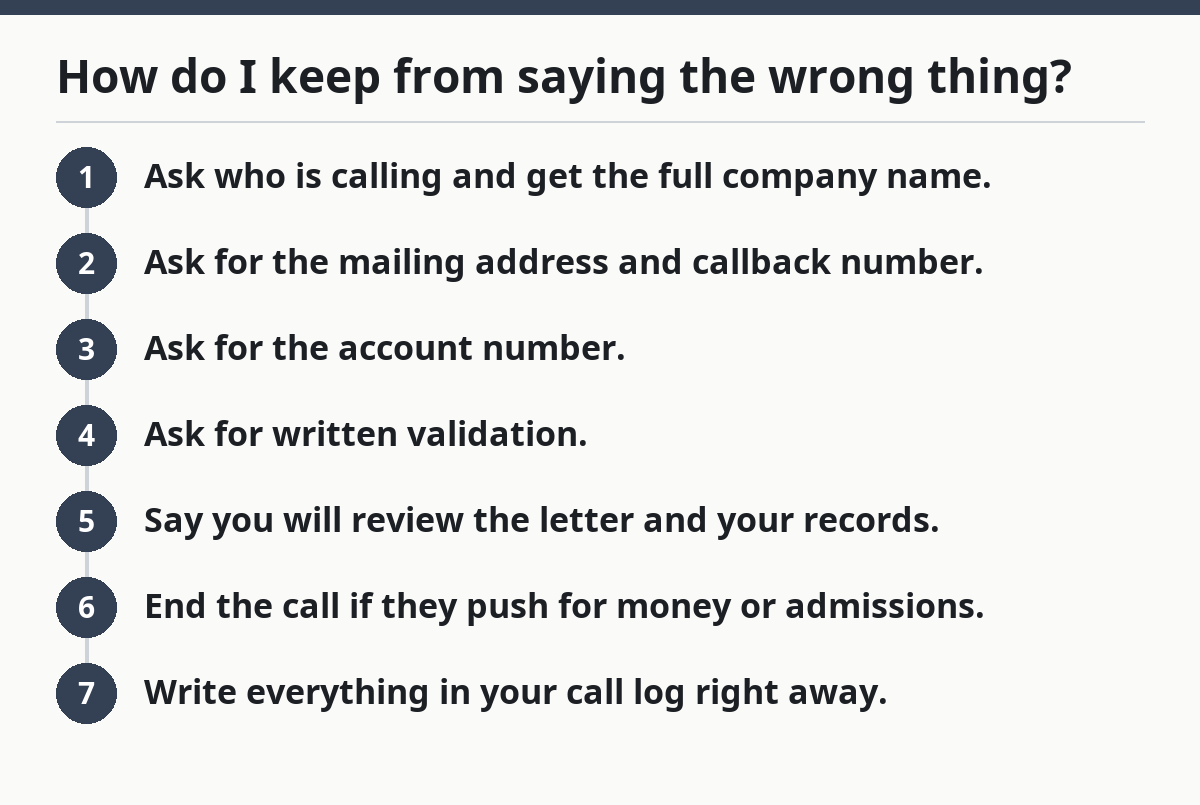
Use this pattern:
- Ask who is calling and get the full company name.
- Ask for the mailing address and callback number.
- Ask for the account number.
- Ask for written validation.
- Say you will review the letter and your records.
- End the call if they push for money or admissions.
- Write everything in your call log right away.
What to say in the middle of pressure:
- “I’m not confirming anything on this call.”
- “I need the documents first.”
- “Please stop asking for a payment commitment.”
- “I’ll respond after I review the written notice.”
What not to say:
- “I forgot about that account.”
- “I think that was from my old address.”
- “I can’t pay right now.”
- “Maybe I owe that.”
Those phrases can become useful against you later because they suggest ownership, awareness, or ability to pay. You do not need to lie. You just need to avoid volunteering facts that you have not verified.
If the caller asks for a debit card, bank routing number, or a one-time “good faith” amount, slow the call down. Payment talk belongs after the paper trail, not before it. A rushed first call is where people make the mistake that costs them the most.
A simple debt collector call script
Picture this: the phone is on speaker, your notes page is open, and you want one script that fits in 60 seconds. Keep it short. Keep it flat.
Use this script:
“I’m taking notes. Please give me your full name, company name, mailing address, callback number, and the account number. I’m not discussing payment on this call. Send me written validation, and I’ll review it before I respond.”
Then stop. If the collector keeps talking, repeat one line:
“I need it in writing.”
If the caller becomes pushy, use a boundary:
“Do not contact me by phone about this again. Send all future communication in writing.”
That last line is a serious step, and the rules around contact limits vary by country and jurisdiction. If you live in the U.S., the Fair Debt Collection Practices Act and Consumer Financial Protection Bureau guidance explain some of the contact rules that may apply. If you are outside the U.S., check your local consumer agency before relying on any one-line script as universal law. The FTC’s debt collection guidance and the CFPB’s sample letters are useful starting points.
What to verify before you end the call:
- You got the collector’s full legal name
- You wrote down the company name correctly
- You have the account number
- You requested written validation
- You did not admit the debt
- You did not agree to a date, amount, or method of payment
If any one of those is missing, you are not done yet. Ask again once. Then end the call if the pressure continues.
What should make me stop the call?
You should stop the call when the conversation turns vague, aggressive, or contradictory. That is not rude. It is smart recordkeeping. A first call is for identification and validation, not for verbal traps.
The caller won’t give an account number: that means you cannot match the file to anything in your records — end the call and ask for written notice.
The collector refuses a mailing address: without a place to send a dispute or request, you cannot protect your rights — hang up and note the refusal.
They demand immediate money: that is pressure, not proof — say you will review the letter first and stop the call.
They push for a yes or no about ownership: that can box you into an admission — say you are not confirming anything by phone.
The story changes during the call: a changing creditor name, balance, or date is a red flag — ask for the details in writing and end the call.
You feel rushed or confused: confusion is a bad place to make promises — take notes, say you need the written version, and stop.
Here’s the rule that saves people trouble: if the call stops being a fact-gathering call, it stops being a useful call. You do not need to win an argument. You need a clean record and a paper trail.
The mistakes that cause the most damage
Picture this: you think you’re being polite, but every extra sentence gives the collector more to work with. That is how people get boxed in. The first call is not the place for storytelling, guessing, or bargaining. It is the place for restraint.
Common mistakes:
- Admitting the debt is yours. Consequence: you may weaken later disputes — say you need written validation instead.
- Promising a date you cannot keep. Consequence: a collector may treat it as a commitment, so do not discuss timing without a review of the file and, if needed, a professional’s advice.
- Giving bank details on the call. Consequence: you may open the door to an unwanted debit — wait until you have checked the written file.
- Arguing about every line item. Consequence: the call runs long and gets sloppy — ask for the balance breakdown in writing.
- Ignoring the call log. Consequence: you lose dates, names, and what was said — write it down while it is fresh.
The better alternative is boring but powerful: short answers, written requests, and a clean note of who said what. That may feel slow. It is still faster than trying to repair a bad phone call later.
When the standard script is not enough
Because of that first-call caution, the same script still helps when the collector says the debt is from a different state, the account is very old, or the call comes after a court paper has already shown up. In those cases, the usual script still helps, but it may not be enough on its own. The facts around the debt now matter more than the tone of the call.
Use extra caution if:
- The collector says the debt is very old. Time limits on collection vary by location, and old debt can raise separate rules.
- You already received a lawsuit or court notice. A phone script does not replace a legal response deadline.
- The debt is tied to a joint account. Another person’s signature or activity may matter.
- The collector calls at work or at odd hours. Contact rules can be different depending on where you live.
- You suspect identity theft. That changes the task from “review the balance” to “challenge the account.”
What to do in these cases:
- Ask for written validation anyway.
- Keep the call log.
- Do not make payment promises.
- Save every letter and voicemail.
- Get qualified local help if a deadline, lawsuit, or identity problem is in play.
For broader communication strategy, the hub on debt payoff communication and negotiation can help once the first-call basics are handled. This page is only about the opening call, not the whole debt plan.
What a good first call looks like
Since the goal is control, a good first call ends with notes instead of confusion. That is a good result. You do not need the collector to like you. You need the file, the name, and the next step in writing.
A good first call usually ends with:
- The collector identifying themselves clearly
- You getting the company name and account number
- You asking for a debt validation letter
- No admission from you
- No promise to pay
- A note in your call log with the date and time
That outcome is enough. It is not flashy. It does give you control.
The truth is, the first call is mostly about not making things worse. If you leave with the right details and no rushed commitment, you have done the job. If the caller wants an answer right now, the correct answer is still the same: send it in writing.
What should I say to a debt collector on the phone?
Say that you need the debt in writing before you discuss anything else. Ask for the collector’s full name, company name, mailing address, callback number, and account number, then stop there if they push for payment or an admission. A short, calm script protects you better than an explanation.
Should I admit the debt is mine during a collector call?
No, not on the first call. A phone admission can narrow your options later, especially if the balance, creditor, or dates turn out to be wrong. Ask for written validation first, review your records, and only then decide how to respond.
Can I ask a debt collector to put everything in writing?
Yes, and you should. A written notice gives you a record of who says they own the debt, what they say is owed, and where to send disputes or requests. If the caller resists that request, consult a qualified consumer-rights adviser or attorney before deciding what to do next, and consider ending the call. For federal background, see the FTC debt collection page and the CFPB debt collection resources.
What information should I get before talking about payment?
Get the collector’s full legal name, company name, mailing address, callback number, account number, original creditor name, current balance, and written validation notice first. Without those details, you cannot check whether the file is accurate or whether the caller is even the right party to deal with.
Drafted with AI; not yet reviewed by a person.