Last updated: November 19, 2026
Key Takeaways
- A debt payment buffer gives a few weeks of cover between income and a debt payment.
- It works like a sinking fund for a known bill, not general savings.
- Start with enough for the next minimum payment, plus transfer time and a small margin.
- Keep the money in a separate savings account that is easy to move from but awkward to spend from.
A debt payment buffer helps you cover a minimum payment when cash is tight, and the simplest start is a separate savings account with money set aside before the bill date. This guide explains how to build a debt payment buffer before you need it, using a clear target and a separate account.
That buffer is not a substitute for paying debt on time. It is a short-term cushion for bill timing, and the steps below show how to build one without confusing it with emergency savings.
What a debt payment buffer is for, and who should use one
A debt payment buffer is for anyone who wants a few weeks of protection between income and a debt payment. It is a cash cushion built for one job: keeping a minimum payment from bouncing when timing gets messy.
This is information, not financial advice. Debt rules, account limits, and late-fee policies vary by country and lender, so a qualified adviser should be consulted for your own situation. If you already know your due dates, your minimum payment, and the account you can use for savings, you have enough to start.
A good fit is someone with steady income, a fixed payment date, and a real risk of bill overlap. Not even close for someone trying to solve irregular income swings on the same page. That is a different problem.
Scope check: this page covers a buffer fund for debt-specific timing risk, not general emergency savings, not debt snowball or avalanche strategy, and not how to choose which debt to pay first.
- You already know your minimum payment on each account.
- You know when each payment is due.
- You can open or use one separate savings account.
- You can spare small deposits before the bill hits.
How do you build a debt payment buffer before the bill is due?
You build it by setting a target, moving cash into a separate account, and linking each deposit to a bill date so the money is ready before the lender pulls it. The process works best when the buffer is treated like a sinking fund, which means money saved for a known future expense.
-
List every debt payment date and minimum payment. Write down the due date, the amount due, and whether the lender drafts automatically or expects you to send payment. Verify that the dates are current on the statement or app. If a date is unclear, your buffer can miss the bill by a day.
-
Pick one place for the buffer. Use a separate savings account, not the same checking account you spend from every day. Verify that transfers are easy and that the balance is visible. If the money sits beside spending cash, it gets used too soon.
-
Set a first target tied to one payment. Start with enough to cover one minimum payment plus any bank transfer time you know your account needs. Verify that the target matches the smallest bill that could trigger a late fee. If the target is too low, the buffer looks full while still failing.
-
Schedule deposits on payday. Move a fixed amount the same day income arrives, even if it is small. Verify that the transfer leaves enough in checking for rent, food, and other bills due before the next payday. If the transfer causes an overdraft, the plan is too aggressive.
-
Tag the money by bill. If you have more than one debt, label the savings bucket in your own notes with the next due date or creditor name. Verify that you can tell which payment the cash is meant for. If you cannot, one bill will quietly steal another bill’s protection.
-
Keep the buffer untouched unless a payment is at risk. Use it only when timing would otherwise make a minimum payment late or short. Verify after each use that the balance still covers the next payment date. If the account becomes a spillover fund for spending, it stops working.
-
Refill it after every use. Put replacement deposits back on the calendar within 24 hours of the withdrawal. Verify that the refill schedule is visible in your budget or banking app. If you wait until “later,” the next bill arrives first.
-
Review the amount every 30 days. Check whether minimum payments changed, a fee was added, or a new debt entered the picture. Verify that the buffer still covers the soonest payment. If not, raise the target before the due date closes in.
The truth is, a buffer works because it turns a payment deadline into a cash task. It does not fix overspending. It fixes timing.
How big should the debt payment buffer be?
The right size is the amount needed to cover the next minimum payment, plus enough time for transfers to clear, with a small reserve if your bills hit close together. It should be large enough to stop one missed payment, not so large that it becomes idle cash.
A useful first target is often the next one payment, then the next two if due dates cluster within the same 7 to 14 days. That is a practical rule, not a universal standard. Some lenders allow a short grace period; others do not, and late fees can start right away.
What matters is the gap between bill dates and cash dates. If payday lands 3 days after the due date, the buffer needs to sit in front of that gap, not behind it. If two minimum payments fall in the same week, the buffer should be large enough to cover both if your cash flow is tight.
- One-payment buffer: useful when debts are spaced out.
- Two-payment buffer: useful when two due dates sit close together.
- More than two payments: usually means the problem is no longer timing alone.
One clean way to think about it is reserve planning. You are setting aside enough money to absorb a known bill pattern, not stocking a general stash.
Where should the money sit while you’re building it?
The money should sit in a separate savings account that is easy to move from but awkward to spend from. That keeps the buffer visible without putting it in the path of daily card swipes.
A plain savings account is usually better than a checking account because it creates a small barrier. It is also easier to label mentally as bill money, not shopping money. If your bank lets you open a second savings sub-account, that can work too, as long as it is clearly separate.
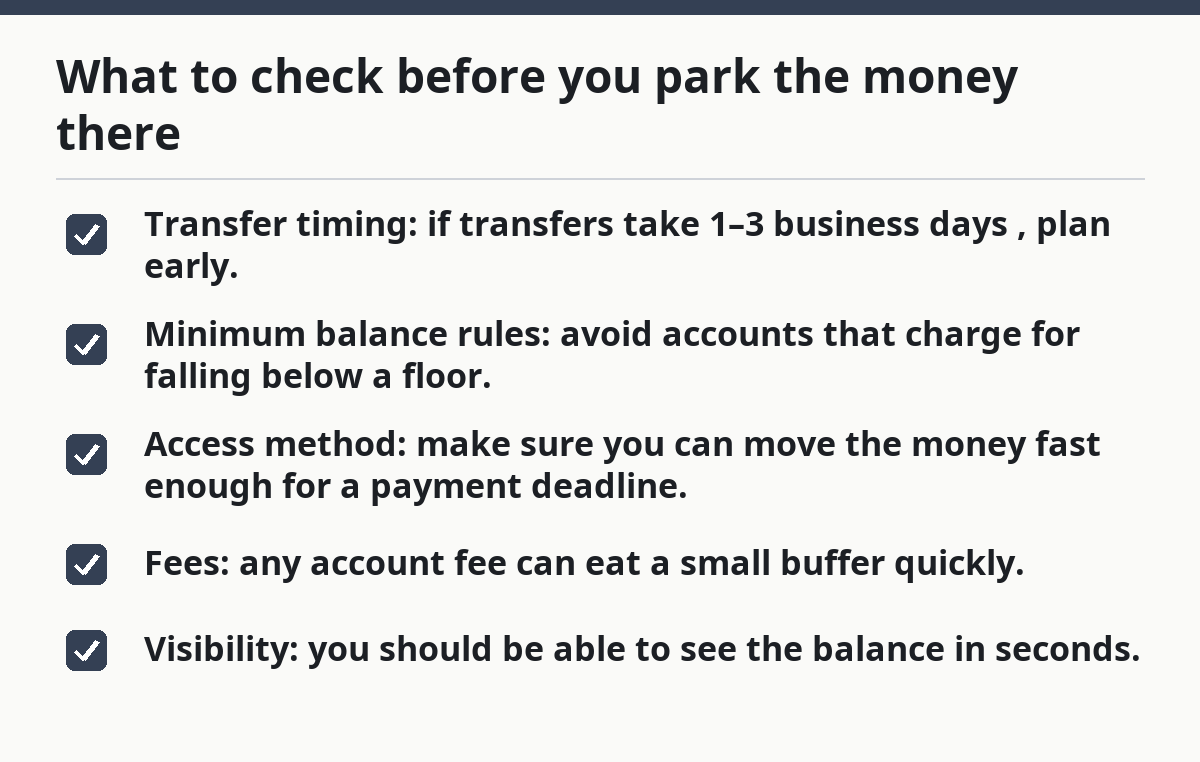
What to check before you park the money there
- Transfer timing: if transfers take 1–3 business days, plan early.
- Minimum balance rules: avoid accounts that charge for falling below a floor.
- Access method: make sure you can move the money fast enough for a payment deadline.
- Fees: any account fee can eat a small buffer quickly.
- Visibility: you should be able to see the balance in seconds.
If the account is hard to access, the buffer may fail when you need it. If it is too easy to raid, it will disappear before the bill arrives. The sweet spot is separate, visible, and slightly inconvenient.
What mistakes break a debt payment buffer?
The buffer breaks when people treat it like spare cash, underfund it, or ignore due dates. Those mistakes are common because the account balance looks real long before the protection is real.
-
Saving after the bill. If you wait until the due date passes, the buffer never gets ahead of the payment cycle. The result is the same scramble every month. The fix is to move money on payday.
-
Mixing the buffer with emergency savings. If one account has to cover a car repair and a credit card minimum payment, the money gets assigned twice. The result is confusion and accidental shortfalls. The fix is to keep a debt buffer and an emergency fund separate.
-
Guessing instead of listing due dates. If you are off by even a few days, the buffer can miss the draft window. The result is a late fee or a returned payment. The fix is to write down every date from the statement.
-
Using the buffer for non-debt spending. A quick transfer to cover groceries can leave the next minimum payment exposed. The result is a hole that looks small until the bill arrives. The fix is to treat the account as spoken-for money.
-
Building it once and forgetting it. Minimum payments can change after a balance shift, a rate change, or a fee. The result is a buffer that used to work but no longer does. The fix is a monthly review.
-
Putting too much into it too soon. If the transfer drains checking, you create a new shortfall before the old one is solved. The result is one bill protected and another bill missed. The fix is to build the buffer in steps.
The catch is that a buffer is only as strong as the schedule behind it. No schedule, no cushion.
When does the standard approach not fit?
The standard approach does not fit when the payment date problem is really an income problem, a collection problem, or a debt-size problem. In those cases, a simple savings buffer is the wrong tool.
Your paycheck changes a lot: the timing gap is not predictable — use a different cash-flow plan built around variable income, because a fixed payday deposit may miss the mark.
You are already behind on minimum payments: the buffer will not cure arrears — focus on catching up with the lender’s current rules before building a new reserve.
Your account charges fees for transfers or low balances: the buffer can leak through account costs — move the money into an account with simpler access and fewer fees.
You face an automatic draft before payday every month: the problem is the order of bills — arrange the payment date if the lender allows it, or hold the money earlier.
You cannot leave enough cash in checking after rent and food: the buffer is too ambitious right now — start with a smaller target and build it one payment at a time.
Those are not failures. They are signs that the plain version of the method needs a different setup.
What does a good debt payment buffer look like in practice?
A good debt payment buffer matches the next bill, sits in a separate account, and gets refilled before it is empty. It is boring, on purpose.
The best sign is simple: when a due date hits, the payment is already there. The account is not a long-term stash, and it is not meant to grow forever. It is meant to catch the next minimum payment without forcing a last-minute transfer from somewhere else.
A workable setup often looks like this:
- one savings account for the buffer;
- one written list of due dates;
- one automatic or manual transfer on payday;
- one monthly review of minimum payment changes.
If that sounds plain, good. The buffer should be plain. Fancy systems fail when the bill date arrives on a Tuesday and the money is still sitting in the wrong place.
The guide to managing debt payoff cash flow sits on the same idea: put money where the calendar says it will be needed, then keep it there until the payment clears.
How big should a debt payment buffer be?
A debt payment buffer should be big enough to cover the next minimum payment, then the next one if two bills fall close together. That is the cleanest rule of thumb when the goal is bill timing, not long-term savings. If you are unsure, a qualified adviser can help you judge the right reserve for your own accounts.
Where should I keep a debt buffer?
Keep a debt buffer in a separate savings account that is easy to move from and hard to spend from. That separation helps prevent the money from blending into your daily cash. If transfers take a few business days, move the money early enough to beat the due date.
Is a debt buffer different from an emergency fund?
Yes, a debt buffer is different from an emergency fund. A debt buffer is for a known payment date and a known minimum payment; an emergency fund is for surprise costs like repairs or medical bills. Keeping them separate makes it easier to see what money is already assigned.
A simple checklist to start this week
You can start with three actions in under 30 minutes. Start with the due dates you already know, then move the first buffer amount into a separate savings account. Set the next transfer for payday so the money grows before the bill lands.
If you do only one thing, do this: match the buffer to the soonest minimum payment on your calendar. That one move gives the plan a job.
- Write down the next due date.
- Write down the minimum payment.
- Move the first transfer.
- Schedule the refill.
- Check the balance before each bill date.
The point is not to build a giant reserve overnight. The point is to stop being surprised by a payment you already knew was coming.
Drafted with AI; not yet reviewed by a person.