Last updated: November 19, 2026
Quick Answer: In most cases, debt payoff after divorce starts with a 4-step check: identify who is legally on each account, compare the divorce order with the lender contract, protect any joint accounts, and rebuild a post-split budget from current income. Debt after divorce is split by who is legally on the account, not by who used the card or who kept the furniture. Your divorce agreement can assign payment duties, but it does not erase a lender’s rights on joint debt. The sections below sort out what to check, what to change, and how to protect a new budget in the topic of debt payoff after divorce or separation: how to split obligations and protect your plan.
Key takeaways
- Shared debt obligations can stay tied to both names even after the marriage ends.
- A divorce agreement can say who pays, but creditors still follow the original contract.
- Your credit report is a practical way to spot accounts that still need action.
- A separate budget helps you match debt payments to the income you actually have now.
- The cleanest plan usually starts with joint accounts, then moves to the rest of the list.
This is information, not financial advice. For your own situation, a qualified adviser or attorney should review the documents before you rely on them.
What shared debt obligations mean after a split
Shared debt obligations mean you may still be legally responsible for the same account even after separation, because the contract with the lender did not change just because the relationship did. That is true for many joint credit cards, co-signed loans, and some mortgage or auto debt. The divorce may change payment duties between spouses, but it does not automatically change the lender’s contract.
Picture this: you’ve moved into a smaller place, the bills have changed, and the old joint credit card still shows up on your credit report. You need to know which balances are yours to pay by agreement, which ones are yours to pay by contract, and which ones need a formal change with the lender. Big difference.
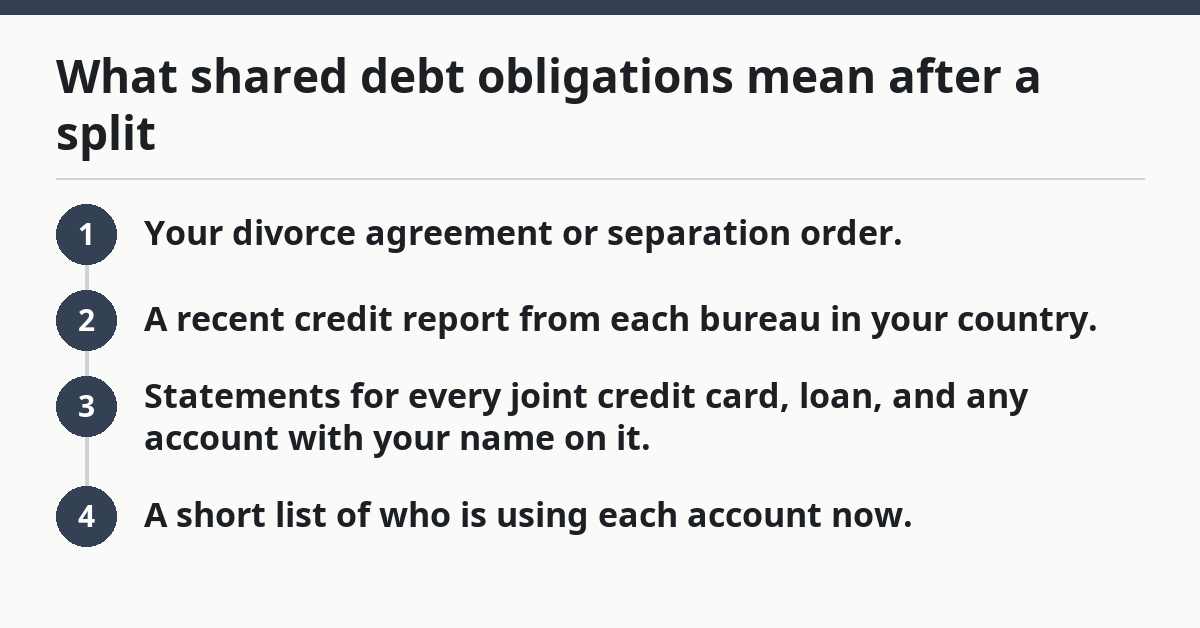
Start with the paperwork you already have:
- Your divorce agreement or separation order.
- A recent credit report from each bureau in your country.
- Statements for every joint credit card, loan, and any account with your name on it.
- A short list of who is using each account now.
That list matters because account use and account ownership are not the same thing. If your name is on a joint credit card, the lender can still pursue you if payments stop, even if the agreement says your ex will pay. The agreement can give you a claim against the other person later, but it does not force the lender to wait.
What to verify:
- The exact names on each account.
- Whether the account is joint, individual, or co-signed.
- Whether the balance is current, late, or in default.
- Whether the agreement says one spouse must refinance, close, or transfer the debt.
If anything is unclear, pause before making a payoff plan. A plan built on the wrong account list wastes months.
How to split debt after divorce or separation
Split debt by contract first, then by budget second. That means you map each obligation to the name on the account, then decide how the payments fit into your new monthly income and living costs.
Picture this: you’re staring at three statements, one court document, and a bank app that no longer matches your household. The job is not to make every debt “fair” in the abstract. The job is to build a plan that still works when rent, child care, and groceries are now on one income instead of two. The catch is that fairness and legal responsibility may not be the same thing.
- List every debt. Write down the creditor, account number last four digits, balance, minimum payment, and whose name is on it. Use a single page or spreadsheet.
- Mark the account type. Label each one joint, individual, or co-signed. If the label is missing, check the original agreement or the most recent statement.
- Read the divorce agreement line by line. Note who is assigned each debt, whether a refinance is required, and whether any deadlines are listed.
- Compare the agreement to the contract. If the lender still shows both names, assume both names still matter to the lender until the account is changed.
- Sort by risk, not by emotion. Joint credit cards and loans with both names usually deserve the first pass because missed payments can hit both credit files.
- Build a separate budget. Use your post-split income only. Set rent, utilities, food, transportation, and minimum debt payments before extra payoff dollars.
- Choose the payment flow. Decide which account gets paid from which bank account so there is no gap if one person misses a transfer.
- Set proof of payment. Keep confirmations, screenshots, or bank records for each payment in case the other party disputes it later.
Verify each step against a real document, not memory. If the agreement says a debt is yours but the creditor still lists both names, the problem is not solved. If the account is in one name only, but the other spouse promised to pay, that is a different risk: enforcement against the spouse may be through the divorce process, not the lender.
A workable split usually aims for three things: no missed payments, no surprise credit damage, and no plan that depends on money you no longer have.
What to check on your credit report before you pay a cent
Your credit report shows which debts still need legal cleanup, which still need payment, and which have already fallen off your active list. That makes it a strong starting point before you send one extra dollar.
Picture this: you think a joint card was closed, but the report still shows an open line with a balance and a recent late mark. Or you think your ex refinanced the auto loan, but your name is still there. Those are not minor details. They change who gets chased if something goes wrong.
Check for these items on each report:
- Open joint credit cards.
- Co-signed loans.
- Old addresses that could block notice from a creditor.
- Late payments reported after the separation date.
- Accounts listed twice or under slightly different names.
Use the report to answer four questions:
- Is the account still open?
- Is your name still attached?
- Is there a balance or only an old entry?
- Is the payment history still changing?
If you see a problem, don’t assume the lender has already fixed it. Credit reporting can lag behind life changes by a billing cycle or more. That delay matters if you are trying to rebuild after a split.
A good habit is to pull the report again after a change is made, often about one to two billing cycles later, so you can see whether the update actually posted. If it didn’t, save the document trail and follow up through the lender’s dispute process or the credit bureau’s correction process.
For general consumer credit rules, the Consumer Financial Protection Bureau and the Federal Trade Commission both publish plain-language guidance on credit reports and disputes. If you’re outside the U.S., use your local credit regulator or consumer agency, since reporting systems and rights differ by country.
Who is responsible for joint debt after divorce?
Both people can still be responsible to the lender if both names are on the account, even when the divorce agreement says only one person should pay. That is the part people miss most often.
Picture this: the decree says your former spouse “shall pay” the joint card, but the lender never signed that paper. If the account is late, the creditor can still contact either named borrower. The decree helps between the two of you; it does not automatically rewrite the loan.
Here’s the practical order of operations:
- Joint credit card: confirm whether it can be closed, paid down, or separated. If it stays open, treat it as a shared risk until the lender changes the account. If the account stays open, ask a family-law attorney or financial professional how the risk is handled in your state or country, and check the creditor’s written policy.
- Co-signed loan: assume both signatures remain live until the debt is refinanced or paid off.
- Mortgage or auto loan: check whether the title, note, and insurance all line up. One document changing does not fix the others.
- Individual debt: if it is only in one name, the other spouse usually should not be paying it unless the divorce agreement says that payment is part of the settlement.
- Assigned debt in the divorce agreement: this changes who should bear the cost between spouses, but not always who the creditor can pursue.
If the agreement says one person must refinance by a certain date and that does not happen, the old account often remains a shared problem. That can affect credit, cash flow, and the next housing application.
The cleanest approach is to think in layers: lender rules first, court order second, household fairness third. That order may not feel fair, but it matches how debt actually works.
How do I protect my credit during separation?
Protect your credit during separation by limiting new shared exposure, keeping every due date visible, and watching the reports until the old accounts stop changing. That is the shortest honest answer.
Picture this: you’ve separated, the bills are split, and one forgotten joint payment can still land on your credit file. You need a buffer between your life changes and the lender’s reporting cycle. This is where a separate budget and clean account handling matter more than good intentions.
Use these protections:
- Close or freeze joint spending where allowed. If a joint credit card is still active, ask whether it can be closed to new charges while you work the balance down.
- Set up your own payment calendar. Mark due dates on a phone, paper planner, or calendar app. A missed payment can trigger damage within one billing cycle.
- Keep minimum payments current. A single missed payment can trigger late fees and reporting problems.
- Separate cash flow fast. Move your paycheck, autopays, and emergency cash into accounts that only you control.
- Track every change in writing. Save statements, emails, and confirmation numbers.
- Check credit reports regularly. Watch for late marks, new inquiries, or unexpected balances.
What not to do:
- Don’t assume your ex will pay on time just because the agreement says so.
- Don’t rack up new joint charges “for convenience.”
- Don’t ignore a small balance; small balances can still become late marks.
- Don’t rely on memory for due dates after the household split.
If you’re trying to protect your score while also paying down debt, the better move is usually to reduce the number of accounts that can surprise you. Fewer shared accounts means fewer ways for one missed payment to spread.
The mistakes people make, and what they cost
The biggest mistakes are treating the divorce agreement like a lender contract, skipping the credit report, and using the old household budget after income has changed. Those errors can leave you paying too much, paying the wrong account first, or taking a credit hit you did not plan for.
Picture this: the paperwork is signed, the move is done, and you think the hard part is over. Then a payment is missed, a creditor reports it, and both credit files take the hit. That is the cost of confusion.
Common errors:
- Relying on verbal promises. Consequence: you have no clean record if the other person stops paying. Better move: get payment duties into the written divorce agreement and keep records of each payment.
- Ignoring a joint credit card after separation. Consequence: new charges and late fees can keep building. Better move: close it if possible or stop new use and pay it down on a set schedule.
- Using household-level budgets from before the split. Consequence: the plan breaks when one income no longer covers two sets of costs. Better move: rebuild a separate budget from current income and current housing costs.
- Paying emotional debts first. Consequence: you may overpay one account while another shared account turns delinquent. Better move: start with contracts, due dates, and credit risk.
- Not checking the credit report for 30 to 60 days. Consequence: mistakes stay hidden. Better move: recheck after account changes post, then again if anything looks off.
- Assuming one payoff fixes the whole picture. Consequence: an old co-signed account can still haunt your file. Better move: treat each account on its own terms.
The right correction is usually boring: list, verify, pay, document, repeat. Boring is good here.
When the standard approach does not apply
The standard approach needs adjustment if the debt is in dispute, the account is already late, or one person cannot cover even the minimums. In those cases, the usual “split and pay” plan can fail fast.
Picture this: the divorce order is still being negotiated, the mortgage is upside down, or one spouse has already stopped paying a joint card. A simple budget sheet will not solve a legal or cash-flow break. You need a different path, and fast.
- The account is already delinquent: It may be reporting late fees and damage now — your plan needs to focus on stopping the bleed, not just dividing the bill.
- The divorce agreement is not final: The debt split can change — avoid making long-term assumptions until the final order is signed.
- One income cannot cover both minimums and living costs: The budget does not balance — the payoff plan needs to be reduced to what you can actually carry.
- A lender still shows both names after a refinance was supposed to happen: The account is not truly separated — keep monitoring until the paperwork changes.
- There is a business debt, tax debt, or secured loan involved: The stakes are different — those obligations can follow rules beyond a normal consumer card or loan.
If you hit one of those situations, the standard payoff order may not fit. That does not mean you are stuck; it means the problem is partly legal, partly credit, and partly cash flow. The fix usually starts with the documents, not the spreadsheet.
For background on broader debt payoff planning with life changes, the hub on this site covers the wider picture without repeating the account-by-account steps here.
Who is responsible for joint debt after divorce?
Both people may still be responsible to the lender if both names are on the account. The divorce agreement can say who should pay, but it usually does not erase the original contract.
Drafted with AI; not yet reviewed by a person.