Last updated: November 19, 2026
Quick Answer: In most cases, you can keep paying debt after a major life change by protecting minimum payments first, resetting the budget, and giving the plan one full billing cycle to settle; one 30-day review is usually enough to tell whether the new setup works. A major life change can throw off a debt payoff plan fast, but you can keep making progress by resetting the budget, protecting minimum payments, and adjusting the plan before the next due date. The fix is a plan reset, not a panic move. The sections below show what to change, what to leave alone, and when a new schedule makes more sense. If you are trying to keep paying debt after a major life change, this guide shows how to keep paying debt after a major life change without losing your plan.
Key takeaways
- Keep the debt plan alive by protecting minimum payments first, then reshaping the rest of the budget.
- Treat a job change, move, new baby, or marriage as a timing problem and a cash-flow problem, not a reason to abandon the plan.
- An emergency fund helps prevent one life change from turning into a chain of missed payments.
- Some changes call for a simpler repayment path, not a bigger monthly push.
- This is information, not financial advice; for your own situation, talk with a qualified adviser.
- For repayment basics, see the Consumer Financial Protection Bureau and FTC guidance on debt and budgeting. CFPB debt collection resources and FTC: Dealing with debt are useful starting points.
Who this plan is for — and who it is not for
This applies to someone who still has income, still has debt payments due, and needs to keep a debt payoff plan working after a move, a wedding, a new baby, or a job shift. It assumes you already know your debts, your due dates, and your basic monthly budget.
It is not the right guide for a temporary job loss, a leave of absence, or a plan that has already fallen behind on payments. Those situations need a different playbook. If your income has changed but payments are still current, this guide fits.
Picture this: you are opening bills on a Sunday night and the numbers no longer match the life you had last month. Your debt payoff plan is still there, but the calendar, rent, groceries, or child costs have moved under your feet.
That is the point where a plan should be edited, not abandoned. A clean reset usually works better than trying to force last month’s numbers into this month’s life.
- Keep the old debt list.
- Keep the due dates.
- Change the budget math first.
A debt payoff plan is just a monthly system for sending extra money after minimum payments. If the life change altered your cash flow by even one paycheck cycle, the system needs a fresh setup.
What changes first after a life event?
Your budget changes first, then your payment order, then your emergency fund target. The debt itself does not change, but the way cash enters and leaves your account often does.
Picture this: you have moved across town, your rent is different, and the move deposit wiped out the cushion you used to send extra to debt. Or maybe a new baby brought diaper costs, medical bills, and a tighter sleep schedule that makes late payments more likely.
The truth is, the first question is not “How hard should I pay?” It is “What can I pay on time, every time?”
Start with these four pieces:
- Income timing: note whether paydays shifted from weekly to biweekly, or from one employer to two.
- Fixed costs: update rent, childcare, transport, insurance, and any new recurring bill.
- Debt due dates: list every minimum payment and the exact day it leaves your account.
- Cash cushion: check how much is left in checking after the move, wedding, or family change.
If you are still covering minimum payments, the job is to keep those automatic. If not, the plan needs a reset before you chase extra principal.
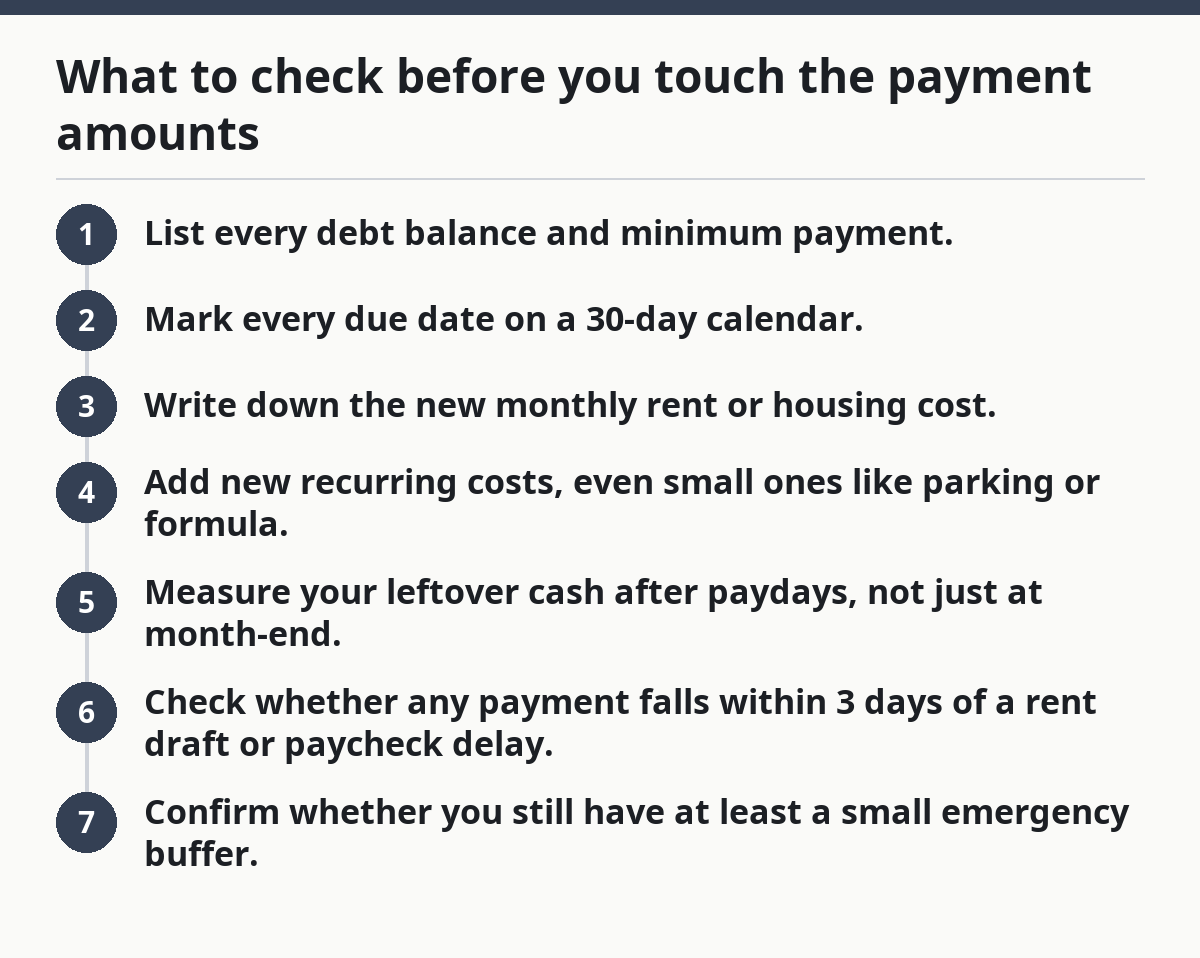
What to check before you touch the payment amounts
You do not need a new spreadsheet from scratch, but you do need a fresh snapshot. The following check helps keep you from cutting the wrong line item on the debt plan.
- List every debt balance and minimum payment.
- Mark every due date on a 30-day calendar.
- Write down the new monthly rent or housing cost.
- Add new recurring costs, even small ones like parking or formula.
- Measure your leftover cash after paydays, not just at month-end.
- Check whether any payment falls within 3 days of a rent draft or paycheck delay.
- Confirm whether you still have at least a small emergency buffer.
If any payment date now lands too close to a low-balance day, that is a problem. The fix is usually date shifting, not skipping the debt plan.
How do you keep the debt plan working step by step?
You keep it working by changing the order of operations: protect minimum payments, reset the budget, then rebuild extra payments only after the new monthly numbers make sense. A debt payoff plan that ignores the new cash flow will usually break in the second or third month.
Picture this: you are looking at a new apartment lease, a new grocery bill, or a spouse’s income combined with yours, and you need a plan that fits the new shape of the month. The answer is a short, practical reset.
- Freeze the old extra-payment amount for 1 month. Stop assuming last month’s surplus still exists. Verify the new surplus after rent, groceries, transport, and child costs are paid. If the surplus is negative, the plan is already overextended.
- Protect every minimum payment first. Set these to auto-pay or calendar reminders before any extra principal. Verify each due date is covered 5 to 7 days early. If any account risks a late payment, the plan needs simplification, not more ambition.
- Build a fresh monthly budget. Use one month of real numbers, not a guess. Verify fixed costs, variable costs, and debt payments against actual bank activity. If a category is missing—daycare, movers, extra fuel—your budget is incomplete.
- Choose one payoff method for the new season. Keep the debt avalanche or debt snowball structure, but only if the payment size still fits. The avalanche pays highest interest first; the snowball pays smallest balance first. If the chosen method now depends on money you do not have, the structure is the wrong size.
- Reset the emergency fund target. Even a small buffer matters after a move or family change. Verify that you have enough to avoid using a card for every surprise. If every small shock hits debt payments, the buffer is too thin.
- Shift due dates if the calendar is crowded. Ask creditors whether payment dates can be moved closer to payday. Verify that rent, utilities, and debt do not all land in the same 48-hour window. If they do, missed timing—not lack of effort—is the problem.
- Change the extra payment amount only after the first full new month. Wait until you see the new spending pattern in real time. Verify that the new number still leaves room for food, gas, and one small surprise. If it does not, lower the extra payment before the account drains.
- Review after 30 days. Compare the budget to the actual bank balance and adjust again. If the plan only works on paper, it is not a working plan.
The best part of a reset is that small changes can keep momentum alive. A debt payoff plan does not need to be aggressive to be effective; it needs to be paid on time.
What a good reset looks like
A good reset is usually boring in the best way. Minimum payments go out automatically, the budget matches the new life, and the extra payment is smaller than before but still real.
Here is the tell: if the next 2 pay cycles pass without a missed minimum, the reset is working. If every cycle feels like a rescue, the plan needs another edit.
- Fewer money surprises.
- One calendar for all bills.
- A clear extra-payment number.
- A buffer that stays untouched unless the month truly changes.
What should change after a major expense shift?
Your extra debt payment should change before your minimum payments do, and the emergency fund should change before you touch those minimums. A major expense shift usually means housing, childcare, transportation, or household size changed enough to alter the monthly math.
Picture this: you just married and merged households, or you moved and now your commute is longer. The life event may look personal, but the budget effect is mechanical.
On the flip side, some changes look huge and do not require a full debt overhaul. If your income stayed the same and the new cost is one-time, you may only need a one-month pause on extra principal, not a new long-term plan.
Use this test:
- Permanent expense increase: lower the monthly extra payment.
- One-time cost: use the emergency fund or a planned sinking fund.
- Income timing change: move payment dates if possible.
- New shared household: assign one bill owner per due date.
A sinking fund is money set aside for a known cost that is not monthly. That can be a move, a wedding, or baby gear. If you do not have one, build one before you ask debt payments to absorb the hit.
The mistakes people make after a life change
The biggest mistake is trying to keep the old extra-payment number untouched. That usually causes a bounced transfer, a late payment, or a drained checking account, and then the whole plan loses trust.
Picture this: you keep sending the same extra $150 every month after rent jumps or daycare starts, and by the third week you are moving money around just to cover groceries. That is not discipline. It is a budget mismatch.
Common errors and what they cost:
- Keeping the old budget: the result is hidden shortfalls. The fix is a fresh monthly expense list.
- Skipping the emergency fund: the result is using debt again for every small shock. The fix is a small buffer before extra principal.
- Changing too many things at once: the result is not knowing what broke. The fix is to adjust one category at a time.
- Ignoring due dates: the result is a late fee or missed payment risk. The fix is a calendar, not memory.
- Treating a one-time cost like a permanent one: the result is overcutting the budget for months. The fix is a separate sinking fund, and if the timing is unclear, consult a qualified adviser before making a long-term cut.
The truth is, a debt payoff plan can survive a life change only if it stays readable. If you cannot explain where the money goes in 30 seconds, the plan is too messy.
When the standard approach does not apply
The standard approach stops working if the new life change made your monthly cash flow too tight for minimum payments, or if the payment schedule now collides with rent and basic living costs. That means the issue is no longer optimization; it is fit.
Picture this: you have a new baby, a higher rent, and a changed pay schedule all at once. The plan that used to work may now be too rigid.
Minimum payments no longer fit the month: this means the budget is out of balance — simplify the plan and review spending before adding extra debt payments.
Paydays moved later in the month: this means timing, not effort, is the issue — ask for due-date shifts and align bills with income.
New household costs are recurring: this means the change is permanent — lower the old extra-payment target and rebuild around the new base.
Your emergency fund is gone: this means one surprise can knock the whole plan off track — pause extra payments until a small buffer is rebuilt.
You are mixing old and new money habits: this means the plan is unclear — start one household budget with one set of bill owners and one review date.
If the situation is more complex than a standard monthly reset, a qualified financial adviser can help you sort the moving parts for your own circumstances. This article is information, not financial advice.
How long does a reset take?
A workable reset usually takes one billing cycle to set up and 30 days to confirm. The actual time depends on how many bills changed, whether your income timing shifted, and whether your payment dates can be moved.
Picture this: you have 3 bills, 1 new cost, and a paycheck that lands a week later than before. You do not need months of planning to get back on track; you need one clean month of attention.
A realistic reset often includes:
- 1 evening to list current costs.
- 1 call or online request to shift due dates.
- 1 updated budget for the next 30 days.
- 1 review at the end of the month.
A good result is not “I paid more than ever.” A good result is “I paid every minimum on time, knew my extra payment number, and did not raid the emergency fund for a normal bill.” That is how a debt payoff plan survives a major life change.
How do I restart debt payoff after a life change?
You restart by rebuilding the budget around the new life, not by forcing the old extra-payment amount to work. First protect minimum payments, then set a fresh monthly extra amount that fits the new income and costs. If the change is permanent, adjust the plan for the next 30 days and review it again after one full billing cycle.
What should I change after a major expense shift?
Change the categories that moved, not the entire debt plan at once. Update housing, childcare, transport, groceries, and any new recurring bill first, then see what extra payment is still left. If the expense is one-time, use a sinking fund or emergency fund instead of shrinking the debt plan for months.
How do I protect debt progress during transitions?
Protect the payment dates, the minimums, and one small cash buffer. Keep due dates away from rent and payday gaps, and avoid using the extra-payment amount until the new month proves it fits. A 30-day review helps catch problems before they turn into missed payments.
Drafted with AI; not yet reviewed by a person.