
Last updated: November 18, 2026
Debt payoff tools and trackers help you see the debt, choose a payoff method, and stay on schedule without guessing. This guide to Debt Payoff Tools and Trackers: Complete Guide explains how the right tool matches how you think, how often your balances change, and whether you need automation or a simple scoreboard. This is information, not financial advice, and a qualified adviser should be consulted for your own situation.
Key takeaways
- The payoff tool that works best is usually the one you will keep updating for months.
- A calculator helps you choose a strategy; a tracker helps you follow it.
- If your balances or rates change often, flexible tools beat rigid spreadsheets.
- If you want a lower-friction system, a basic app or template is usually enough.
- If your debt picture is complicated, a licensed credit counsellor or financial adviser may be the better next step.
- No tool fixes a cash-flow problem by itself; it only makes the plan visible.
What a debt payoff tool actually does
A debt payoff tool turns a pile of balances into a plan you can act on. It usually does one or more of four jobs: lists debts, calculates payoff order, projects interest over time, and tracks payments against a target date. Some tools are just calculators. Others are trackers with reminders. A few combine both.
That difference matters because people often buy the wrong thing. A calculator answers, “If I pay $X extra each month, how long will this take?” A tracker answers, “Did I actually make the payment, and what remains?” A full payoff tool tries to do both. For many users, that is overkill.
The simplest tool that still answers your main question is usually the best place to start. If the question is “Which debt should I attack first?” a payoff calculator is enough. If the question is “Will I stay on track for the next 18 months?” a tracker matters more. If the question is “What happens if I make irregular extra payments?” then a flexible spreadsheet or a calculator with custom payment fields is usually the cleanest fit.
The main methods these tools support are the debt avalanche and debt snowball. Avalanche usually means paying the highest interest rate first; snowball usually means paying the smallest balance first. A good tool should let you compare both, because the better emotional plan is not always the lowest-interest plan. That is a trade-off, not a flaw.
One source worth checking for plain-language debt guidance is the U.S. Consumer Financial Protection Bureau’s debt collection and credit counseling pages, and the UK MoneyHelper site for debt help and budgeting. The CFPB explains debt collection rights and credit counseling options, while MoneyHelper offers debt advice and budgeting guidance. Neither replaces personal advice, but both are useful for definitions and next steps.
For related budgeting context, see how to build a monthly budget and how to prioritize bills.
How to choose the right type of tool

The right tool depends on how messy your debt is and how much manual work you will tolerate. If you have two or three debts, fixed due dates, and a steady extra-payment amount, a spreadsheet or basic calculator is usually enough. If you have many accounts, variable APRs, promotional periods, or irregular payments, a dedicated tracker saves time.
Here is the practical split:
- Simple calculator: Best when you want one decision, fast. It tells you payoff order, total interest, or payoff date. It is weak at long-term tracking.
- Spreadsheet tracker: Best when you want control. You can model extra payments, balance changes, and payoff scenarios. It is only good if you will keep it updated.
- App-based tracker: Best when you want reminders and automatic visual progress. It often reduces friction, but you may trade away customization.
- Debt-management worksheet or printable chart: Best when you want a low-tech, visible plan. It is useful for people who think better on paper or who want a shared household system.
- Counsellor or adviser workflow: Best when the problem is not organization but overload. If minimum payments are already strained, a tool may not be enough on its own.
A generic article usually misses the biggest point: debt payoff tools are not interchangeable. A person with a single credit card and a student loan does not need the same system as someone with five revolving accounts and changing minimums. The tool should fit the complexity of the debt, not the other way around.
If you need one rule of thumb, use this: choose the least complex tool that still shows your total debt, minimum payments, extra payment plan, and expected payoff order. Anything above that should earn its keep by saving time, not by looking polished.
For a step-by-step framework, see how to create a debt snowball and how to compare debt avalanche vs snowball.
Debt payoff calculator vs tracker: what changes in practice?
A calculator answers the planning question; a tracker answers the behavior question. That is the real difference, and it changes which one is useful on day one.
A payoff calculator is strongest when you are still deciding between strategies. It can show how changing an extra payment affects payoff time, or how interest accumulates when balances stay high. Many calculators also let you compare avalanche versus snowball. That makes them ideal before you commit to a method.
A tracker is stronger after the decision is made. It records payment dates, balances, progress bars, and sometimes reminders or alerts. It helps prevent drift: the missed transfer, the forgotten due date, the “I’ll update it next weekend” problem. For a household juggling rent, bills, and debt, that discipline matters more than a perfect model.
The weakness of calculators is that they can create a false sense of precision. Real life rarely follows a perfect monthly schedule. You might get a bonus one month, face a car repair the next, or shift money between debts. A calculator that assumes fixed inputs will look neat and be wrong fast.
The weakness of trackers is that they can become a chore. If logging every payment takes too long, the system breaks. That is why many people quit spreadsheet trackers after the first few months. The tool is fine; the upkeep is the problem.
A strong compromise is a tracker with a calculator built in, or a spreadsheet with separate tabs for “plan” and “actual.” That way the forecast and the reality live in the same place. If the tool cannot do both, keep the forecast in one place and the live record in another only if you are disciplined enough to maintain both.
For more on payment timing and credit reporting, the Consumer Financial Protection Bureau and MoneyHelper are useful reference points.
The honest side-by-side

The tool that wins here depends on whether you need flexibility or speed. A spreadsheet is better for customization and irregular debt; an app is better for simple progress and routine updates.
| Criteria | Spreadsheet tracker | App-based payoff tracker | Winner for condition |
|---|---|---|---|
| Custom payment schedules | Strong; can model odd dates and variable amounts | Usually limited to preset patterns | Spreadsheet for irregular income |
| Setup time | Slower, especially if you build formulas | Faster, often guided by templates | App for quick start |
| Ongoing upkeep | Manual updates required | Often easier to maintain | App for busy users |
| Flexibility for multiple debts | High if you know formulas | Moderate; depends on app design | Spreadsheet for complex debt stacks |
| Visual motivation | Can be built, but you must create it | Usually built in with charts and milestones | App for motivation |
| Error risk | Higher if formulas are wrong | Lower if the app is well designed | App for users who dislike manual math |
| Privacy/control | More control if stored locally | Depends on app permissions and data policy | Spreadsheet for privacy-conscious users |
| Sharing with a partner | Good if both can edit carefully | Good if the app supports shared access | Either, depending on household habits |
| Scenario planning | Excellent if you can edit assumptions | Good only if the app includes scenario tools | Spreadsheet for “what if” planning |
| Reminders/alerts | Weak unless you add them yourself | Strong in many apps | App for reminder-driven users |
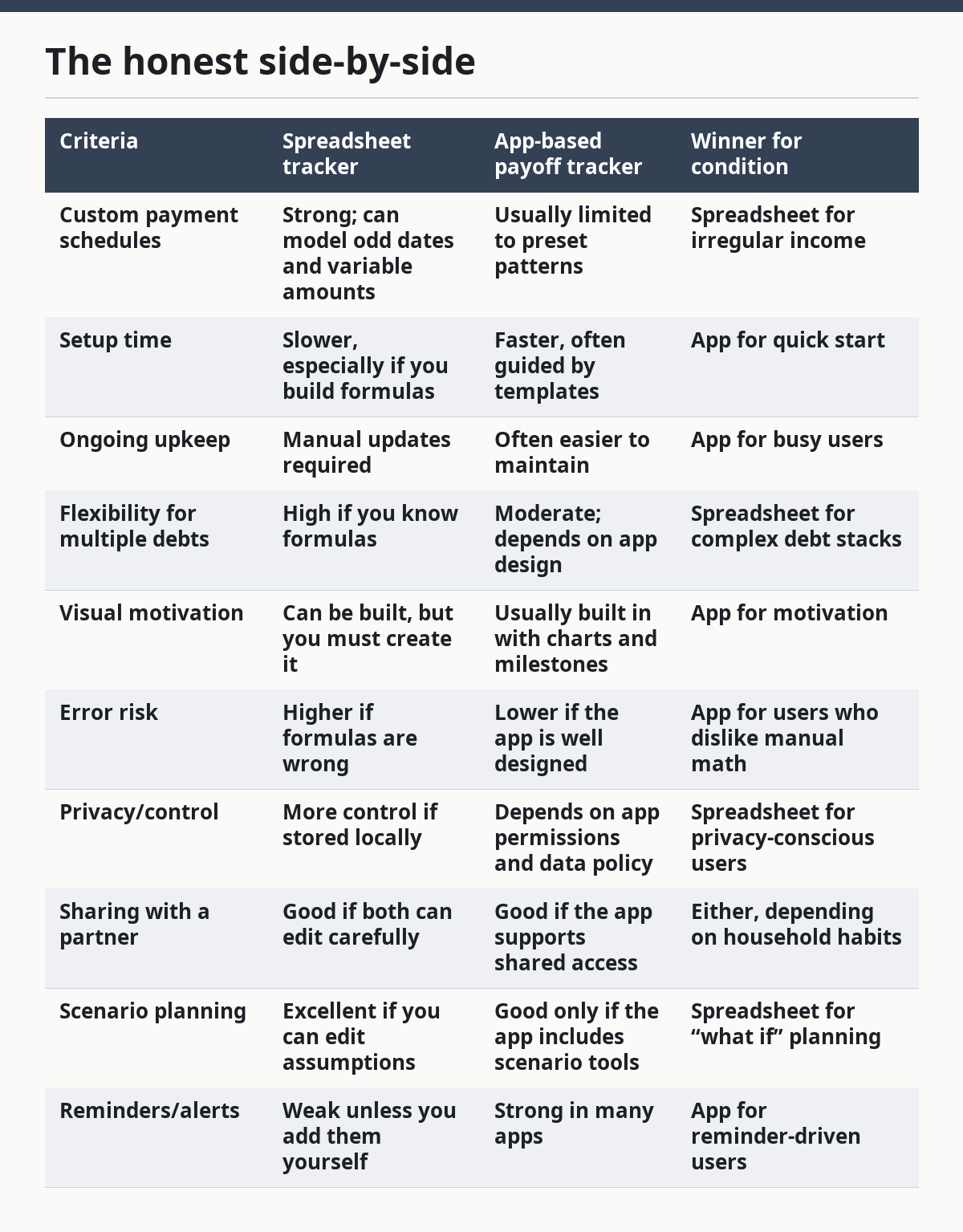
The table is blunt on purpose: spreadsheets win on control, apps win on convenience. That is the whole trade-off. If your debt picture is simple, the convenience of an app usually matters more than the modeling power of a spreadsheet. If your situation changes often, the spreadsheet’s flexibility is worth the extra effort.
A common mistake is choosing a spreadsheet because it feels more serious. Serious is not the same as useful. A badly maintained spreadsheet is just abandoned homework in tab form. A simple app that gets updated every week is more effective than a beautiful model that never gets opened.
For a broader comparison of budgeting tools, see budgeting apps vs spreadsheets.
Spreadsheet trackers: who should actually use them
A spreadsheet wins for people who want full control and are willing to do the upkeep. It is the strongest choice when debt details change, when you want to test multiple payoff scenarios, or when you need a shared household dashboard.
The big strength of a spreadsheet is transparency. You can see every assumption: balance, APR, minimum payment, extra payment, payoff month, and total interest estimate. If a lender changes a rate or a balance moves after a payment posts, you can fix the sheet yourself. That matters when your debt is not static.
A spreadsheet also handles edge cases better than many apps. You can model a one-time lump sum, split extra payments across debts, or change the order halfway through the year. If you are using a debt avalanche approach and want to compare it with a snowball variant, a spreadsheet makes that comparison visible without forcing you into a single app’s logic.
The drawback is simple: manual work. If you hate updating cells, the tool will decay. A formula error can also mislead you, especially if you copy a template without understanding it. A tracker that looks precise but hides a broken formula is worse than a blank page.
This is not the right tool for someone who wants the system to remind them automatically or for someone who is already overwhelmed by money tasks. It is also a poor fit if you only need a quick answer and do not want to manage data. If your main problem is consistency, not analysis, a spreadsheet may ask more of you than it gives back.
If the reader likes detail and tolerates maintenance, though, spreadsheet trackers are the most adaptable debt payoff tool available. They are especially useful when the debt story is complicated enough that a generic app cannot express it clearly.
If you are building one from scratch, a debt payoff spreadsheet template can save setup time.
App-based payoff trackers: who should actually use them
An app-based tracker wins for people who want the plan to stay visible without much manual labor. It is the better choice when motivation, reminders, and progress visuals matter more than fine-grained scenario building.
The main advantage is friction reduction. Open the app, enter the debt, set a target, and keep moving. Many apps include charts, payoff timelines, and reminders that make progress feel tangible. That matters because debt payoff is partly a math problem and partly a follow-through problem. The app handles the follow-through better than a static sheet for many users.
Apps also reduce the “I will update it later” trap. If payment tracking lives on your phone, the odds of checking it are higher than if the same information is buried in a file you need to open on a laptop. Some apps also make it easier to share progress with a spouse or partner, which helps in households that coordinate bills together.
The downside is that apps often simplify the debt picture. They may not model unusual payment timing, rate changes, or nuanced category splits as well as a spreadsheet. Some also depend on a subscription, account creation, or data permissions that a cautious user may dislike. If the app’s design does not match your payoff method, you may end up forcing your plan into the software instead of the other way around.
This is not the best option for a person who wants complete control over every assumption. It is also not ideal if you are uncomfortable linking financial data to a third-party service, or if you need a highly customized model for variable income, promotional APRs, or multiple payoff priorities.
A good app tracker is the right choice when the main obstacle is consistency, not complexity. If you are more likely to use a tool that nags you than a tool that lets you build formulas, the app is the better fit.
For app-based planning, consumer finance advice from the CFPB can help you interpret your options.
When should you pick a calculator instead of a tracker?
A calculator is the better first step when you still need the plan, not the habit. If you have not decided between snowball and avalanche, or if you are trying to estimate payoff dates before committing money, a calculator gives the cleanest answer.
A calculator is also the right tool when your debt is stable enough that you do not need a running dashboard. If your balances are fixed, your payment dates are routine, and you only want to know what an extra $50 or $100 does to the payoff timeline, the calculator does the job with less clutter.
This matters because many people jump straight into tracking before deciding how to pay the debt down. That can waste time. A tool that tracks five debts beautifully is still the wrong tool if you have not chosen the order of attack. Use the calculator to answer the “what if” question first, then move to tracking.
The weakness is obvious: a calculator is not a maintenance tool. Once the plan starts, it will not keep you honest unless you pair it with a separate reminder system or a tracker. That makes it less useful for long campaigns that last 12 months or more, especially if your balances shift.
A calculator is also a poor choice if you need accountability. If you already know the plan but keep missing due dates, a calculator adds information you already have. In that case, the problem is behavioral, and the tool should reflect that.
So the rule is simple: use a calculator to choose the path, not to walk it. If the debt payoff question is still “What should I do?”, a calculator fits. If the question has become “Did I do it?”, you need a tracker.
For definitions of payoff order and interest basics, the UK MoneyHelper debt guidance is a reliable reference.
Exception scenarios that flip the verdict
The normal verdict changes in a few specific cases. Those exceptions are where generic advice breaks, so they deserve direct treatment and, where needed, a consultation with a qualified professional.
-
Your income is irregular. A spreadsheet can beat an app here because you may need to model months with higher or lower payments. If your cash flow changes from month to month, rigid app logic can hide the real plan.
-
You share finances with a partner. An app can win if both people will actually open it. Shared visibility often matters more than advanced modeling, especially when one person is the primary bill-payer.
-
Your debt balance changes often because of floating rates or transfers. A tracker with editable assumptions is better than a fixed calculator. If APRs change or you move balances between cards, you need a system that does not collapse when the inputs shift.
-
You are overwhelmed and need the simplest possible start. A basic calculator or a one-page worksheet can beat both spreadsheets and apps. In that situation, the tool you will use this week is better than the one that looks smartest on paper.
These exceptions matter because debt payoff tools are only helpful if they match the user’s life. A person with a stable salary, three accounts, and no appetite for spreadsheets may do better with a plain app. A freelancer with variable income and six debts may need a custom sheet. The right answer changes when the inputs change.
If a tool creates more stress than clarity, it is the wrong tool, even if the reviews are good or the features look impressive. The best payoff system is the one that fits the shape of the debt and the shape of the person managing it.
For complex cases, the Consumer Financial Protection Bureau and a licensed debt adviser can help you evaluate the next step.
Which debt payoff tool should you choose?
Choose a spreadsheet tracker if you have irregular payments, multiple debts, or a need to compare payoff scenarios in detail. Choose an app-based tracker if you want reminders, visual progress, and the least manual upkeep. Neither if you are already behind on minimum payments and need personal debt advice, hardship support, or a structured plan from a qualified adviser.
That is the cleanest call. Spreadsheet first for complexity; app first for consistency. A calculator sits one step earlier in the process and is best for deciding strategy, not running the campaign.
If the debt is simple and the problem is motivation, pick the app. If the debt is messy and the problem is strategy, pick the spreadsheet. If you are not yet sure which debt method to use, start with a calculator and then move into whichever tracker matches your life.
The wrong move is to collect tools instead of making decisions. You do not need five dashboards. You need one system that shows the next payment, the next target, and the next milestone.
For more practical setup help, see how to automate bill reminders and how to review credit card statements.
What mistakes make debt trackers fail?
Debt trackers usually fail because they become too complicated, too manual, or too disconnected from real payments. If a tracker takes 15 minutes to update after every paycheck, many people will stop using it. If it does not reflect actual balances, the numbers lose meaning. If it hides the payoff order, it becomes decoration.
Another common mistake is tracking without a goal. A balance list is not a payoff system unless it includes priority order, due dates, and a method for extra payments. People often create a nice-looking sheet and still have no decision rule. That is not tracking; it is note-taking.
A third mistake is forgetting to update after a balance transfer, fee, or rate change. Debt payoff tools depend on current data. A stale APR or an outdated minimum payment can distort the timeline enough to make the plan misleading.
The fix is not more features. It is fewer moving parts. Keep the tracker close to your payment routine, use the same review day each month, and store only the fields that change the decision: balance, minimum, rate, extra payment, due date, and payoff target. If a field does not change what you do next, it probably does not belong in the core tracker.
The most effective debt payoff tool is the one that helps you act this month, then again next month. That is the standard that matters.
Drafted with AI; not yet reviewed by a person.