Last updated: November 19, 2026
Quick answer: if you have your minimum payments covered, a well-directed extra payment can reduce principal immediately and shorten the payoff timeline. This guide on how to pay off debt faster with extra money shows where that extra should go, how to label it, and when to avoid sending it at all. In practice, the first extra dollar is most useful when it reaches the right account, posts before interest is calculated, and is applied to principal rather than a future bill.
Key Takeaways
- Extra payments cut the balance that future interest is charged on, speeding payoff.
- Send the extra as principal reduction while keeping every minimum payment current.
- The best target is the debt where cost, rules, and timing make the extra dollar work hardest.
- Extra payments fail when the money posts but the instructions are unclear.
This is information, not financial advice. Debt rules, interest charges, and consumer protections vary by country and can change, so a qualified adviser should be consulted for your own situation.
Who this applies to, and what you need in place

This applies to someone who already keeps current on at least the minimum payment and has a little extra money from a tax refund, work bonus, side hustle income, or a monthly budget surplus. It assumes you know your creditor names, balances, interest rates, due dates, and whether any debt has a prepayment fee or penalty. If you do not have those basics, extra payments can still help, but they are easier to misdirect.
The primary idea is simple: a debt payment has two parts. The minimum payment keeps the account current; the extra payment reduces principal, which is the amount you actually owe before interest is added. Principal reduction is what shortens the life of the debt. The part many people miss is that a payment can be misapplied if the lender does not know it is extra. On some accounts, an unspecified overpayment may simply advance the next due date instead of cutting principal right away.
I am not covering how to build a full debt payoff plan here, and I am not covering collections. Those are separate questions. This page is for the person who already knows, “I have extra money — where does it go so it does the most work?”
A good fit is also someone who can leave a small cash buffer untouched. Even an extra $100 is useful, but not if it empties the checking account and causes an overdraft fee or a late payment next month. If your budget is tight enough that one surprise car repair would force a missed payment, this approach needs a cushion first.
What extra debt payments do to principal
Extra debt payments reduce the balance that future interest is charged on, and that is the main reason they speed up payoff. Most consumer debts accrue interest on the outstanding principal, often daily or monthly depending on the contract. When the balance is lower, the next interest charge is lower too. That is the compounding effect people want to interrupt.
The mechanism matters more than the label on the payment. A lender may treat an “extra payment,” an “additional principal payment,” or a “principal-only payment” differently, so if the terms are unclear, check the account instructions or ask the lender before you send money. Those words are not interchangeable in every contract. Before you send money, check the account terms or payment instructions and look for any guidance on how to direct extra funds. If the lender has a specific box for principal-only payments, use it.
The biggest payoff impact usually comes from applying extra money to the balance with the highest interest cost or the harshest penalty for carrying a balance, but that is only part of the picture. Timing matters too. An extra payment sent early in the billing cycle usually reduces interest more than the same amount sent after the statement closes, because the balance spends fewer days at the higher amount. On some loans, even a 7-day difference can change how much interest accrues for that cycle.
Not every debt reacts the same way. Credit cards, installment loans, auto loans, student loans, and mortgages can all handle extra payments differently. Some have no prepayment penalty; some do. Some accept extra principal payments online; others require a note or phone call. If you want the extra money to shorten the term, not just sit in limbo, make the payment instructions part of the decision.
For a broader sequence that connects this step to the rest of the process, the hub on debt payoff plan should sit alongside this page, not replace it. For related budgeting guidance, see how to create a debt payoff plan, debt snowball vs avalanche, and how to build an emergency fund.
How should extra money be applied?

Extra money should be applied to the target debt in a way that leaves the minimum payment intact and clearly marks the rest as principal reduction. That is the cleanest way to make one extra dollar do the job of several future dollars.
Use this sequence:
- Confirm the minimum payment is already covered for the month. Pay the full minimum on every active account first, before sending any extra. Verify the due date and the posted amount on the statement or app. If the extra payment would leave one account short, the problem is not strategy; it is cash flow.
- Pick one debt to target with the extra payment. Choose a specific account, not “debt in general.” Verify the current balance, interest rate, and whether the lender allows principal-only payments. If the account terms are unclear, the extra may be applied in the wrong way.
- Time the payment before the statement cut-off if possible. Send the extra amount 3 to 7 days before the statement closes or before interest is calculated, if the lender’s system allows it. Verify the payment posting date, not just the send date. If the posting date slips past the cycle, the interest savings can be smaller than expected.
- Specify how the lender should apply it. Use the payment portal’s “principal only,” “additional principal,” or similar field, or follow the lender’s written instructions. Verify the confirmation screen or receipt says the amount will reduce principal. If the system shows the payment as a future installment or unapplied funds, stop and correct it.
- Keep the minimum payment on autopay if you can do so safely. Automatic minimums reduce the risk of a missed payment while manual extra payments handle the surplus. Verify that autopay pulls only the minimum or scheduled amount, not the extra. If the extra is included by mistake, you may lose flexibility in a tight month.
- Apply lump sums as soon as they are available. A tax refund or work bonus does not help while it sits in a checking account for 6 weeks. Verify the extra payment clears and posts to principal. If you are waiting for a “better” month, the debt keeps charging interest in the meantime.
- Check the next statement for misapplied funds. Confirm the principal dropped by the amount you expected, minus any interest or fee that still applies. If the statement shows a lower payment due next month but the balance barely changed, the lender may have advanced the due date instead of reducing principal.
- Repeat the process on the same account until it is gone or until your priorities change. Consistency matters more than size. Verify each payment posting and balance change. If you keep switching targets without a reason, progress becomes hard to track and easy to abandon.
The whole point is control. A $200 extra payment can shave months off a payoff if it lands correctly; the same $200 can be nearly useless if the lender applies it as a holding credit, a future payment, or a payment made after interest has already been calculated.
Where should extra money go first?
Extra money should go first to the debt where the combination of cost, rules, and timing gives the biggest payoff impact. That is usually the account with the highest interest rate, the one that compounds most frequently, or the one that is closest to a costly penalty threshold.
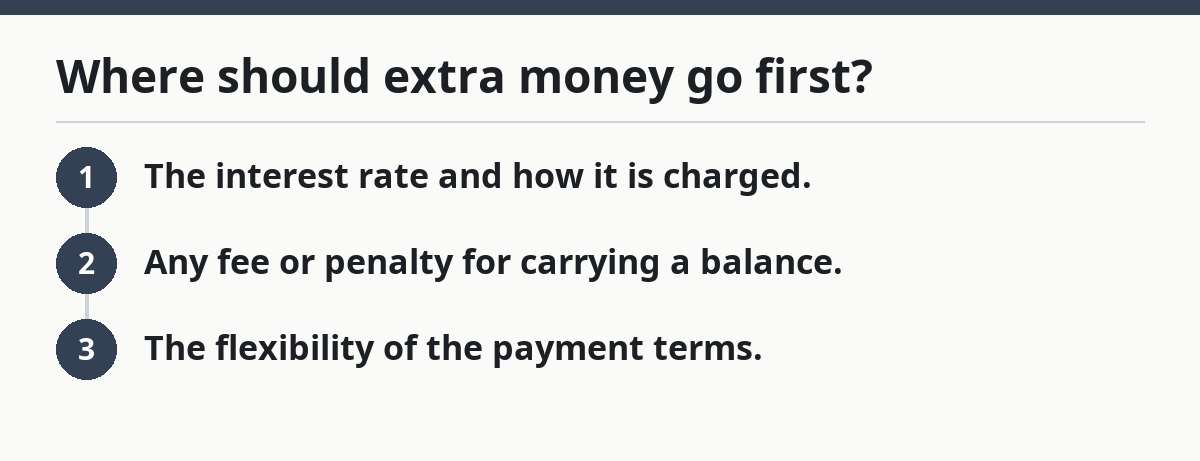
If you have multiple debts, compare three things before sending the extra:
- The interest rate and how it is charged.
- Any fee or penalty for carrying a balance.
- The flexibility of the payment terms.
A credit card with a high variable rate often absorbs extra money efficiently because the balance is typically sensitive to timing. An installment loan with a fixed schedule may still benefit, but the lender may recalculate less often. A mortgage or auto loan may allow principal-only extra payments, yet the paperwork can be stricter. The best destination is the one where your next dollar has the clearest effect on principal.
Do not ignore non-interest costs. If one account has a late fee risk or a penalty interest clause, getting current there may matter more than shaving a few dollars off a lower-rate debt. The same is true if a lender has a minimum balance requirement to avoid a fee. A lower interest rate is not always the best place for extra money when a fee is waiting.
A simple rule helps: after the minimums are handled, point extra money at the debt that is both expensive and easy to pay down early. If two debts look similar, use the one with the clearer principal-only option or the one that posts faster.
What mistakes turn extra payments into wasted effort?
Extra payments fail when the payment is real but the instructions are sloppy. The most common mistakes are procedural, not mathematical.
1. Sending extra without marking it as principal-only.
Consequence: the lender may apply it to a future due date instead of the balance, which weakens the interest benefit. Correct alternative: use the lender’s principal-only field or follow written payment instructions.
2. Skipping the minimum payment on another account.
Consequence: one late fee or penalty can wipe out the advantage of the extra payment. Correct alternative: cover every minimum first, then send surplus to the target debt.
3. Making the extra payment after the statement closes.
Consequence: the balance may have already been used to calculate that cycle’s interest. Correct alternative: send the payment earlier in the billing period, ideally several days before the cutoff.
4. Paying extra while keeping no cash buffer.
Consequence: a small emergency can force a missed payment next month, which is far more expensive than the extra helped. Correct alternative: keep enough cash to avoid overdrafts and at least the next minimum payment.
5. Splitting small extras across too many debts.
Consequence: the balance barely moves anywhere, so the psychological payoff is weak and the administrative work rises. Correct alternative: direct the extra to one account at a time until it is meaningfully reduced.
6. Ignoring account terms that limit prepayment.
Consequence: if a prepayment fee applies under the contract, it can cut into the benefit of the extra payment. Correct alternative: read the loan terms or ask the lender how extra payments are handled before you send money.
The pattern is the same in every case: the dollar is useful only if it reaches principal, posts on time, and does not create a new problem elsewhere.
When extra payments are the wrong tool
Extra payments are the wrong tool when they threaten your basic stability, conflict with a contract, or miss a larger risk. In those cases, the issue is not motivation; it is fit.
You cannot reliably cover every minimum payment: Extra payments do not fix a cash-flow gap — they can make it worse if they leave you short. Use the extra money to stay current, not to chase speed.
The account has a prepayment fee or a special payoff clause: The lender may charge for early repayment or treat the payment in a narrow way, so check the contract first or ask for written instructions before sending extra.
The payment portal cannot direct funds to principal: If the system only advances the due date, the extra may not reduce interest the way you expect. Use the lender’s documented process or wait until you can confirm how it will post.
You have no emergency cushion at all: A full extra payment that empties the account can trigger overdrafts or missed bills — keep a small reserve before speeding up payoff.
Your highest-risk debt is already in default or collections: Extra payment strategy here is not the same as ordinary payoff sequencing — this page is not the right guide, and the account may need different handling.
Another financial issue is more urgent than interest savings: If you are behind on rent, facing a tax bill, or at risk of losing utilities, extra debt payments may be the wrong priority. Stop and address the immediate risk first.
These are not moral failures. They are signs that a different tool is needed.
How to use windfalls without losing the benefit
Windfalls should be directed quickly and deliberately, because idle money loses value while debt keeps accruing interest. A tax refund, work bonus, inheritance, insurance payout, or side hustle income can all work as extra debt payments if the money is separated before it gets absorbed by everyday spending.
The first move is to decide the job of the windfall before it lands. If the full amount is going to debt, write the target account down. If part of it must stay liquid for taxes or upcoming bills, split it in advance so you do not accidentally overcommit. Tax rules vary by country, and some bonuses are not as large after withholding, so do not promise the debt more than actually arrives.
A windfall should usually be paid in one lump sum as soon as the funds clear, not stretched across months unless your lender’s process or your cash flow requires it. The benefit of a lump sum is that it shortens the time interest accrues on that amount. A side hustle that brings in $150 this month and $150 next month is still useful, but the sooner each piece posts, the sooner principal falls.
There is one honest trade-off: a windfall used for debt is not available for a repair, a move, or a medical bill. That is why the right answer depends on what else is waiting. If you have no buffer and no near-term expenses, extra debt payments make sense. If the money is likely to be needed for something unavoidable within 30 days, hold it instead of sending it all to principal.
For current rates, tax treatment, and consumer protections, check the rules that apply where you live. In the United States, for example, the Consumer Financial Protection Bureau explains how payments are often applied; the Federal Trade Commission also has consumer guidance on debt and credit. For more background, see the CFPB’s debt collection guidance and the FTC’s credit and debt advice.
How do I know it is working?
It is working when the balance falls faster than scheduled and the statement shows less principal remaining after each extra payment. The goal is not a dramatic change in one month; it is a steady reduction in the amount on which future interest is charged.
A good sign is that your next statement shows the payment posted where you intended it to post. A better sign is that the balance drops by the extra amount minus any interest that still accrued before the payment posted.
Drafted with AI; not yet reviewed by a person.