Last updated: November 19, 2026
Key Takeaways
- Pay the most damaging bill first, then move down the list by due date and flexibility.
- Confirm the paycheck problem with payroll or your employer.
- Call creditors before the due date if there is a real chance you will miss a payment.
- Stop the short-term plan and get qualified help once it is no longer a one-paycheck gap.
A missed paycheck is a cash-flow problem, not a moral failure, and the fix is to protect the payments that trigger fees first. In short: pause nonessential spending, contact each creditor before the due date, and use a missed paycheck plan to cover minimum payment obligations until the deposit arrives. This guide on how to handle a missed or late paycheck without missing debt payments keeps the focus on timing, not blame.
This article is information, not financial advice. A qualified adviser should be consulted for your own situation, especially if you are already behind on several bills, have a court-ordered payment, or are facing a second missed paycheck. For general consumer guidance, see the CFPB’s pages on debt collection and loan servicing at consumerfinance.gov.
Who this applies to, and what you need first
This applies to anyone waiting on a late payroll deposit, dealing with an employer payroll delay, or trying to avoid a late fee on a credit card, loan, or other debt while normal income is temporarily interrupted. This missed paycheck and late paycheck guide assumes you already know your due dates, have access to your bank app or statements, and can contact creditors by phone, chat, or secure message. If you are unsure about your rights or the creditor’s process, consult a qualified professional and check the creditor’s written terms or a consumer-rights source such as the CFPB.
It is usually the right approach when the delay is short and you still expect the paycheck to arrive soon, even if the exact hour is unclear. It is not the right approach if your income has stopped entirely, if you are choosing between debt payments and essential living costs for more than a few days, or if a creditor has already begun collections on a secured debt or court-ordered obligation; in those cases, consult a qualified debt adviser, legal aid service, or consumer credit counselor and review guidance from the CFPB or Legal Services Corporation.
The main goal here is narrow: keep the account from aging into a late status while you buy time. That usually means protecting priority bills first, then keeping at least the minimum payment flowing on debts where a missed payment causes the fastest damage. A minimum payment is the smallest amount a creditor says is due to keep an account current. Autopay is the automatic withdrawal set up through your bank or creditor; it helps when income is steady, but it can overdraft an account when a paycheck is late.
For a broader framework on irregular income and debt timing, the hub on debt payoff and irregular income management can help once the immediate fire is out.
What should I pay first if my paycheck is late?
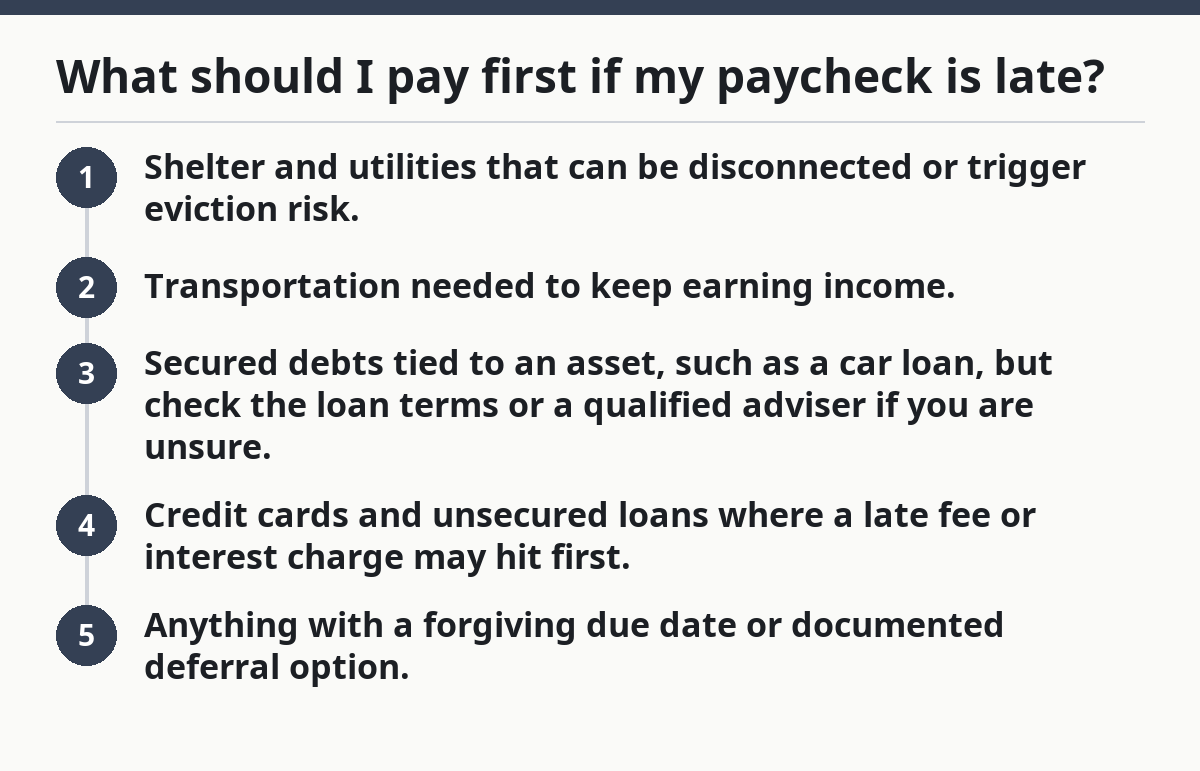
When your paycheck is late, pay the bill that causes the fastest penalty or the biggest real-world consequence first, then work down the list by due date and flexibility. Start with housing, utilities that can be shut off, transportation needed for work, and any debt payment that is close enough to hit a late fee or reported delinquency.
The reason is simple: not every bill reacts the same way to delay. A mortgage, rent, car payment, or credit card minimum may have different grace periods, late-fee rules, and reporting timelines. Those timelines vary by country, lender, and contract, so the bill itself matters more than a generic “most important” list. If you do not have the contract in front of you, use the creditor’s app or statements and look for phrases like “due date,” “grace period,” “late fee,” and “minimum payment.”
A practical priority order often looks like this:
- Shelter and utilities that can be disconnected or trigger eviction risk.
- Transportation needed to keep earning income.
- Secured debts tied to an asset, such as a car loan, but check the loan terms or a qualified adviser if you are unsure.
- Credit cards and unsecured loans where a late fee or interest charge may hit first.
- Anything with a forgiving due date or documented deferral option.
The correct result is not “everything paid on time no matter what.” The correct result is that the most damaging item stays current or gets an approved deferment. If you cannot tell which bill is most urgent, stop and call the creditor whose due date is closest to today. That call usually gives you the fastest answer.
How to handle a missed paycheck without missing debt payments, step by step
Follow a missed paycheck plan in this order: verify the delay, stop preventable cash leakage, protect priority bills, contact creditors, and set a temporary payment schedule before the due dates pass.
- Confirm the paycheck problem with payroll or your employer. Check the pay stub, direct deposit status, and payroll portal, then ask for the new deposit date in writing if possible. What worked: you have a named contact and a specific expected date or a statement that payroll is being corrected. What signals a problem: no one can tell you whether the pay is delayed, reversed, or misdirected, because that means the cash gap may last longer than a day.
- Freeze nonessential spending for 7 days. Pause subscriptions, delivery apps, dining out, and any discretionary card use until the paycheck lands. Verify that card balances stop moving and that no new charges are posting. A problem shows up if automatic renewals or impulse spending keep draining the same account you need for bills.
- List every payment due in the next 14 days. Write the creditor name, due date, minimum payment, and any stated late fee or grace period. Keep the list to one page or one phone note so you can scan it fast. The step worked if you can rank the bills in under 10 minutes. It is failing if you are guessing at dates or skipping bills because the paperwork is scattered.
- Separate priority bills from everything else. Mark only the bills that would create immediate hardship if missed: housing, utilities, transportation, and the smallest debt payment that would trigger the worst consequence. If a bill has a hardship line or payment assistance page, flag it. This step works when you can see a short “must pay” list, not a long wish list.
- Contact each creditor before the due date. Use phone, secure message, or the creditor’s online chat and say the payment will be late because of a payroll delay, then ask for a temporary extension, payment deferral, fee waiver, or due-date change. A deferral means the creditor lets you skip or move a payment for a set time. You know this worked when the representative gives a case number, confirms the arrangement, or places a note on the account. If the answer is only “pay what you can,” ask whether a partial payment keeps the account from being marked late.
- Protect autopay from overdrawing the account. If a linked checking account may not have enough funds, turn off or reduce autopay for the affected bill only, and replace it with a manual payment date that matches the corrected paycheck. Verify the change in the app or confirmation email. The warning sign is an autopay attempt that would bounce, because a returned payment can create fees on both sides.
- Move cash to the single account that will pay the highest-priority bill. Transfer available funds from less-used accounts, but leave enough to avoid NSF fees, where NSF means nonsufficient funds. If you can only fund one payment, send it to the bill with the shortest grace period or the largest penalty. The step worked if one account clearly covers one key payment. It is a problem if you spread tiny amounts across every bill and leave all of them short.
- Set a hard reminder for the new payment date. Put a calendar alert 24 hours before the creditor agreed deadline and another on the morning of the payment. Verify that the reminder includes the amount, the channel, and the confirmation number. If there is no written reminder, the arrangement is easy to forget and easy for the creditor to dispute.
- Recheck the account after the paycheck arrives. Confirm the deposit posted, then pay any bills that were deferred and restore normal autopay only after the balance can safely absorb it. The plan worked if no bill aged into a late status and no overdraft fee hit the account. If the paycheck is still missing after the promised date, move immediately to the “when to stop” section below.
A generic article often skips the exact order and tells people to “call someone” without saying whom, when, or what to ask for. That is too vague to prevent a late fee. The point is to create a temporary bridge, not a perfect budget. For step-by-step consumer guidance, the CFPB explains how to prioritize bills, avoid fees, and contact servicers.
Which bills can wait, and which cannot?
Bills with a short grace period, a flexible due date, or a hardship option can sometimes wait 24 to 72 hours, while bills tied to housing, transportation, or a creditor’s strict delinquency rules usually cannot. The exact timeline depends on the contract, the lender, and local law, so the right move is to look up each account’s terms instead of assuming every bill behaves the same way.
A useful test is this: if missing the payment would block you from earning income or keep you from sleeping indoors, it belongs near the top. If missing it only creates an interest charge or a modest late fee, it may rank lower than the bill that keeps you housed and working. That does not mean the lower-priority bill is unimportant; it means the timing is more flexible.
When two bills seem equally urgent, choose the one with the least forgiving creditor first. Some lenders offer a brief accommodation if you ask before the due date; others do not. Creditors are the parties you owe money to, and they are the ones who can approve a deferral, waive a fee, or refuse one. The earlier you call, the more options usually remain.
If you are unsure, ask each creditor three direct questions:
- Is there a grace period?
- Can I make a partial payment now and avoid being marked late?
- Can you place a note on the account while payroll is delayed?
If the answer to all three is no, move that bill higher on the list.
Should I call creditors if I might miss a payment?
Yes, call creditors before the due date if there is any real chance you will miss a payment. A same-day call after the due date is better than silence, but it gives you fewer options and less leverage.
The reason to call early is that many temporary solutions depend on timing. A payment deferral, hardship arrangement, due-date change, or fee waiver often has to be requested before the account becomes delinquent. Once a payment is late, the creditor may still help, but the late fee or reporting event may already be set in motion. That is why a 10-minute call can be worth more than an hour of account anxiety.
Use a script that stays factual:
- “My paycheck was delayed.”
- “I expect payment on [date].”
- “Can you offer a deferral, extension, or temporary reduced payment?”
- “Will this keep the account from being reported late?”
- “Can you give me a reference number or written confirmation?”
Keep the record. A note on your phone with the date, time, name, and outcome is enough to start, but a confirmation email or secure message is better. If the creditor refuses to help, do not argue for 20 minutes. Ask whether there is a hardship department, then move to the next account.
One trade-off matters here: calling may feel uncomfortable, but waiting often narrows the choices. If you know the paycheck is late by even one business day, call sooner rather than later.
When to stop and get qualified help
Stop using a short-term missed paycheck plan and get qualified help when the problem is no longer a one-paycheck gap. A financial counselor, debt adviser, bankruptcy attorney, or legal aid service may be needed when the situation has moved beyond temporary triage.
Specific situations that call for outside help:
- The paycheck is missing for more than one pay cycle: this suggests a payroll error, job loss, or serious employer issue — contact your payroll department, labor authority, or a qualified adviser.
- You cannot cover rent, utilities, and minimum debt payments at the same time: this means the budget gap is structural, not temporary — ask for hardship options and professional guidance.
- A creditor threatens repossession, eviction, wage garnishment, or legal action: this is no longer just a late-fee problem — get legal help quickly.
- Your account already shows repeated overdrafts or returned payments: this can snowball into multiple fees — stop autopay on the affected accounts and get a human review of the cash flow.
- You are deciding which bill to skip between child support, taxes, or court-ordered payments and ordinary consumer debt: these obligations can have very different consequences — speak to a qualified professional before acting.
- You are relying on high-cost borrowing to cover everyday bills for the third time or more: the gap may be too wide for a one-time fix — ask for a debt review and income-stabilizing plan.
This is where a generic internet checklist can do damage. The right answer may be a payment plan, a hardship program, a legal referral, or a formal restructuring option, depending on the debt type and your jurisdiction. Because rules differ by country and by creditor, do not assume one country’s timeline or legal remedy applies to you. For help finding local legal aid, see Legal Services Corporation at lsc.gov.
Common mistakes that turn a late paycheck into late fees
The most common mistake is paying the wrong bill first and letting a flexible account consume cash that was needed for a strict one. The result is avoidable late fees or a bounced payment on the bill with the least tolerance. The better alternative is to rank bills by penalty, due date, and consequence before paying anything.
Another mistake is trusting autopay when the checking balance is uncertain. That can trigger an overdraft fee, a returned-payment fee, or a missed payment on the creditor’s side. The fix is to pause the specific autopay that would bounce and switch to a manual payment only after the deposit clears.
A third mistake is calling after the due date and assuming the creditor will forgive everything. Some will help, but not all. The better move is to call before the due date and ask for a documented accommodation, such as a 1-payment deferral or a short extension.
A fourth mistake is spreading the available money across all debts. That often leaves every account short and none protected. Concentrate the cash on the highest-consequence bill first, then handle the rest after the paycheck posts.
A fifth mistake is ignoring small accounts because the balance is small. A small credit card minimum can still trigger a late fee or reporting issue, and that can be more expensive than the size of the payment suggests. Use the terms of the account to decide what matters, and check the creditor’s written policy or a consumer-rights source if the rules are unclear.
Drafted with AI; not yet reviewed by a person.