Last updated: November 19, 2026
Quick answer: a balance transfer fee is too high when it takes too large a share of the interest you would save before the intro APR ends, or when it is large relative to the debt you can actually move onto the card. A transfer can still make sense with a fee, but only if the numbers leave you ahead after the fee, the card’s transfer limit, and the introductory rate period are all counted.
Key Takeaways
- The up-front cost of moving debt to a balance transfer card is only worth it if the savings exceed it.
- A transfer fee is too high when fees and minimum payments leave little net benefit after the intro period.
- Judge the deal by break-even, not by the fee’s sticker price alone.
- Before you act, verify the transfer amount, promo window, and card rules in writing.
This is information, not financial advice. Rates, limits, and rules vary by issuer and country, and a qualified adviser should be consulted for your own situation.
Who this applies to — and who should pause

This applies to someone comparing a balance transfer credit card, a transfer fee, and the size of a specific debt balance they want to move. It assumes you already know your current interest rate, your approximate statement balance, and how much of that balance the new card will accept as a credit limit or transfer limit. If you do not have those three numbers, the math will be guesswork. For How to Tell If a Balance Transfer Fee Is Too High for Your Debt Amount, those numbers are the starting point.
The key question is not “Is there a fee?” Nearly every balance transfer has one. The real question is whether the fee is small enough compared with the amount you can transfer and the time you’ll have at the intro apr. A 3% fee on a $5,000 transfer is a very different proposition from the same percentage on a $700 balance, even though the rate is identical. The smaller transfer can be too small to justify the setup cost.
This guide is for people trying to judge the fee against the debt amount, not for people choosing among every debt strategy. It does not tell you whether a balance transfer is better than another consolidation method, and it does not rank debts by payoff order. That keeps the math clean.
Pause and get qualified advice if your debt is part of a bankruptcy process, a court order, a tax debt, or a problem with variable income that makes minimum payments unpredictable. A balance transfer can create a false sense of breathing room if the new card’s payment requirement and the transfer deadline do not fit your cash flow.
What the balance transfer fee is really buying you
A balance transfer fee is the up-front cost for moving debt from one account to a balance transfer credit card. It usually appears as a percentage of the amount moved, with a minimum fee on many cards; for example, U.S. issuers commonly disclose transfer-fee terms in card offers and account agreements. That fee is not the whole cost. The true cost is the fee plus any interest you still pay before the transfer posts, plus any interest that starts again after the promotional period ends. The Consumer Financial Protection Bureau explains how credit card terms and fees are disclosed in its credit card resources.
The fee is worth considering only if it buys you enough time at a lower rate to offset itself. That is why the size of the debt matters. A fee on a larger transfer can be easier to justify because the same percentage fee may open more months of reduced interest. On a small debt, the fee may consume too much of the benefit before you even make the first reduced-rate payment. For a How to Tell If a Balance Transfer Fee Is Too High for Your Debt Amount comparison, the transfer size matters as much as the rate.
A common mistake is treating the fee as a simple yes/no barrier, but that should be checked against the issuer’s terms and, if needed, a professional’s advice. It is better to think of it as a hurdle measured against the debt amount and the promo window. A card with a short 6-month intro period and a sizable transfer fee may be worse for a larger balance than a card with a longer intro period and the same fee. The intro apr matters because it sets the time horizon for the savings. The transfer fee matters because it is the price of that horizon.
If the fee is large enough that you would need many months of interest savings just to get back to zero, the fee may be too high for the debt amount you are moving. If the balance is small, that break-even point can be uncomfortably close to the end of the promotional window.
How to compare the fee against your debt amount

The balance transfer fee is too high when the fee plus any required minimum payments leaves too little real savings after the introductory period. The clean way to judge that is to compare three things: the fee, the amount you can transfer, and the interest you would otherwise pay during the intro period.
Start with the exact balance you plan to move, not the full statement balance if you will only transfer part of it. Then check the transfer cap on the card. Many issuers do not let you move the entire approved limit; the cap may be lower than the credit limit, and some cards exclude cash advances or certain promotional balances. If the transfer limit is lower than your debt amount, the fee should be judged only on the portion that can actually move.
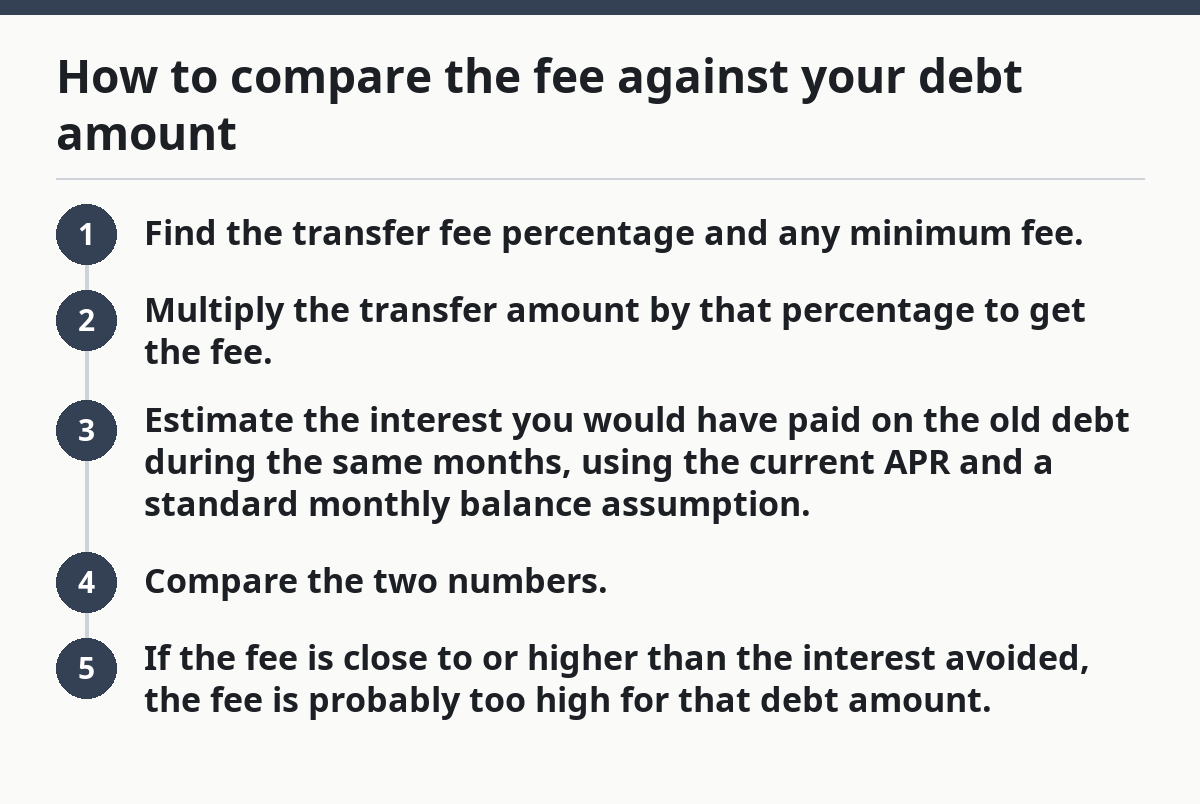
A practical break-even test looks like this:
- Find the transfer fee percentage and any minimum fee.
- Multiply the transfer amount by that percentage to get the fee.
- Estimate the interest you would have paid on the old debt during the same months, using the current APR and a standard monthly balance assumption.
- Compare the two numbers.
- If the fee is close to or higher than the interest avoided, the fee is probably too high for that debt amount.
A concrete pattern helps. If the debt is small enough that the fee takes a meaningful bite out of the principal before interest savings even begin, the deal gets weaker. If the debt is large enough that several months of interest would have been expensive, the same fee can be more acceptable. That is why there is no single universal cutoff. The ratio between fee and transfer amount is only half the story; the other half is how much interest the intro apr actually saves.
If you want a simple rule of thumb, ask whether the fee still looks reasonable after you shorten the promo period by a month. That stress test shows how fragile the deal is. If losing one month of low-rate time makes the whole transfer unattractive, the fee is already borderline.
For more structure on the broader payoff decision, the hub on debt consolidation and payoff tools can help you compare options without mixing up the math.
The balance transfer math that actually matters
The balance transfer math is about break-even, not about the sticker price of the fee. Break-even is the point where the interest you avoid equals the fee you pay. A fee of 3% is not automatically high or low. On a large enough balance, it may be reasonable. On a small enough balance, it may be too expensive to justify.
To make the math honest, use the balance you expect to transfer, not the amount you wish you had. Then factor in the length of the intro apr, because a 12-month promo and a 0% period are not equally useful if your payoff pace is slow. The longer the promo, the more room there is for the fee to be offset by reduced interest. The shorter the promo, the more likely the fee is too high for a small debt.
A useful check is the monthly carry cost on the old debt. If the old APR is high, even a moderate fee may be easier to justify because the avoided interest piles up fast. If the old APR is already modest, the fee can overwhelm the savings, especially on a balance under a few thousand dollars. That is why people sometimes transfer a debt and still feel disappointed: they focused on the introductory rate and ignored the setup cost.
You also need to watch the payment schedule. If the issuer requires a minimum payment every month, the debt may fall slowly enough that the fee takes a larger share of the benefit. If you can clear the balance well before the promo ends, the fee has more room to pay for itself. If you cannot, the fee can become dead weight.
To make How to Tell If a Balance Transfer Fee Is Too High for Your Debt Amount more concrete, two real-world checks help. First, confirm whether the fee is charged on the amount transferred or on the amount approved. Second, confirm whether the transfer is subject to a minimum fee even on a tiny balance. A percentage that looks small on paper can still be too high once a floor is added.
What to check before you move a dollar
The balance transfer fee is too high when the card terms make the transfer smaller, slower, or more expensive than the headline rate suggests. Before you act, verify the transfer amount, the promotional window, and the card’s rules in writing. A card can advertise a useful intro apr and still be poor for your debt amount if the transfer limit is tight or the promo period is short. The CFPB and the UK’s Financial Conduct Authority both publish consumer credit guidance that explains why written terms matter.
- Check the exact transfer fee formula. Confirm whether the issuer charges a percentage, a flat minimum, or both. Verify the fee on a transfer of your planned amount, and flag it if the minimum fee makes a small balance unusually expensive.
- Confirm the transfer limit. Ask how much of your approved credit line can actually be moved. Verify that the transfer cap covers the debt you expect to move, not just the card’s headline limit. If the cap is lower, your fee must be judged on a smaller transfer, which can change the result.
- Note the intro APR length. Write down the promo length in months, such as 6, 12, or 18 months. Verify the date when the promotional rate ends, because a fee that looks manageable over 18 months can feel expensive over 6 months.
- Estimate the current interest cost. Use your existing APR and current balance to estimate what you would pay if you did nothing. If the avoided interest is only slightly larger than the fee, the transfer is fragile.
- Check how payments are applied. Verify whether new purchases, transferred balances, and any remaining old balance are treated separately. If payments are split in a way that leaves expensive debt untouched, the fee may not buy you the relief you expected. If needed, confirm the rule with the issuer.
- Look for transfer timing rules. Some issuers require the transfer within a set number of days after account opening, often 60 or 120 days. If you miss that window, the fee may be wasted because the promo rate no longer applies.
- Compare the fee with your payoff pace. If you can reasonably clear the transferred debt before the promo ends, the fee has a better chance of being worthwhile. If your monthly budget only covers minimums, the math is weaker.
If any one of those checks fails, the deal may still work, but the fee deserves a much harder look. The strongest warning sign is a small balance with a minimum transfer fee. That is where the fee can look proportionally huge even when the percentage sounds ordinary.
For an authoritative explainer on how promotional card terms are disclosed, the Consumer Financial Protection Bureau’s credit card resources are a useful reference, and the UK’s Financial Conduct Authority publishes guidance on credit card and borrowing disclosures in its consumer finance materials.
When is a balance transfer fee too high?
A balance transfer fee is too high when it is large enough that the transfer stops producing meaningful net savings before the intro apr ends. That usually happens in five situations, and each one has a consequence.
The balance is very small relative to the fee floor: a minimum fee can eat a big chunk of the debt — do not transfer unless the avoided interest clearly exceeds that floor.
The promo period is short, such as 6 months: there is less time for interest savings to offset the fee — a shorter promo makes the same fee harder to justify.
The transfer limit covers only part of the debt: the fee may apply to a smaller amount than you expected, while the leftover debt keeps charging interest — compare the partial transfer result, not the full card offer.
Your existing APR is already moderate: a lower-rate debt leaves less interest to save — the transfer fee may outweigh the benefit even if the intro apr is attractive.
You cannot pay above minimums: slow principal reduction means the fee stays in the picture longer — if your budget is tight, the transfer may not create enough breathing room.
The issuer’s rules make the transfer awkward: fees, timing windows, and application of payments can reduce the real benefit — if the mechanics are unclear, treat the fee as suspect until the terms are confirmed. Consult a professional if you are unsure.
The point is not to hunt for a magic threshold. The point is to decide whether the fee is high for your debt amount, your payoff pace, and your promo length. A fee that is acceptable on a $10,000 transfer may be a bad deal on a $1,000 transfer, even if both cards advertise the same rate.
Mistakes that make the fee look cheaper than it is
The balance transfer fee looks smaller than it is when people ignore the parts that do not show up in the headline. The most common errors are predictable, and each one can turn a borderline deal into a bad one.
One mistake is comparing the fee only to the current monthly interest charge. That understates the cost because the transfer fee is paid up front, while the benefit arrives slowly over several billing cycles. The correct alternative is to compare the fee to the total interest avoided over the full intro period.
Another mistake is using the full credit limit instead of the amount you can actually transfer. If the card only allows a portion of the line to be used for the transfer, the fee should be measured against that smaller amount. Otherwise the math looks better than it is.
A third mistake is ignoring a minimum fee. A 3% transfer fee sounds manageable on paper, but a floor can make a small balance disproportionately expensive. The correct approach is to calculate the fee on your exact balance and then compare it to the interest savings.
A fourth mistake is assuming the intro apr lasts long enough to clear the debt automatically. A 0% or low-rate period is not a repayment plan. If the balance will still be there when the promo ends, the fee may simply have postponed the problem.
A fifth mistake is transferring a balance without checking whether purchases will share the same billing treatment. If new spending starts on the card, payments may not reduce the transferred balance as quickly as expected, which weakens the fee’s value.
A sixth mistake is treating a balance transfer as a universal answer. It is not. If the fee is high relative to a small debt, or if the promo is short, the right move may be to stay put and pay down the balance directly.
When the standard guidance does not apply
The usual fee break-even check needs adjustment when your debt is not a plain, single balance. The standard advice is weakest in a few edge cases.
If you have multiple balances with different APRs, the math changes because each balance has a different interest cost. In that case, the fee should be compared against the portion of debt that actually benefits from the transfer. If you have one high-rate balance and one low-rate balance, the fee may be justified for one and not the other.
If your issuer offers a variable promo structure, the savings can shift over time. That matters because the fee is fixed while the benefit may not be. A fee that looks fine in month one can be less attractive if the promo shortens, changes, or is tied to spending behavior.
If your income is uneven, minimum payments become part of the math. A transfer that looks good on paper can fail in practice if you cannot reliably make the required payment every month. In that case, the fee should be judged alongside cash flow, not just interest saved.
If you are moving only part of a debt, do not forget the leftover balance. It may keep accruing interest at the old rate, which reduces the value of the transfer. The fee should be measured against the part of the debt that actually gets relief.
If your card charges a fee floor, the percentage can be misleading. A small transfer can make the floor the real driver of cost, not the advertised rate. That is why the same fee can be acceptable for one balance and too high for another.
For all of these cases, the answer to How to Tell If a Balance Transfer Fee Is Too High for Your Debt Amount is still the same in principle: compare the total cost you will pay with the total interest you will avoid, then check the issuer’s rules before you rely on the result.
Drafted with AI; not yet reviewed by a person.