
Last updated: November 19, 2026
Quick answer: for most people restarting debt payoff after setbacks, the right move is to protect essentials, keep minimums current, and restart extra payments at an amount you can sustain for the next 3 to 6 months. That is the core of Debt payoff after setbacks — The Complete Guide, because the plan has to fit the new reality, not the old one. This guide settles what to pay first, what to pause, and how to keep the same setback from wrecking the next six months.
I write on personal finance for readers who need clear, non-hype money guidance that still works when life gets messy. This article on debt payoff after setbacks is information, not financial advice; for your own situation, a qualified adviser should review the details.
Key takeaways
- A setback does not mean debt payoff failed. It means the plan needs a reset.
- The first job is to stop the next crisis from getting worse: housing, food, utilities, transport, and minimum debt obligations.
- If cash is tight, a short pause on extra payoff is often better than missing essentials.
- A smaller, steadier payment can beat an aggressive plan that collapses after one bad month.
- The best payoff method after a setback is the one you can keep running for the next 3 to 6 months.
- If your income, medical bills, or housing situation changed hard, ask for help early from creditors, a nonprofit credit counselor, or a qualified adviser.
What a setback changes — and what it doesn’t

Picture this: you were paying down balances, then a layoff, medical bill, car repair, or family emergency hit. Your numbers changed, but your debt did not disappear, and your old payment plan may now be too tight to survive the month.
The answer is to reset the order of operations, not to start over from zero. First cover essentials and minimums, then rebuild a small buffer, then restart extra debt payoff in a size you can repeat for at least 3 months.
Because the shock can be temporary or permanent, the same setback can mean different things on paper. A one-time expense with the same income calls for a different response than a cut in hours, a job loss, or a new recurring cost like child care.
What usually still holds:
- Keep paying the debts where missing a payment causes the most damage.
- Protect housing, food, utilities, and work transport first.
- Reduce extra debt payments before you cut essentials.
- Use any short-term relief option only if you understand the terms and the timeline.
A debt plan fails when it depends on perfect months. Real life does not work that way, and debt payoff after setbacks works best when the plan expects uneven months.
Which bills come first after you get knocked off track?
Picture this: the due dates are piling up, your account balance is thinner than it was last month, and every bill feels urgent. You need a ranking that tells you where each dollar should go before the next paycheck lands.
The right order is survival bills first, debt second, extras last. If you are choosing between keeping the lights on and sending extra money to a credit card, the lights win.
A plain order of operations:
- Housing, food, medicine, utilities, and transport to work.
- Minimum required debt payments.
- Insurance and taxes that would create a bigger problem if ignored.
- Any debt payment above the minimums.
- Nonessential spending and sinking-fund goals that can wait.
The reason this works is simple. Missing rent, power, or a car payment can trigger late fees, shutoffs, repossession risk, or the loss of income. Missing an extra debt payment usually hurts less than missing an essential bill.
So if your budget is so tight that minimums are also in danger, stop making extra payoff payments until the minimums are safe again. A half-finished avalanche plan is not better than a boring, survivable budget.
What to pause first:
- Extra principal payments
- Accelerated payoff challenges
- Optional subscriptions
- “Round-up” debt apps that still drain cash you need this month
- Any automatic transfer that leaves your checking account too thin
What to keep if you can:
- Minimum debt payments
- Rent or mortgage
- Utilities
- Insurance tied to a car, home, or job
- Basic groceries and medicine
To make the order easier to follow, many readers also compare it against the CFPB’s plain-language debt guidance at https://www.consumerfinance.gov/consumer-tools/debt-collection/, especially if a bill has already started to slip.
Do you pause debt payoff or keep going?

Picture this: you still want progress, but your savings is thin and one more surprise could put you in the red. The question is not “Should I quit?” It is “How much payment can the budget handle without breaking?”
The honest answer is keep going at a smaller level if the essentials stay covered. If that is not possible, pause extra payoff and protect stability first.
There are three common cases:
-
Case 1: Income dipped, but the loss is temporary.
Keep minimums current and reduce extra payoff to a token amount if needed. Even a small payment can keep the habit alive, but only if it does not crowd out essentials. -
Case 2: Income dropped for longer than a month or two.
Stop extra payments and rebuild the budget around the new income. A 0% stretch is better than a plan that creates overdrafts. -
Case 3: You have a cash buffer.
Use part of the buffer to keep minimums and essentials current, not to chase an aggressive payoff target. Cash flow stability matters more than speed right now.
A paused payoff plan is not a moral failure. It is a cash-flow decision, and debt payoff after setbacks often improves when you treat it that way.
A practical test:
- If the next 30 days are shaky, protect the basics.
- If your minimum payments are safe and your checking account stays above zero, a reduced payoff amount may still work.
- If you have to choose between a debt payment and groceries, the plan is already too tight.
The difference between the snowball and avalanche after a setback
Picture this: you are trying to restart debt payoff, and now you need a method that won’t collapse the first time the car needs a repair. The method matters less than the one you can actually repeat, but the two classic approaches do not behave the same in a crisis.
The snowball method is often a better fit for people who need motivation from fast wins. The avalanche method is usually better for people whose budget is stable enough to follow the math for a longer stretch.
A quick comparison table:
| Criteria | Snowball | Avalanche | Winner for this condition |
|---|---|---|---|
| First target | Smallest balance | Highest interest rate | Snowball for morale after a setback |
| Speed of early wins | Faster-feeling progress | Slower at first | Snowball when motivation is fragile |
| Interest cost over time | Usually higher | Usually lower | Avalanche when the budget holds |
| Works best when | You need momentum | You can stay patient | Snowball after a rough month |
| Risk of quitting | Lower for many beginners | Higher if the wait feels long | Snowball if discouragement is the main threat |
| Best if cash flow is tight | Yes, because it creates visible progress | Sometimes, but only with discipline | Snowball for tight budgets |
| Best if debt load is large | Can feel slower and cost more | Often better mathematically | Avalanche for stable earners |
| Easy to explain | Very easy | Slightly harder | Snowball if you want simplicity |
| Sensitivity to missed months | Lower emotional strain | Can feel wasted if interrupted | Snowball after disruption |
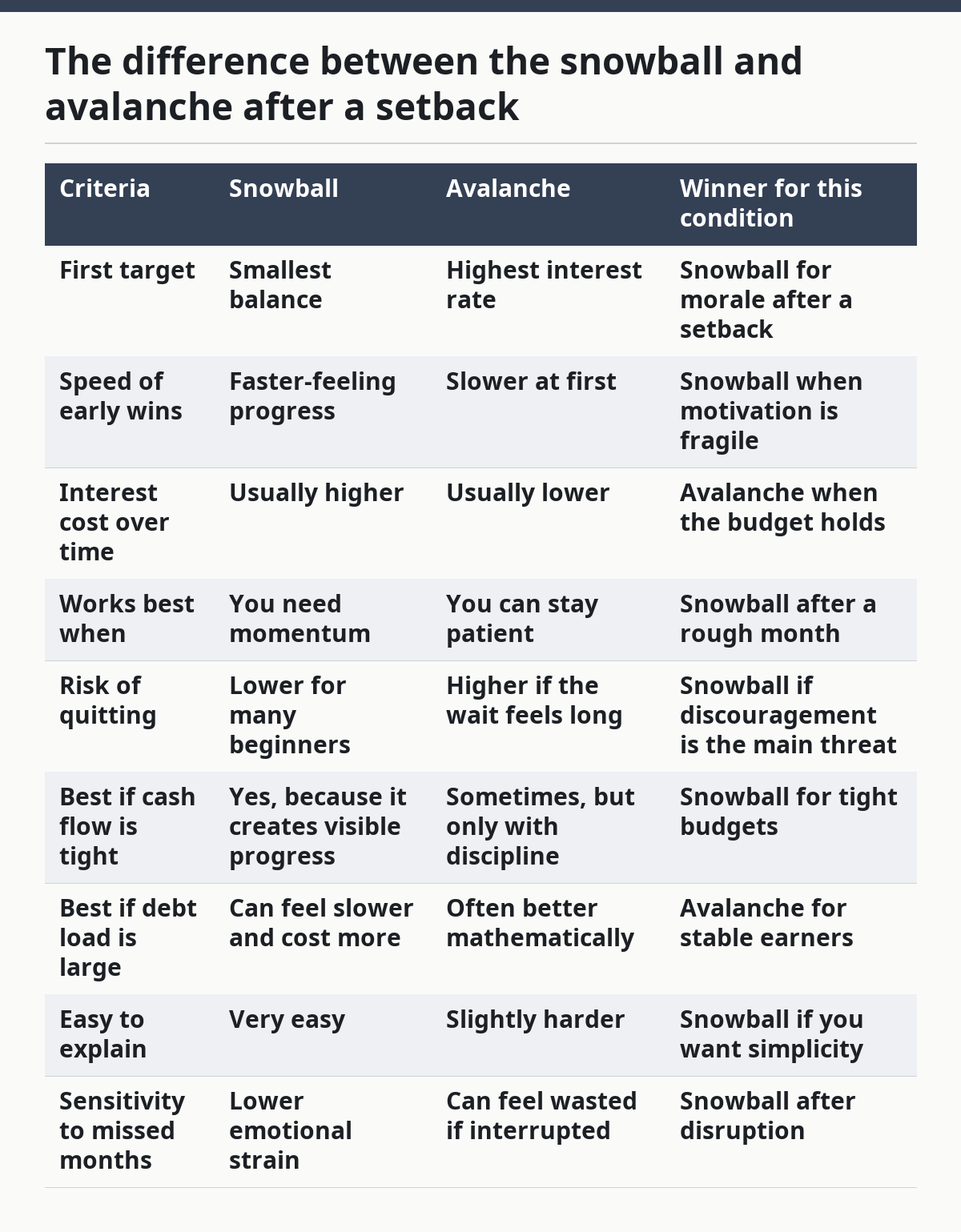
The key point is not that one method is “better” in all cases. It is that the wrong method for your current stress level can make you quit, which is why debt payoff after setbacks should prioritize follow-through over theory.
Snowball method: when it helps, and where it can backfire
Picture this: you need a plan that gives you visible progress while your life still feels shaky. A small win matters because the hardest part of debt payoff after a setback is not arithmetic — it is staying engaged long enough to build momentum again.
The snowball method is a strong fit for damaged confidence. You pay the smallest balance first while keeping minimums current on everything else, then roll each finished payment into the next balance.
That first cleared account can matter more than the interest math suggests. When you have just been hit by a setback, seeing one balance disappear can reduce the sense that you are drowning.
However, snowball has a cost. If your larger balances carry much higher rates, you may pay more interest over time than you would with avalanche. That trade-off is real, not theoretical.
Where snowball fits well:
- You missed a payment recently and feel behind.
- Your budget is tight but not broken.
- You do better with quick milestones.
- You need a plan you can explain in one sentence.
Where snowball can backfire:
- You have large high-interest balances and a steady enough income to use a math-first plan.
- You are already comfortable with delayed gratification.
- You may be tempted to celebrate a paid-off balance by spending the freed cash elsewhere.
Two honest weaknesses:
- It can cost more in interest than another method.
- It can hide the size of the biggest debt problem if you never look past the next small win.
Who should skip this: someone with stable income, no cash-flow crisis, and several high-rate balances may be better served by avalanche, because the interest savings can matter more than quick wins.
Buy this if: you are a reader who needs momentum after a rough month and would otherwise stall out.
Skip this if: you can stay disciplined for a longer payoff horizon and want the math-first route.
Avalanche method: when the math matters more than the mood
Picture this: your budget is steady again, your minimums are covered, and you want the debt to cost you less in the long run. This is the point where the interest-rate order becomes more valuable than the emotional boost of quick wins.
The avalanche method is the cleaner choice when your goal is lower total interest and your budget can stay steady. You pay extra toward the highest-interest balance first, while keeping minimums current everywhere else.
That sounds less exciting than snowball because it often is. The payoff is delayed, but the math usually favors you if the plan survives long enough.
The catch is patience. If you restart with avalanche while your income is still unstable, the method can feel abstract and discouraging. People often abandon it not because it is bad, but because the payoff signal arrives slowly.
Real strengths:
- It targets the costliest debt first.
- It can reduce total interest over time.
- It works well when your budget is predictable month to month.
- It suits people who are less motivated by quick account closures.
Real weaknesses:
- The first months may feel unrewarding.
- One surprise bill can make the plan feel pointless.
- It can be harder to keep up emotionally after a setback.
Who should skip this: someone whose cash flow still swings from month to month may be better off with snowball or a temporary stabilization plan, because a slower emotional payoff can trigger quitting.
Buy this if: you are the kind of reader who can follow a plan for months without needing a visible win every week.
Skip this if: you are still recovering from a setback that makes next month uncertain.
For a broader consumer-facing explanation of debt relief trade-offs, the Federal Trade Commission’s guidance at https://consumer.ftc.gov/articles/debt-relief-scams can help you separate legitimate options from bad promises.
What if the setback was a job loss, medical bill, or divorce?
Picture this: the setback is not a flat tire. It is a change that affects your income, your debt balance, or both. You need a response that matches the size of the hit, not a generic “tighten your belt” script.
The bigger the structural change, the more likely you need a temporary debt strategy before a payoff strategy. A one-off emergency may only require a reset. A job loss, separation, or long medical leave may require a full budget rewrite.
Three common situations need different handling:
- Job loss or reduced hours: rebuild the budget around base income first. The goal is not to finish debt faster. The goal is to stay current where possible and avoid new damage.
- Medical bills: check whether the bill can be reviewed, set on a payment plan, or separated from higher-priority debt. Medical debt rules vary by place and can change.
- Divorce or household split: the old budget is usually gone. Shared bills, duplicated rent, and changed child expenses can make the old payoff order useless.
The truth is, a setback that changes income often means the old payment target is no longer the right target, and debt payoff after setbacks must be rebuilt around what is actually coming in.
Useful moves in this stage:
- List the new net income you can count on.
- Separate fixed costs from flexible costs.
- Re-rank debts by risk and cost.
- Contact creditors early if a payment will be missed.
- Ask a qualified adviser or nonprofit credit counselor to review options if the debt load is now hard to manage.
The date or rule that mattered last year may not apply now. Local protections, collection practices, and hardship options vary by country and change over time.
How to rebuild a payoff plan that can survive the next surprise
Picture this: you want a plan that does not collapse the first time the washer breaks or your hours get cut. The fix is to make the plan less clever and more durable.
The strongest restart plan has three layers: basics, buffer, payoff. If those layers are in the wrong order, the next setback sends you back to zero.
Start here:
- Build a bare-bones monthly budget based on actual income.
- Set a tiny emergency buffer before aggressive payoff if your checking account is too fragile.
- Keep automatic payments only where they will not trigger overdrafts.
- Choose one payoff method and leave it alone for a while.
- Review the budget on a fixed date each month, not every time you feel anxious.
A useful rule of thumb: if you cannot describe your next month’s cash flow in plain English, your debt plan is too complicated. Simpler plans survive rough months better.
What to include in the restart budget:
- Rent or mortgage
- Groceries
- Utilities
- Gas or transit
- Insurance
- Minimum debt payments
- Child care or school costs
- A small, realistic repair line if your life is currently noisy
What to cut first:
- Sinking funds that are not urgent
- Extra principal payments
- Optional upgrades
- Any recurring charge you forgot you still had
A restart plan should feel almost boring. That is a feature, not a flaw, because stability matters more than speed when debt payoff after setbacks is the goal.
Which setback changes the choice between snowball and avalanche?
Picture this: you know both methods, but now you need to choose the one that matches the setback you just survived. The answer changes based on whether the problem was emotional, financial, or structural.
The overall verdict is snowball for instability, avalanche for stability. If the setback rattled your confidence or your cash flow, snowball often keeps the plan alive. If the setback passed and your budget is steady again, avalanche can save more interest.
Cases where the verdict flips:
-
Your emergency fund is gone, but income is steady.
Snowball can still be better at first, because rebuilding trust in the plan matters. Once you regain a small cushion, avalanche may become the better long-run choice. -
Your debt balances are large and your income is stable.
Avalanche is usually the cleaner fit because interest cost matters more when you can stick with it. -
You can only afford the minimums for a few months.
Neither method is really the point. Stabilization comes first. After that, choose the method that fits the new budget. -
You are likely to quit if progress feels too slow.
Snowball is often the better choice, even if it is not the cheapest route. A plan you keep is better than a perfect plan you abandon.
There is no magic method that fixes a broken budget. The method only matters after the budget can hold it, and that is why debt payoff after setbacks should be matched to your current cash flow.
What should you do if you’re behind right now?
Picture this: the due date has already passed, late fees are stacking up, and you are not sure whether to send a partial payment or wait until next payday. This is the moment where action matters more than guilt.
The best move is to avoid silence and make a short-term plan today only if it will not create a worse cash shortage later; otherwise, contact the creditor now and ask about hardship options, due-date changes, or a temporary arrangement. If you can pay something without causing a later overdraft, paying something may help. If paying would break the budget, call or message the creditor and ask about hardship options, due-date changes, or a temporary arrangement.
A few ground rules:
- Do not ignore the account.
- Do not empty your checking account just to feel caught up.
- Do not borrow from one fragile bill to pay another fragile bill without knowing the next due date.
- Do ask for a written record of any changed terms.
If the debt is beyond a simple catch-up, nonprofit credit counseling may help you understand whether a debt management plan, hardship program, or another route fits your situation. The Consumer Financial Protection Bureau has plain-language debt guidance at https://www.consumerfinance.gov/consumer-tools/debt-collection/, and the National Foundation for Credit Counseling explains counseling options at https://www.nfcc.org/.
A setback is not a character flaw. It is a signal that the plan needs a smaller engine and a wider margin.
FAQ: debt payoff after a setback
Should I stop paying extra debt if my savings is gone?
Yes, if the extra payment puts essentials at risk. Minimums and basic living costs come first, and extra payoff can wait until your cash flow is steady again. A plan that drains checking to zero is usually too fragile to keep.
Is it better to pay the smallest debt or the highest-interest debt after a setback?
It depends on whether you need motivation or savings. The smallest-debt approach can create faster wins, while the highest-interest approach can reduce long-run cost if your budget is stable enough to hold it. After a setback, the better choice is the one you can keep following for several months.
Should I use a hardship program if I’ve fallen behind?
Possibly, if the current payment no longer fits your income. Hardship programs can buy time or reduce pressure, but the terms vary by creditor and country, and some arrangements affect fees or credit reporting. A qualified adviser or nonprofit counselor can help you compare the trade-offs.
Can I restart debt payoff with a very small amount?
Yes, and that is often smarter than waiting for a perfect month that never comes. A small, repeatable payment can rebuild momentum while you protect the basics. The amount matters less than whether it fits your real budget.
When should I ask for help instead of handling it myself?
Ask for help when minimum payments, housing, food, or utilities are at risk, or when the debt picture has changed for more than a short stretch. A local nonprofit counselor or qualified financial adviser can help you sort through options without guessing.
Drafted with AI; not yet reviewed by a person.