
Last updated: November 19, 2026
Key Takeaways
- Match the tool to your debt setup, your payoff method, and how much control you want.
- A debt payoff calculator estimates payoff time, interest, and the effect of a set payment.
- The method matters more than the brand of tool, especially for snowball vs. avalanche.
- A calculator is fastest, a spreadsheet is most flexible, and an app is best for reminders.
Debt payoff calculators and planning tools help you see which debt to attack first, how long payoff may take, and how much interest a plan could save. The right tool is the one that matches your debt list, your cash flow, and your payoff method—not the one with the flashiest chart. The sections below settle which calculator fits which job, what each tool leaves out, and how to use the result without fooling yourself. Debt payoff calculators and planning tools — The Complete Guide works best when you use current balances, current rates, and a realistic monthly payment.
A quick note before the tools: this is information, not financial advice. Debt laws, interest rules, and tax treatment vary by country and change over time, so a qualified adviser should review your own situation, and you should check official guidance such as the Consumer Financial Protection Bureau’s budgeting and debt resources and the Federal Trade Commission’s debt guidance: https://www.consumerfinance.gov/consumer-tools/budgeting/ and https://consumer.ftc.gov/articles/debt-relief-and-credit-repair-scams.
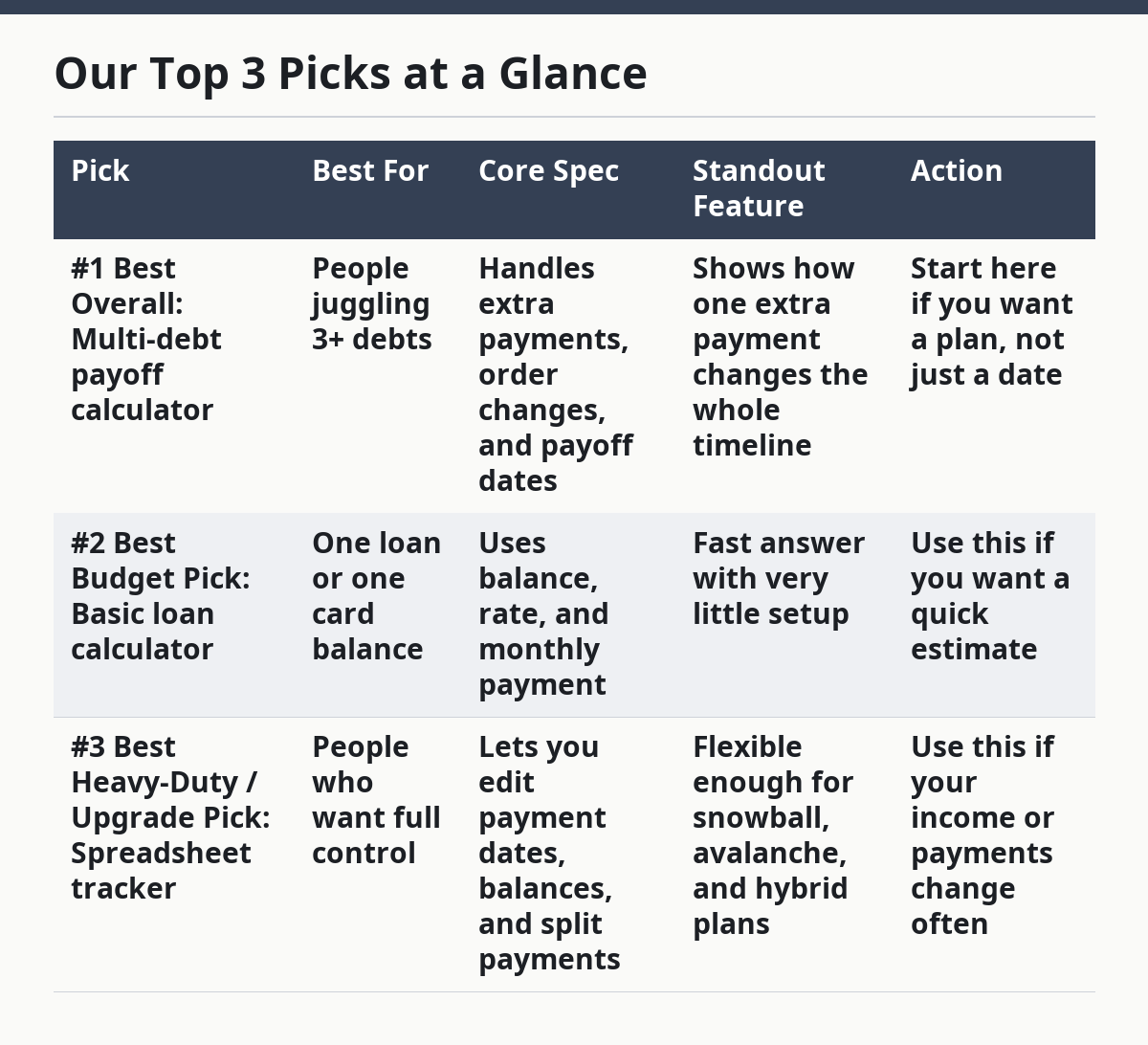
Our Top 3 Picks at a Glance

If you only want the shortest answer, pick the tool that matches your debt style. A basic calculator can work for one loan; a snowball or avalanche planner can work for several debts; a spreadsheet can work when your payoff plan changes every month.
| Pick | Best For | Core Spec | Standout Feature | Action |
|---|---|---|---|---|
| #1 Best Overall: Multi-debt payoff calculator | People juggling 3+ debts | Handles extra payments, order changes, and payoff dates | Shows how one extra payment changes the whole timeline | Start here if you want a plan, not just a date |
| #2 Best Budget Pick: Basic loan calculator | One loan or one card balance | Uses balance, rate, and monthly payment | Fast answer with very little setup | Use this if you want a quick estimate |
| #3 Best Heavy-Duty / Upgrade Pick: Spreadsheet tracker | People who want full control | Lets you edit payment dates, balances, and split payments | Flexible enough for snowball, avalanche, and hybrid plans | Use this if your income or payments change often |
What a debt payoff calculator actually tells you
A debt payoff calculator tells you how fast a balance can fall if you keep paying a set amount, and it can estimate interest and payoff date. That answer is only as good as the numbers you type in, so the tool is a forecast, not a promise.
Picture this: you have three credit cards, a student loan, and a car note, and each one has its own rate, due date, and minimum payment. A payoff calculator turns that mess into a map, which is useful because debt feels bigger when it stays unstructured.
The main outputs are usually these:
- payoff date
- total interest
- monthly payment required
- order for paying extra
- effect of one-time or recurring extra payments
Here’s the catch: some calculators assume fixed interest and fixed payments, which breaks down if your rate is variable, your minimum changes, or you miss a month. For a variable-rate product, check the lender’s terms and the current rate terms on the account before you trust the result. For a fact check on consumer debt and budgeting basics, the CFPB is a good starting point: https://www.consumerfinance.gov/consumer-tools/budgeting/.
For plain-language guidance on consumer debt and budgeting, the Consumer Financial Protection Bureau’s consumer pages are a good starting point: https://www.consumerfinance.gov/consumer-tools/debt-collection/ and https://www.consumerfinance.gov/consumer-tools/budgeting/. The CFPB also explains debt collection basics and budgeting in separate consumer pages, which makes it easier to check your numbers against official guidance.
Which payoff method are you actually using?

The right calculator depends on the method, and the method matters more than the brand of tool. A snowball calculator, avalanche calculator, and simple amortization calculator can all use the same debts, but they answer different questions.
Picture this: you want motivation, not perfect math, and you need to see a debt disappear fast even if it is not the most efficient choice. That is a snowball setup, and it works best when visible wins keep you on plan.
A simple way to sort the methods:
- Snowball: pay extra to the smallest balance first, then roll that payment forward.
- Avalanche: pay extra to the highest-interest debt first, then roll that payment forward.
- Hybrid: focus on one order, but allow a balance transfer, lump sum, or due-date shift to change the plan.
- Static amortization: keep payments fixed and let the calculator show the date.
The truth is, the method you can stick with beats the one that looks smartest on paper. Avalanche usually reduces interest more when all else is equal, but snowball can be easier to follow if you need early wins to keep going. The FTC warns that debt decisions can go wrong when you ignore the terms, so it is worth checking the account details before you commit: https://consumer.ftc.gov/articles/debt-relief-and-credit-repair-scams.
A good calculator should let you test both methods without rebuilding the plan from scratch. If it can’t, it is a date estimator, not a planning tool.
Debt payoff calculator vs spreadsheet vs app: what’s the real difference?
A calculator gives you a fast answer, a spreadsheet gives you control, and an app gives you reminders. That is the cleanest split, and it matters because most people do not need all three at once.
Picture this: you’re staring at balances on a phone screen after work and want one number before dinner. A calculator wins that moment because it is quick, while a spreadsheet is better once the plan gets messy.
| Criteria | Calculator | Spreadsheet | Winner for [condition] |
|---|---|---|---|
| Setup time | Usually fastest | Slower at the start | Calculator for a quick estimate |
| Flexibility | Limited | High | Spreadsheet for changing balances |
| Visual payoff date | Usually built in | You have to build it | Calculator for simple debt |
| Payment scenarios | Often basic | Easy to model | Spreadsheet for “what if” planning |
| Error risk | Lower if simple | Higher if formulas are wrong | Calculator for beginners |
| Long-term tracking | Weak | Strong | Spreadsheet for ongoing payoff |
| Reminder features | Rare | None unless you build them | App for habit support |
| Custom debt types | Sometimes limited | Very flexible | Spreadsheet for student loans, cards, and mixed debt |
| Sharing with a partner | Limited | Easy to share | Spreadsheet for household planning |
On the flip side, apps win when the plan depends on behavior. A phone reminder that hits on payday can keep an extra-payment plan alive longer than a pretty chart.
Use a calculator if:
- your debt list is short
- you want a quick payoff estimate
- you only need one scenario at a time
Use a spreadsheet if:
- you change payment amounts often
- you split debts with a spouse or partner
- you want to compare snowball and avalanche side by side
Use an app if:
- you need reminders
- you forget due dates
- you want the plan in your pocket
A spreadsheet can copy the logic of most payoff tools once you know the formulas, but it also lets you see the exact assumptions on the page. That transparency is the point.
How to read the numbers without getting fooled
The payoff date is only meaningful if the inputs are honest. A calculator can show a fast finish date and still mislead you if it ignores fees, skipped months, or a changing interest rate.
Picture this: your card says one minimum payment, but the balance still barely moves because most of the payment covers interest. A payoff calculator can expose that problem fast, which is why it is useful even before you change anything.
Look closely at these inputs:
- Current balance: use the real balance, not last month’s statement if the amount changed.
- Interest rate: use the rate in the account terms; promotional rates can expire.
- Minimum payment: some tools let you set this, but lenders may use different formulas.
- Extra payment: decide whether it happens once or every month.
- Payment timing: paying earlier in the cycle can reduce interest in some setups.
The catch is that many tools assume you pay on time every month. Miss one payment and the result changes. Make a late payment, add a fee, or switch from fixed to variable interest, and the clean estimate starts to bend.
A good tool shows you the assumptions plainly. A better one lets you edit them. If a calculator hides fees, ignores compounding, or won’t let you change the order of debts, treat the result as a rough sketch and check the account terms or ask a qualified professional before relying on it.
For debt and interest basics, the Federal Trade Commission’s consumer guidance is useful: https://consumer.ftc.gov/articles/debt-relief-and-credit-repair-scams. For general budgeting and debt order planning, the CFPB’s budgeting tools are also worth a look: https://www.consumerfinance.gov/consumer-tools/budgeting/.
Which planning tool fits your debt problem?
A single-balance calculator is best when you only need a date. A multi-debt planner is better when the real question is which debt gets the next dollar.
Picture this: you have a credit card at a higher rate than your personal loan, but the loan is small and annoys you every month. A planning tool lets you compare the math and the emotional weight instead of guessing.
Single-loan calculators
A single-loan calculator wins when you have one car loan, one student loan, or one credit card and no side debts in the plan. It answers a narrow question well: “If I pay X each month, when am I done?”
The strengths are obvious. It is fast, easy, and hard to mess up. A person can use it in under a minute and get a useful first estimate.
The weakness is the blind spot. It does not help you choose between multiple balances, and it can hide the cost of paying the wrong account first.
Who Should Skip This: Anyone with three or more debts should move to a multi-debt planner instead, because the order of payments becomes part of the answer.
Buy this if: you have one debt and want a clean payoff date.
Skip this if: you need to rank several balances by rate or size.
Snowball planners
A snowball planner wins for people who need visible momentum. It shows the smallest balance first, then lets you roll that payment into the next one.
The strength is behavioral. Seeing one account disappear can make the next payment easier to keep. That matters when the problem is not math but follow-through.
The weakness is cost. If the smallest balance is not the highest-rate debt, you may pay more interest over time than with an avalanche plan. That is the trade-off, and a planner should show it.
Who Should Skip This: If your main goal is minimizing interest and you can stay disciplined, an avalanche planner fits better.
Buy this if: you want early wins and clear milestones.
Skip this if: you only care about interest cost and can stay with a strict order.
Avalanche planners
Because the highest-interest debt is already established, an avalanche planner wins for readers who can follow a rule without needing a morale boost every week. It targets the highest-interest debt first, which is often the most efficient structure on paper.
Its strength is cost control. If balances and rates stay steady, this method can reduce interest versus a snowball approach. It also gives a clear decision rule, which removes guesswork. When balances are similar, the rate difference can matter more than the size of the payment.
Its weakness is psychological. The smallest debt may sit there for a long time, which can feel slow even when the math is sound.
Who Should Skip This: If you tend to quit when progress is invisible, a snowball tool may fit your behavior better.
Buy this if: you want a rules-based plan and can wait for the first account payoff.
Skip this if: slow early progress makes you abandon plans.
Spreadsheet trackers
A spreadsheet tracker wins for households with irregular income, bonus checks, or split payments. It is a strong planning tool when the question changes every month.
The strength is control. You can model due dates, extra payments, one-time windfalls, and balance transfers in the same sheet. That flexibility is hard to beat.
The weakness is maintenance. A spreadsheet can become wrong if you stop updating it, and formula errors can quietly distort the result.
Who Should Skip This: If formulas make you uneasy, a basic calculator is safer and faster.
Buy this if: your debt plan changes often and you want full visibility.
Skip this if: you want a simple answer with little setup.
The honest side-by-side: what matters most
A good debt tool is not the one with the most charts; it is the one that matches your decision. If you are choosing between snowball and avalanche, the real question is whether motivation or interest cost matters more in your case.
Picture this: you are deciding what to do with an extra payment of a few hundred dollars. The tool that shows the effect on interest, payoff date, and debt order in one place has the most value.
| Criteria | Snowball Planner | Avalanche Planner | Winner for [condition] |
|---|---|---|---|
| Early visible wins | Strong | Weak | Snowball for motivation |
| Interest cost | Can be higher | Often lower | Avalanche for efficiency |
| Ease of sticking with it | High for many people | High for disciplined planners | Snowball for habits |
| Best use case | Behavior-first payoff | Math-first payoff | Depends on your style |
| Works with small debts | Very well | Very well | Tie |
| Works with high-rate debt | Fine, but not always optimal | Very well | Avalanche for expensive balances |
| Emotional clarity | Strong | Moderate | Snowball if you need momentum |
| Decision rules | Simple | Simple | Tie |
| Long-term savings focus | Moderate | Strong | Avalanche for cost control |
| Good for bonus payments | Yes | Yes | Tie |
The position is plain: avalanche is the better planning framework if you can follow it, while snowball is the better behavior tool if you need visible progress to keep going. Neither is “best” in the abstract.
Here’s the catch: a calculator that cannot switch between these two approaches is missing half the job. A reader should not have to rebuild the whole plan just to see which order changes the finish date.
A planning tool earns its keep when it answers three questions at once:
- Which debt gets the extra payment?
- What changes if I pay more next month?
- What happens if I miss one month or get a windfall?
If a tool cannot answer at least two of those, it is too thin for serious planning.
What the best tools get right—and what weak tools miss
A strong payoff tool does more than total the balances. It shows assumptions, lets you change the payment order, and makes the effect of extra money easy to see.
Picture this: you enter three debts, then add a $50 or $100 extra payment and want to know whether the finish date moves by months or barely changes. A decent tool shows the difference without making you recalculate from scratch.
What strong tools usually include:
- editable payment order
- recurring and one-time extra payment fields
- payoff date for each debt
- total interest estimate
- clear treatment of minimum payments
- ability to compare two methods side by side
What weak tools often miss:
- due dates and payment timing
- variable rates
- fees
- partial-month effects
- payoff order flexibility
That last point matters. A calculator that only tells you “debt free in X months” can be misleading because it hides the path. The path is the part you actually have to follow.
If you want a planning tool that is worth keeping open in a tab, look for one that makes its assumptions visible in plain English. Hidden math is bad math when money is tight.
When the answer flips: cases that change the choice
The overall verdict changes fast when your debt picture changes. A tool that is perfect for one borrower can be a bad fit for another.
Picture this: your paycheck changes month to month, one card has a promotional rate, and a bonus payment might land in three months. A rigid calculator will struggle, while a flexible tracker will earn its keep.
Here are the situations where the choice flips:
- You only have one debt. A basic calculator beats a full planning tool because there is nothing to compare.
- Your income changes a lot. A spreadsheet or tracker beats a simple calculator because payment amounts are not fixed.
- You need motivation more than math. A snowball planner beats an avalanche plan if small wins keep you from quitting.
- You want the lowest interest path and can stay disciplined. An avalanche planner beats snowball because the order matters more than the morale boost.
The truth is, there is no universal winner. The best tool depends on how many debts you have, how steady your income is, and whether you are likely to stick with a strict plan for months at a time.
How to use a payoff calculator the right way
A payoff calculator works best when you feed it exact numbers and then stress-test the result. The first pass is a starting point, not the final answer.
Picture this: you have the balances in front of you and you want a real plan before the next paycheck hits. The right move is to enter current balances, list each rate, and test at least two payment orders.
Use this workflow:
- Gather each balance, rate, and minimum payment.
- Decide whether you want snowball or avalanche.
- Enter a realistic extra payment, not a hope.
- Check the payoff date and total interest.
- Change one assumption at a time and compare the result.
If the tool supports it, run three scenarios:
- minimum payments only
- minimum plus a small extra amount
- minimum plus a larger windfall payment
That simple stress test shows where your plan is fragile. If a small extra payment changes the timeline a lot, that is useful. If changing the payment order barely moves the date, then the emotional benefit may matter more than the math.
Do not use a payoff calculator as permission to spend. Use it as a map. A map shows the road; it does not drive the car.
The verdict: which type of tool to choose
Choose a basic calculator if you have one debt and want a fast payoff date. Choose a multi-debt planner or spreadsheet if you have several balances, changing income, or extra payments that need tracking. Neither is the right fit if you ignore the numbers after the first day.
Picture this: you want a tool that makes the next payment clearer, not one that adds more noise. The answer is simple—use the least complex tool that can still model your real debt picture.
FAQ
Do debt payoff calculators include interest correctly?
They usually include interest in a simplified way, but the result depends on the inputs and the model. If a calculator uses fixed payments and a fixed rate, it can be a useful estimate; if your rate changes or fees apply, the estimate can drift.
Is a snowball calculator better than an avalanche calculator?
A snowball calculator is better if you need early wins to stay motivated, while an avalanche calculator is better if you want the lower-interest structure. The better choice depends on whether behavior or efficiency is the bigger risk in your plan.
Can I use a spreadsheet instead of a debt app?
Yes, and many people do. A spreadsheet is often better if you want full control over balances, due dates, and extra payments, but it takes more effort to maintain and is easier to break with a formula mistake.
What numbers do I need before I start?
You need each balance, each interest rate, each minimum payment, and any extra amount you can pay regularly. If you can also note due dates and whether a rate is promotional or variable, the plan will be more accurate.
Should I trust the payoff date exactly?
No, treat it as an estimate. The date can move if you miss a payment, add a fee, change the order of debts, or get a rate change, so it is best used as a planning target rather than a guarantee.
Drafted with AI; not yet reviewed by a person.