Last updated: November 19, 2026
Quick Answer: In How to decide whether a fee-heavy debt should be paid off early, the cleanest starting point is to compare the payoff quote, the penalty, and the fees you would stop paying; if closing now saves more than it costs, early payoff can make sense.
Fee-heavy debt is worth paying off early when the total fee drag can outpace the comfort of keeping cash on hand. This guide shows how to compare interest, prepayment penalties, late fees, annual fees, and account maintenance fees before you move a dollar. In How to decide whether a fee-heavy debt should be paid off early, the key is to compare the full cost, not just the headline rate.
What “fee-heavy debt” means in plain English
Fee-heavy debt is debt where the bill is not just the interest rate; it also carries charges like a prepayment penalty, a late fee, an annual fee, or an account maintenance fee. That matters because a debt with a modest rate can still cost more than it looks if the fees keep stacking up.
The hard part is that fees do different jobs. A late fee punishes missed due dates, an annual fee keeps the account open, and a prepayment penalty can make early payoff expensive. A simple APR alone may not show the whole picture.
This article is information, not financial advice. Personal finance rules vary by country, lender, and contract, so a qualified adviser should review your own situation if the numbers are tight or the document is unclear.
Picture this: you’re holding a loan statement, a payment app, and a balance that looks manageable, but the fine print mentions a fee every month. You need to know if early payoff actually helps, or if the fee schedule changes the math enough to make waiting smarter. For how to decide whether a fee-heavy debt should be paid off early, that fee schedule is the first thing to check.
Key takeaways
- Look at the whole cost of the debt, not just the stated rate.
- A prepaid penalty can wipe out the benefit of early repayment.
- Ongoing fees matter most when they continue even if the balance falls.
- Missed payments can cost more than the interest rate suggests.
- The right move depends on the contract, not a generic rule.
Which fee-heavy debts deserve a closer look?
The answer is any debt where fees can keep charging after the balance is already falling. A credit card with an annual fee, a loan with a prepayment penalty, or an account with monthly maintenance fees all deserve a second look before you send extra money. For how to decide whether a fee-heavy debt should be paid off early, these are the contracts that need the closest reading.
Here’s the catch: a fee-heavy debt is not automatically the one to attack first. The question is whether the fees are one-time, recurring, avoidable, or triggered by early payoff. Those are very different things.
A plain-rate loan and a fee-heavy loan can look similar on paper for the first month. By month 12, they may not be close at all.
Use this lens:
- One-time exit fee: a charge that appears when you pay early or close the account.
- Recurring fee: a monthly or annual charge that keeps coming even if you do nothing else.
- Penalty fee: a fee triggered by a rule break, such as a late payment.
- Service fee: a charge for holding or administering the account.
If the fee is only a late fee, the answer may be more about payment discipline than early payoff. If the fee is an annual fee or maintenance fee, the math can favor closing the account sooner. If it is a prepayment penalty, early payoff can be a trap.
For a broader decision tree on payoff order, this page fits inside the site’s Debt payoff decision rules and edge cases hub.
How do I compare interest with fees without guessing?
The answer is to compare the effective cost, which means the real cost after adding fees to interest over the time you expect to keep the debt. That comparison is better than staring at the listed rate alone.
Start with the statement and the contract, not memory. You need the interest rate, the fee names, when each fee applies, and whether any fee changes if you pay early, miss a payment, or keep the account open for a full year.
Then ask three questions:
- What fees happen only once?
- What fees repeat on a schedule?
- Which fees can be avoided by paying on time or closing the account?
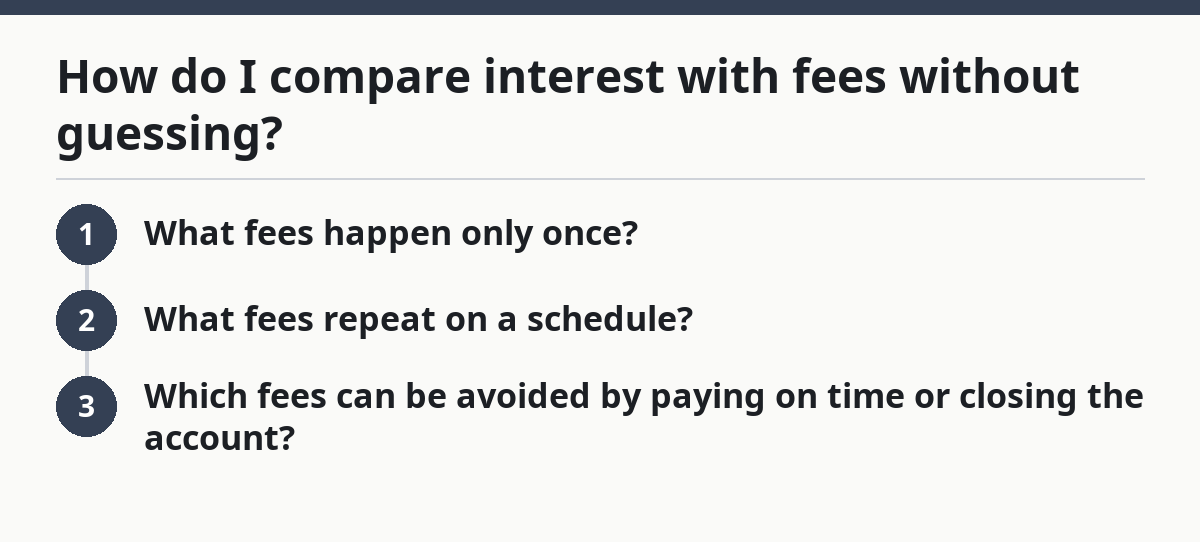
If the answer to the third question is “none,” that debt is probably fee-heavy in a real sense.
Check these items before you decide:
- The stated interest rate and how it compounds.
- Any prepayment penalty language.
- Any late fee amount and grace period.
- Any annual fee or account maintenance fee.
- The minimum payment and whether fees count toward it.
- The balance you would still owe after an early payoff quote.
If the lender can give you a payoff amount, use that exact figure. If not, ask for it in writing before making a move. A rough estimate is not enough when fees are involved. For how to decide whether a fee-heavy debt should be paid off early, the written payoff amount is usually the safest number to use.
How to decide whether paying early makes sense
The answer is to pay early only when the savings from stopping future interest and fees are larger than the penalty, lost flexibility, and any cash shortage you create. That is the whole test.
Picture this: you have enough cash to wipe out a loan, but the contract says a prepayment charge will apply, or the account also carries a fee that shows up every month. You are not asking “Can I pay it off?” You are asking “What do I give up, and what do I stop paying?”
Use this step-by-step check:
- Get the payoff number in writing. Ask for the exact payoff quote on a specific date, then verify whether it includes accrued interest and any closure fee. A mismatch here means the later math is wrong.
- List every fee line by line. Write down the prepayment penalty, late fee, annual fee, and account maintenance fee. Verify how often each one appears. If the document is vague, that is a problem.
- Separate one-time from recurring costs. A one-time $0-style exit charge is different from a monthly fee that continues for 12 months. Verify which fees vanish when the balance hits zero and which do not. If they keep going after payoff, the debt may still be expensive to keep open.
- Estimate the holding period. Decide how long you would keep the debt if you do not pay it off now: 3 months, 12 months, or longer. Verify that estimate against your cash flow. If the estimate is fuzzy, do not pretend it is precise.
- Add future fees to future interest. Compare the next several months of interest with the fees you would avoid by closing the account. Verify whether the fee burden is larger than the interest savings. If you cannot show that clearly, you do not yet have a decision.
- Check your emergency cash first. Keep enough cash for a real short-term problem, not just a nice round number. Verify that early payoff will not force a new late fee, overdraft, or borrowing next month. If it would, the plan is shaky.
- Look for penalty timing. Some contracts charge a prepayment penalty only if you pay within a set window, such as the first 12 months. Verify the window and the formula. If the timing is close, waiting a little may change the result.
- Confirm the end state. Make sure the account actually closes or stops billing once paid. Verify that no annual fee or maintenance fee can post after payoff. If the lender says the account stays open, the fee may keep coming back.
The right answer is not always “pay it off now.” Sometimes it is “pay enough to reduce interest, but not so much that you trigger a fee that ruins the gain.” That is especially true with early payoff penalties.
When does a fee make debt worth paying off early?
The answer is when the fee is cheaper than the cost of leaving the debt in place. That sounds simple, but the details matter because fees can be one-time, recurring, or triggered by your own action. In How to decide whether a fee-heavy debt should be paid off early, the comparison only works when you include the full fee picture.
Here are the cases where early payoff gets stronger:
- The debt has an annual fee or account maintenance fee that you can stop by closing the account.
- The debt has a late fee pattern because you keep barely missing due dates.
- The debt has no prepayment penalty, and the interest keeps running month after month.
- The account still charges fees even when the balance is low.
- The payoff quote shows a clear end to all charges, not just the principal.
On the flip side, early payoff is weaker when the prepayment penalty is large enough to eat the interest savings, or when paying early would leave you short on cash and force a second round of borrowing. That second round can make the first payoff look smart while the full picture is not.
A useful test is this: if you close the debt today, do you stop paying all future charges tied to it? If yes, early payoff is more likely to help. If no, the debt may still be expensive even after it is gone.
The mistakes people make with fee-heavy debt
The answer is that people usually miss one fee, compare the wrong time period, or pay off a balance without checking what happens next. Those mistakes can turn a good move into an expensive one.
Picture this: you focus on the interest rate, pay off a balance fast, then discover the account still billed an annual fee until closure went through. That kind of mistake is common because the statement looks neat while the contract is messy.
Common errors:
- Ignoring the prepayment penalty. The consequence is that early payoff costs more than expected. The better move is to ask for the payoff quote and read the closure terms first.
- Forgetting recurring fees. The consequence is that the debt stays costly even as the balance falls. The better move is to add annual fee and maintenance fee costs into the comparison.
- Using the posted rate as the full cost. The consequence is a false sense of savings. The better move is to calculate effective cost, including every fee you can identify.
- Paying off without cash backup. The consequence is a new late fee, overdraft charge, or fresh borrowing. The better move is to keep enough liquid cash for the next few weeks or months.
- Assuming one lender treats fees like another. The consequence is that a rule from one card or loan gets applied to a different contract. The better move is to trust the actual contract, not general memory, and to review the document with a qualified adviser if the terms are hard to interpret. See CFPB guidance on fees and disclosures at https://www.consumerfinance.gov/ and the CFPB’s debt collection overview at https://www.consumerfinance.gov/consumer-tools/debt-collection/ for general consumer protections.
- Missing a closure step. The consequence is that account maintenance or annual fees keep posting. The better move is to confirm the account is closed in writing.
If the paperwork is hard to read, that itself is a signal. Confusing billing terms are not neutral; they are part of the cost. For how to decide whether a fee-heavy debt should be paid off early, a hard-to-read contract can change the answer.
When the standard rule does not apply
The answer is that the usual “pay extra when you can” rule breaks down when fees are triggered by early payoff, when cash is too thin, or when the debt has charges that behave like a subscription. That is where the standard advice needs modification.
Picture this: you have a debt with an early settlement charge, another bill due in 10 days, and no room in checking for both. Now the decision is not about speed. It is about avoiding a payment failure that creates more fees.
Use caution in these situations:
- Prepayment penalty present: A penalty can erase the gain from early payoff. What to do: compare the penalty against the future interest and fee savings before sending money.
- Late fee history: If you miss due dates often, the main problem is cash timing, not debt size. What to do: automate minimum payments first, then decide on extra payoff later.
- Annual fee close to posting: If the annual fee is due in a few weeks, paying early may save that charge only if the account closes in time. What to do: confirm the closure date in writing.
- Maintenance fee keeps running: If the account charges a monthly maintenance fee, the balance alone may not be the issue. What to do: find out whether closing the account stops the fee immediately or later.
- Thin emergency cash: If payoff would leave you unable to handle a normal bill, the result may be new debt. What to do: keep the cash buffer and reduce the balance more slowly.
When the contract is unclear, or the numbers depend on timing you cannot verify, get a qualified financial adviser to review the documents for your situation. That is not because the math is magical; it is because the fee language can be.
The cleanest way to think about the decision
The answer is to compare three numbers: what you pay to close now, what you would pay if you wait, and what cash you lose by moving too fast. That is the simplest honest test.
A debt with a 0 balance is not always cheap if fees continue for the rest of the year. A debt with a small balance is not always urgent if closing it triggers a penalty larger than the saved interest. The right decision lives in the spread between those numbers.
A quick rule of thumb: if the only thing standing between you and payoff is habit, the fees may deserve a hard look. If the only thing standing between you and financial breathing room is the final payment, a slower payoff can be the better shape.
Use the fee list, the payoff quote, and your cash buffer together. That is how you decide whether early payoff helps or hurts. For how to decide whether a fee-heavy debt should be paid off early, the final check is whether the fees disappear faster than your cash cushion.
Are fees more important than interest?
Fees are sometimes more important than interest, but not always. A single annual fee can matter more than a low interest rate, while a one-time late fee may matter less than months of interest. The right comparison is the total cost over the time you expect to keep the debt.
How do I compare fee-heavy debts?
Compare the payoff quote, the interest that would accrue, and every fee that may still hit the account. Write down prepayment penalties, late fees, annual fees, and account maintenance fees, then ask which ones stop if you pay early. That gives you a cleaner answer than using the stated rate alone.
When does a fee make debt worth paying off early?
A fee makes early payoff more attractive when paying off now stops more future charges than it creates today. That usually means recurring fees, late fees you can avoid, or no prepayment penalty. If the closure fee or penalty is larger than the saved interest and fees, early payoff is harder to justify.
Drafted with AI; not yet reviewed by a person.